Jewelry Cement Glue Formulation
USD $65
PDF manual · Instant downloadJewelry Cement Glue Formulation: a PDF guide to making strong, clear jewellery adhesives safe for metals and gemstones, with chemistries, manufacturing, testing and troubleshooting.
Payment Methods
Refund Policy
Custom Formulation Services
Formulation Consultation
Contact Us
Jewelry Cement Glue Formulation is a practical PDF guide for adhesive manufacturers, jewellery-supply companies, craft-product brands and entrepreneurs who want to make a strong, durable and safe adhesive for jewellery making. Jeweller’s glue, also called jewellery cement, bonds the many materials found in jewellery, including metals, gemstones, pearls, glass, crystals, beads, wood, shell and plastics, and it must do so without staining, clouding or damaging precious components. This page explains how a jewelry cement glue formulation works, what the guide covers and how a jewelry cement glue formula is designed, made and tested, so you can decide whether it fits your business.
This guide is published by Chemical Formulation Services, the formulation publishing and consultancy business of CFS Formulation Services Ltd in Sheffield, United Kingdom. It is written for people who want to understand the product from the raw material to the finished pack, and it keeps its claims practical rather than promotional.
At a glance
- Product: Jewelry Cement Glue Formulation, a digital PDF Product Making Guide.
- Also searched as: jewelry cement glue formula, jeweler glue, gemstone adhesive, jewellery epoxy.
- What it covers: adhesive chemistries, fillers, additives, manufacturing, packaging, bond testing and troubleshooting.
- Key goals: strong clear bond, safe for metals and stones, controlled open time and neat application.
- Who it is for: adhesive makers, jewellery suppliers, craft brands and entrepreneurs.
- Delivery: instant PDF download after payment is confirmed.
- Publisher: CFS Formulation Services Ltd, England and Wales company number 16678503.
What makes jewellery adhesive special
Jewellery is small, valuable and often delicate. Components are bonded together in tiny contact areas, handled frequently and worn against skin, so the adhesive must be reliable and safe. A general-purpose glue may yellow, cloud, creep, attack a plastic bead or leave a visible mark. A jewellery cement must grip smooth metal and glass, hold gemstones in settings, bond porous materials like wood or shell, stay clear or tinted to match, resist sweat, water and everyday knocks, and flow into tight spaces without messy squeeze-out. Where it touches skin, it must also be non-irritating once cured.
Jewellers use cement for jobs such as attaching gemstones to settings or findings, fixing pearls to posts, bonding cabochons into bezels, attaching ear studs and pendant bails, assembling costume jewellery, filling and securing beads and repairing broken pieces. Some jobs need a fast-grab glue that holds in seconds, while others need a slower, stronger bond that can be repositioned before it sets.
Types of jewellery adhesive chemistry
Two-part epoxy
Epoxy is the workhorse of jewellery bonding. A resin and hardener are mixed just before use and cure into a hard, strong, water-resistant bond with excellent gap-filling ability. Clear grades are available for gemstones and glass, and slow-cure types give time for positioning. Epoxy bonds metals, stones, glass, ceramics and many plastics very well.
Cyanoacrylate (super glue)
Cyanoacrylates cure in seconds by reacting with surface moisture. They suit quick tacking and small, close-fitting parts, but they are brittle, can bloom or frost around the joint, and may not be ideal for stones set in gaps or for items under repeated impact.
Acrylic and UV-curing adhesives
UV-curable adhesives stay liquid until exposed to ultraviolet light, then cure in seconds. They are crystal clear and ideal for glass-to-glass and glass-to-metal bonds, providing excellent positioning control. They require a UV lamp and a light-transmitting joint.
Polyurethane and flexible adhesives
Flexible adhesives suit joints that move or bond dissimilar materials, such as metal to leather or fabric, giving shock absorption.
Solvent-based cements
Traditional jewellery cements use resins dissolved in solvents. They dry by solvent evaporation and form flexible films, and they have been used for settings in costume jewellery for decades. Their solvent content calls for good ventilation.
Hot-melt and contact adhesives
Used in mass production for particular assemblies, with application equipment and heat or pressure.
Main components of the formulation
Base resin or polymer
The resin provides strength, clarity and adhesion. Choices depend on the chemistry above, for example epoxy resins, cyanoacrylate monomers, acrylic oligomers or polyurethane prepolymers.
Hardeners, catalysts and initiators
Epoxy hardeners such as amines or polyamides, photoinitiators for UV systems and stabilisers for cyanoacrylates control cure speed and final properties.
Fillers and thixotropes
Fumed silica and similar fillers give the glue a paste-like body that stays where it is placed, prevents running down a vertical surface and fills small gaps. They are used sparingly in clear products so as not to cloud the bond.
Flexibilisers and toughening agents
These improve impact resistance and prevent brittleness, important for items that are worn and knocked.
Adhesion promoters
Silane coupling agents improve bonding to glass, stones and metals, and help the joint resist humidity.
UV stabilisers and anti-yellowing agents
Clear jewellery adhesives must not turn yellow in sunlight or with age. Stabilisers protect the bond line.
Colourants and pearl effects
Small amounts of pigment or dye create tinted or opaque cements to match metal settings or coloured stones.
Solvents and diluents
Used in solvent-based types to adjust viscosity and open time.
What is inside the Jewelry Cement Glue Formulation guide
The guide is a technical formulation data sheet for a strong and durable jewellery adhesive that is safe to use on precious metals, gemstones and other jewellery components. It describes adhesive chemistries and their pros and cons, practical formulations, step-by-step manufacturing, packaging ideas, bond strength and colour tests, troubleshooting and business advice. It follows the CFS style of clear, industrially minded instructions that manufacturers and entrepreneurs can follow.
How the adhesive is made
The outline below shows the general sequence. The guide gives the full details.
Step 1: Select and check raw materials
Resins, hardeners, fillers and additives are checked for purity, colour and moisture. For clear products, even small colour in the raw materials will show in the bond.
Step 2: Prepare each component
For two-part systems, the resin side and the hardener side are made separately, each with its own additives and fillers.
Step 3: Mix and de-aerate
Each component is mixed under controlled conditions, preferably under vacuum, to remove air bubbles that would show as cloudiness or weak spots.
Step 4: Adjust viscosity and test
Viscosity, open time, cure time and colour are tested against the standard, and adjustments are made.
Step 5: Fill and package
Components are filled into syringes, twin-barrel cartridges, small bottles or tubes with fine nozzles. Moisture-sensitive types need tightly sealed, suitable packaging.
Step 6: Label and store
Packs are labelled with mixing ratio, working time, cure time, safety information and shelf life, and stored in cool, dry conditions.
Equipment requirements
A small adhesive unit needs accurate scales, planetary or similar mixers with vacuum capability, filling equipment for syringes, tubes and cartridges, nozzle and cap supplies, and a clean working area. A laboratory needs a viscometer, hardness tester, a tensile or shear test jig, a UV lamp for UV-curing types and an oven for accelerated ageing. Reactive adhesives require dry air, clean transfer and cleaning protocols.
Using the adhesive well
Good bonding depends on clean surfaces, so metals and stones are degreased with alcohol before gluing. Roughening smooth metal slightly improves grip. Mixed epoxy should be applied sparingly with a fine tool, parts pressed together and held or clamped until the glue sets, and excess wiped away before curing. Cyanoacrylate should be used in thin films, and UV adhesives cured with the proper wavelength and time. Items should not be worn or exposed to water until fully cured, and heat should be avoided in the first hours. Thorough instructions on the pack greatly reduce complaints.
Quality control for every batch
- Appearance and colour: clear, bubble-free and consistent from batch to batch.
- Viscosity: suitable for fine application without stringing or running.
- Mix ratio accuracy: for two-part products, correct output from dispensers.
- Open time and cure time: measured under standard conditions.
- Bond strength: shear or pull tests on metal-to-metal, metal-to-glass and stone samples.
- Water and sweat resistance: soaking tests followed by strength checks.
- Yellowing: UV and heat exposure tests of cured samples.
- Staining check: make sure the adhesive does not discolour metals, pearls or porous stones.
- Shelf life: stored samples tested for viscosity change and cure performance.
Troubleshooting
Bond fails or stones fall out
Dirty surfaces, wrong adhesive type, too thick a layer or insufficient cure. Clean parts, choose an adhesive suited to the materials and allow full cure.
Cloudy or frosted joint
Bubbles, moisture, cyanoacrylate blooming or filler overloading. De-aerate, control humidity and use less filler.
Yellowing over time
Poor UV stability or aromatic hardeners. Use light-stable resins and stabilisers.
Glue runs or strings
Viscosity too low or too tacky. Adjust thixotropic filler and choose suitable nozzle sizes.
Cure too fast or too slow
Adjust hardener type and level, or advise users on temperature.
Staining of pearls or porous stones
Solvents or colour from the adhesive may be absorbed. Use non-staining types and test first.
Brittle failure on impact
The adhesive is too rigid. Add toughening agents or choose a flexible system.
Safety, skin contact and regulation
Many adhesive ingredients can irritate skin or cause allergies. Uncured epoxy resin and hardeners are well-known sensitisers, so users should wear gloves, avoid skin contact and work in ventilated areas. Cyanoacrylates bond skin in seconds and can irritate eyes and airways, so keep solvents like acetone available as an aid for accidental bonding and seek medical advice for eye contact. Once fully cured, adhesives are generally inert, but jewellery that touches skin is covered by regulations in many regions that limit nickel release and certain chemicals, so choose ingredients and test with that in mind. Products need safety data sheets, hazard labels and child-safe packaging where required, and must comply with rules on transport of chemicals. Craft glues sold to children must meet toy safety standards.
The business opportunity
Jewellery making has grown as a hobby, a small business and a full industry, with online sellers, craft markets, repair shops and manufacturers all buying adhesive. Specialist jewellers’ glues sell at higher prices than general glues because users value reliability. Manufacturers can supply jewellery supply shops, bead stores, craft retailers, repair workshops, online marketplaces and private-label customers. Small syringes, twin cartridges and kits with applicators, mixing pads and instructions create a premium impression. Clear, honest instructions about which materials the glue will and will not bond are important.
Related CFS guides help you expand. Browse the Industrial Adhesive Formulations category for adhesive formulas, and see Adhesive Remover Formula for removing glue residue, Artificial Grass Adhesive Formula and Gypsum Bond Formula for other adhesive types. For metal finishing, see Color Gold Plating Solutions Formula, Silver Casting Formulations and Grinding Paste & Lapping Compound Formulation, along with the Metal Polishing Formula category.
Getting started
Begin with a clear two-part epoxy, since it is versatile and forgiving. Make small batches and test bonding on typical jewellery samples, including brass, silver, glass stones and wood. Check clarity, colour stability, strength and water resistance, and compare with respected products. Ask a few jewellers to try samples, gather feedback on working time and appearance, refine the formula and prepare clear packaging and instructions before scaling up.
How to get the best results from this guide
Treat the guide as a tested starting point rather than a finished factory. Begin with a small trial batch in the laboratory or on a bench, using the exact raw materials you plan to buy, and record every weight, temperature, mixing time and observation. Compare the result with the quality checks in the guide, change only one thing at a time, and keep a note of what each change did. Once a small batch is consistently good, repeat it several times, then scale up in stages, because mixing, heating and cooling behave differently in larger vessels. Keep retained samples of every batch, write simple standard operating procedures for your team, and build relationships with two suppliers for each key raw material. Finally, check the labelling, safety and product rules in the country where you will sell, and ask a qualified person to review your process. This careful, documented approach is what turns a good formulation into a reliable product and a trusted brand.
Who should buy this guide?
The guide is written for practical readers. It suits manufacturers who want to add a new product to an existing plant, startups choosing their first product, private-label brands that need to understand what they are buying, technical staff who must set specifications and train operators, and consultants and students who want a structured, plain-language reference. It is less suitable for anyone looking for a quick shortcut or a guarantee, because every formulation still needs testing with your own materials, equipment and local rules. If you are unsure whether it matches your project, send a short question through the contact page before you order, and we will tell you honestly whether it fits.
What is inside the Jewelry Cement Glue Formulation guide
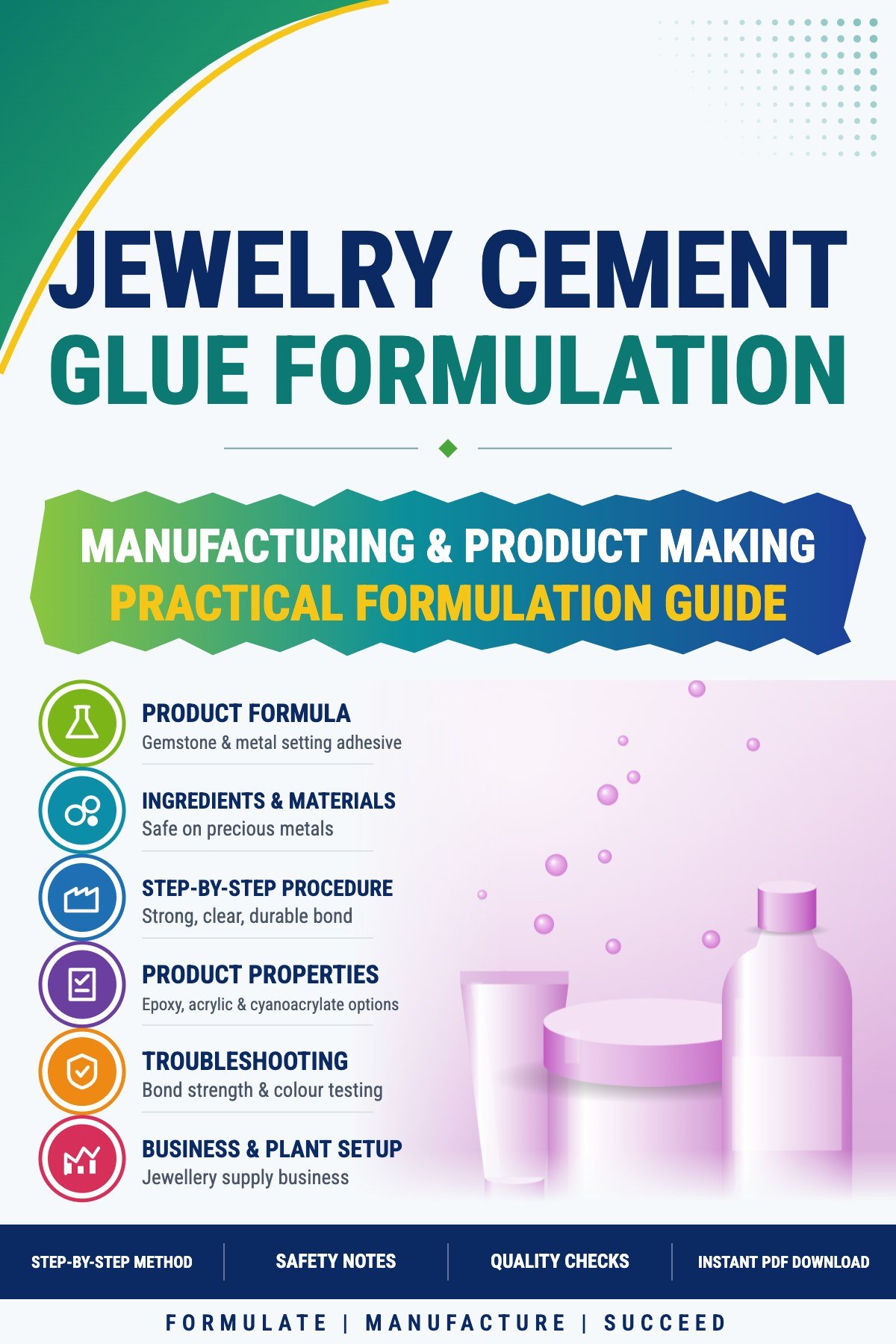
Every Product Making Guide in our shop follows the same structure so you know where to look. This guide includes the product formula, the ingredients and materials, the procedure and preparations, the industrial requirements and the technical specifications. In practice you receive:
- The formulation, written so you can follow it at the bench and scale it up.
- Ingredients and materials, with the job of each material and advice on grades and suppliers.
- The manufacturing procedure, including order of addition, mixing and preparations.
- Industrial requirements, covering equipment, space and packaging.
- Technical specifications, describing what a good finished product should look like and how it should behave.
- Troubleshooting for the faults that makers meet most often.
- Business guidance, to help you take the product from the bench to the market.
These Product Making Guides of chemical formulations and formulas are for manufacturers, startups and entrepreneurs. Every guide contains industrially tested, practical formulations. Anyone who buys a guide can make the product by following its step-by-step instructions. Raw materials vary between suppliers, so always confirm your results with a small trial batch before scaling up.
Who stands behind this guide?
Chemical Formulation Services is the trading name of CFS Formulation Services Ltd, registered in England and Wales under company number 16678503, with its office at Unit F, Winston Business Park, Churchill Way, Sheffield S35 2PS. The business was founded by George Enrick and publishes formulation manuals, technical guides and industry reports. You can check our details on the Companies House register, read about us, or contact us with any question before you order.
A written formulation cannot replace testing with your own raw materials, equipment and climate, and we say so plainly. What the guide does give you is a tested, structured starting point that can save you months of trial and error. Our terms and conditions explain what a purchase from us covers.
How to order
- Select Add to cart to keep browsing, or Buy Now to go straight to checkout.
- Pay with PayPal, Stripe, Xoom by PayPal, Payoneer, payment links for debit and credit cards, or Western Union, Ria and all money exchanges.
- If you pay through a money exchange, email your payment slip to Info@chemicalformulationservices.com. After confirmation, your instant download link is emailed to you.
- For online payments, the PDF is available as soon as the payment is confirmed.
All products are digital downloads and all payments are nonrefundable once the file is delivered, so please read the refund policy and the FAQs before you order. You can compare this guide with others in the formula shop or browse our industrial project reports.
Frequently asked questions about jewelry cement glue formulation
What is the Jewelry Cement Glue Formulation guide?
It is a digital PDF Product Making Guide to formulating and making strong, durable adhesives for jewellery, safe on precious metals and gemstones.
Which adhesive types are used in jewellery?
Two-part epoxy, cyanoacrylate, UV-curing acrylics, flexible polyurethanes and solvent-based cements are all used, depending on the materials and the job.
Why do some jewellery glues turn yellow?
Poor UV stability or certain hardeners cause yellowing, so clear jewellery adhesives use light-stable resins and stabilisers.
Is jewellery glue safe on skin?
Cured adhesive is generally inert, but uncured epoxy and cyanoacrylate can irritate or sensitise skin, so use gloves and ventilation and allow full cure before wearing.
Can one glue bond every jewellery material?
No. Some plastics, porous stones and pearls need specific adhesives, and users should test a hidden spot first.
How do I receive the guide?
You receive an instant PDF download after payment is confirmed. For money exchanges, email your payment slip to Info@chemicalformulationservices.com and the link is emailed after we confirm it.
Is the payment refundable?
All payments are nonrefundable because the product is an instant digital download. See the refund policy for details.
Can you help with a custom formulation?
CFS Formulation Services Ltd offers formulation and product development consultancy. Send a short brief through the Contact page.
Last reviewed: November 2026. This page is general information about a digital product. It is not a safety data sheet or professional advice, and any formulation should be tested and reviewed by a qualified person before commercial use.