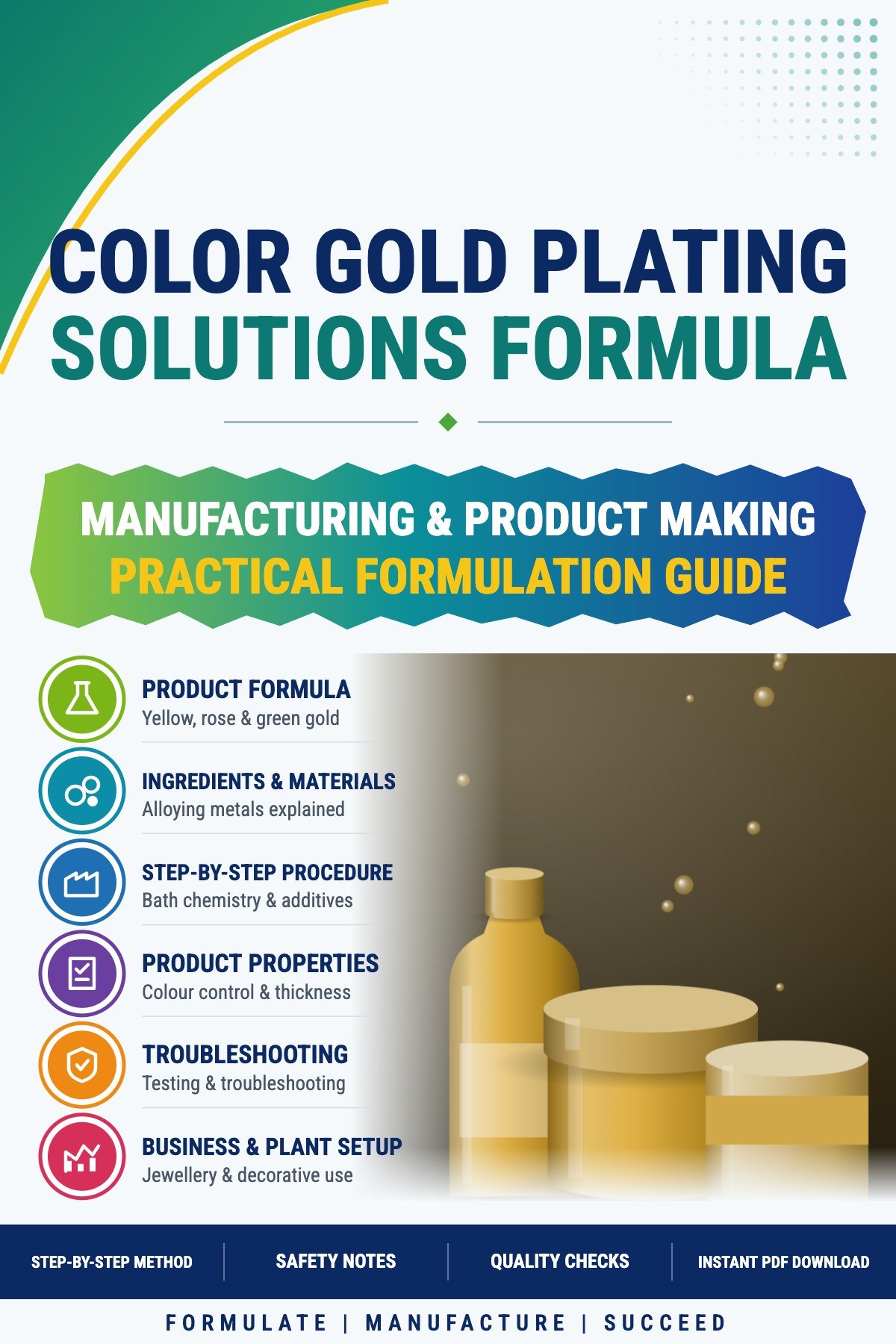

Color Gold Plating Solutions Formula
USD $75
PDF manual · Instant downloadColor Gold Plating Solutions Formula: a PDF guide to coloured gold electroplating baths, alloying metals, colour control, testing and troubleshooting for platers and jewellers.
Payment Methods
Refund Policy
Custom Formulation Services
Formulation Consultation
Contact Us
Color Gold Plating Solutions Formula is a practical PDF guide for electroplaters, surface-finishing professionals, jewellery manufacturers, chemical engineers, students and entrepreneurs who want to understand coloured gold electroplating from both the science and the shop-floor side. Coloured gold deposits, in shades such as yellow, rose, green, white and even more unusual tones, are made by plating gold together with small amounts of other metals. This page explains how a color gold plating solutions formula works, what the guide covers and how a color gold plating solutions formulation is controlled in practice, so you can decide whether it suits your needs.
This guide is published by Chemical Formulation Services, the formulation publishing and consultancy business of CFS Formulation Services Ltd in Sheffield, United Kingdom. It is written for people who want to understand the product from the raw material to the finished pack, and it keeps its claims practical rather than promotional.
At a glance
- Product: Color Gold Plating Solutions Formula, a digital PDF Product Making Guide.
- Also searched as: color gold plating solutions formulation, rose gold plating bath, green gold plating, coloured gold electroplating.
- What it covers: bath chemistry, alloying metals, additives, operating conditions, testing and troubleshooting.
- Key goals: accurate colour, even thickness, good adhesion and wear resistance.
- Who it is for: electroplaters, jewellery makers, finishing professionals, students and manufacturers.
- Delivery: instant PDF download after payment is confirmed.
- Publisher: CFS Formulation Services Ltd, England and Wales company number 16678503.
Why gold comes in many colours
Pure gold is a deep yellow metal, but it is soft, so jewellery and decorative items are usually made from alloys. The colour of a gold alloy depends on the other metals mixed with it. Adding copper moves the shade toward pink and red, which gives rose gold. Adding silver shifts it toward green, and adding nickel or palladium makes it paler and whiter. Electroplating can reproduce these colours in thin deposits on a base metal. A bath is designed to deposit gold together with a controlled amount of one or more alloying metals, so the surface takes on the desired shade even though the layer is only a few microns thick.
This is how a plater can finish brass, silver or nickel-plated parts in rose, green or yellow gold at a fraction of the cost of solid gold. It is also why the details of the bath formulation are valuable: a small change in composition produces a visible change in colour.
How gold electroplating works
As in other electroplating, the part is the cathode in a conductive solution that holds dissolved metal. When direct current passes, metal ions reduce at the surface and deposit as a solid layer. In gold plating, the gold is usually held in solution as a complex, and the alloying metals are added as soluble salts or complexes. The anodes may be insoluble materials such as platinised titanium or stainless steel, with the metal content replenished by adding concentrates, or they may be partly soluble. The composition of the deposit depends on the bath ratio of metals, the current density, the temperature, the pH and the agitation. Because each variable can change the colour, a gold bath calls for careful, repeatable control.
The colours and what makes them
Yellow gold
Classic yellow tones come from a balance of gold with small amounts of silver and copper, or from bright gold deposits with minimal alloying. Different shades such as lemon, rich yellow and 24-carat look can be reached through bath adjustment.
Rose and red gold
Copper is the main colouring element. Higher copper content in the deposit gives deeper pink and red hues. The challenge is to keep the copper level stable so that every batch matches.
Green gold
Silver in the deposit moves the tone to greenish yellow. Cadmium was once used in some green gold alloys, but it is now avoided for health and legal reasons, and modern practice uses safer alternatives.
White gold and pale tones
Nickel, palladium or other metals whiten the deposit. Because nickel can cause allergic reactions on skin, nickel-free choices are strongly preferred in jewellery, and in many regions the release of nickel from articles in prolonged skin contact is limited by law.
Other decorative shades
Brown, grey and darker tones can be produced through alloying, bath conditions or finishing treatments. The guide explains what controls these effects.
Main components of a coloured gold bath
Gold source
Gold enters the bath as a soluble complex, commonly based on cyanide in traditional systems or on sulphite and other non-cyanide chemistries in newer ones. The concentration of gold sets the plating speed and the range of useful current density.
Alloying metal sources
Copper, silver, cadmium-free alternatives, nickel, palladium, cobalt and similar metals are added in measured amounts to produce the target shade. Their concentrations must be monitored and topped up, since they are used up at different rates from gold.
Conducting salts and buffers
These keep the solution conductive and hold the pH steady. Many gold baths work only in a narrow pH window.
Brighteners and grain refiners
Small additive levels improve brightness, hardness and smoothness. Too much additive can make the deposit brittle or change the colour, so dosing is precise.
Operating conditions that affect colour
Temperature, current density, pH and agitation are the major levers. Higher current density often alters the proportion of alloying metal that deposits, which can shift the shade. Temperature affects deposition efficiency and the stability of complexes. Agitation brings fresh solution to the part and gives even colour across the surface. The guide explains how to set these conditions and how to hold them steady, because colour consistency is the main commercial requirement in decorative gold plating.
Preparing the surface
A good gold finish needs a good underlayer. Parts are degreased, cleaned, activated and often plated with a nickel or copper strike before gold. For jewellery, a nickel-free underlayer is used where skin contact is expected. Brightness of the base metal carries through to the final finish, so polished parts give bright plating. A barrier layer between a brass or copper base and the gold prevents base metal from diffusing into the gold and changing its colour over time.
What is inside the Color Gold Plating Solutions Formula guide
The guide is a technical reference that links electrochemistry with industrial practice. It provides bath compositions for the different gold colours, operating parameters, step-by-step preparation of solutions, maintenance schedules, analysis methods, troubleshooting and notes on equipment. It also discusses recovery of gold from rinse waters and spent solutions, which is important both for cost and for environmental reasons.
Equipment and plant requirements
A gold plating line needs small tanks made of plastic or lined steel, a precise low-voltage rectifier, heaters with thermostat control, filtration, racks or barrels, rinse tanks, drag-out recovery tanks and a laboratory for analysis. Because gold is expensive, bath volumes are often kept small and drag-out is carefully recovered. Fume extraction, good ventilation and secure storage protect people and metal. If cyanide-based chemistry is used, strict safety procedures and approvals apply.
Quality control for gold deposits
- Colour matching: compare finished parts with reference samples under consistent lighting, or measure with a colorimeter.
- Thickness: X-ray fluorescence or other gauges confirm the deposit meets the specification.
- Adhesion: bend, tape and heat tests check bonding.
- Porosity and corrosion: tests for pores that expose the base metal.
- Wear resistance: abrasion tests, since coloured gold deposits on jewellery face daily wear.
- Bath analysis: regular checks of gold, alloy metals, pH and additives with written records.
Troubleshooting coloured gold plating
Wrong or uneven colour
Check alloy metal levels, current density and temperature. Uneven colour across a part also points to poor agitation or uneven current distribution.
Dull or cloudy deposits
Often caused by contamination, low additive levels or poor surface preparation.
Burnt or dark deposits
Excessive current density, low gold content or low temperature can burn the deposit. Reduce current and check bath balance.
Poor adhesion
Almost always a cleaning or activation fault, or a missing underlayer. Check every pre-treatment step.
Colour change after plating
Diffusion from the base metal or tarnish of alloying metals can alter colour. Use proper barrier layers and protective post-treatments.
Brittleness
Too much additive or organic contamination makes the deposit brittle. Use carbon treatment and adjust the additive.
Safety, environment and compliance
Plating chemicals can be hazardous. Cyanide-based gold baths are acutely toxic, and mixing cyanide with acid releases lethal gas, so storage and handling need strict controls. Several alloying metals, including nickel and cobalt, are health hazards, and cadmium is heavily restricted. Operators need protective equipment, ventilation and training, and all waste must be treated and disposed of in line with local environmental law. Jewellery rules can also limit nickel release and require correct description of plated articles. Obtain the necessary permits, and ask a qualified person to review your process before you begin. You remain responsible for safety and compliance.
The business opportunity
Coloured gold finishes are in constant demand from jewellery makers, watch and accessory manufacturers, decorative hardware companies and electronics producers. Fashion drives interest in rose gold and other tones, and plating gives manufacturers a flexible, affordable way to offer them. Plating shops that deliver consistent colour, strong adhesion and reliable lead times can win loyal customers. The ability to match a customer’s colour sample exactly is a strong selling point.
Plating is closely linked to other finishing steps. Browse the Electroplating Formula category for more bath formulations, and see Gold Electroplating & Polishing Formula, Zinc Plating Bath Formulation and Cadmium Plating Formulation for related processes. The Metal Polishing Formula and Metal Treatment categories cover polishing and treatment of the metal before and after plating.
Getting started
Start with a small bench-scale bath, test on sample parts and record every parameter. Build a library of reference colours, tune your bath until you can reproduce them reliably, and only then move to production volumes. Pair this with sound refining and recovery practices so that gold is not wasted. The guide supplies the technical foundation, and your testing builds the experience.
How to get the best results from this guide
Treat the guide as a tested starting point rather than a finished factory. Begin with a small trial batch in the laboratory or on a bench, using the exact raw materials you plan to buy, and record every weight, temperature, mixing time and observation. Compare the result with the quality checks in the guide, change only one thing at a time, and keep a note of what each change did. Once a small batch is consistently good, repeat it several times, then scale up in stages, because mixing, heating and cooling behave differently in larger vessels. Keep retained samples of every batch, write simple standard operating procedures for your team, and build relationships with two suppliers for each key raw material. Finally, check the labelling, safety and product rules in the country where you will sell, and ask a qualified person to review your process. This careful, documented approach is what turns a good formulation into a reliable product and a trusted brand.
Who should buy this guide?
The guide is written for practical readers. It suits manufacturers who want to add a new product to an existing plant, startups choosing their first product, private-label brands that need to understand what they are buying, technical staff who must set specifications and train operators, and consultants and students who want a structured, plain-language reference. It is less suitable for anyone looking for a quick shortcut or a guarantee, because every formulation still needs testing with your own materials, equipment and local rules. If you are unsure whether it matches your project, send a short question through the contact page before you order, and we will tell you honestly whether it fits.
What is inside the Color Gold Plating Solutions Formula guide
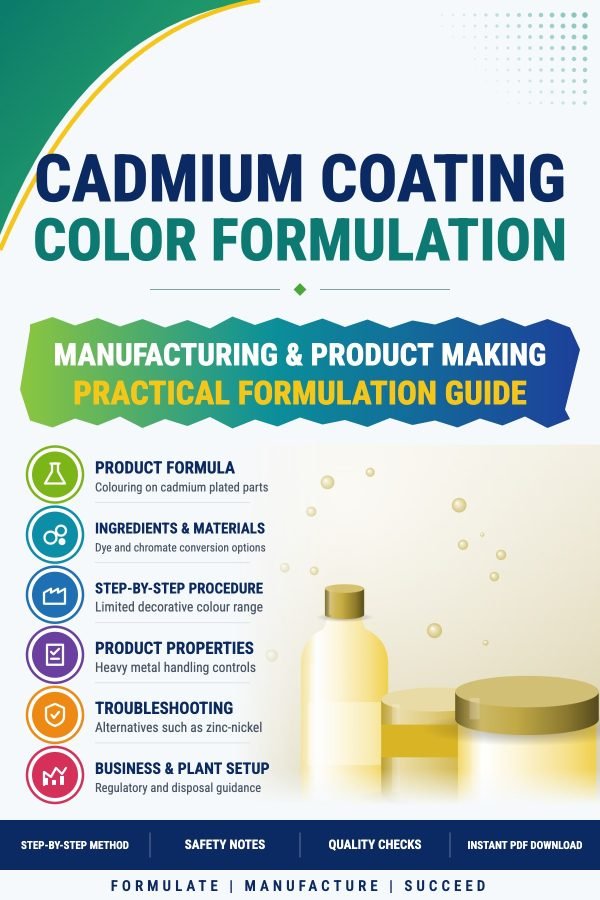
Every Product Making Guide in our shop follows the same structure so you know where to look. This guide includes the product formula, the ingredients and materials, the procedure and preparations, the industrial requirements and the technical specifications. In practice you receive:
- The formulation, written so you can follow it at the bench and scale it up.
- Ingredients and materials, with the job of each material and advice on grades and suppliers.
- The manufacturing procedure, including order of addition, mixing and preparations.
- Industrial requirements, covering equipment, space and packaging.
- Technical specifications, describing what a good finished product should look like and how it should behave.
- Troubleshooting for the faults that makers meet most often.
- Business guidance, to help you take the product from the bench to the market.
These Product Making Guides of chemical formulations and formulas are for manufacturers, startups and entrepreneurs. Every guide contains industrially tested, practical formulations. Anyone who buys a guide can make the product by following its step-by-step instructions. Raw materials vary between suppliers, so always confirm your results with a small trial batch before scaling up.
Who stands behind this guide?
Chemical Formulation Services is the trading name of CFS Formulation Services Ltd, registered in England and Wales under company number 16678503, with its office at Unit F, Winston Business Park, Churchill Way, Sheffield S35 2PS. The business was founded by George Enrick and publishes formulation manuals, technical guides and industry reports. You can check our details on the Companies House register, read about us, or contact us with any question before you order.
A written formulation cannot replace testing with your own raw materials, equipment and climate, and we say so plainly. What the guide does give you is a tested, structured starting point that can save you months of trial and error. Our terms and conditions explain what a purchase from us covers.
How to order
- Select Add to cart to keep browsing, or Buy Now to go straight to checkout.
- Pay with PayPal, Stripe, Xoom by PayPal, Payoneer, payment links for debit and credit cards, or Western Union, Ria and all money exchanges.
- If you pay through a money exchange, email your payment slip to Info@chemicalformulationservices.com. After confirmation, your instant download link is emailed to you.
- For online payments, the PDF is available as soon as the payment is confirmed.
All products are digital downloads and all payments are nonrefundable once the file is delivered, so please read the refund policy and the FAQs before you order. You can compare this guide with others in the formula shop or browse our industrial project reports.
Frequently asked questions about color gold plating solutions formula
What is the Color Gold Plating Solutions Formula guide?
It is a digital PDF Product Making Guide covering the chemistry, formulations, operating conditions, testing and troubleshooting of coloured gold electroplating baths.
How are different gold colours produced?
Gold is plated together with controlled amounts of other metals. Copper gives rose tones, silver gives green tones and nickel or palladium whiten the deposit.
Why is nickel avoided in jewellery plating?
Nickel can cause skin allergy, and many regions limit its release from articles worn against skin, so nickel-free underlayers are preferred.
Why does colour vary between batches?
Small changes in bath composition, current density, temperature and agitation shift the alloy ratio in the deposit, so tight control is needed.
Are cyanide gold baths dangerous?
Yes. Cyanide is highly toxic and releases lethal gas on contact with acid, so strict safety controls and permits are required, and non-cyanide systems may be preferred.
How do I receive the guide?
You receive an instant PDF download after payment is confirmed. For money exchanges, email your payment slip to Info@chemicalformulationservices.com and the link is emailed after we confirm it.
Is the payment refundable?
All payments are nonrefundable because the product is an instant digital download. See the refund policy for details.
Can you help with a custom formulation?
CFS Formulation Services Ltd offers formulation and product development consultancy. Send a short brief through the Contact page.
Last reviewed: November 2026. This page is general information about a digital product. It is not a safety data sheet or professional advice, and any formulation should be tested and reviewed by a qualified person before commercial use.