
Liquid Nail Glue Formula
USD $75
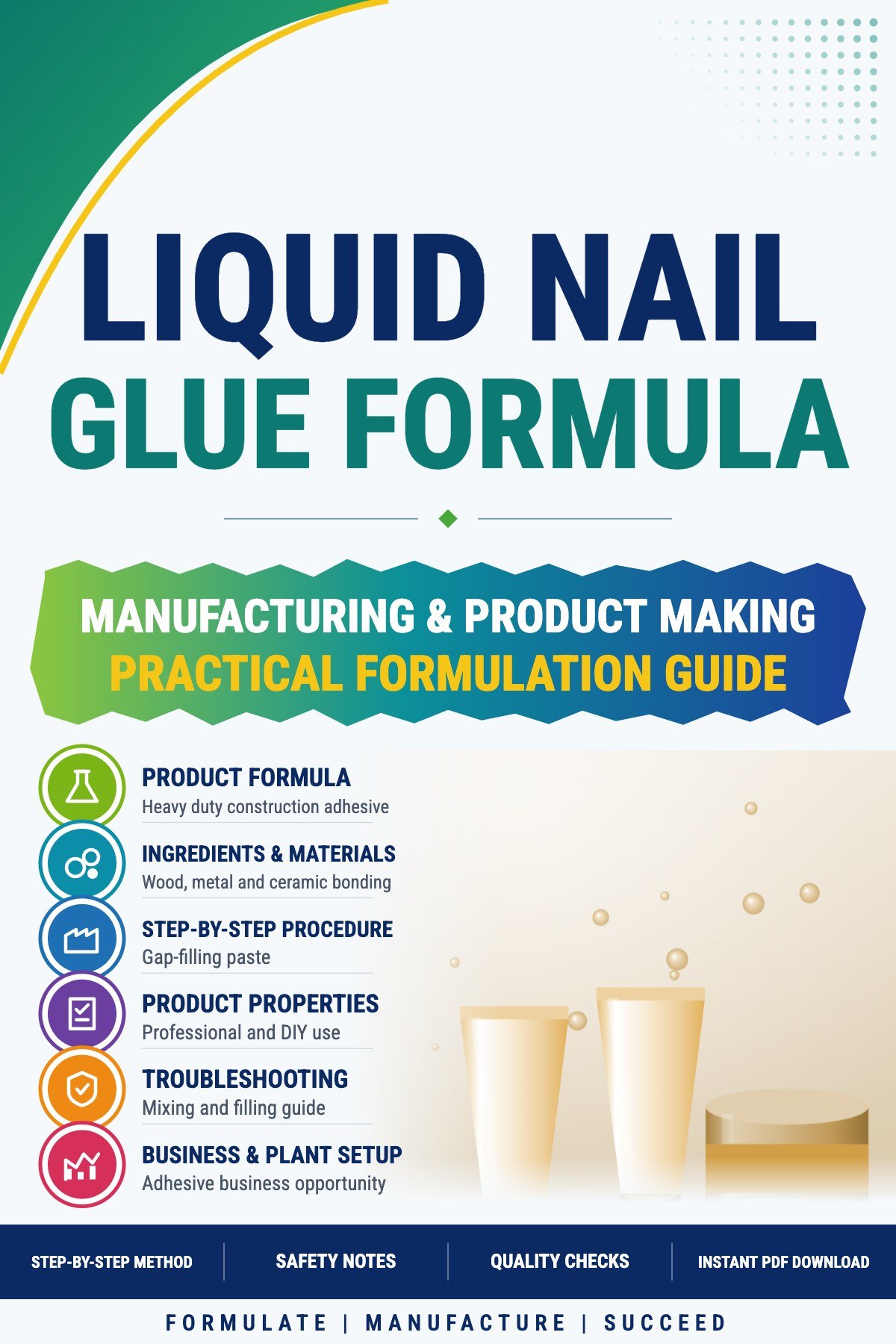
PDF manual · Instant downloadLiquid Nail Glue Formula: a PDF guide to making heavy duty construction adhesive paste for wood, metal and ceramics, with formulas, filling and testing. Independent guide.
Payment Methods
Refund Policy
Custom Formulation Services
Formulation Consultation
Contact Us
Liquid Nail Glue Formula is a practical PDF guide for adhesive manufacturers, hardware and building-product suppliers, startups and entrepreneurs who want to make a high-performance “liquid nails” construction adhesive. This kind of cartridge-applied paste glue replaces or supplements nails and screws, giving exceptional bonding strength and versatility on wood, metal, ceramics, masonry and many other materials, for professionals and DIY users alike. “Liquid Nails” is a well-known brand name; this guide uses the phrase only to describe the product category, is independent and is not affiliated with any brand owner. This page explains how a liquid nail glue formulation works, what goes into a liquid nail glue formula, how it is made, tested and filled, and how to turn it into a business.
This guide is published by Chemical Formulation Services, the formulation publishing and consultancy business of CFS Formulation Services Ltd in Sheffield, United Kingdom. It is written for people who want to understand the product from the raw material to the finished pack, and it keeps its claims practical rather than promotional.
At a glance
- Product: Liquid Nail Glue Formula, a digital PDF Product Making Guide.
- Also searched as: liquid nail glue formulation, construction adhesive formula, heavy duty panel adhesive, no more nails glue, mounting adhesive.
- Form: thick gap-filling paste in cartridges, applied with a caulking gun.
- Bonds: wood, metal, ceramics, masonry, plasterboard, foam and many plastics.
- Who it is for: adhesive makers, hardware suppliers, private-label brands and entrepreneurs.
- Delivery: instant PDF download after payment is confirmed.
- Publisher: CFS Formulation Services Ltd, England and Wales company number 16678503.
What a construction adhesive does
A construction adhesive is a thick paste that sticks building materials together, usually in place of mechanical fixings or in addition to them. Carpenters use it to glue wall panels, skirting boards, architraves, floor boards and stair treads. Tradespeople fix plasterboard, ceramic trim, mirrors, foam insulation, decorative mouldings, metal trims and masonry. DIY users hang shelves, mount tiles and fix loose joints. The paste is squeezed from a cartridge with a caulking gun in beads, spreads under pressure, grabs the surface quickly and gradually cures to a tough bond. Compared with nails or screws, adhesive spreads the load over a wide area, avoids visible fixings and fills gaps.
The challenge of formulation is getting many properties into one product: strong initial grab so that parts stay in place, enough open time to adjust, gap-filling ability with no sag, good adhesion to porous and non-porous surfaces, flexibility to absorb movement, resistance to moisture and temperature and a cure that is neither too fast nor too slow. The guide shows how to balance these properties in a practical, manufacturable recipe.
Main types of construction adhesive
Solvent-based rubber adhesives
Traditional “heavy duty” liquid nail products are solutions of synthetic rubber (styrene block copolymers or chloroprene), tackifying resins, fillers and solvents. They have strong initial grab, excellent adhesion to many surfaces and good moisture resistance. They dry by solvent evaporation, so they should not be used between two impermeable surfaces without allowing venting. Solvent odour and flammability require care, and VOC regulation limits their use in some markets.
Water-based acrylic adhesives
Acrylic emulsion-based pastes, filled with calcium carbonate and other fillers, are low in odour, non-flammable and clean up with water. They suit indoor use on porous materials such as wood, plasterboard and foam. Their initial grab and moisture resistance are lower than solvent-based types, but modern formulas have improved a lot.
Polyurethane adhesives
Moisture-curing polyurethane pastes cure by reacting with moisture in the air and substrate, giving very strong, flexible, waterproof bonds suitable for exterior and demanding uses. They need careful manufacturing under moisture-free conditions and careful handling because of isocyanate content.
MS polymer and hybrid adhesives
Silane-modified polymer adhesives are isocyanate-free, solvent-free, moisture-curing and flexible with excellent adhesion to many substrates. They are growing quickly, but raw materials are more costly.
Typical ingredients
- Polymer base: synthetic rubber or block copolymer, acrylic emulsion, polyurethane prepolymer or silane-modified polymer.
- Tackifying resins: hydrocarbon or rosin ester resins for grab and adhesion in solvent systems.
- Fillers: calcium carbonate, talc, silica and clays that give bulk, gap filling and strength while reducing cost.
- Thixotropic agents: fumed silica, bentonite or fine precipitated calcium carbonate to prevent sag.
- Solvents or water: carriers that set viscosity and open time.
- Plasticisers: improve flexibility.
- Adhesion promoters: silanes for glass, metal and mineral surfaces.
- Stabilisers and antioxidants: help shelf life.
- Pigments: usually off-white, beige or tan.
Choosing the right grade for each job
A single liquid nails product rarely covers every job, so successful brands offer a small range. A general-purpose interior adhesive suits skirting, mouldings, shelves and panels. A heavy-duty or panel-and-moulding grade has higher solids and more grab for vertical work. A foam-board adhesive is formulated without aggressive solvents so that polystyrene and polyurethane insulation does not dissolve. A mirror adhesive is chosen so that it does not attack the silvering. An exterior or all-weather adhesive uses polyurethane or hybrid polymers and resists water, sun and freeze-thaw. A fast-grab or instant-grip grade reduces the need for props. Colour-coded cartridges, with a clear panel of uses on the label, help customers choose in the shop without staff advice.
Surface preparation and application tips
Instructions on the cartridge decide whether the customer’s job succeeds. Surfaces should be clean, dry, dust-free and free of oil, wax or loose paint. Cut the nozzle to a small opening for neat beads, and apply the adhesive in a continuous wavy line or in dabs, spaced for the size of the panel. Press the pieces together and, if the adhesive is solvent-based, pull them apart briefly and re-press to let solvent flash off and improve grab. Support heavy panels with temporary props or tape until the adhesive has cured. Do not use the adhesive in thick layers on two non-porous surfaces unless the product is moisture-curing. Provide coverage figures, such as metres of bead per cartridge, to help buyers estimate quantities.
Cure times and ultimate strength
Customers need to know three times: how long they have to position the parts, when the joint can be handled and when it reaches full strength. Open time may range from ten to thirty minutes, handling strength can be reached in a few hours and full strength after one to seven days, depending on adhesive type, temperature, humidity and joint thickness. Moisture-curing products cure from the outside in, so thick beads take longer. Water-based types need moisture to escape through porous substrates. Publish a table of these times at several temperatures, and warn against loading joints before they are ready.
Cartridge, sausage and pail packaging
Standard 300 millilitre plastic cartridges with piston plugs fit common caulking guns. Aluminium foil sausages suit moisture-curing products with long storage needs. Pails and tubs serve contractors who trowel adhesive. Choose packaging made of materials that resist the adhesive’s solvents and prevent moisture entry. Label with batch number and expiry date, and give storage advice, such as keeping cartridges upright, in a cool place, between about 5 and 25 degrees Celsius, and away from frost, which damages water-based types.
Positioning against established brands
Well-known brands have strong distribution and trust, so a new entrant needs a clear angle. Options include a lower price with similar performance, local manufacture and fast delivery, a niche product such as foam-safe or low-odour, an eco-friendly water-based line, bundles with caulking guns for DIY retailers and private-label supply for chains. Back claims with test data and real jobs, and train shop staff to demonstrate the product. Over time, consistent quality and fair pricing build the brand.
What is inside the Liquid Nail Glue Formula guide
The guide describes a high-performance adhesive formulated for exceptional bonding strength and versatility in many applications, ideal for professional and DIY projects, forming strong, durable bonds on wood, metal, ceramics and more. It explains why professional formula expertise matters, and gives recipes, mixing steps, cartridge filling, testing and troubleshooting.
How the adhesive is made
Production uses a heavy-duty planetary or double-arm kneader mixer capable of handling high viscosity pastes, preferably with vacuum and a cooling jacket.
Dissolving the polymer
For solvent-based types, charge solvent and add rubber, mixing until dissolved, which can take hours. Add resin and mix until clear. Keep the vessel covered and earthed because the solvents are flammable.
Adding fillers and thixotropes
Add fillers gradually under mixing until the paste is smooth, then add thixotropic agent and mix until it develops structure. Control temperature as friction heats the mass.
Adding minor ingredients
Add silane, antioxidant, pigment and any other additives and mix until uniform.
Vacuum de-aeration
Apply vacuum while mixing to remove air, because bubbles weaken the bond and cause irregular bead flow.
Cartridge filling
Fill into plastic or aluminium cartridges using a piston or pneumatic filling machine, insert follower plugs and seal. Moisture-curing types must be filled under dry conditions.
Testing
- Viscosity and extrusion rate: pass through a standard nozzle at a given pressure.
- Sag resistance: bead on vertical surface does not slump.
- Open time and skin-over time: time to assemble the joint.
- Initial grab: tack or hold on vertical lap joints.
- Shear and peel strength: on wood, metal, plasterboard, ceramic and plastics after 24 hours and 7 days.
- Water and temperature resistance: soak and heat tests.
- Cure rate: through-cure depth for moisture-curing types.
- Shelf life: stability in cartridges stored warm.
- Foam and substrate compatibility: solvent effects on polystyrene.
Troubleshooting
Bead sags or slumps
Low thixotropy. Increase fumed silica or adjust filler ratio.
Hard to extrude
Too viscous. Reduce filler or thixotrope, or use a more fluid base.
Poor initial grab
Too little tackifier or polymer. Adjust resin level and polymer concentration.
Bubbles or voids in the bead
Air in the batch. Use vacuum de-aeration and fill carefully.
Cartridge thickens or gels in storage
Moisture entering or reactive ingredients. Dry fillers and improve sealing.
Melts polystyrene foam
Aggressive solvents. Use a water-based or foam-safe solvent formula.
Safety and regulation
Solvent-based adhesives are flammable and give off vapour that irritates and can cause dizziness, so use ventilation and no ignition sources in the plant and advise users to work in ventilated areas. Isocyanate-containing polyurethanes are sensitisers and need strict controls. Wear gloves, eye protection and respirators when handling raw materials. Many regions limit VOC content of construction adhesives and require labelling of hazards and use instructions. Provide safety data sheets and warnings such as keeping away from heat, not smoking and ventilating during use and cure.
Business opportunity
Construction adhesive is a staple in hardware shops, builders’ merchants, DIY stores and online. Brand owners earn good margins, and private label for chains and distributors is common. A new maker can compete by serving a niche: fast-grab panel adhesive, mirror adhesive, foam-safe adhesive, exterior all-weather, low-VOC water-based, or wood-flooring adhesive. Cartridge sizes of 280, 300 and 310 millilitres are standard, while sausage packs and pails serve professional users. Clear labels with substrates, cure times and application tips help sales. Pairing the adhesive with caulking guns, sealants and fillers broadens the offer.
Related CFS guides help you build an adhesives range. Browse the Industrial Adhesive Formulations and Construction Chemicals categories, and see Contact Adhesive Formulations, , Metal Bond Adhesive Formula, , Artificial Grass Adhesive Formula, Granite Marble & Stone Bonding Formula and Anchor Grout Bonding Formulation.
Getting started
Pick one chemistry, for instance a water-based acrylic panel adhesive, which needs the simplest equipment. Make small batches, bond wood-to-wood and wood-to-plasterboard test pieces, measure strength and sag, and compare with leading brands. Choose cartridges, labels and filling equipment. Test in real jobs with builders, adjust open time and grab, and then expand to solvent-free hybrid or exterior grades.
How to get the best results from this guide
Treat the guide as a tested starting point rather than a finished factory. Begin with a small trial batch in the laboratory or on a bench, using the exact raw materials you plan to buy, and record every weight, temperature, mixing time and observation. Compare the result with the quality checks in the guide, change only one thing at a time, and keep a note of what each change did. Once a small batch is consistently good, repeat it several times, then scale up in stages, because mixing, heating and cooling behave differently in larger vessels. Keep retained samples of every batch, write simple standard operating procedures for your team, and build relationships with two suppliers for each key raw material. Finally, check the labelling, safety and product rules in the country where you will sell, and ask a qualified person to review your process. This careful, documented approach is what turns a good formulation into a reliable product and a trusted brand.
Who should buy this guide?
The guide is written for practical readers. It suits manufacturers who want to add a new product to an existing plant, startups choosing their first product, private-label brands that need to understand what they are buying, technical staff who must set specifications and train operators, and consultants and students who want a structured, plain-language reference. It is less suitable for anyone looking for a quick shortcut or a guarantee, because every formulation still needs testing with your own materials, equipment and local rules. If you are unsure whether it matches your project, send a short question through the contact page before you order, and we will tell you honestly whether it fits.
What is inside the Liquid Nail Glue Formula guide
Every Product Making Guide in our shop follows the same structure so you know where to look. This guide includes the product formula, the ingredients and materials, the procedure and preparations, the industrial requirements and the technical specifications. In practice you receive:
- The formulation, written so you can follow it at the bench and scale it up.
- Ingredients and materials, with the job of each material and advice on grades and suppliers.
- The manufacturing procedure, including order of addition, mixing and preparations.
- Industrial requirements, covering equipment, space and packaging.
- Technical specifications, describing what a good finished product should look like and how it should behave.
- Troubleshooting for the faults that makers meet most often.
- Business guidance, to help you take the product from the bench to the market.
These Product Making Guides of chemical formulations and formulas are for manufacturers, startups and entrepreneurs. Every guide contains industrially tested, practical formulations. Anyone who buys a guide can make the product by following its step-by-step instructions. Raw materials vary between suppliers, so always confirm your results with a small trial batch before scaling up.
Who stands behind this guide?
Chemical Formulation Services is the trading name of CFS Formulation Services Ltd, registered in England and Wales under company number 16678503, with its office at Unit F, Winston Business Park, Churchill Way, Sheffield S35 2PS. The business was founded by George Enrick and publishes formulation manuals, technical guides and industry reports. You can check our details on the Companies House register, read about us, or contact us with any question before you order.
A written formulation cannot replace testing with your own raw materials, equipment and climate, and we say so plainly. What the guide does give you is a tested, structured starting point that can save you months of trial and error. Our terms and conditions explain what a purchase from us covers.
How to order
- Select Add to cart to keep browsing, or Buy Now to go straight to checkout.
- Pay with PayPal, Stripe, Xoom by PayPal, Payoneer, payment links for debit and credit cards, or Western Union, Ria and all money exchanges.
- If you pay through a money exchange, email your payment slip to Info@chemicalformulationservices.com. After confirmation, your instant download link is emailed to you.
- For online payments, the PDF is available as soon as the payment is confirmed.
All products are digital downloads and all payments are nonrefundable once the file is delivered, so please read the refund policy and the FAQs before you order. You can compare this guide with others in the formula shop or browse our industrial project reports.
Frequently asked questions about liquid nail glue formula
What is the Liquid Nail Glue Formula guide?
It is a digital PDF Product Making Guide to making heavy duty construction adhesive paste in cartridges, covering formulas, mixing, filling, testing and troubleshooting. It is independent and not affiliated with any brand.
Which types of liquid nail adhesive exist?
Solvent-based rubber, water-based acrylic, polyurethane and silane-modified polymer types.
How do I stop the bead sagging?
Add thixotropic agents such as fumed silica and balance filler levels.
Why use vacuum mixing?
It removes air that would weaken the bond and cause uneven bead flow.
Can it be used on polystyrene foam?
Only if foam-safe; strong solvents melt polystyrene.
How do I receive the guide?
You receive an instant PDF download after payment is confirmed. For money exchanges, email your payment slip to Info@chemicalformulationservices.com and the link is emailed after we confirm it.
Is the payment refundable?
All payments are nonrefundable because the product is an instant digital download. See the refund policy for details.
Can you help with a custom formulation?
CFS Formulation Services Ltd offers formulation and product development consultancy. Send a short brief through the Contact page.
Last reviewed: November 2026. This page is general information about a digital product. It is not a safety data sheet or professional advice, and any formulation should be tested and reviewed by a qualified person before commercial use.