
Waterproof Glue Formation
USD $65
PDF manual · Instant downloadWaterproof Glue Formation: a PDF guide to making waterproof and water-resistant glues, with chemistries, fillers, manufacturing, application and water-resistance testing.
Payment Methods
Refund Policy
Custom Formulation Services
Formulation Consultation
Contact Us
Waterproof Glue Formation is a practical PDF guide for adhesive manufacturers, hardware and repair-product brands, craft-supply companies and entrepreneurs who want to make strong glues whose bond is unaffected by water and moisture. Waterproof, or water-resistant, adhesive is needed for outdoor projects, boat and marine repairs, bathrooms and kitchens, garden furniture, pipework, aquariums, water-related crafts and any repair in a wet environment. This page explains how a waterproof glue formulation works, what the guide covers and how a waterproof glue formula is designed, made, applied and tested, so you can decide whether it suits your business.
This guide is published by Chemical Formulation Services, the formulation publishing and consultancy business of CFS Formulation Services Ltd in Sheffield, United Kingdom. It is written for people who want to understand the product from the raw material to the finished pack, and it keeps its claims practical rather than promotional.
At a glance
- Product: Waterproof Glue Formation, a digital PDF Product Making Guide.
- Also searched as: waterproof glue formula, waterproof glue formulation, water-resistant adhesive, marine glue, outdoor adhesive.
- What it covers: adhesive chemistries, fillers, hardeners, additives, manufacturing, application and water-resistance testing.
- Key goals: bond strength that survives soaking, humidity, rain and temperature swings.
- Who it is for: adhesive makers, hardware and DIY brands, craft suppliers and entrepreneurs.
- Delivery: instant PDF download after payment is confirmed.
- Publisher: CFS Formulation Services Ltd, England and Wales company number 16678503.
Why water defeats most glues
Many everyday adhesives are quite sensitive to water. Basic white craft glues based on polyvinyl acetate are soft when wet, and traditional animal glues and starch pastes dissolve or swell. Even when an adhesive is not soluble, water can creep along the bond line and weaken it. It can push between the adhesive and the surface, a process called displacement, it can swell porous substrates such as wood and paper, causing stress, and it can attack certain polymer links through hydrolysis. Add temperature swings and freezing, which turn absorbed water into ice that expands and breaks bonds, and many joints made with ordinary glue fail within months outdoors.
A waterproof glue is designed to resist all of these. It uses polymer chemistry that does not dissolve in water, sticks to the surface strongly enough to resist displacement, forms a tight network that blocks water entry, and stays flexible enough to cope with movement and temperature changes.
What waterproof really means
The word waterproof is used loosely on packaging. Some adhesives are truly waterproof, meaning that they stay bonded under prolonged immersion, boiling or repeated wet and dry cycles. Others are water resistant, meaning they survive splashes, humidity and occasional wetting but fail under continuous soaking. Standards for wood adhesives, such as classes that describe resistance to cold water, repeated soaking or boiling, help define performance. The guide encourages makers to define performance clearly, test against it and label honestly, because claims of waterproof performance that are not backed up can lead to failures and complaints.
Main adhesive types for wet conditions
Two-part epoxy
Epoxy is a standard choice for truly waterproof bonds. Cured epoxy is dense, non-porous and highly resistant to water and many chemicals. It sticks to wood, metal, glass, ceramics, concrete and many plastics. Underwater and wet-surface epoxies exist for marine and plumbing repairs. Epoxy is rigid, so toughened or flexible grades are used where movement is expected.
Polyurethane adhesives
Moisture-curing polyurethane glues use water in the air and in the substrate to cure, expanding slightly as they do, and form tough, flexible, waterproof bonds. They are popular for wood, stone, masonry and mixed-material joints outdoors. They need protection from moisture in the pack and care with the foaming reaction.
Resorcinol and phenol-resorcinol formaldehyde
These traditional marine and structural wood adhesives give extremely durable waterproof bonds. Their dark colour and formaldehyde content mean that they are mainly used in industrial and specialist settings, and handling needs care.
Cross-linking PVA (water-resistant PVA)
Modified polyvinyl acetate adhesives with cross-linkers or special additives achieve better water resistance than ordinary PVA. They are easy to use, solvent-free and widely used for woodworking joints that see humidity or occasional wetting.
Cyanoacrylate
Super glues bond many materials fast and have fair water resistance on non-porous surfaces, but long-term underwater performance is limited.
Solvent-based contact and rubber cements
Some chloroprene and polyurethane contact adhesives give water-resistant bonds for rubber, leather, laminates and footwear.
MS polymer and silicone adhesive sealants
These flexible products resist water, weather and movement and are used where sealing as well as bonding is needed, as in bathrooms, boats and building joints.
Hot-melt and reactive hot-melt adhesives
Reactive polyurethane hot melts cure into water-resistant bonds for industrial assembly.
Main components of a waterproof glue formula
- Base resin or polymer: epoxy resin, polyurethane prepolymer, cross-linkable PVA or others.
- Hardener or cross-linker: amines, polyamides, isocyanate or other agents that build the water-resistant network.
- Fillers: silica, calcium carbonate, talc or glass beads that add body, fill gaps and reduce shrinkage.
- Thixotropes: fumed silica to prevent sagging on vertical joints.
- Adhesion promoters: silanes that improve bonding to glass, metal and masonry and protect against water attack at the interface.
- Flexibilisers and tougheners: improve peel, impact and movement tolerance.
- Catalysts or accelerators: adjust working time and cure speed.
- Moisture scavengers: protect moisture-sensitive adhesives in the container.
- Biocides and stabilisers: keep water-based glues from spoiling and extend shelf life.
- Colourants: dyes or pigments for identification and appearance.
What is inside the Waterproof Glue Formation guide
The guide is a technical formulation data sheet on glues that create a strong bond unaffected by exposure to water or moisture. It describes how different chemistries compare, gives practical formulations, explains step-by-step manufacturing, provides application guidance and water-resistance tests, covers troubleshooting and discusses packaging and business ideas. It follows the CFS style of clear, industrially minded instructions.
How the glue is made
The outline below shows the general approach for a two-part epoxy and a one-part moisture-cure glue. The guide gives the full details.
Step 1: Check and dry raw materials
Resins, hardeners, fillers and additives are checked for quality, and fillers are dried, since water damages both epoxy and polyurethane glues.
Step 2: Make the base component
The resin is charged to a planetary or similar mixer, with reactive diluent, fillers, thixotrope and additives added gradually, and blended under vacuum to remove air.
Step 3: Make the hardener component
For two-part systems, the hardener is blended with its own fillers and additives in a separate vessel. The two components are designed to be mixed at a simple ratio.
Step 4: Adjust and test
Viscosity, pot life, cure time and strength are checked, and adjustments are made.
Step 5: Fill, seal and label
Components are filled into syringes, twin tubes, tubs or cartridges, or, for moisture-cure types, into moisture-proof tubes and cartridges, then sealed and labelled with instructions and safety information.
Equipment requirements
A workshop needs accurate scales, a planetary mixer with vacuum capability, a disperser for fillers, filling equipment for tubes or cartridges, and a clean, dry production area. A laboratory needs a viscometer, hardness tester, a lap-shear or pull-off test set-up, a water bath or immersion tanks, an oven for ageing and a freezer for freeze-thaw tests.
Application guidance
Good bonding starts with clean, dry, sound surfaces, free of dust, grease, loose paint and old glue. Wood is sanded lightly, metals are degreased and abraded, and slippery plastics are roughened. Epoxies are mixed accurately in the specified ratio, applied in a thin even layer to both surfaces, assembled and clamped until set. Moisture-cure polyurethanes are applied sparingly, as they foam, and damp surfaces may be lightly misted if the instructions say so. Joints should cure fully before exposure to water, and cure time depends on temperature. Repairs in wet places may need special underwater or wet-surface formulas. Ensure the glue is suitable for the materials, since some foams and plastics resist all common glues.
Quality control for every batch
- Mix ratio and appearance: accurate, uniform and consistent from batch to batch.
- Viscosity and sag: suitable for application.
- Pot life and cure time: measured under standard conditions.
- Dry bond strength: shear and peel strength on typical materials.
- Wet bond strength: strength after soaking in cold water for a defined period, after boiling water exposure if claimed, and after repeated wet and dry cycles.
- Freeze-thaw resistance: bonds tested after cycles of freezing and thawing.
- Heat and UV ageing: for outdoor products.
- Shelf life: changes in viscosity, gel time and strength during storage.
Troubleshooting
Bond fails after soaking
The adhesive is only water resistant, not waterproof, or the surface was damp or dirty during bonding. Use a more resistant chemistry, add adhesion promoters and improve preparation.
Bubbles and foam in the bond line
Moisture in a polyurethane glue, or air in an epoxy. Control moisture and de-aerate, and apply thin layers.
Glue stays tacky
Wrong mix ratio, cold weather or expired hardener. Mix accurately and keep within the temperature range.
Brittle joint cracks in cold weather
Adhesive too rigid for movement. Choose a flexible grade or add tougheners.
Glue hardens in the tube
Moisture entered a moisture-cure product. Improve packaging and use moisture scavengers.
Discolouration or yellowing outdoors
Poor UV resistance. Use stabilisers or choose aliphatic or UV-stable systems for visible joints.
Poor adhesion to plastics
Low surface energy plastics resist most glues. Use primers, surface treatment or specialised adhesives.
Safety, health and regulation
Many waterproof glues contain reactive chemicals. Uncured epoxy resin and amine hardeners irritate skin and eyes and are powerful sensitisers, polyurethane glues contain isocyanates that can sensitise the airways, and cyanoacrylate bonds skin and irritates eyes. Resorcinol and phenol-based glues contain hazardous components, including formaldehyde. Gloves, eye protection, ventilation and careful handling are important. Solvent-based glues are flammable. Products must carry hazard labels and safety data sheets, and comply with chemical and consumer product regulations, including child-safety rules for packaging and limits on formaldehyde and VOCs in many markets. Glues used on drinking-water pipes or food-contact surfaces must meet relevant approvals. Do not claim suitability for safety-critical or structural uses unless tested and approved.
The business opportunity
Water exposure is everywhere, in gardens, bathrooms, boats, pools, roofs and drains, so waterproof glues sell steadily through hardware stores, marine suppliers, plumbing merchants, craft shops, building suppliers and online platforms. Manufacturers can offer small consumer tubes, syringes and sticks, as well as professional cartridges and bulk kits. Specialised products, such as clear waterproof glue, underwater epoxy putty and outdoor wood adhesive, each build their own loyal customers. Honest performance claims, clear instructions and a good data sheet reduce returns and build trust.
Related CFS guides complement this product. See Metal Bond Adhesive Formula, , Gypsum Bond Formula, Artificial Grass Adhesive Formula and Adhesive Remover Formula, and browse the Industrial Adhesive Formulations category. For protecting surfaces from water, see Transparent Waterproofing Agent Formula and the Construction Chemicals category. For polyurethane chemistry, see IMUTHANE Prepolymers Formula.
Getting started
Begin with a two-part epoxy and a cross-linking PVA wood glue, two products with different markets and manageable chemistry. Make small batches, bond test pieces of wood, metal and plastic, and run soaking, boiling and freeze-thaw tests. Compare with respected brands and adjust. Ask a few users to try samples in real conditions, gather feedback and refine your products, packaging and labels before scaling up.
How to get the best results from this guide
Treat the guide as a tested starting point rather than a finished factory. Begin with a small trial batch in the laboratory or on a bench, using the exact raw materials you plan to buy, and record every weight, temperature, mixing time and observation. Compare the result with the quality checks in the guide, change only one thing at a time, and keep a note of what each change did. Once a small batch is consistently good, repeat it several times, then scale up in stages, because mixing, heating and cooling behave differently in larger vessels. Keep retained samples of every batch, write simple standard operating procedures for your team, and build relationships with two suppliers for each key raw material. Finally, check the labelling, safety and product rules in the country where you will sell, and ask a qualified person to review your process. This careful, documented approach is what turns a good formulation into a reliable product and a trusted brand.
Who should buy this guide?
The guide is written for practical readers. It suits manufacturers who want to add a new product to an existing plant, startups choosing their first product, private-label brands that need to understand what they are buying, technical staff who must set specifications and train operators, and consultants and students who want a structured, plain-language reference. It is less suitable for anyone looking for a quick shortcut or a guarantee, because every formulation still needs testing with your own materials, equipment and local rules. If you are unsure whether it matches your project, send a short question through the contact page before you order, and we will tell you honestly whether it fits.
What is inside the Waterproof Glue Formation guide
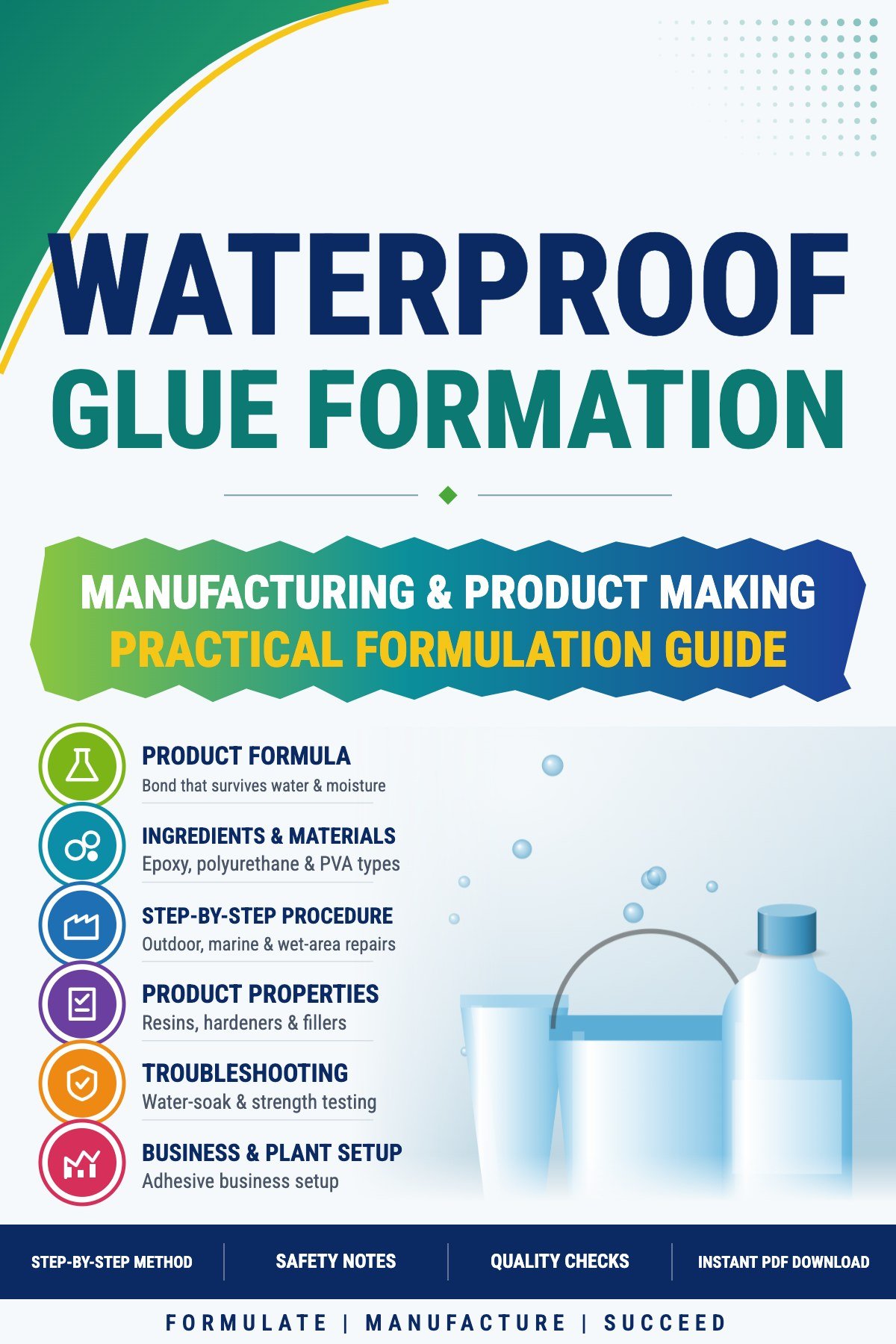
Every Product Making Guide in our shop follows the same structure so you know where to look. This guide includes the product formula, the ingredients and materials, the procedure and preparations, the industrial requirements and the technical specifications. In practice you receive:
- The formulation, written so you can follow it at the bench and scale it up.
- Ingredients and materials, with the job of each material and advice on grades and suppliers.
- The manufacturing procedure, including order of addition, mixing and preparations.
- Industrial requirements, covering equipment, space and packaging.
- Technical specifications, describing what a good finished product should look like and how it should behave.
- Troubleshooting for the faults that makers meet most often.
- Business guidance, to help you take the product from the bench to the market.
These Product Making Guides of chemical formulations and formulas are for manufacturers, startups and entrepreneurs. Every guide contains industrially tested, practical formulations. Anyone who buys a guide can make the product by following its step-by-step instructions. Raw materials vary between suppliers, so always confirm your results with a small trial batch before scaling up.
Who stands behind this guide?
Chemical Formulation Services is the trading name of CFS Formulation Services Ltd, registered in England and Wales under company number 16678503, with its office at Unit F, Winston Business Park, Churchill Way, Sheffield S35 2PS. The business was founded by George Enrick and publishes formulation manuals, technical guides and industry reports. You can check our details on the Companies House register, read about us, or contact us with any question before you order.
A written formulation cannot replace testing with your own raw materials, equipment and climate, and we say so plainly. What the guide does give you is a tested, structured starting point that can save you months of trial and error. Our terms and conditions explain what a purchase from us covers.
How to order
- Select Add to cart to keep browsing, or Buy Now to go straight to checkout.
- Pay with PayPal, Stripe, Xoom by PayPal, Payoneer, payment links for debit and credit cards, or Western Union, Ria and all money exchanges.
- If you pay through a money exchange, email your payment slip to Info@chemicalformulationservices.com. After confirmation, your instant download link is emailed to you.
- For online payments, the PDF is available as soon as the payment is confirmed.
All products are digital downloads and all payments are nonrefundable once the file is delivered, so please read the refund policy and the FAQs before you order. You can compare this guide with others in the formula shop or browse our industrial project reports.
Frequently asked questions about waterproof glue formation
What is the Waterproof Glue Formation guide?
It is a digital PDF Product Making Guide to formulating and making glues that create strong bonds unaffected by water and moisture, covering chemistries, manufacturing, application and testing.
What is the difference between waterproof and water resistant?
Waterproof adhesives stay bonded under prolonged immersion or boiling, while water resistant ones survive humidity, splashes and occasional wetting but may fail with continuous soaking.
Which chemistries work best in wet conditions?
Two-part epoxy and moisture-curing polyurethane are leading choices, along with phenol-resorcinol for specialist wood work, cross-linking PVA for lighter duty and MS polymer sealant-adhesives.
Why do some polyurethane glues foam?
They cure by reacting with moisture, which releases carbon dioxide and expands the glue slightly, so apply thinly and clamp the joint.
How should waterproof claims be tested?
With soak, boil and repeated wet-dry tests, plus freeze-thaw and ageing tests, measuring bond strength afterwards and labelling performance honestly.
How do I receive the guide?
You receive an instant PDF download after payment is confirmed. For money exchanges, email your payment slip to Info@chemicalformulationservices.com and the link is emailed after we confirm it.
Is the payment refundable?
All payments are nonrefundable because the product is an instant digital download. See the refund policy for details.
Can you help with a custom formulation?
CFS Formulation Services Ltd offers formulation and product development consultancy. Send a short brief through the Contact page.
Last reviewed: November 2026. This page is general information about a digital product. It is not a safety data sheet or professional advice, and any formulation should be tested and reviewed by a qualified person before commercial use.