Offset Plate Processing & Fountain Solution Technology Formulation
USD $129
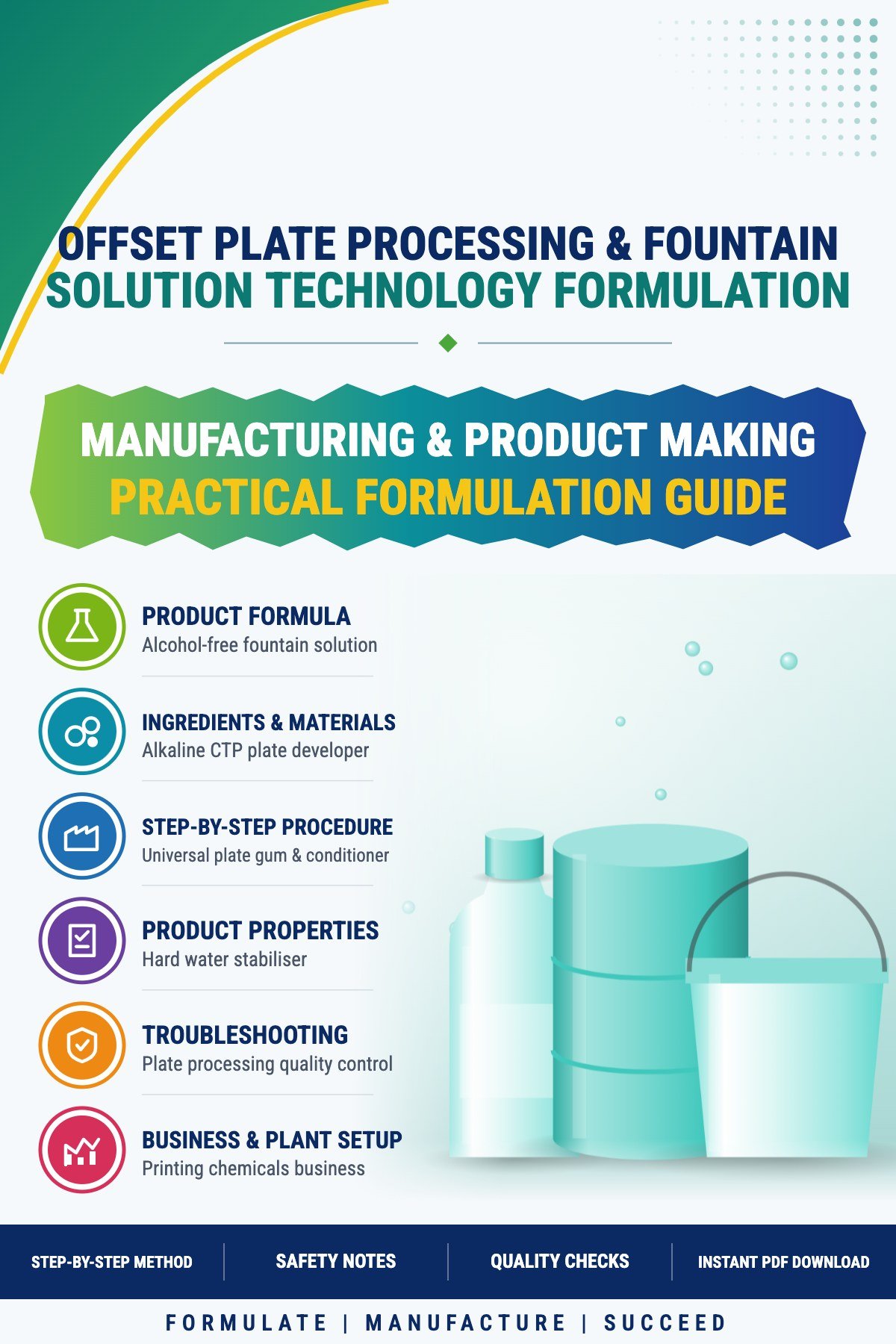
PDF manual · Instant downloadOffset Plate Processing & Fountain Solution Technology Formulation: a PDF guide to alcohol-free fountain solution, CTP plate developer, plate gum, conditioner and hard water stabiliser, with manufacturing and testing.
Payment Methods
Refund Policy
Custom Formulation Services
Formulation Consultation
Contact Us
Offset Plate Processing & Fountain Solution Technology Formulation is a practical PDF guide for printing-chemical manufacturers, plate-processing units and technical professionals who want a comprehensive formulation system for the chemistry that surrounds the offset printing plate. Before a plate ever reaches the press, it is exposed, developed, rinsed and gummed, and once on the press, it is kept printing cleanly by fountain solution. The same plate chemistry, from the developer to the gum to the dampening solution, determines whether the image holds, the non-image area stays clean and the press runs smoothly. This page explains how offset plate processing and fountain solution technology formulation works, what the guide covers and how an offset plate processing and fountain solution technology formula is designed, made and tested, so you can decide whether it suits your business.
This guide is published by Chemical Formulation Services, the formulation publishing and consultancy business of CFS Formulation Services Ltd in Sheffield, United Kingdom. It is written for people who want to understand the product from the raw material to the finished pack, and it keeps its claims practical rather than promotional.
At a glance
- Product: Offset Plate Processing & Fountain Solution Technology Formulation, a digital PDF Product Making Guide.
- Also searched as: offset plate processing and fountain solution technology formula, CTP plate developer, plate gum, alcohol-free fountain solution concentrate, plate conditioner.
- What it covers: alcohol-free fountain solution concentrate, alkaline CTP developer, universal plate gum, plate conditioner and hard water stabiliser.
- Key goals: stable image, clean non-image areas, consistent development and trouble-free press running.
- Who it is for: printing-chemical makers, plate processing units, print technical teams and entrepreneurs.
- Delivery: instant PDF download after payment is confirmed.
- Publisher: CFS Formulation Services Ltd, England and Wales company number 16678503.
The offset plate and its chemistry
Modern offset printing plates are thin sheets of aluminium with a micro-grained, anodised surface and a coating that is sensitive to light or laser energy. In the plate-setter, a computer-to-plate (CTP) system exposes the coating according to the image. Depending on the plate technology, the exposed areas either become soluble in the developer (positive working) or insoluble (negative working). The developer removes the soft, unwanted coating, leaving the image coating on the plate, which will carry ink. The bare aluminium oxide of the non-image area is hydrophilic, receptive to water, and will carry fountain solution. A protective gum is applied to the processed plate, which preserves the hydrophilic nature of the non-image area, prevents oxidation and fingerprints, and keeps the plate clean until it is put on press. This sequence of exposure, development, rinsing and gumming is called plate processing.
Every chemical in the sequence affects quality. If the developer is too weak, coating remains in non-image areas and causes scumming. If it is too strong, it attacks fine image dots and loses detail. If the gum is poor, plates oxidise in storage. If the fountain solution is not matched to the plate and the water, the press may scum, tone or blind. A manufacturer who understands the whole chain can supply a matched system.
The five products covered
Alcohol-free fountain solution concentrate
The dampening liquid added to the press water. It keeps the non-image areas of the plate wet and ink-free, and controls ink-water balance. Alcohol-free versions replace isopropyl alcohol with glycol-based wetting systems, which reduces VOC emissions and press-room odour. The concentrate includes a buffer system to hold the pH, a hydrophilic gum or polymer, surfactants, corrosion inhibitors and biocide. It is diluted at the press, typically at a few percent.
Alkaline CTP plate developer
Many thermal and violet CTP plates are developed in alkaline solutions with a pH around 11 to 13. Developers contain alkali sources such as potassium or sodium hydroxide, silicates or organic bases, surfactants for wetting and dissolving coating, additives for sludge control and buffers for activity. Silicate developers have long been used for positive thermal plates because they give high resolution, while silicate-free formulations avoid certain deposits. Developer strength is monitored by conductivity and replenished to maintain activity as plates are processed.
Universal plate gum
An aqueous solution of gum arabic or synthetic hydrophilic polymers, such as polyvinyl alcohol derivatives and modified starch, with acids and surfactants. It is applied to developed plates to protect them from oxidation and contamination, and make non-image areas hydrophilic. Finisher gums are also used for plates that stay on press for a while. Universal gums work with different plate types.
Plate conditioner
A product for restoring and cleaning plates on press or in the pressroom, for example to remove oxidation, scumming or light ink deposits, or to rejuvenate the hydrophilicity of non-image areas. It is mild enough not to harm the image.
Hard water stabiliser
Hard water, rich in calcium and magnesium, can cause deposits on plates and rollers, change the balance of fountain solution and reduce buffer performance. Chelating agents and sequestrants soften and stabilise the water in the dampening system, preventing scale and keeping the system stable. They are formulated to work without upsetting the pH.
Key components and their jobs
- Buffers: phosphoric, citric or other acids and salts keep the pH steady in fountain solution and gum.
- Hydrophilic polymers: gum arabic and synthetic substitutes protect non-image areas.
- Surfactants: lower surface tension, assist wetting and, in developers, help dissolve the coating.
- Glycols and glycol ethers: alcohol substitutes in fountain solution.
- Alkali sources and silicates: activity of developer.
- Chelating agents: bind hardness ions and metals.
- Corrosion inhibitors: protect plates and press parts.
- Biocides: prevent microbial growth in tanks, gum and developer replenishers.
- Anti-foam agents: control foam in recirculating systems.
- Dyes: identification.
Matching the system to the printing plant
Printers buy results, not chemical names. A newspaper plant running high-speed coldset presses needs a developer that stays active across thousands of plates and a fountain solution that is forgiving of variable ink and paper. A commercial sheetfed printer is more sensitive to ink-water balance, dot sharpness and fast wash-up. A packaging printer working on board and foil cares about stable colour and minimal scumming over long runs. Ask each customer about the plate brand and type, the plate-setter, the processor, the water hardness, the ink and the press speed before recommending a package. Keeping a short technical data sheet for each product, with typical dosing, pH and conductivity ranges and clear storage advice, helps your customers use it correctly and helps you handle complaints calmly.
Water quality and its influence on results
Water makes up most of a fountain solution, so its quality decides performance. Hard water causes scale and unstable buffering, while very soft or deionised water can be corrosive or poorly buffered. Many plants use reverse osmosis or softening units. Recommend that customers check water conductivity and hardness regularly and keep a record next to the dosing settings. Where water varies through the year, a hard water stabiliser or a slightly adjusted dose is a simple way to keep the press consistent.
Packaging, storage and shelf life
Use plastic containers that resist alkali and acid and have secure, labelled closures. Developers should be protected from carbon dioxide in the air, which reduces alkalinity, so keep drums and replenisher tanks tightly closed. Gums and fountain concentrates can grow microbes if they are contaminated, so use clean filling equipment, add a suitable biocide and avoid returning used liquid to stock containers. Record batch numbers and dates so you can trace any issue, and give clear storage temperature limits to prevent freezing or heat damage.
What is inside the Offset Plate Processing & Fountain Solution Technology Formulation guide
The guide is a comprehensive technical formulation system developed for printing chemical manufacturers and plate-processing units. It includes alcohol-free fountain solution concentrate, alkaline CTP plate developer, universal plate gum, plate conditioner and hard water stabiliser formulations, together with step-by-step manufacturing, quality control, performance testing, troubleshooting and commercial advice. It follows the CFS style of clear, industrially minded instructions.
How the products are made
The outline below shows the general sequence. The guide gives full details.
Making a fountain solution concentrate
Soft or deionised water is charged to a plastic or stainless steel tank. Buffers and inhibitors are dissolved, gum or polymer is hydrated carefully, surfactants and glycols are added, and finally biocide and dye. pH and conductivity are checked.
Making an alkaline developer
Water is charged, alkali is added slowly with cooling (the dissolution is strongly exothermic), then silicate or organic base, surfactants, chelating agents and additives are blended in. Activity is checked by conductivity and pH, and by a test development of plate samples.
Making plate gum
Gum arabic or polymer is hydrated in warm water, filtered to remove impurities, then blended with acid, surfactant and biocide. The gum is clarified, pH adjusted and filtered.
Making plate conditioner
A mild acidic or neutral cleaner is prepared with mild abrasives or solvents as the formula requires, and tested for safety on image areas.
Making hard water stabiliser
Chelating agents are dissolved in water, buffers are added to adjust pH, and a biocide is included.
Equipment requirements
A plant needs plastic or stainless steel tanks with low-shear agitators, accurate scales or flow meters, filtration, filling equipment and corrosion-resistant storage. Handling concentrated alkali and acids needs protective equipment, eyewash and ventilation. A laboratory needs a pH meter, conductivity meter, titration equipment, a surface tension tester and access to a plate-setter and processor, or an arrangement with a printer or plate maker for performance trials. Test plates and a test press are valuable.
Quality control for every batch
- Appearance and clarity.
- pH and conductivity: within specification for each product.
- Developer activity: time to clean non-image area, retention of fine dots, and sludge behaviour.
- Gum performance: protection of plates in storage, oxidation tests and hydrophilicity.
- Fountain solution performance: ink-water balance, run-up, scumming resistance and stability on press.
- Hard-water tolerance: performance with high-hardness water.
- Foam: low foam in recirculating systems.
- Compatibility: no attack on plate, blanket or roller materials.
- Stability: storage tests for precipitation or microbial growth.
Troubleshooting
Plate scumming on press
Incomplete development, poor gum, wrong fountain pH or too little dampening. Check each stage and adjust.
Loss of fine image detail
Developer too strong or too hot, or over-development. Reduce activity or time.
Plate oxidation or stains
Poor gumming or storage. Improve gum coverage and storage conditions.
Developer sludge
Dissolved coating accumulates. Add sludge-control additives, replenish and clean the processor regularly.
Deposits on plate or rollers
Hard water scale. Add hard-water stabiliser or treat the water.
Foaming in the processor or dampening
Excess surfactant or aeration. Add anti-foam and check pumping.
Microbial slime
Inadequate biocide or dirty tanks. Clean the system and adjust biocide.
Safety, health and environment
Alkaline developers are corrosive and cause chemical burns to skin and eyes, so gloves, goggles and aprons are essential, and eyewash should be at hand. Dissolving alkali generates heat. Acidic gum and fountain concentrates also irritate. Never mix acid and alkali concentrates. Biocides can sensitise skin. Developer waste is alkaline and contains dissolved coatings, so it must be neutralised and disposed of according to regulations. Used fountain solution and gum contain metals, inks and chemicals, and must be collected for treatment. Provide safety data sheets and hazard labels. Alcohol-free fountain solutions reduce VOC emissions and fire risk, which helps meet environmental rules.
The business opportunity
Every offset printing plant uses plates, developer, gum and fountain solution continuously. Plate processing and pressroom chemistry is a recurring, consumable business. Manufacturers can supply commercial printers, newspaper plants, packaging printers and trade plate-makers. Matching a complete system of plate developer, gum, fountain solution and conditioner to a customer’s plate type and water creates convenience and reliability. Technical support, on-press troubleshooting and bulk delivery are valued. Offering alcohol-free, low-VOC and long-life developers meets growing environmental demands.
Related CFS guides help you serve the printing industry. Browse the Ink Formulations category, and see Offset Printing Fountain Solution, Press Room Cleaning & Maintenance Chemicals Formulations, Offset Ink Varnish & Performance Additives Formulation, CMYK Printing Inks Formulations and High Gloss Over Print Varnish Formula. For general cleaning and chelation knowledge, see the Cleaning Products and Detergent Formulations categories.
Getting started
Begin with a matched trio of products: an alcohol-free fountain solution concentrate, a universal plate gum and a hard-water stabiliser, since they involve safer chemistry. Make small batches, test with printers’ plates and water, and compare with major brands. Add a CTP developer when you can validate it on specific plates with a plate-setter. Document results, gather printer feedback, refine labels and safety information, and expand the range as your confidence and customer trust grow.
How to get the best results from this guide
Treat the guide as a tested starting point rather than a finished factory. Begin with a small trial batch in the laboratory or on a bench, using the exact raw materials you plan to buy, and record every weight, temperature, mixing time and observation. Compare the result with the quality checks in the guide, change only one thing at a time, and keep a note of what each change did. Once a small batch is consistently good, repeat it several times, then scale up in stages, because mixing, heating and cooling behave differently in larger vessels. Keep retained samples of every batch, write simple standard operating procedures for your team, and build relationships with two suppliers for each key raw material. Finally, check the labelling, safety and product rules in the country where you will sell, and ask a qualified person to review your process. This careful, documented approach is what turns a good formulation into a reliable product and a trusted brand.
Who should buy this guide?
The guide is written for practical readers. It suits manufacturers who want to add a new product to an existing plant, startups choosing their first product, private-label brands that need to understand what they are buying, technical staff who must set specifications and train operators, and consultants and students who want a structured, plain-language reference. It is less suitable for anyone looking for a quick shortcut or a guarantee, because every formulation still needs testing with your own materials, equipment and local rules. If you are unsure whether it matches your project, send a short question through the contact page before you order, and we will tell you honestly whether it fits.
What is inside the Offset Plate Processing & Fountain Solution Technology Formulation guide
Every Product Making Guide in our shop follows the same structure so you know where to look. This guide includes the product formula, the ingredients and materials, the procedure and preparations, the industrial requirements and the technical specifications. In practice you receive:
- The formulation, written so you can follow it at the bench and scale it up.
- Ingredients and materials, with the job of each material and advice on grades and suppliers.
- The manufacturing procedure, including order of addition, mixing and preparations.
- Industrial requirements, covering equipment, space and packaging.
- Technical specifications, describing what a good finished product should look like and how it should behave.
- Troubleshooting for the faults that makers meet most often.
- Business guidance, to help you take the product from the bench to the market.
These Product Making Guides of chemical formulations and formulas are for manufacturers, startups and entrepreneurs. Every guide contains industrially tested, practical formulations. Anyone who buys a guide can make the product by following its step-by-step instructions. Raw materials vary between suppliers, so always confirm your results with a small trial batch before scaling up.
Who stands behind this guide?
Chemical Formulation Services is the trading name of CFS Formulation Services Ltd, registered in England and Wales under company number 16678503, with its office at Unit F, Winston Business Park, Churchill Way, Sheffield S35 2PS. The business was founded by George Enrick and publishes formulation manuals, technical guides and industry reports. You can check our details on the Companies House register, read about us, or contact us with any question before you order.
A written formulation cannot replace testing with your own raw materials, equipment and climate, and we say so plainly. What the guide does give you is a tested, structured starting point that can save you months of trial and error. Our terms and conditions explain what a purchase from us covers.
How to order
- Select Add to cart to keep browsing, or Buy Now to go straight to checkout.
- Pay with PayPal, Stripe, Xoom by PayPal, Payoneer, payment links for debit and credit cards, or Western Union, Ria and all money exchanges.
- If you pay through a money exchange, email your payment slip to Info@chemicalformulationservices.com. After confirmation, your instant download link is emailed to you.
- For online payments, the PDF is available as soon as the payment is confirmed.
All products are digital downloads and all payments are nonrefundable once the file is delivered, so please read the refund policy and the FAQs before you order. You can compare this guide with others in the formula shop or browse our industrial project reports.
Frequently asked questions about offset plate processing & fountain solution technology formulation
What is the Offset Plate Processing & Fountain Solution Technology Formulation guide?
It is a digital PDF Product Making Guide to a matched system of alcohol-free fountain solution, alkaline CTP developer, plate gum, plate conditioner and hard water stabiliser, with manufacturing, testing and troubleshooting.
What does plate gum do?
It protects the processed plate from oxidation and fingerprints and keeps non-image areas hydrophilic so they stay clean.
Why do CTP developers need monitoring?
Developer loses activity as plates are processed, so conductivity and pH are checked and the bath is replenished to keep development consistent.
Why use a hard water stabiliser?
Calcium and magnesium cause scale and upset buffering, so chelating agents keep the dampening system stable.
Are alkaline developers hazardous?
Yes. They are corrosive, so use protective equipment, eyewash and correct neutralisation and disposal.
How do I receive the guide?
You receive an instant PDF download after payment is confirmed. For money exchanges, email your payment slip to Info@chemicalformulationservices.com and the link is emailed after we confirm it.
Is the payment refundable?
All payments are nonrefundable because the product is an instant digital download. See the refund policy for details.
Can you help with a custom formulation?
CFS Formulation Services Ltd offers formulation and product development consultancy. Send a short brief through the Contact page.
Last reviewed: November 2026. This page is general information about a digital product. It is not a safety data sheet or professional advice, and any formulation should be tested and reviewed by a qualified person before commercial use.