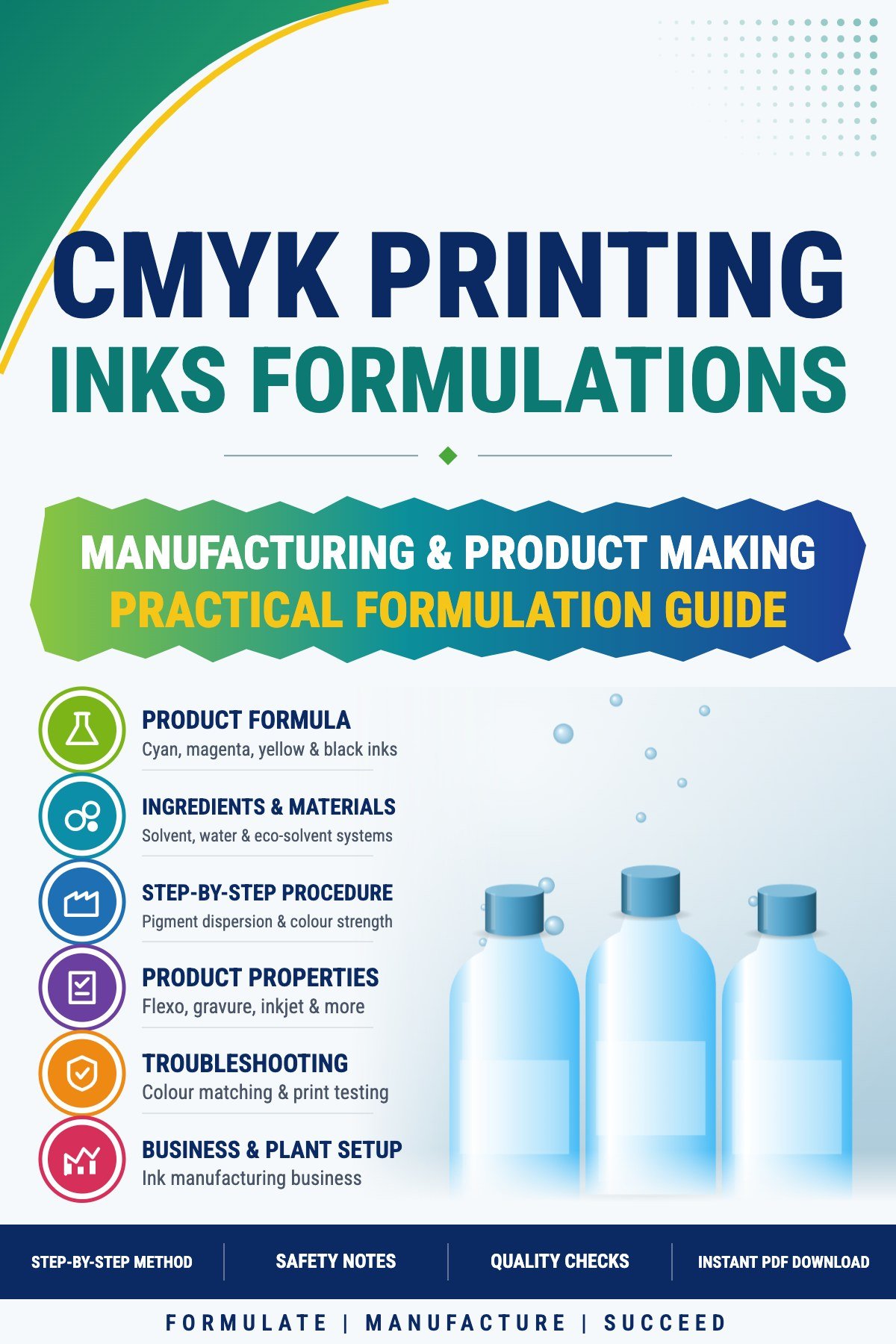

CMYK Printing Inks Formulations
USD $75
PDF manual · Instant downloadCMYK Printing Inks Formulations: a PDF guide to making cyan, magenta, yellow and black inks for solvent, water-based and eco-solvent systems, with pigments, dispersion, colour matching and testing.
Payment Methods
Refund Policy
Custom Formulation Services
Formulation Consultation
Contact Us
CMYK Printing Inks Formulations is a practical PDF guide for new and growing ink manufacturers, print-supply businesses and entrepreneurs who want to launch CMYK ink production with ready-to-produce, professional-grade formulations. CMYK stands for cyan, magenta, yellow and key (black), the four process colours that combine to reproduce full-colour images in almost all commercial printing. This page explains how CMYK printing inks formulations work, what the guide covers and how a CMYK printing inks formula is designed for solvent-based, water-based and eco-solvent systems, made and tested, so you can decide whether it suits your plans.
This guide is published by Chemical Formulation Services, the formulation publishing and consultancy business of CFS Formulation Services Ltd in Sheffield, United Kingdom. It is written for people who want to understand the product from the raw material to the finished pack, and it keeps its claims practical rather than promotional.
At a glance
- Product: CMYK Printing Inks Formulations, a digital PDF Product Making Guide.
- Also searched as: CMYK printing inks formula, process colour inks, four colour printing inks, solvent water and eco-solvent inks.
- What it covers: pigments, binders, solvents, additives, dispersion, colour control, manufacturing and testing.
- Key goals: accurate colour, strong tinting strength, smooth printing, adhesion and stable shelf life.
- Who it is for: ink manufacturers, print-supply companies, printers and entrepreneurs.
- Delivery: instant PDF download after payment is confirmed.
- Publisher: CFS Formulation Services Ltd, England and Wales company number 16678503.
How CMYK printing works
Full-colour printing does not use hundreds of separate inks. Instead, it uses four inks printed in overlapping patterns of tiny dots, called halftones. Cyan, magenta and yellow are the subtractive primary colours, each absorbing part of the visible spectrum. When printed together, they can reproduce a wide range of colours. In theory, equal amounts of cyan, magenta and yellow give black, but real pigments are not perfect and give a muddy brown, so a separate black ink, called the key plate, is added for deep blacks, sharp text and fine detail. The human eye blends the tiny dots into smooth colour. Quality depends on the colour and transparency of each ink, the accuracy of the dot, the ink film thickness and the paper or substrate.
This process is used for magazines, packaging, labels, posters, banners, textiles, ceramic transfers, wide-format graphics, digital inkjet printing, flexographic and gravure printing and more. Each process has its own ink needs, but the colour logic is the same.
The four process colours
Cyan
Typically a phthalocyanine blue pigment, very strong, lightfast and stable, with a clean greenish blue hue. Copper phthalocyanine pigment is the standard because of its high tinting strength and durability.
Magenta
A bluish red. Quinacridone, rhodamine lake and similar organic pigments are used. Quinacridones have excellent lightfastness, while some lakes give higher brightness at lower cost.
Yellow
Diarylide yellows are the standard for process printing because of their strength, transparency and cost. Other yellows are used where heat or lightfastness requirements are higher.
Black (Key)
Carbon black provides a deep, neutral black. Particle size and structure affect jetness, flow and gloss.
Each of the process pigments must be semi-transparent, so that the colours can overprint and blend. Opaque pigments would hide the colours below.
Types of CMYK ink systems
Solvent-based inks
Used on non-absorbent substrates such as plastic films, foils and rigid plastics. Resins such as nitrocellulose, polyamide, acrylic, polyurethane or vinyl are dissolved in solvents like ethanol, ethyl acetate and propyl acetate. They dry fast by evaporation and give excellent adhesion and gloss. Flexographic and gravure packaging inks are often solvent-based.
Water-based inks
Pigment dispersions in water with acrylic resin solutions or emulsions. They are used on paper, board, corrugated cardboard and some films. They reduce VOC emissions and fire risk, and are preferred for food packaging and environmentally minded printing. Drying takes more energy and control.
Eco-solvent inks
Used in wide-format inkjet printers for banners, vinyl and signs, these inks use glycol ether esters and other milder solvents that evaporate slowly and have low odour and lower hazard than traditional strong solvent inks. They give outdoor durability on vinyl and similar substrates.
Other systems
Offset inks (oil-based pastes), UV-curable inks (acrylate), latex inks and aqueous pigment inkjet inks each have their own technology. The principle of CMYK colour is the same across them.
Main components of an ink
Pigments
The colourants. Particle size, strength, shade and purity decide the ink’s colour range (the gamut). Fine, narrow particle size distributions are vital for inkjet.
Binders (resins)
Hold pigment to the substrate and provide adhesion, gloss, flexibility and rub resistance. The resin type is matched to the substrate and process.
Solvents or water
Carry the pigment and resin, controlling viscosity and drying. Solvent mixtures balance speed and flow.
Dispersants
Keep pigment particles separated and stable in the liquid, which is critical for colour strength and shelf life.
Additives
Waxes for rub resistance, wetting agents, defoamers, plasticisers, flow agents, biocides (for water-based inks) and others fine-tune the ink for the process.
What is inside the CMYK Printing Inks Formulations guide
The guide is a set of ready-to-produce, professional-grade ink formulations for new and growing businesses in solvent-based, water-based and eco-solvent ink markets. It explains the roles of ingredients, gives formulations for the four process colours in the different systems, describes step-by-step manufacturing, quality control, press and printer testing, troubleshooting and the business side of ink production. It follows the CFS style of clear, industrially minded instructions.
How CMYK inks are made
The outline below shows the general sequence. The guide gives full details.
Step 1: Prepare the vehicle
Resins are dissolved in solvent or dispersed in water, with plasticiser and additives, until the vehicle is clear and meets viscosity specification.
Step 2: Premix the pigment
Pigment is wetted out in part of the vehicle with dispersant using a high-speed disperser, forming a paste free of dry lumps.
Step 3: Mill
The paste is ground in a bead mill, triple-roll mill or similar equipment until the required fineness is reached. Colour strength and gloss develop during milling, so temperature and time are controlled.
Step 4: Let down
The base is blended with the remaining vehicle, solvent or water and additives. Viscosity, strength and drying are adjusted.
Step 5: Match colour
Each ink is compared with a standard using drawdowns or press proofs, and measured with a spectrophotometer where available. Cyan, magenta, yellow and black have to match the target hue and strength so that they combine properly.
Step 6: Filter
Inks are filtered, particularly for inkjet and gravure, to remove oversize particles.
Step 7: Fill and label
Inks are filled into clean containers, sealed and labelled with type, colour, batch and safety information.
Equipment requirements
An ink plant needs accurate scales, high-speed dispersers, bead mills or three-roll mills, mixing tanks, filtration, filling equipment and a laboratory. The laboratory needs viscometers, grind gauges, drawdown applicators, a proofing press or hand proofer, a spectrophotometer or densitometer, drying and rub testers, adhesion tests and a test printer or press. Solvent-based production needs explosion-proof equipment and ventilation.
Quality control for every batch
- Colour and strength: hue, density and dot behaviour compared with standard.
- Transparency: process colours must overprint without hiding underlying inks.
- Fineness of grind and particle size.
- Viscosity and surface tension: suited to the printing process.
- Drying speed and gloss.
- Adhesion and rub resistance: on the intended substrate.
- Lightfastness and resistance properties: as required.
- Storage stability: no settling, skinning, gelling or colour drift.
- Print trial: four-colour test print to check colour balance, trapping and gray balance.
Troubleshooting
Weak colour strength
Low pigment content, poor dispersion or pigment type. Improve milling and pigment load.
Wrong hue or dirty overprints
Pigment shade or contamination. Use correct process pigments and avoid cross-contamination between colours.
Poor adhesion
Resin mismatch with substrate. Choose the right binder and surface-treat the substrate.
Slow drying or set-off
Wrong solvent balance or thick ink film. Adjust solvent blend and ink film thickness.
Nozzle or screen clogging
Coarse particles or ink drying in the nozzle. Improve filtration, milling and humectant balance.
Foaming (water-based inks)
Air entrapment. Add defoamer and avoid aggressive mixing.
Dot gain too high
Viscosity, surface tension or substrate absorption issues. Adjust ink properties and press settings.
Safety, health and regulation
Pigment dust should be controlled by extraction and respiratory protection. Solvent-based inks are flammable and release harmful vapours, so use ventilation and grounding. Eco-solvent inks are milder but still need care. Many countries restrict VOC emissions and certain solvents, and inks used on food packaging must comply with low-migration rules and avoid restricted substances. Pigments must be free of banned heavy metals and, for some markets, azo dyes that release harmful amines. Provide safety data sheets and correct hazard labelling. Dispose of waste ink, wash solvents and rinse water according to hazardous waste rules.
The business opportunity
Printing is universal, and CMYK inks are the backbone of the ink industry. Packaging printers, label printers, newspaper and magazine printers, textile and sign printers, and inkjet users all consume CMYK inks. A local manufacturer can serve flexographic and gravure converters with solvent or water-based inks, sign makers with eco-solvent inks and small printers with refill or bulk inks. Colour matching, technical service and quick delivery are central to success. Starting with one process and expanding gradually, with a strong laboratory and consistent quality, is a sensible route.
Related CFS guides help you build the ink business. Browse the Ink Formulations category, and see , Screen Printing Ink Formula, CMYKW DTF Printing Ink Formula, Pigment-Based Sublimation Ink Formulation, Screen Printing Solvent-Based Nitrocellulose Ink Formulations and Offset Printing Fountain Solution. For finishes, see High Gloss Over Print Varnish Formula and Paper Coating Lacquer Formula.
Getting started
Choose one system, such as water-based flexographic inks for paper or eco-solvent inks for signs. Make small batches of each of the four colours, check strength, transparency and viscosity, and test print on your target substrate. Compare with commercial inks and adjust the pigment and resin balance. Ask a friendly printer to run trials, collect feedback, refine your formulas and colour standards, and then extend your range and customer base.
How to get the best results from this guide
Treat the guide as a tested starting point rather than a finished factory. Begin with a small trial batch in the laboratory or on a bench, using the exact raw materials you plan to buy, and record every weight, temperature, mixing time and observation. Compare the result with the quality checks in the guide, change only one thing at a time, and keep a note of what each change did. Once a small batch is consistently good, repeat it several times, then scale up in stages, because mixing, heating and cooling behave differently in larger vessels. Keep retained samples of every batch, write simple standard operating procedures for your team, and build relationships with two suppliers for each key raw material. Finally, check the labelling, safety and product rules in the country where you will sell, and ask a qualified person to review your process. This careful, documented approach is what turns a good formulation into a reliable product and a trusted brand.
Who should buy this guide?
The guide is written for practical readers. It suits manufacturers who want to add a new product to an existing plant, startups choosing their first product, private-label brands that need to understand what they are buying, technical staff who must set specifications and train operators, and consultants and students who want a structured, plain-language reference. It is less suitable for anyone looking for a quick shortcut or a guarantee, because every formulation still needs testing with your own materials, equipment and local rules. If you are unsure whether it matches your project, send a short question through the contact page before you order, and we will tell you honestly whether it fits.
What is inside the CMYK Printing Inks Formulations guide
Every Product Making Guide in our shop follows the same structure so you know where to look. This guide includes the product formula, the ingredients and materials, the procedure and preparations, the industrial requirements and the technical specifications. In practice you receive:
- The formulation, written so you can follow it at the bench and scale it up.
- Ingredients and materials, with the job of each material and advice on grades and suppliers.
- The manufacturing procedure, including order of addition, mixing and preparations.
- Industrial requirements, covering equipment, space and packaging.
- Technical specifications, describing what a good finished product should look like and how it should behave.
- Troubleshooting for the faults that makers meet most often.
- Business guidance, to help you take the product from the bench to the market.
These Product Making Guides of chemical formulations and formulas are for manufacturers, startups and entrepreneurs. Every guide contains industrially tested, practical formulations. Anyone who buys a guide can make the product by following its step-by-step instructions. Raw materials vary between suppliers, so always confirm your results with a small trial batch before scaling up.
Who stands behind this guide?
Chemical Formulation Services is the trading name of CFS Formulation Services Ltd, registered in England and Wales under company number 16678503, with its office at Unit F, Winston Business Park, Churchill Way, Sheffield S35 2PS. The business was founded by George Enrick and publishes formulation manuals, technical guides and industry reports. You can check our details on the Companies House register, read about us, or contact us with any question before you order.
A written formulation cannot replace testing with your own raw materials, equipment and climate, and we say so plainly. What the guide does give you is a tested, structured starting point that can save you months of trial and error. Our terms and conditions explain what a purchase from us covers.
How to order
- Select Add to cart to keep browsing, or Buy Now to go straight to checkout.
- Pay with PayPal, Stripe, Xoom by PayPal, Payoneer, payment links for debit and credit cards, or Western Union, Ria and all money exchanges.
- If you pay through a money exchange, email your payment slip to Info@chemicalformulationservices.com. After confirmation, your instant download link is emailed to you.
- For online payments, the PDF is available as soon as the payment is confirmed.
All products are digital downloads and all payments are nonrefundable once the file is delivered, so please read the refund policy and the FAQs before you order. You can compare this guide with others in the formula shop or browse our industrial project reports.
Frequently asked questions about cmyk printing inks formulations
What are the CMYK Printing Inks Formulations?
They are a digital PDF Product Making Guide with ready-to-produce cyan, magenta, yellow and black ink formulations for solvent-based, water-based and eco-solvent systems, with manufacturing and testing.
Why is black added to CMY?
Real cyan, magenta and yellow pigments give a muddy brown when combined, so a separate black ink provides deep blacks, sharp text and detail.
What are eco-solvent inks?
Milder solvent inks, based on glycol ether esters, used in wide-format inkjet printers for banners and vinyl, with lower odour and hazard than strong solvent inks.
Why must process pigments be transparent?
So the colours can overprint and blend, producing a wide range of hues without hiding the inks beneath.
Which pigments are standard?
Copper phthalocyanine for cyan, quinacridone or rhodamine lake for magenta, diarylide for yellow and carbon black for black.
How do I receive the guide?
You receive an instant PDF download after payment is confirmed. For money exchanges, email your payment slip to Info@chemicalformulationservices.com and the link is emailed after we confirm it.
Is the payment refundable?
All payments are nonrefundable because the product is an instant digital download. See the refund policy for details.
Can you help with a custom formulation?
CFS Formulation Services Ltd offers formulation and product development consultancy. Send a short brief through the Contact page.
Last reviewed: November 2026. This page is general information about a digital product. It is not a safety data sheet or professional advice, and any formulation should be tested and reviewed by a qualified person before commercial use.