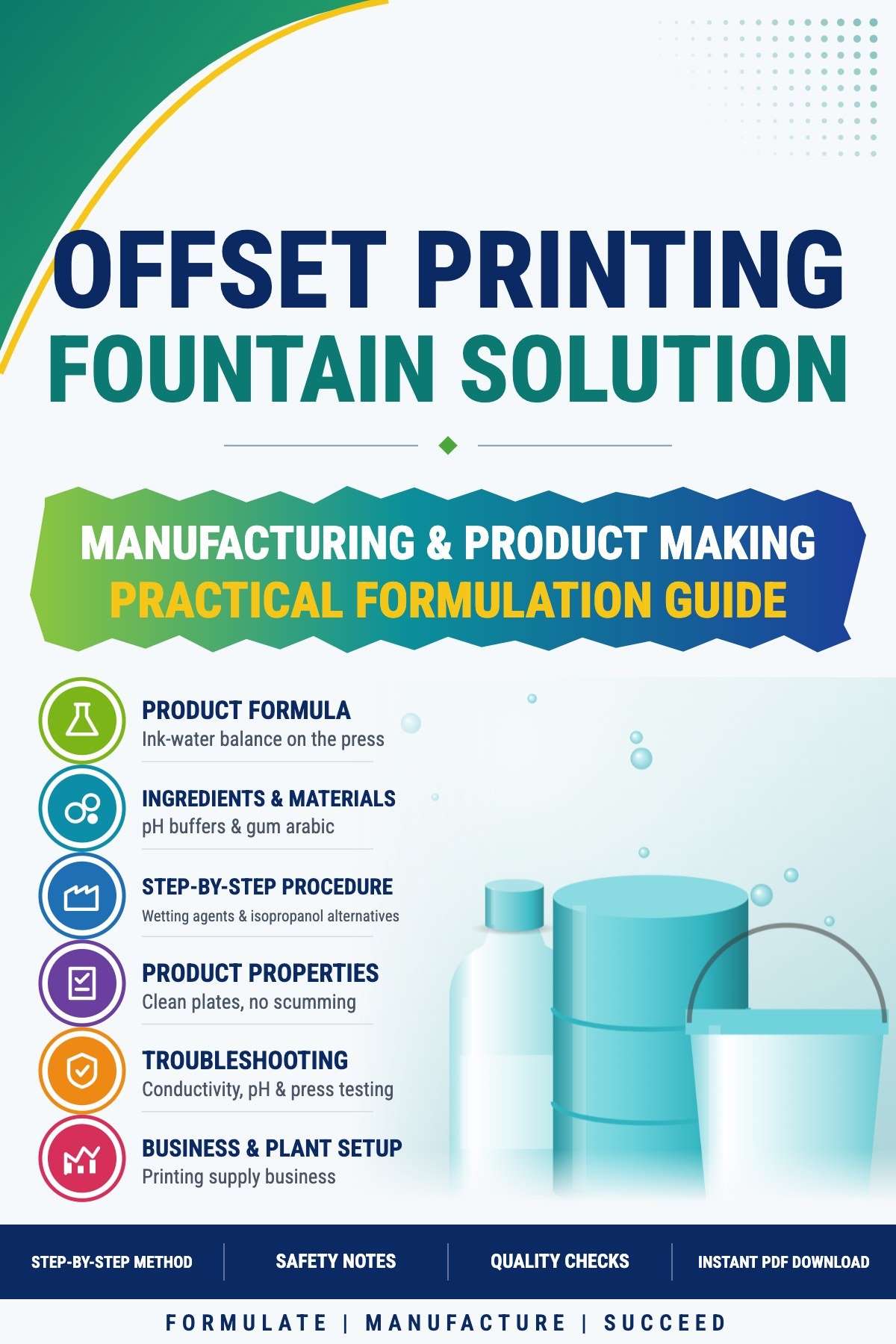

Offset Printing Fountain Solution
USD $75
PDF manual · Instant downloadOffset Printing Fountain Solution: a PDF guide to making offset lithography fountain solution concentrates, with buffers, gum, surfactants, mixing, testing and press troubleshooting.
Payment Methods
Refund Policy
Custom Formulation Services
Formulation Consultation
Contact Us
Offset Printing Fountain Solution is a practical PDF guide for printing-chemical manufacturers, press-room suppliers, commercial printers and entrepreneurs who want to make a high-performance fountain solution with simple mixing techniques. Fountain solution is the water-based liquid that dampens the printing plate on an offset lithographic press, and it is the key to keeping ink and water in balance, holding a stable pH and getting clean, sharp prints from the first sheet to the last. This page explains how an offset printing fountain solution formula works, what the guide covers and how an offset printing fountain solution formulation is made, tested and used, so you can decide whether it suits your business.
This guide is published by Chemical Formulation Services, the formulation publishing and consultancy business of CFS Formulation Services Ltd in Sheffield, United Kingdom. It is written for people who want to understand the product from the raw material to the finished pack, and it keeps its claims practical rather than promotional.
At a glance
- Product: Offset Printing Fountain Solution, a digital PDF Product Making Guide.
- Also searched as: offset printing fountain solution formula, dampening solution, fount solution concentrate, alcohol-free fountain solution.
- What it covers: buffers, gum, surfactants, alcohol substitutes, biocides, mixing, testing and press troubleshooting.
- Key goals: ink-water balance, pH stability, clean non-image areas, fast roll-up and easy running.
- Who it is for: printing-chemical makers, press suppliers, commercial printers and entrepreneurs.
- Delivery: instant PDF download after payment is confirmed.
- Publisher: CFS Formulation Services Ltd, England and Wales company number 16678503.
How offset lithography works
Offset lithography is based on a simple physical idea: oil and water do not mix. A printing plate, usually made of aluminium, has two kinds of surface. The image areas, which will carry ink, are oleophilic, meaning they attract oil-based ink. The non-image areas are hydrophilic, meaning they attract water and repel ink. On the press, the plate is first wetted by a film of fountain solution, which settles only on the non-image areas, and then inked by the roller train. The ink sticks to the image areas and is refused by the wet non-image areas. The inked image is transferred to a rubber blanket and then to the paper, which is why the process is called offset.
Everything depends on the balance between ink and water. Too much water emulsifies into the ink, weakens colour, slows drying and causes mottling. Too little water lets ink creep into non-image areas, causing scumming and toning, where background areas print as a tint. The fountain solution is the tool that allows operators to hold this balance steadily across long runs at high speed.
What fountain solution does
- Wets and protects the non-image areas: keeps them water-receptive so that they repel ink.
- Controls surface tension: allows a thin, even film of water on the plate and rollers.
- Buffers pH: keeps the solution in the right range, typically mildly acidic, so that plates and ink behave consistently.
- Prevents corrosion and oxidation: protects plates, rollers and press parts.
- Helps keep the system clean: reduces ink build-up, hickeys and piling.
- Controls microbial growth: biocides stop algae and bacteria that block lines and spoil the solution.
Main components of a fountain solution concentrate
Water-receptive agent: gum arabic and substitutes
Gum arabic, a natural gum from acacia trees, has long been used to make non-image areas hydrophilic. It forms a thin protective film on the plate. Modern concentrates also use cellulose derivatives, synthetic polymers and starch derivatives, which offer more consistent quality and supply than natural gum.
Buffer system
Acids and their salts hold the pH steady. Phosphoric acid and phosphates, citric acid and citrates, and other organic acids and salts are common. The pH target depends on plate type and ink and is generally in the range of 4 to 5.5 for conventional systems. Good buffering gives resistance to pH changes from paper, ink and hard water.
Surfactants (wetting agents)
Surfactants reduce surface tension so that the solution spreads easily on the plate. Traditionally, isopropyl alcohol was added to the diluted solution to reduce surface tension, but alcohol is volatile and restricted. Modern fountain solutions use surfactant systems and glycol ethers to deliver good wetting at lower or zero alcohol levels.
Alcohol substitutes
Glycols, glycol ethers and special wetting blends replace isopropanol, reducing VOC emissions, odour and health risks, and enabling alcohol-free printing.
Corrosion inhibitors
Nitrates, phosphates, silicates and organic inhibitors protect aluminium plates and press parts.
Biocides
Preservatives stop microbial growth in the concentrate and in recirculating dampening tanks.
Hard-water conditioners
Chelating agents bind calcium and magnesium so that plates do not sensitise and deposits do not form.
Humectants
Glycerin and similar humectants help the film stay on the plate during stoppages.
Dyes
A light dye helps operators tell the concentrate from water.
What is inside the Offset Printing Fountain Solution guide
The guide is a high-performance formulation designed for easy and efficient manufacturing with simple mixing techniques. It enables manufacturers to produce high-quality fountain solutions that enhance offset printing efficiency while maintaining ink-water balance, pH stability and press performance. It describes ingredient roles, practical formulations for conventional and alcohol-reduced concentrates, step-by-step manufacturing, quality control, press testing, troubleshooting and business ideas. It follows the CFS style of clear, industrially minded instructions.
How the concentrate is made
The outline below shows the general sequence. The guide gives full details.
Step 1: Prepare clean mixing equipment
Tanks and tools must be clean and free of residues, because contamination affects pH and wetting. Plastic or stainless steel is used, and metals that corrode in acid are avoided.
Step 2: Charge water
Deionised or softened water is loaded into the mixing tank, since high mineral content causes precipitation with some buffer salts.
Step 3: Add buffers and inhibitors
Acids and salts are dissolved in turn, with stirring, followed by corrosion inhibitors and chelating agents.
Step 4: Add gum or polymer
Gum arabic or the synthetic substitute is hydrated carefully. Some gums need time or gentle warming to dissolve without lumps. The solution is filtered to remove impurities from natural gum.
Step 5: Add surfactants and glycols
Wetting agents and alcohol substitutes are added with mixing until the concentrate is clear and homogeneous.
Step 6: Add biocide and dye
Preservative and colour are added last.
Step 7: Adjust, test and fill
pH, conductivity, surface tension and dilution behaviour are checked, adjustments made and the concentrate is filled into plastic containers, with labels showing dilution rate, pH range and safety information.
Equipment requirements
A fountain solution plant needs plastic or stainless steel mixing tanks with agitators, accurate scales or meters, filtration, filling lines, a laboratory with pH and conductivity meters, a surface tension tester or tensiometer, and a test press or access to a customer press for performance trials. Protective equipment is required for handling acids.
Use on the press
The concentrate is diluted with water in the press dampening system, usually at a rate of two to five percent, though the rate depends on the product and conditions. The pH and conductivity of the working solution are measured regularly and adjusted. Operators use refrigerated recirculators to hold solution temperature, since cooler solution reduces ink emulsification. Water quality is managed by filters or reverse osmosis units. Regular cleaning of tanks, filters and lines prevents biological growth. The press operator learns to run with the least water that keeps the plate clean.
Quality control for every batch
- Appearance: clear, uniform liquid, free of sediment.
- pH of concentrate and diluted solution: within specification.
- Conductivity: checks concentration and consistency.
- Surface tension: measured at working dilution.
- Foam: low foaming at working dilution.
- Storage stability: no separation, precipitation or microbial growth.
- Press performance: run-up, ink-water balance window, scumming resistance and stability over a run.
- Plate and roller compatibility: no corrosion, blinding or swelling.
Troubleshooting
Scumming or toning
Insufficient dampening, low gum protection or wrong pH. Increase dampening and check concentrate and pH.
Ink emulsification and weak colour
Too much water, high solution temperature or wrong surfactant balance. Reduce water, cool the solution and adjust the concentrate.
Piling and hickeys
Paper dust, ink-water imbalance or contamination. Improve cleaning and adjust the dampening.
Plate blinding or image loss
Aggressive pH or gum build-up on the image. Adjust pH and rinse system.
Foaming in the dampening tank
Excess surfactant or air entrainment. Use low-foam formulations and check the circulation system.
Slime or odour in tanks
Microbial growth. Increase biocide, clean the system and improve water quality.
pH drifts
Poor buffering or hard water. Strengthen the buffer system and treat the water.
Safety, health and environment
Fountain solution concentrates contain acids and chemicals that can irritate skin and eyes, so gloves and goggles should be worn during mixing and handling. Isopropyl alcohol, where used, is flammable and a VOC, and limits on its use exist in many countries, which is why alcohol-free systems are widely preferred. Spent fountain solution and press washings contain ink particles, metals and chemicals, and must be disposed of according to wastewater regulations. Biocides can sensitise skin. Provide safety data sheets and proper labelling, and follow VOC and waste rules in your market. Keep concentrates in sealed containers away from children and incompatible chemicals such as bleach and strong alkalis.
The business opportunity
Every offset printing house needs fountain solution, and it is a regular consumable. Customers include commercial printers, newspaper and book printers, packaging printers and in-house print departments. A manufacturer can supply fountain concentrate in drums and pails, along with related products such as plate cleaners, blanket washes, roller cleaners and press maintenance chemicals. Technical service on the press, quick troubleshooting and reliable supply are decisive, since an unstable fountain solution can cost a printer many hours. Local manufacturing offers shorter lead times and tailored products for local water and paper.
Related CFS guides help you serve the printing industry. Browse the Ink Formulations category, and see , High Gloss Over Print Varnish Formula, Paper Coating Lacquer Formula, Watermark Printing Ink Formulations and Bronze Gold Ink Formulation. For cleaning chemistry, see the Cleaning Products and Detergent Formulations categories and Adhesive Remover Formula.
Getting started
Begin with a simple alcohol-free concentrate built on a phosphate or citrate buffer, gum or polymer, and a wetting package. Make small batches, measure pH and conductivity, and trial them on a friendly printer’s press. Record dilution rate, ink-water balance and any issues, adjust the formula, and compare with leading brands. Build technical data sheets, safety documents and customer support before expanding into related press-room products.
How to get the best results from this guide
Treat the guide as a tested starting point rather than a finished factory. Begin with a small trial batch in the laboratory or on a bench, using the exact raw materials you plan to buy, and record every weight, temperature, mixing time and observation. Compare the result with the quality checks in the guide, change only one thing at a time, and keep a note of what each change did. Once a small batch is consistently good, repeat it several times, then scale up in stages, because mixing, heating and cooling behave differently in larger vessels. Keep retained samples of every batch, write simple standard operating procedures for your team, and build relationships with two suppliers for each key raw material. Finally, check the labelling, safety and product rules in the country where you will sell, and ask a qualified person to review your process. This careful, documented approach is what turns a good formulation into a reliable product and a trusted brand.
Who should buy this guide?
The guide is written for practical readers. It suits manufacturers who want to add a new product to an existing plant, startups choosing their first product, private-label brands that need to understand what they are buying, technical staff who must set specifications and train operators, and consultants and students who want a structured, plain-language reference. It is less suitable for anyone looking for a quick shortcut or a guarantee, because every formulation still needs testing with your own materials, equipment and local rules. If you are unsure whether it matches your project, send a short question through the contact page before you order, and we will tell you honestly whether it fits.
What is inside the Offset Printing Fountain Solution guide
Every Product Making Guide in our shop follows the same structure so you know where to look. This guide includes the product formula, the ingredients and materials, the procedure and preparations, the industrial requirements and the technical specifications. In practice you receive:
- The formulation, written so you can follow it at the bench and scale it up.
- Ingredients and materials, with the job of each material and advice on grades and suppliers.
- The manufacturing procedure, including order of addition, mixing and preparations.
- Industrial requirements, covering equipment, space and packaging.
- Technical specifications, describing what a good finished product should look like and how it should behave.
- Troubleshooting for the faults that makers meet most often.
- Business guidance, to help you take the product from the bench to the market.
These Product Making Guides of chemical formulations and formulas are for manufacturers, startups and entrepreneurs. Every guide contains industrially tested, practical formulations. Anyone who buys a guide can make the product by following its step-by-step instructions. Raw materials vary between suppliers, so always confirm your results with a small trial batch before scaling up.
Who stands behind this guide?
Chemical Formulation Services is the trading name of CFS Formulation Services Ltd, registered in England and Wales under company number 16678503, with its office at Unit F, Winston Business Park, Churchill Way, Sheffield S35 2PS. The business was founded by George Enrick and publishes formulation manuals, technical guides and industry reports. You can check our details on the Companies House register, read about us, or contact us with any question before you order.
A written formulation cannot replace testing with your own raw materials, equipment and climate, and we say so plainly. What the guide does give you is a tested, structured starting point that can save you months of trial and error. Our terms and conditions explain what a purchase from us covers.
How to order
- Select Add to cart to keep browsing, or Buy Now to go straight to checkout.
- Pay with PayPal, Stripe, Xoom by PayPal, Payoneer, payment links for debit and credit cards, or Western Union, Ria and all money exchanges.
- If you pay through a money exchange, email your payment slip to Info@chemicalformulationservices.com. After confirmation, your instant download link is emailed to you.
- For online payments, the PDF is available as soon as the payment is confirmed.
All products are digital downloads and all payments are nonrefundable once the file is delivered, so please read the refund policy and the FAQs before you order. You can compare this guide with others in the formula shop or browse our industrial project reports.
Frequently asked questions about offset printing fountain solution
What is the Offset Printing Fountain Solution guide?
It is a digital PDF Product Making Guide to formulating and making fountain solution concentrates for offset printing, with ingredients, mixing, testing and press troubleshooting.
What does fountain solution do?
It wets the non-image areas of the printing plate so they repel ink, controlling the ink-water balance and keeping prints clean.
Why use alcohol substitutes?
Isopropyl alcohol is volatile and restricted, so glycol-based wetting systems let printers run with little or no alcohol.
What is the typical working pH?
Conventional systems often run at a mildly acidic pH of about 4 to 5.5, though the best value depends on plates, inks and the product.
How is slime in dampening tanks prevented?
With biocides, clean water, regular tank cleaning and filtration.
How do I receive the guide?
You receive an instant PDF download after payment is confirmed. For money exchanges, email your payment slip to Info@chemicalformulationservices.com and the link is emailed after we confirm it.
Is the payment refundable?
All payments are nonrefundable because the product is an instant digital download. See the refund policy for details.
Can you help with a custom formulation?
CFS Formulation Services Ltd offers formulation and product development consultancy. Send a short brief through the Contact page.
Last reviewed: November 2026. This page is general information about a digital product. It is not a safety data sheet or professional advice, and any formulation should be tested and reviewed by a qualified person before commercial use.