Offset Plate Protective Gum Formula
USD $65
PDF manual · Instant downloadOffset Plate Protective Gum Formula: a PDF guide to protective gum for PS and CTP offset plates, with gum types, ingredients, manufacture, use and testing.
Payment Methods
Refund Policy
Custom Formulation Services
Formulation Consultation
Contact Us
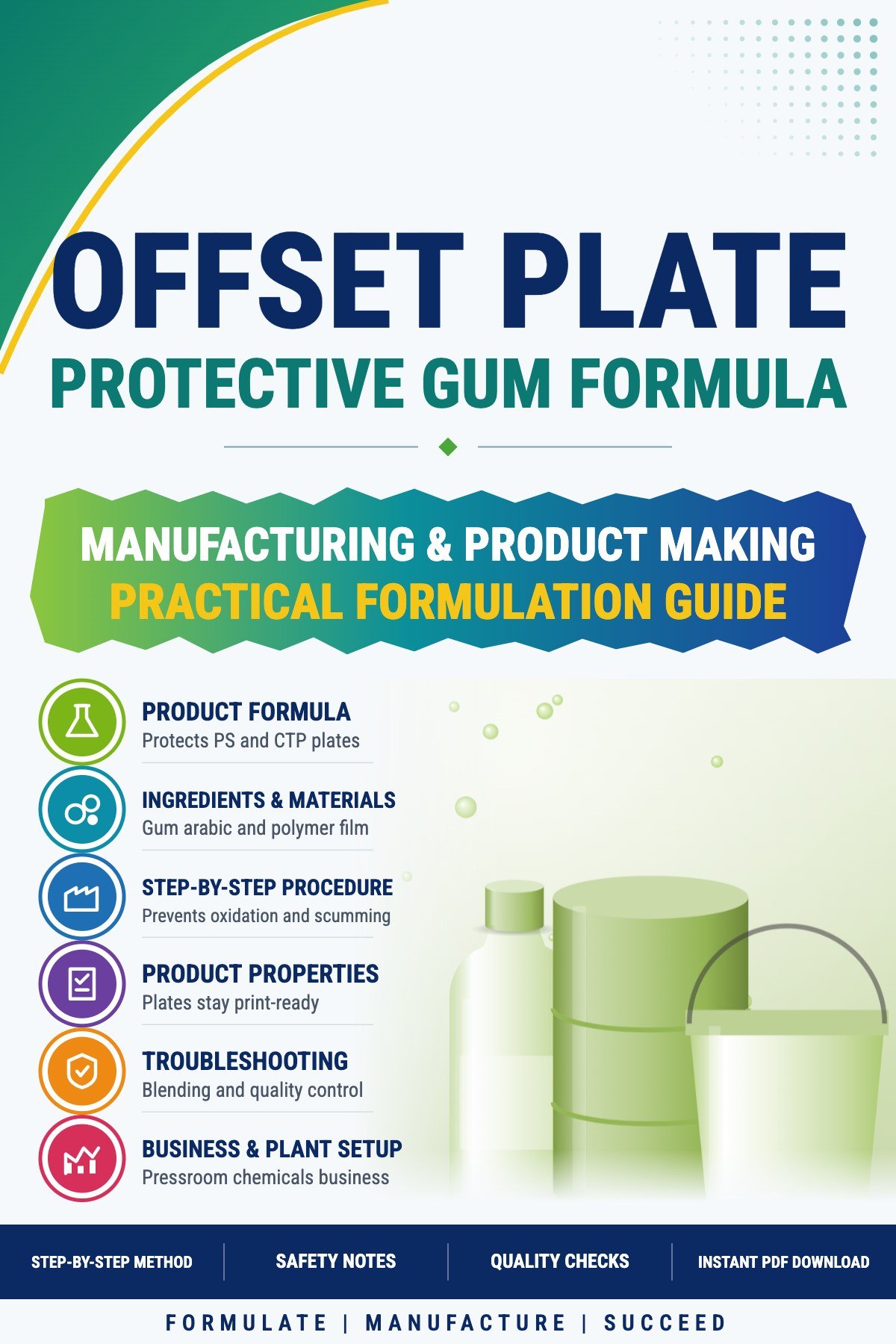
Offset Plate Protective Gum Formula is a practical PDF guide for printing-chemical manufacturers, pressroom suppliers, startups and entrepreneurs who want to make the protective gum that plays a vital role in the offset printing industry. Printers use it to preserve PS (presensitised) and CTP (computer-to-plate) plates after imaging and development. These plates are sensitive to oxidation, humidity and handling, and the gum creates a thin, stable film that shields the surface from corrosion and scumming, so plates stay clean and print-ready even after storage. This page explains how an offset plate protective gum formulation works, what goes into an offset plate protective gum formula, how it is made and tested, and how to turn it into a profitable pressroom chemical.
This guide is published by Chemical Formulation Services, the formulation publishing and consultancy business of CFS Formulation Services Ltd in Sheffield, United Kingdom. It is written for people who want to understand the product from the raw material to the finished pack, and it keeps its claims practical rather than promotional.
At a glance
- Product: Offset Plate Protective Gum Formula, a digital PDF Product Making Guide.
- Also searched as: offset plate protective gum formulation, plate gum, finisher gum, gum arabic solution for plates, CTP plate gum.
- Function: protective hydrophilic film on developed plates.
- Key goals: prevent oxidation, fingerprints and scumming, and restore hydrophilic non-image areas.
- Who it is for: printing chemical makers, plate suppliers, pressroom product brands and entrepreneurs.
- Delivery: instant PDF download after payment is confirmed.
- Publisher: CFS Formulation Services Ltd, England and Wales company number 16678503.
Why offset plates need protective gum
In offset lithography, ink is carried by the image areas of a plate, which are oleophilic (oil-loving), while the non-image areas are hydrophilic (water-loving), so they hold a thin film of fountain solution that repels ink. The plate is usually aluminium, whose surface is grained and anodised to create a porous, hydrophilic oxide layer. After exposure and development, the exposed non-image aluminium is bare, clean and highly reactive. In contact with air and moisture, it oxidises rapidly, forming a layer that is less hydrophilic. Fingerprints, grease, dust and fumes also contaminate the surface. If the plate is put on press in this state, the non-image areas accept ink, a defect called scumming or toning, and the press must be washed and re-prepared, wasting paper, ink and time.
A protective gum solves this problem. It is applied to the developed plate as a thin film and dried. The film seals the non-image areas from air and contamination, keeps them hydrophilic and can be easily washed off when the plate goes on press, where the fountain solution takes over. Plates can then be stored, transported and handled without damage.
Main types of plate gum
Gum arabic based solutions
The classic plate gum is a solution of gum arabic, a natural exudate from acacia trees, in water, usually with a mild acid, such as phosphoric acid, and a preservative. Gum arabic forms a hydrophilic film and its carboxyl groups bind to the aluminium oxide surface. Natural gums vary in quality and supply, so formulators filter and standardise them.
Synthetic polymer gums
Modern gums use synthetic hydrophilic polymers, such as polyvinyl alcohol derivatives, polyacrylic acid, carboxymethyl cellulose, dextrin or modified starch, either alone or blended with gum arabic. They give consistent quality, better film strength and sometimes better protection under harsh conditions.
Finisher (finishing) gums
Used on the processor’s final stage for thermal and violet CTP plates, combining the roles of final rinse and gum. They protect the plate right after development, and many are designed to be left on the plate during storage.
Baking gums
For plates that will be baked in an oven to harden the image for very long runs, special gums protect the non-image areas during heating and are washed off before printing.
Cleaner-gum and restoring gums
Used to remove oxidation or light scumming from plates on press, restoring the hydrophilic nature of the non-image areas.
Core ingredients
- Hydrophilic film-formers: gum arabic, dextrin, modified starch, carboxymethyl cellulose, polyvinyl alcohol and other polymers.
- Acid or buffer: phosphoric acid, citric acid or salts for pH control, typically in the mildly acidic range, and to help bond the gum to the surface.
- Surfactants: low levels of wetting agents help the gum spread evenly and rewet the plate.
- Humectants: glycerin or sorbitol keep the film pliable and prevent cracking in dry air.
- Salts: certain salts, like magnesium nitrate, can help film formation and prevent oxidation.
- Preservative: a biocide to stop mould and bacteria, which readily grow in gum solutions.
- Dye: optional, for easy identification.
- Water: deionised, to avoid metal ions that can disturb the film.
Gum for different plate technologies
Plate technology determines gum choice. Conventional presensitised (PS) plates with diazo or photopolymer coatings tolerate a standard acidic gum arabic solution. Thermal CTP plates, imaged by infrared laser, often develop in alkaline solution, and require gums that suit their coatings and do not attack the image. Violet-laser photopolymer plates use a pre-wash, developer and gum sequence, and the gum often has a role in protecting the sensitive polymer layer. Processless or chemistry-free plates are developed on press and are not gummed in the usual way, but still benefit from specialised cleaning and conditioning products. Always ask the plate maker for recommended gums, and test your formula with a range of plate types, because a gum that works well on one may stain or blind another.
Gum concentration, film thickness and drying
Gum concentration is usually stated as degrees Baumé or percent solids. A too-dilute gum gives a thin film that may not protect, while a too-concentrated gum leaves a sticky, thick film that can cause problems on press or hold dust. Film thickness is controlled by applying a measured amount and polishing it out to a thin, even layer. Fast-drying gums reduce handling time; slower gums give longer open time for operators. In humid climates, gums need more humectants to avoid stickiness when plates are stacked, and in dry climates they need more to avoid cracking. Test across seasons and climates, and advise customers on gum dilution, application and drying.
Using gum during press stoppages and plate storage
When a press stops mid-run for more than a few minutes, plates on the cylinder may begin to oxidise or dry-in. Printers apply a thin gum film to protect the non-image areas, then wash off and restart. For long storage of developed plates, stacked with interleaving paper, a well-applied gum film protects them for weeks or months, depending on conditions. Plate stores should be cool, dry and dark, away from solvent fumes, and plates should be kept flat or on edge in cartons. Educate printers that gum is a protective film, not a substitute for good storage practice.
Packaging, labelling and shelf life
Pack gum in plastic bottles and jerricans with tight caps that keep out contamination. Label with plate types, dilution, application instructions, batch number, shelf life and safety statements. Shelf life is generally six to twelve months, shorter for natural gum products without strong preservation. Advise users not to return used gum to stock containers, since it contains dirt and microbes. Keep retained samples and test old stock for viscosity, pH and microbial growth before sale.
Technical service and customer education
Plate-related problems are costly for printers, so strong technical service wins customers. Offer visits to analyse scumming problems, check water quality, review plate processing and adjust fountain solution. Provide troubleshooting guides and checklists. Train operators on correct gumming technique, storage and handling. Keep records of plate type, press, paper, ink and fountain solution at each customer, which helps solve problems quickly and lets you recommend the right product.
What is inside the Offset Plate Protective Gum Formula guide
The guide explains that the offset plate protective gum plays a vital role in the offset printing industry, that printers use it to preserve PS and CTP plates after imaging and development, that plates are sensitive to oxidation, humidity and handling, and that the gum creates a thin, stable film that shields the surface from corrosion and scumming, keeping plates clean and print-ready even after storage. It gives recipes, manufacturing steps, testing and troubleshooting.
How the gum is made
Hydrating the gum
Charge deionised water to a clean tank, add gum arabic or other polymers slowly under stirring to avoid lumps. Natural gum needs time, often several hours, to dissolve, sometimes with gentle warming. Filter or strain the solution to remove impurities and bark particles.
Adding acid, humectants and salts
Add phosphoric acid or buffer, glycerin and salts in turn with mixing. Adjust pH to the range specified, commonly around 3.5 to 5.5 depending on plate type.
Adding surfactant and preservative
Add wetting agent and preservative, and dye if used. Check clarity and viscosity.
Filtering and filling
Filter through a fine filter, fill into clean containers, and label with directions, dilution (for concentrates), batch number and safety information.
How printers use plate gum
After developing and rinsing, the plate is coated with gum, using a sponge, cloth, spray or automatic gumming unit in the processor, spreading a thin, even film. The film is polished lightly with a soft cloth and dried, either by air or in the processor’s dryer. The plate is stored or sent to press. On press, the gum film dissolves into the fountain solution and the plate rolls up cleanly. Some printers apply a light gum film again if the plate is stopped on press for a time, preventing oxidation during stand-by.
Testing and quality control
- Appearance, pH and viscosity.
- Baumé or solids content: measure of gum concentration.
- Film formation: uniformity and drying behaviour on test plates.
- Protection tests: store gummed plates under humid conditions, then check for oxidation, staining and scumming on press.
- Roll-up behaviour: speed of clean-up and ink acceptance on press.
- Compatibility: with plate coatings, ink and fountain solutions.
- Resolubility: film dissolves in water or fountain solution.
- Microbial stability: check for mould and bacteria.
- Shelf life.
Troubleshooting
Plates scum when put on press
Gum film too thin, plates oxidised before gumming or wrong pH. Apply more evenly, gum promptly and adjust formula.
Gum film cracks or flakes
Dry air or too little humectant. Add glycerin and gum in humid conditions.
Image areas blind or ink acceptance falls
Gum attacking image coating or left on image. Use gum compatible with the plate and wipe thoroughly.
Gum solution turns cloudy or mouldy
Microbial growth. Improve preservative and hygiene, and use fresh solution.
Streaks or uneven gumming
Poor wetting or sponge technique. Add wetting agent and train operators.
Plate corrosion or pitting
Wrong acid or chloride contamination. Use pure materials and deionised water.
Safety and handling
Plate gums are low in hazard, but phosphoric acid in concentrates can irritate eyes and skin. Use gloves and eye protection when handling concentrates. Preservatives may sensitise some users. Keep containers closed to prevent contamination, and dispose of waste gum with printing waste according to local rules. Slippery spills create slip hazards, so clean promptly. Provide safety data sheets and instructions.
Business opportunity
Every offset printing plant uses plate gum, and many use it daily. Demand comes from commercial printers, newspapers, packaging printers and in-plant presses. A producer can sell gum in 1, 5, 20 and 200 litre containers, with different grades for PS plates, thermal CTP plates, violet CTP plates and baking. Technical support and plate-compatibility testing are essential selling points. Supplying a package of fountain solution, plate cleaner, blanket wash and gum makes your company a one-stop pressroom supplier. Private label for plate manufacturers is a further opportunity.
Related CFS guides help you build a printing-chemicals range. Browse the Ink Formulations category, and see Offset Plate Processing & Fountain Solution Technology Formulation, Offset Printing Fountain Solution, Press Room Cleaning & Maintenance Chemicals Formulations, Offset Ink Varnish & Performance Additives Formulation, and .
Getting started
Start with a gum arabic and glycerin solution with mild phosphoric acid. Test it on developed plates with a plate-maker or friendly printer, store gummed plates for several days in humid conditions, then run them on press. Compare roll-up and scumming against a commercial gum. Add synthetic polymer grades for CTP plates once you have validated performance. Prepare data sheets and offer samples to local printers.
How to get the best results from this guide
Treat the guide as a tested starting point rather than a finished factory. Begin with a small trial batch in the laboratory or on a bench, using the exact raw materials you plan to buy, and record every weight, temperature, mixing time and observation. Compare the result with the quality checks in the guide, change only one thing at a time, and keep a note of what each change did. Once a small batch is consistently good, repeat it several times, then scale up in stages, because mixing, heating and cooling behave differently in larger vessels. Keep retained samples of every batch, write simple standard operating procedures for your team, and build relationships with two suppliers for each key raw material. Finally, check the labelling, safety and product rules in the country where you will sell, and ask a qualified person to review your process. This careful, documented approach is what turns a good formulation into a reliable product and a trusted brand.
Who should buy this guide?
The guide is written for practical readers. It suits manufacturers who want to add a new product to an existing plant, startups choosing their first product, private-label brands that need to understand what they are buying, technical staff who must set specifications and train operators, and consultants and students who want a structured, plain-language reference. It is less suitable for anyone looking for a quick shortcut or a guarantee, because every formulation still needs testing with your own materials, equipment and local rules. If you are unsure whether it matches your project, send a short question through the contact page before you order, and we will tell you honestly whether it fits.
What is inside the Offset Plate Protective Gum Formula guide
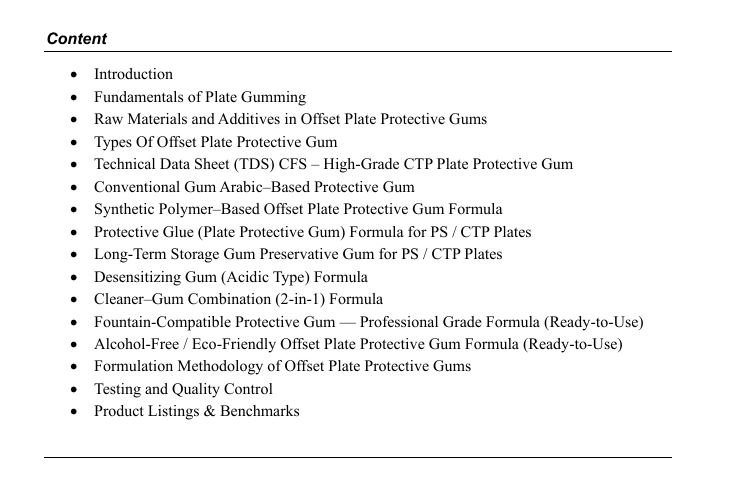
Every Product Making Guide in our shop follows the same structure so you know where to look. This guide includes the product formula, the ingredients and materials, the procedure and preparations, the industrial requirements and the technical specifications. In practice you receive:
- The formulation, written so you can follow it at the bench and scale it up.
- Ingredients and materials, with the job of each material and advice on grades and suppliers.
- The manufacturing procedure, including order of addition, mixing and preparations.
- Industrial requirements, covering equipment, space and packaging.
- Technical specifications, describing what a good finished product should look like and how it should behave.
- Troubleshooting for the faults that makers meet most often.
- Business guidance, to help you take the product from the bench to the market.
These Product Making Guides of chemical formulations and formulas are for manufacturers, startups and entrepreneurs. Every guide contains industrially tested, practical formulations. Anyone who buys a guide can make the product by following its step-by-step instructions. Raw materials vary between suppliers, so always confirm your results with a small trial batch before scaling up.
Who stands behind this guide?
Chemical Formulation Services is the trading name of CFS Formulation Services Ltd, registered in England and Wales under company number 16678503, with its office at Unit F, Winston Business Park, Churchill Way, Sheffield S35 2PS. The business was founded by George Enrick and publishes formulation manuals, technical guides and industry reports. You can check our details on the Companies House register, read about us, or contact us with any question before you order.
A written formulation cannot replace testing with your own raw materials, equipment and climate, and we say so plainly. What the guide does give you is a tested, structured starting point that can save you months of trial and error. Our terms and conditions explain what a purchase from us covers.
How to order
- Select Add to cart to keep browsing, or Buy Now to go straight to checkout.
- Pay with PayPal, Stripe, Xoom by PayPal, Payoneer, payment links for debit and credit cards, or Western Union, Ria and all money exchanges.
- If you pay through a money exchange, email your payment slip to Info@chemicalformulationservices.com. After confirmation, your instant download link is emailed to you.
- For online payments, the PDF is available as soon as the payment is confirmed.
All products are digital downloads and all payments are nonrefundable once the file is delivered, so please read the refund policy and the FAQs before you order. You can compare this guide with others in the formula shop or browse our industrial project reports.
Frequently asked questions about offset plate protective gum formula
What is the Offset Plate Protective Gum Formula guide?
It is a digital PDF Product Making Guide to gum solutions that protect developed offset plates, covering types, ingredients, manufacture, use and testing.
What does plate gum do?
It forms a thin hydrophilic film that protects non-image areas from oxidation, fingerprints and scumming.
Is gum arabic still used?
Yes, alone or blended with synthetic polymers, although quality varies by source.
Why preserve the gum solution?
Gum solutions grow mould and bacteria easily, so a biocide is needed.
Can one gum suit all plates?
Not always. Compatibility with PS, thermal and violet CTP plates should be tested.
How do I receive the guide?
You receive an instant PDF download after payment is confirmed. For money exchanges, email your payment slip to Info@chemicalformulationservices.com and the link is emailed after we confirm it.
Is the payment refundable?
All payments are nonrefundable because the product is an instant digital download. See the refund policy for details.
Can you help with a custom formulation?
CFS Formulation Services Ltd offers formulation and product development consultancy. Send a short brief through the Contact page.
Last reviewed: November 2026. This page is general information about a digital product. It is not a safety data sheet or professional advice, and any formulation should be tested and reviewed by a qualified person before commercial use.