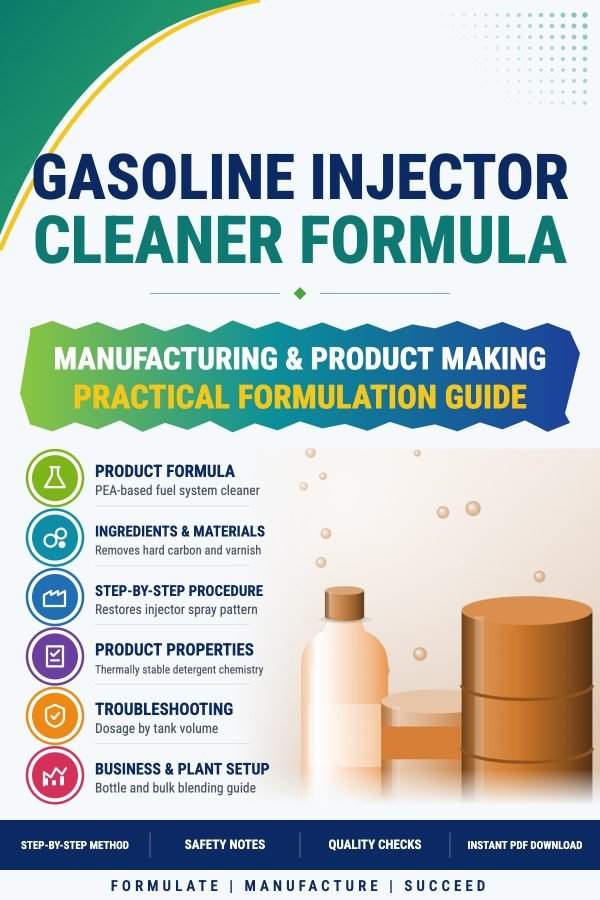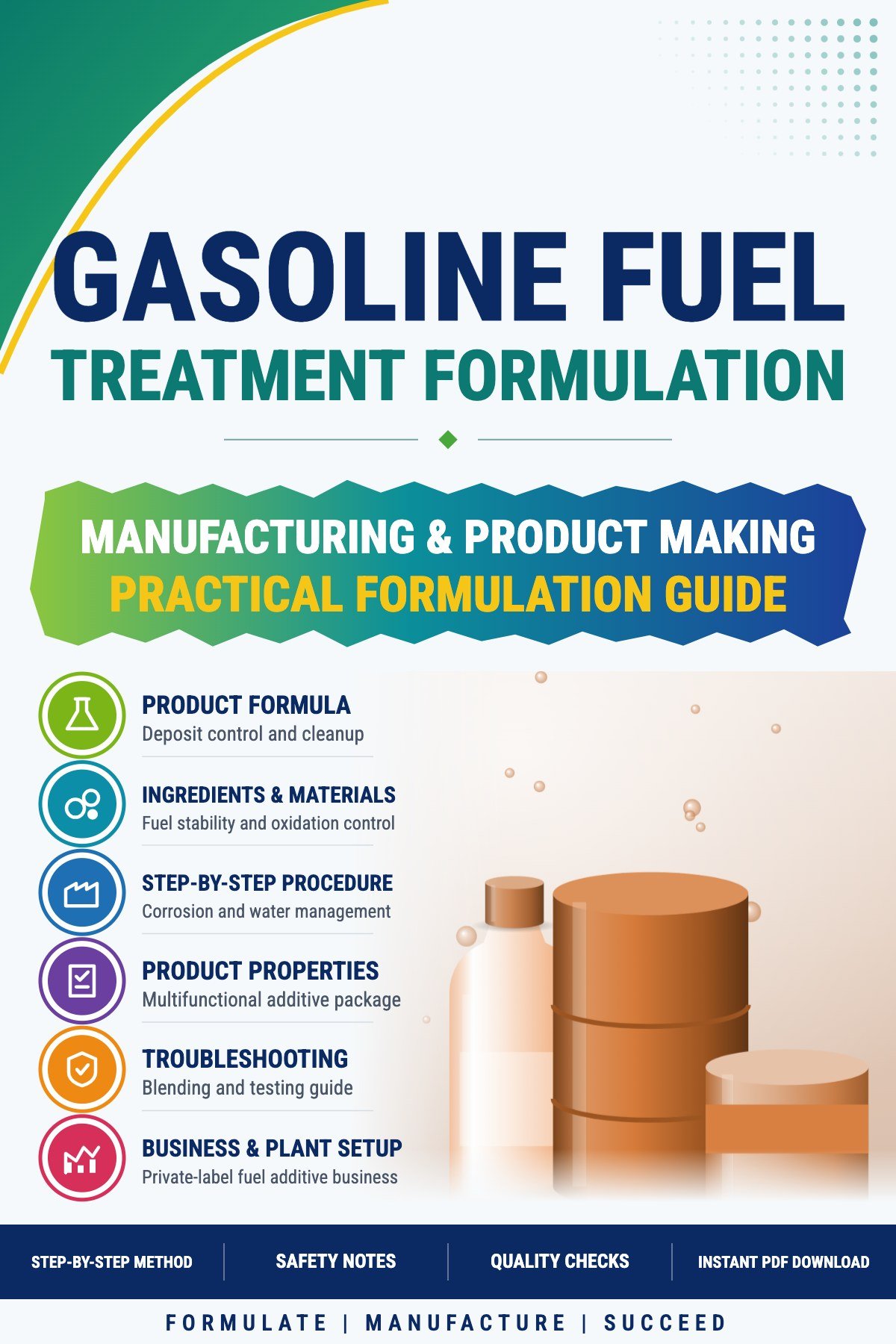

Gasoline Fuel Treatment Formulation
USD $75
PDF manual · Instant downloadGasoline Fuel Treatment Formulation: a PDF handbook to producing multifunctional gasoline additives for deposit control, stability and corrosion protection, with blending and testing.
Payment Methods
Refund Policy
Custom Formulation Services
Formulation Consultation
Contact Us
Gasoline Fuel Treatment Formulation is a practical PDF handbook for fuel-additive manufacturers, private-label brands, industrial blenders, startups and entrepreneurs who want to produce high-performance gasoline fuel additives. A gasoline fuel treatment is a bottle of concentrated additives that a motorist pours into the tank to clean injectors and intake valves, stabilise stored fuel, protect against corrosion and moisture and keep the engine running smoothly. The Gasoline Fuel Treatment and Multifunctional Additives Formulation Handbook provides structured, production-ready formulations that address deposit control, fuel stability, oxidation resistance and more. This page explains how a gasoline fuel treatment formulation works, what goes into a gasoline fuel treatment formula, how it is blended and tested, and what regulations apply.
This guide is published by Chemical Formulation Services, the formulation publishing and consultancy business of CFS Formulation Services Ltd in Sheffield, United Kingdom. It is written for people who want to understand the product from the raw material to the finished pack, and it keeps its claims practical rather than promotional.
At a glance
- Product: Gasoline Fuel Treatment Formulation, a digital PDF Product Making Guide (handbook).
- Also searched as: gasoline fuel treatment formula, petrol fuel additive formulation, fuel injector cleaner, multifunctional gasoline additive, fuel system cleaner.
- Functions: deposit control, fuel stability, oxidation protection, corrosion and water control.
- Used for: after-market bottles, fleet treatment and bulk fuel additisation.
- Who it is for: fuel additive makers, lubricant blenders, private-label brands and entrepreneurs.
- Delivery: instant PDF download after payment is confirmed.
- Publisher: CFS Formulation Services Ltd, England and Wales company number 16678503.
Why gasoline needs additives
Modern gasoline engines are precise machines. Fuel injectors spray fuel in fine mists; intake valves and combustion chambers operate at tight tolerances. Over time, fuel residues, oxidation products and impurities build up as deposits on injector tips, intake valves, throttle bodies and in combustion chambers. These deposits disturb spray patterns, restrict airflow and raise emissions, causing rough idle, hesitation, poor fuel economy and loss of power. Fuel that stands in tanks for weeks or months, in motorcycles, boats, lawn equipment, classic cars and generators, oxidises into gums and varnish, and, with ethanol blends, absorbs water, which causes phase separation and corrosion.
Refiners add detergent and other additives to all commercial gasoline at the terminal, but the dose is limited by cost and specification. After-market fuel treatments top up protection at a higher level, restore engines already carrying deposits and protect fuel in storage. This is a sizeable and profitable product category.
The main additive functions
Detergents and deposit control
Detergent additives clean and keep clean the fuel system. Polyisobutylene amine (PIBA), polyetheramine (PEA), polyisobutylene succinimide and Mannich-base detergents are the main chemistries. Polyetheramines are effective on intake valve and combustion chamber deposits, while PIB amines are widely used for injector and valve cleanliness. Carrier oils or fluidisers help detergents work at higher temperatures and prevent them from contributing to deposits.
Antioxidants and stabilisers
Phenolic and amine antioxidants slow oxidation that forms gum and varnish. Metal deactivators, such as N,N’-disalicylidene-1,2-diaminopropane, neutralise the catalytic effect of dissolved copper and other metals on fuel oxidation. Together they extend storage life.
Corrosion inhibitors
Carboxylic acid- and amine-based inhibitors form a protective film on metal surfaces in tanks, lines and fuel pumps, particularly important with ethanol-blended fuel, which is more corrosive and holds water.
Demulsifiers and water control
Demulsifiers help water separate from fuel and prevent haze or emulsions. In ethanol blends, limited quantities of water can be held in solution, and beyond that separation occurs, so water management additives and good storage practice matter. Alcohol-based drying agents such as isopropanol are used by some brands for small amounts of moisture.
Friction modifiers and upper-cylinder lubricants
Small amounts of lubricity additive protect pumps and upper cylinders, especially in engines running ethanol blends or poor quality fuel.
Octane improvers (optional)
Some treatments carry small octane boosters. These products are covered in a separate guide and are subject to strong regulation.
Solvent and carrier system
Aromatic or aliphatic solvents dissolve and deliver the additive package, control viscosity and flash point and keep the product stable in storage.
Choosing between concentrates for tank dosing and bulk additisation
Two business models use the same chemistry in different ways. The after-market bottle is a small, retail-friendly treatment, typically sized to treat a car’s tank of fuel, with a dose rate worked out per litre of petrol. The bulk additive pack is a concentrate delivered by drum or tanker to fleet depots and fuel terminals, where it is dosed into fuel by injection pumps at much lower treat rates. Bulk additives usually carry more detergent per unit volume, are cheaper per tonne of fuel treated and are sold on test data and fuel quality rather than packaging. Both routes need accurate dose recommendations, because under-dosing gives no benefit and overdosing wastes money and can interfere with fuel specifications. Provide a simple table of dose per litre, per tank and per tonne.
Stabilisers for stored fuel and small engines
Many customers do not need a cleaner, they need a stabiliser. Boat owners, motorcycle riders, garden machinery users, standby generator operators and classic car collectors leave gasoline in tanks for months. A stabiliser blends antioxidants, metal deactivators, corrosion inhibitors and, for ethanol blends, a water-managing component into a low-odour carrier. Its job is to stop gum and varnish formation, prevent rust inside tanks and carburettor bowls and keep fuel burning properly when the engine is restarted. A winter storage kit with stabiliser and ethanol treatment is an easy seasonal product. Test storage stability by ageing treated fuel in sealed containers at elevated temperature and comparing gum and induction period with untreated fuel.
Ethanol-blended fuels and material compatibility
Ethanol-blended gasolines attract water, dissolve certain deposits and rubbers, and corrode some metals. A treatment designed for ethanol fuels must tolerate E10 and higher blends, should not strip protective films from fuel system parts and must avoid components that cause haze or phase separation when water is present. Carrier oils and solvents must be compatible with elastomers such as fluorocarbon, nitrile and fluorosilicone rubbers in injectors, hoses and seals. Test swell and hardness change of common seal materials after soaking in treated fuel. Provide guidance for mixed fleets and flex-fuel vehicles.
Labelling, dosing instructions and customer education
Write the label so that a non-expert can follow it. Say which engines it suits (gasoline only, not diesel), how much to add per litre or per tank, when to add it (before refuelling so that the pump mixes it), how often to use it, and what results to expect. State that it does not replace repairs and servicing, and avoid claims about cure-all benefits. Include warnings about flammability, swallowing and skin contact, and emergency contacts. Customer education through simple videos, data sheets and workshop leaflets reduces misuse and increases trust.
Quality assurance for private-label customers
Private-label customers often have their own quality demands. They may require certificates of analysis for every batch, retained samples, batch traceability, supplier audits and insurance. Keep complete records of raw material lots, mixing sheets, test results and filling. Set specification limits for each property, agree them in writing and reject out-of-spec batches. A brand owner whose product fails in the field will not forgive a supplier with weak controls, so invest in testing early.
What is inside the Gasoline Fuel Treatment Formulation handbook
The handbook is a comprehensive technical guide developed for manufacturers, private-label brands and industrial blenders seeking to produce high-performance gasoline fuel additives. It delivers structured, production-ready formulations designed to address deposit control, fuel stability, oxidation protection and other needs, with blending procedures, quality control, performance testing, packaging and regulatory notes.
How a fuel treatment is blended
Blending is a simple batch mix of liquids, but every step involves flammable materials and the quality of the result depends on good raw materials and mixing discipline.
Preparing the plant
Use clean, dry, earthed stainless steel or lined tanks with explosion-proof motors, closed transfer and vapour extraction. No open flame or sparks in the area.
Charging solvent and carrier
Charge the solvent and carrier oil first, with gentle agitation. Heat slightly only if required for viscous components, using safe heating methods.
Adding detergent and additives
Add the detergent concentrate, antioxidant, metal deactivator, corrosion inhibitor and demulsifier in the sequence given. Mix until the blend is clear and uniform.
Checking and adjusting
Sample for density, viscosity, flash point and appearance. Adjust within tolerance.
Filtering and filling
Filter and fill into bottles or drums using earthed equipment. Use closures with tamper evidence, and label with dosing and safety information.
Testing performance
- Physical properties: density, viscosity, flash point, colour and clarity.
- Compatibility: with gasoline and ethanol blends in all proportions, with no haze, precipitation or phase separation.
- Detergency: engine or bench tests for injector fouling and intake valve deposits, such as standard industry rigs or recognised protocols.
- Oxidation stability: induction period and gum tests on treated fuel.
- Corrosion: copper strip and steel corrosion tests.
- Water tolerance: water separation and haze tests.
- Elastomer and material compatibility: effects on fuel system seals, plastics and metals.
- Storage stability: accelerated ageing of the additive concentrate.
Troubleshooting
Cloudy or hazy blend
Poor solvency or water contamination. Improve solvent, dry raw materials and check compatibility.
Treated fuel hazes or separates
Incompatible demulsifier or ethanol content. Reformulate and test across ethanol blends.
Weak cleaning results
Detergent level or type is not enough. Increase active detergent or choose a better chemistry, and validate in engine tests.
Sticky deposits from the additive itself
Carrier oil too heavy or poor balance. Use proper carrier oil type and level.
Odour complaints
Solvent choice. Use low-odour solvents.
Darkening on storage
Oxidation of the concentrate. Add antioxidants and protect from air.
Regulation, safety and claims
Fuel additives are regulated. In the United States, additives for motor fuels must be registered with the environmental agency, and in the European Union and other regions, fuel quality rules limit certain metals and compounds. Additives containing lead or manganese compounds are heavily restricted. Make sure your formulation complies with fuel quality standards for the market, including limits on sulphur, metals and oxygenates. Never make claims you cannot support, such as large fuel savings or guaranteed power gains. Gasoline additives are flammable, toxic if swallowed and harmful through skin contact or inhalation. Production sites need fire protection, ventilation, spill control and licences for storing flammable liquids. Packaging needs child-resistant closures, hazard pictograms, dosing instructions and warnings, and transport follows dangerous goods rules.
Business opportunity
The automotive after-market, fleet management, marine, motorcycle, small-engine, classic car and generator markets all consume fuel treatments. Products include injector cleaners, complete fuel system cleaners, ethanol treatment, fuel stabilisers for storage and octane and performance boosters. Private labelling for auto-parts chains, lubricant brands and fuel distributors is a major channel, and bulk additive packages supplied to fuel retailers or fleets generate steady volume. Differentiation lies in credible testing, clear instructions on dosing, honest claims and professional packaging. Technical support to workshops and fleet managers builds trust.
Related CFS guides help you build an automotive chemicals range. Browse the Lubricant Formula and Auto Care Products categories, and see Oxygenated Octane Boosters Formula, Multi-Detergent Diesel Injector Cleaners Formula, , AdBlue Diesel Exhaust Fluid Formula, Engine Oil 15W-40 Formula, ATF Transmission Fluid Formulations and Traffic Film Remover Formulations.
Getting started
Start with a basic multifunctional treatment: a PEA or PIB-amine detergent package, an antioxidant, a corrosion inhibitor and a carrier solvent. Blend small laboratory batches, check compatibility with gasoline and ethanol blends and run bench or engine tests with a partner laboratory. Confirm regulatory requirements, design labels and safety data, and trial the product with local fleets and workshops. Use test data and customer feedback to refine and expand to stabilisers and specialty grades.
How to get the best results from this guide
Treat the guide as a tested starting point rather than a finished factory. Begin with a small trial batch in the laboratory or on a bench, using the exact raw materials you plan to buy, and record every weight, temperature, mixing time and observation. Compare the result with the quality checks in the guide, change only one thing at a time, and keep a note of what each change did. Once a small batch is consistently good, repeat it several times, then scale up in stages, because mixing, heating and cooling behave differently in larger vessels. Keep retained samples of every batch, write simple standard operating procedures for your team, and build relationships with two suppliers for each key raw material. Finally, check the labelling, safety and product rules in the country where you will sell, and ask a qualified person to review your process. This careful, documented approach is what turns a good formulation into a reliable product and a trusted brand.
Who should buy this guide?
The guide is written for practical readers. It suits manufacturers who want to add a new product to an existing plant, startups choosing their first product, private-label brands that need to understand what they are buying, technical staff who must set specifications and train operators, and consultants and students who want a structured, plain-language reference. It is less suitable for anyone looking for a quick shortcut or a guarantee, because every formulation still needs testing with your own materials, equipment and local rules. If you are unsure whether it matches your project, send a short question through the contact page before you order, and we will tell you honestly whether it fits.
What is inside the Gasoline Fuel Treatment Formulation guide
Every Product Making Guide in our shop follows the same structure so you know where to look. This guide includes the product formula, the ingredients and materials, the procedure and preparations, the industrial requirements and the technical specifications. In practice you receive:
- The formulation, written so you can follow it at the bench and scale it up.
- Ingredients and materials, with the job of each material and advice on grades and suppliers.
- The manufacturing procedure, including order of addition, mixing and preparations.
- Industrial requirements, covering equipment, space and packaging.
- Technical specifications, describing what a good finished product should look like and how it should behave.
- Troubleshooting for the faults that makers meet most often.
- Business guidance, to help you take the product from the bench to the market.
These Product Making Guides of chemical formulations and formulas are for manufacturers, startups and entrepreneurs. Every guide contains industrially tested, practical formulations. Anyone who buys a guide can make the product by following its step-by-step instructions. Raw materials vary between suppliers, so always confirm your results with a small trial batch before scaling up.
Who stands behind this guide?
Chemical Formulation Services is the trading name of CFS Formulation Services Ltd, registered in England and Wales under company number 16678503, with its office at Unit F, Winston Business Park, Churchill Way, Sheffield S35 2PS. The business was founded by George Enrick and publishes formulation manuals, technical guides and industry reports. You can check our details on the Companies House register, read about us, or contact us with any question before you order.
A written formulation cannot replace testing with your own raw materials, equipment and climate, and we say so plainly. What the guide does give you is a tested, structured starting point that can save you months of trial and error. Our terms and conditions explain what a purchase from us covers.
How to order
- Select Add to cart to keep browsing, or Buy Now to go straight to checkout.
- Pay with PayPal, Stripe, Xoom by PayPal, Payoneer, payment links for debit and credit cards, or Western Union, Ria and all money exchanges.
- If you pay through a money exchange, email your payment slip to Info@chemicalformulationservices.com. After confirmation, your instant download link is emailed to you.
- For online payments, the PDF is available as soon as the payment is confirmed.
All products are digital downloads and all payments are nonrefundable once the file is delivered, so please read the refund policy and the FAQs before you order. You can compare this guide with others in the formula shop or browse our industrial project reports.
Frequently asked questions about gasoline fuel treatment formulation
What is the Gasoline Fuel Treatment Formulation handbook?
It is a digital PDF Product Making Guide handbook to producing multifunctional gasoline additives for deposit control, fuel stability and corrosion protection.
What cleans injectors and valves?
Detergent additives such as polyetheramines, PIB amines and succinimides.
Why does ethanol cause storage problems?
Ethanol absorbs water, which can cause phase separation and corrosion, so water control and inhibitors help.
Are fuel additives regulated?
Yes. Many markets require registration or compliance with fuel quality standards.
Can I claim big fuel savings?
Only with credible test evidence. Avoid exaggerated claims.
How do I receive the guide?
You receive an instant PDF download after payment is confirmed. For money exchanges, email your payment slip to Info@chemicalformulationservices.com and the link is emailed after we confirm it.
Is the payment refundable?
All payments are nonrefundable because the product is an instant digital download. See the refund policy for details.
Can you help with a custom formulation?
CFS Formulation Services Ltd offers formulation and product development consultancy. Send a short brief through the Contact page.
Last reviewed: November 2026. This page is general information about a digital product. It is not a safety data sheet or professional advice, and any formulation should be tested and reviewed by a qualified person before commercial use.