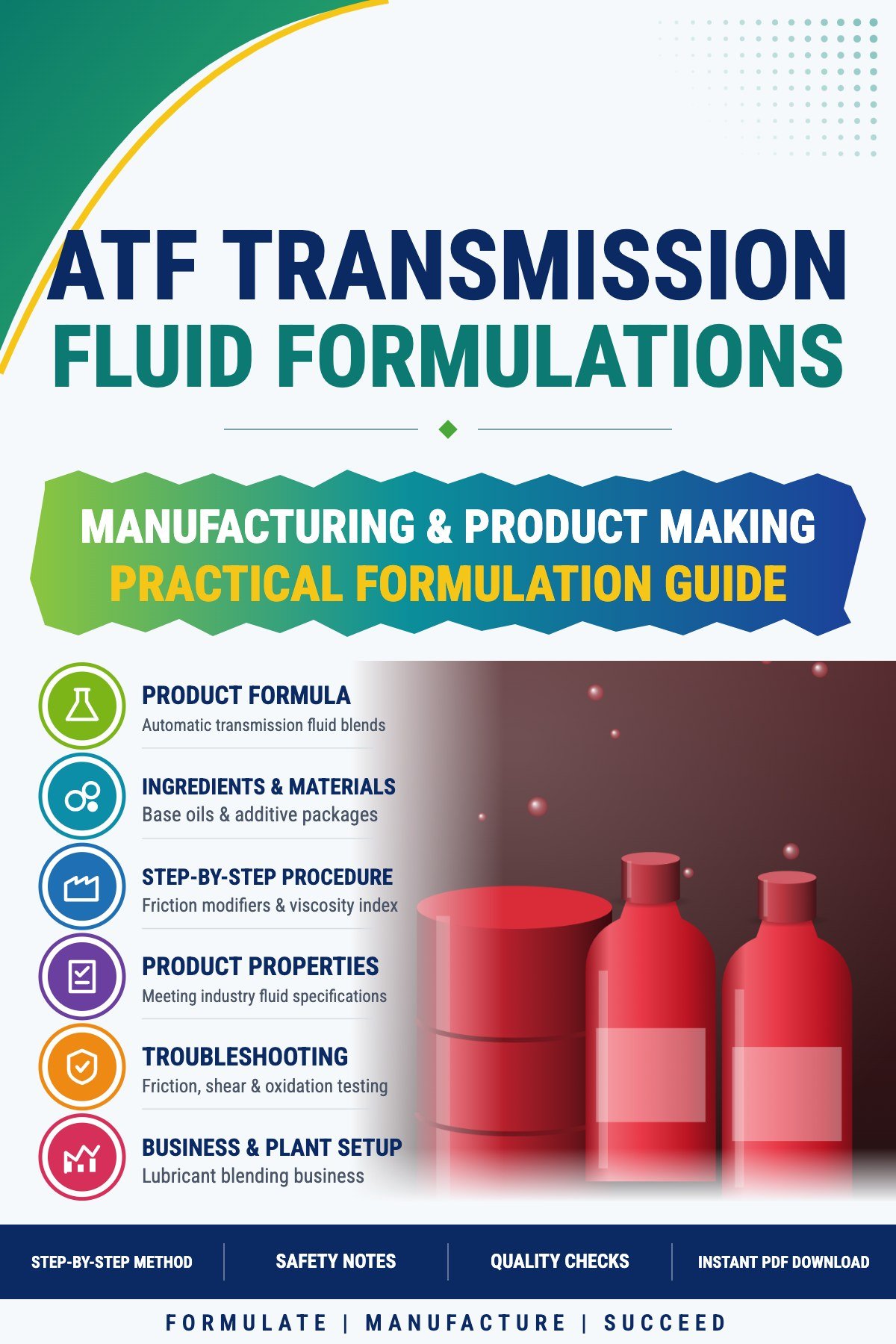

ATF Transmission Fluid Formulations
USD $75
PDF manual · Instant downloadATF Transmission Fluid Formulations: a PDF guide to blending automatic transmission fluid from base oils and additives, with friction control, testing and specification licensing notes.
Payment Methods
Refund Policy
Custom Formulation Services
Formulation Consultation
Contact Us
ATF Transmission Fluid Formulations is a practical PDF guide for lubricant blenders, oil companies, automotive-fluid brands and entrepreneurs who want to understand and produce automatic transmission fluid. ATF is one of the most demanding lubricants on the market, because it does several jobs at once: it lubricates gears and bearings, transmits hydraulic power, controls the friction of clutches and bands that shift gears, cools the transmission and protects metal from wear and corrosion. This page explains how ATF transmission fluid formulations work, what the guide covers and how an ATF transmission fluid formula is built from base oils and additives, blended and tested against industry specifications, so you can decide whether it suits your business. It is important to understand the specification and licensing side, which is covered below.
This guide is published by Chemical Formulation Services, the formulation publishing and consultancy business of CFS Formulation Services Ltd in Sheffield, United Kingdom. It is written for people who want to understand the product from the raw material to the finished pack, and it keeps its claims practical rather than promotional.
At a glance
- Product: ATF Transmission Fluid Formulations, a digital PDF Product Making Guide.
- Also searched as: ATF transmission fluid formula, automatic transmission fluid, Dexron type fluid, Mercon type fluid, ATF blending.
- What it covers: base oils, additive packages, friction modifiers, viscosity index improvers, blending and testing.
- Key goals: smooth shifting, stable friction, wear and oxidation protection, low-temperature flow and seal compatibility.
- Who it is for: lubricant blenders, oil brands, automotive aftermarket suppliers and entrepreneurs.
- Delivery: instant PDF download after payment is confirmed.
- Publisher: CFS Formulation Services Ltd, England and Wales company number 16678503.
What automatic transmission fluid does
An automatic transmission shifts gears without the driver pressing a clutch pedal. Inside, a torque converter, a gear train, planetary gearsets, clutch packs, bands, valve bodies and an oil pump work together. The fluid is the working medium of the whole system. It transmits power in the torque converter, supplies hydraulic pressure that applies clutches and bands, lubricates gears, bearings and bushings, cools the unit by carrying heat to the radiator or cooler, cleans by suspending wear particles and deposits, and protects metals from rust and corrosion. In many designs it also has to engage friction plates smoothly, without harsh shudder or slip.
This combination of tasks makes ATF very different from engine oil or gear oil. Engine oil aims for low friction. ATF needs carefully controlled friction, high at the right moments to grip, but smooth when changing from static to dynamic friction, so shifts feel seamless. The fluid is also exposed to high temperatures and shear for many thousands of kilometres, so it has to keep its properties over a long service life.
Key performance properties
- Friction characteristics: controlled static and dynamic friction for smooth, consistent shifts and for lock-up clutch control.
- Viscosity and viscosity index: thin enough for cold starts, thick enough at operating temperature, and stable under shear.
- Oxidation and thermal stability: resists thickening, varnish and sludge at high temperature.
- Wear protection: protects gears, bearings and clutch surfaces.
- Anti-foam performance: prevents aeration, which would cause loss of pressure and erratic shifting.
- Seal compatibility: keeps rubber and polymer seals soft and leak-free.
- Corrosion protection: protects copper alloys, steel and aluminium parts.
- Low-temperature fluidity: flows freely in cold climates.
- Clean running: dispersants and detergents keep passages clear.
Main components of an ATF
Base oils
Base oils make up most of the fluid. Mineral oils from Group II and Group III, hydro-processed oils and synthetic oils such as polyalphaolefin (PAO) and esters are used. Modern fluids for long-life or high-efficiency transmissions rely on high-quality Group III and synthetic bases with excellent oxidation stability and low-temperature properties. The base oil choice sets viscosity, volatility, stability and cost.
Viscosity index improver
Polymers, such as polymethacrylates and olefin copolymers, make the oil thin enough when cold and thick enough when hot. For ATF they must resist shear, as mechanical shearing cuts polymer chains and reduces viscosity. Shear-stable polymers are essential.
Friction modifiers
Friction modifiers are a signature of ATF technology. Organic compounds such as fatty acid derivatives, amides, esters and other polar compounds adsorb on friction plate surfaces and control friction behaviour. The type and level are matched to the transmission design and clutch materials, which is why different fluid specifications exist.
Dispersants
Ashless dispersants, usually succinimides, hold sludge and soot-like deposits in suspension and keep the transmission clean. Some also help control friction and seal swell.
Anti-wear and extreme-pressure additives
Phosphorus- and sulphur-based compounds, such as zinc-free phosphate esters and sulphurised compounds, protect gears and bearings under load. Their levels are controlled because they can affect friction and yellow metals.
Antioxidants
Hindered phenols and aminic antioxidants slow oxidation and prolong fluid life.
Corrosion inhibitors and metal passivators
Protect steel, aluminium and especially copper alloys found in bushings and thrust washers.
Seal swell agents
Specific esters and aromatic compounds make seal elastomers swell slightly, keeping them soft and preventing leaks.
Antifoam agents
Silicone or non-silicone antifoams in tiny dosages control air entrainment.
Pour point depressants
Improve low-temperature flow of mineral-based fluids.
Dye
ATF is traditionally dyed red, to distinguish it from engine oil and help detect leaks.
Specifications and licensing
ATF is not one product but a family of fluids, each designed to meet specific manufacturer or industry specifications. General Motors’ Dexron series and Ford’s Mercon series are the best known in North America, and other vehicle makers issue their own specifications, such as Toyota, Honda, Nissan, Mitsubishi, Hyundai, Kia, Mercedes-Benz, BMW, ZF and Allison for commercial vehicles. Newer transmissions, such as continuously variable transmissions (CVT) and dual-clutch transmissions (DCT), use their own fluids, which are not interchangeable with conventional ATF. Using the wrong fluid can cause shudder, slipping, overheating and transmission damage. Many specifications are tied to approval and licensing. For example, a fluid sold as Dexron or Mercon licensed may need approval and licence agreements with the owner of the specification, and use of trademarks without approval is not permitted. Producers who do not hold a licence should describe their products as suitable for use where the specification is recommended only if they have evidence, or as meeting an industry performance level, and should avoid using the specification names or logos unless entitled. Check carefully before making claims.
What is inside the ATF Transmission Fluid Formulations guide
The guide is a professional technical guide that explains the principles of ATF manufacturing and shows formulation blueprints for industry-standard ATF types, including those corresponding to commonly requested specifications. It covers base oil selection, additive package roles, example formulations, step-by-step blending, quality control, performance testing, troubleshooting, packaging, regulation and commercial advice. It follows the CFS style of clear, industrially minded instructions for blenders.
How ATF is blended
The outline below shows the general sequence. The guide gives full details.
Step 1: Check base oils and additives
Each lot is verified against its certificate of analysis. Base oils are tested for viscosity and appearance. Additive packages are checked for batch consistency.
Step 2: Charge base oils
Base oils are metered or weighed into a clean, dry blending vessel with agitation. Water contamination and cross-contamination are avoided.
Step 3: Heat gently
Oil is warmed to the blending temperature, typically 50 to 65 degrees Celsius, to help dissolve viscosity improvers and additives.
Step 4: Add the viscosity index improver
The polymer is added slowly with good mixing, because it dissolves slowly, until completely homogeneous.
Step 5: Add the additive package
The ATF additive package, friction modifiers and other components are added in the order specified, with mixing for the required time. Pre-formulated ATF additive packages simplify blending.
Step 6: Add dye and antifoam
Dye and antifoam are added and mixed.
Step 7: Test and adjust
Samples are tested for viscosity at 40 and 100 degrees Celsius, viscosity index, Brookfield viscosity at low temperature, appearance, water content and foam. Adjustments are made as needed.
Step 8: Filter and package
The fluid is filtered and packed into clean drums, pails or bottles, labelled with the product name, performance claims, batch number and safety information.
Equipment requirements
A blending plant needs storage tanks for base oil, a heated blending vessel with agitator or a recirculation blending system, flow meters or scales, filtration, transfer pumps, filling equipment and a laboratory. The laboratory needs viscometers, a Brookfield viscometer for cold flow, a flash point tester, density meter, water test equipment, foam test apparatus and, ideally, access to external labs for friction, shear stability, oxidation and seal compatibility tests, which require specialised rigs.
Quality control for every batch
- Kinematic viscosity at 40 and 100 degrees Celsius, and viscosity index.
- Low-temperature Brookfield viscosity: cold flow performance, often at minus 40 degrees Celsius.
- Appearance, colour and odour: consistent red, bright, no haze.
- Flash point and density.
- Foam tendency and stability.
- Water content and cleanliness.
- Copper corrosion and rust tests.
- Shear stability: viscosity loss after mechanical shear.
- Oxidation stability: accelerated ageing tests.
- Friction performance: clutch friction tests on a recognised rig, and field tests.
- Seal compatibility: swell and hardness change of typical elastomers.
Troubleshooting
Viscosity out of specification
Wrong blending ratio, poor mixing or base oil variation. Adjust the base oil blend and verify scales and meters.
Haze or sediment
Water contamination, incompatible additives or low temperature. Dry the oil, check blending order and filtration.
Foaming
Antifoam depleted or contaminated. Increase antifoam carefully and avoid air entrainment.
Shift shudder or slip complaints
Wrong friction modifier balance or the wrong fluid for the transmission. Verify specification match and use the right additive technology.
Seal leaks or swelling
Seal compatibility not matched. Adjust seal swell agents and test with relevant elastomers.
Short fluid life
Weak oxidation protection or poor base oil. Use better base stocks and antioxidants.
Safety, environment and regulation
Lubricant blending involves hot oil and large quantities of combustible liquid, so facilities need fire protection, spill containment and safe handling. Operators should wear gloves and eye protection, and avoid prolonged skin contact with used and unused oil. Additive packages may contain hazardous components, so read safety data sheets. Used ATF is hazardous waste in many places, and should be collected by licensed recyclers. Products require chemical registration, hazard classification and labelling in line with local rules, and statements about specification compliance must be truthful. Consumer trust depends on honest labelling, because using the wrong fluid can damage a costly transmission. Recommend that owners follow the vehicle manufacturer’s handbook.
The business opportunity
ATF is a major lubricant category, sold to workshops, quick-lube centres, fleets, dealerships, parts stores and retail customers. Blenders can supply under their own brand, private label for distributors or in bulk to workshops. The key to credibility is quality base oils, reputable additive technology, proper testing and clear communication about which vehicles each grade suits. A broader product range, including engine oils, gear oils, hydraulic fluids and greases, makes a brand more valuable to distributors.
Related CFS guides help you build a lubricants range. Browse the Lubricant Formula and Grease Making categories, and see Calcium Sulfonate Grease Formulation, Oxygenated Octane Boosters Formula, Multi-Detergent Diesel Injector Cleaners Formula and . For other automotive products, browse the Auto Care Products category.
Getting started
Start by understanding the fluid types your target market uses, and decide which specifications to serve. Buy good base oils and a complete, approved ATF additive package, and make small laboratory blends, checking viscosity, cold flow and foam. Send samples to an accredited laboratory for the key performance tests, and obtain any necessary licences before claiming a specification. Build supply agreements, packaging and labelling, and grow your range step by step.
How to get the best results from this guide
Treat the guide as a tested starting point rather than a finished factory. Begin with a small trial batch in the laboratory or on a bench, using the exact raw materials you plan to buy, and record every weight, temperature, mixing time and observation. Compare the result with the quality checks in the guide, change only one thing at a time, and keep a note of what each change did. Once a small batch is consistently good, repeat it several times, then scale up in stages, because mixing, heating and cooling behave differently in larger vessels. Keep retained samples of every batch, write simple standard operating procedures for your team, and build relationships with two suppliers for each key raw material. Finally, check the labelling, safety and product rules in the country where you will sell, and ask a qualified person to review your process. This careful, documented approach is what turns a good formulation into a reliable product and a trusted brand.
Who should buy this guide?
The guide is written for practical readers. It suits manufacturers who want to add a new product to an existing plant, startups choosing their first product, private-label brands that need to understand what they are buying, technical staff who must set specifications and train operators, and consultants and students who want a structured, plain-language reference. It is less suitable for anyone looking for a quick shortcut or a guarantee, because every formulation still needs testing with your own materials, equipment and local rules. If you are unsure whether it matches your project, send a short question through the contact page before you order, and we will tell you honestly whether it fits.
What is inside the ATF Transmission Fluid Formulations guide
Every Product Making Guide in our shop follows the same structure so you know where to look. This guide includes the product formula, the ingredients and materials, the procedure and preparations, the industrial requirements and the technical specifications. In practice you receive:
- The formulation, written so you can follow it at the bench and scale it up.
- Ingredients and materials, with the job of each material and advice on grades and suppliers.
- The manufacturing procedure, including order of addition, mixing and preparations.
- Industrial requirements, covering equipment, space and packaging.
- Technical specifications, describing what a good finished product should look like and how it should behave.
- Troubleshooting for the faults that makers meet most often.
- Business guidance, to help you take the product from the bench to the market.
These Product Making Guides of chemical formulations and formulas are for manufacturers, startups and entrepreneurs. Every guide contains industrially tested, practical formulations. Anyone who buys a guide can make the product by following its step-by-step instructions. Raw materials vary between suppliers, so always confirm your results with a small trial batch before scaling up.
Who stands behind this guide?
Chemical Formulation Services is the trading name of CFS Formulation Services Ltd, registered in England and Wales under company number 16678503, with its office at Unit F, Winston Business Park, Churchill Way, Sheffield S35 2PS. The business was founded by George Enrick and publishes formulation manuals, technical guides and industry reports. You can check our details on the Companies House register, read about us, or contact us with any question before you order.
A written formulation cannot replace testing with your own raw materials, equipment and climate, and we say so plainly. What the guide does give you is a tested, structured starting point that can save you months of trial and error. Our terms and conditions explain what a purchase from us covers.
How to order
- Select Add to cart to keep browsing, or Buy Now to go straight to checkout.
- Pay with PayPal, Stripe, Xoom by PayPal, Payoneer, payment links for debit and credit cards, or Western Union, Ria and all money exchanges.
- If you pay through a money exchange, email your payment slip to Info@chemicalformulationservices.com. After confirmation, your instant download link is emailed to you.
- For online payments, the PDF is available as soon as the payment is confirmed.
All products are digital downloads and all payments are nonrefundable once the file is delivered, so please read the refund policy and the FAQs before you order. You can compare this guide with others in the formula shop or browse our industrial project reports.
Frequently asked questions about atf transmission fluid formulations
What are the ATF Transmission Fluid Formulations?
They are a digital PDF Product Making Guide to blending automatic transmission fluid from base oils and additives, covering formulation, blending, testing and specification issues.
What makes ATF different from engine oil?
ATF must control clutch friction for smooth shifting, transmit hydraulic power and cool the transmission, as well as lubricate, so it uses special friction modifiers and shear-stable viscosity improvers.
Can I use the Dexron or Mercon names?
Only if you hold the relevant approval or licence. Without it, avoid using the names or logos and describe the product honestly.
Is ATF the same for CVT and DCT?
No. CVT and dual-clutch transmissions use their own fluids, so conventional ATF is not interchangeable.
Why is ATF dyed red?
The dye distinguishes ATF from other fluids and helps detect leaks.
How do I receive the guide?
You receive an instant PDF download after payment is confirmed. For money exchanges, email your payment slip to Info@chemicalformulationservices.com and the link is emailed after we confirm it.
Is the payment refundable?
All payments are nonrefundable because the product is an instant digital download. See the refund policy for details.
Can you help with a custom formulation?
CFS Formulation Services Ltd offers formulation and product development consultancy. Send a short brief through the Contact page.
Last reviewed: November 2026. This page is general information about a digital product. It is not a safety data sheet or professional advice, and any formulation should be tested and reviewed by a qualified person before commercial use.