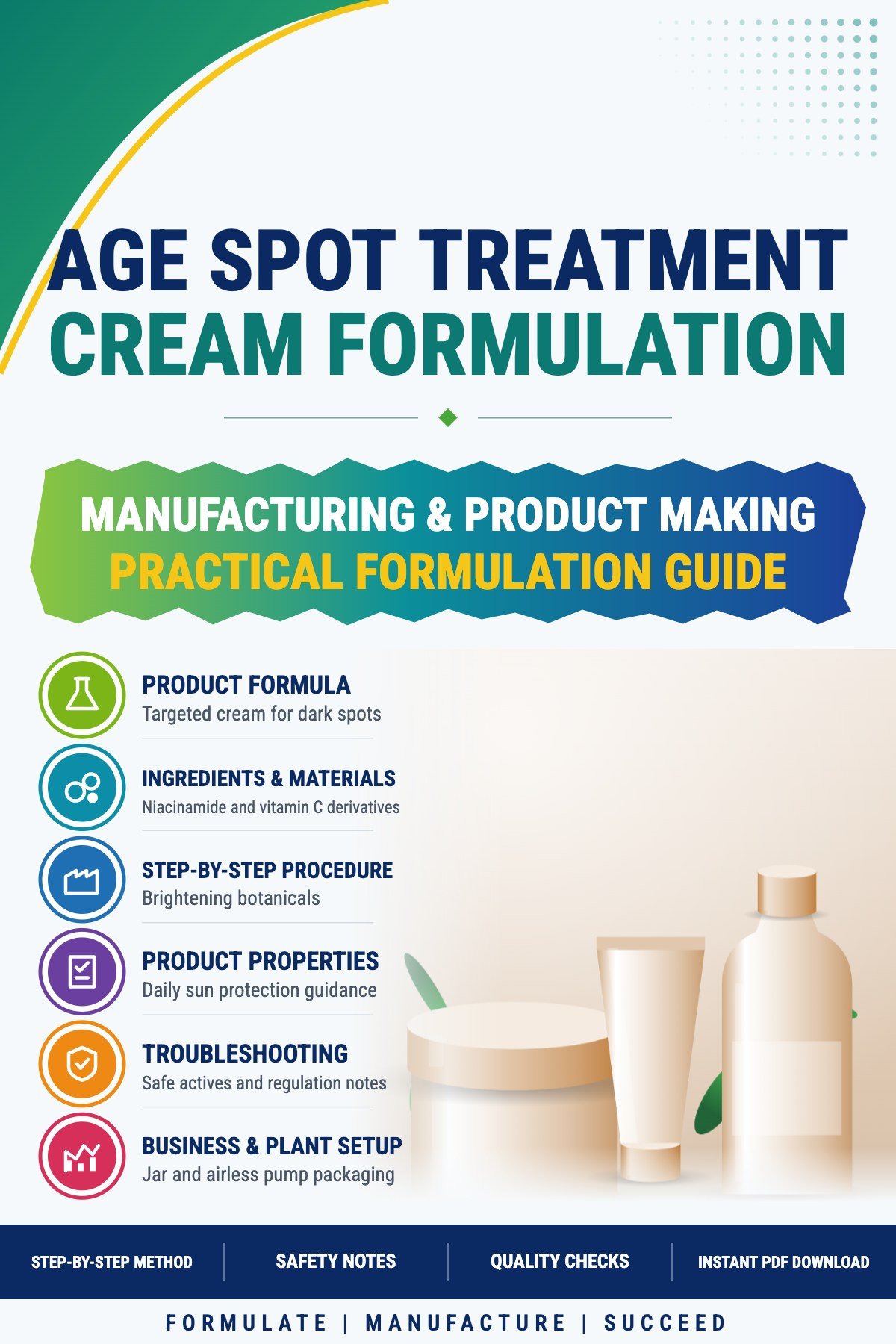

Age Spot Treatment Cream Formulation
USD $70
PDF manual · Instant downloadAge Spot Treatment Cream Formulation: a PDF guide to cosmetic creams that reduce the look of age spots, with permitted actives, stability, making steps, safety and compliant claims.
Payment Methods
Refund Policy
Custom Formulation Services
Formulation Consultation
Contact Us
Age spot treatment creams are specialised skincare products designed to reduce the appearance of age spots, sun spots and hyperpigmentation. These darkened areas, caused by long-term sun exposure and the natural ageing process, are commonly found on the face, hands, shoulders and arms. This professional PDF guide, Age Spot Treatment Cream Formulation, is for cosmetic manufacturers, private-label brands, startups and entrepreneurs. This page explains how an age spot treatment cream formula works, which active ingredients are legal and sensible to use, which ones to avoid, how the cream is made and tested, and how to write honest claims.
This guide is published by Chemical Formulation Services, the formulation publishing and consultancy business of CFS Formulation Services Ltd in Sheffield, United Kingdom. It is written for people who want to understand the product from the raw material to the finished pack, and it keeps its claims practical rather than promotional.
At a glance
- Product: Age Spot Treatment Cream Formulation, a digital PDF Product Making Guide.
- Also searched as: age spot treatment cream formula, dark spot cream, hyperpigmentation cream, brightening cream, sun spot cream.
- Base: oil-in-water emulsion carrying brightening and antioxidant actives.
- Key goals: even-looking tone, active stability, skin comfort and compliant claims.
- Who it is for: cosmetic start-ups, dermatology-adjacent brands, pharmacies, salons and entrepreneurs.
- Delivery: instant PDF download after payment is confirmed.
- Publisher: CFS Formulation Services Ltd, England and Wales company number 16678503.
How age spots form
Skin colour comes from melanin, produced by melanocytes in the lower epidermis. Ultraviolet light, hormones and inflammation can trigger local overproduction and clumping of melanin. Over decades, sun exposure causes solar lentigines, commonly called age spots or liver spots: flat, brown patches on exposed skin. Similar discoloration can follow acne, injuries or hormonal change. A cosmetic cream cannot change the underlying genetics or reverse sun damage, but regular use of suitable ingredients, together with daily sun protection, can gradually lighten the look of dark patches and improve skin evenness.
Important safety note on prohibited ingredients
Some skin-lightening products on the market contain dangerous ingredients. Mercury compounds are banned in cosmetics almost everywhere and cause kidney and nerve damage. Hydroquinone is prohibited in cosmetics in the European Union and restricted or prescription-only in many other regions, and may cause irritation, ochronosis or other effects with improper use. High-strength steroids are medicines, not cosmetic ingredients. Do not use or sell products that contain these. A responsible formula uses permitted, well-characterised ingredients at safe levels, with clear instructions and honest claims.
Permitted brightening and evening actives
Niacinamide
Vitamin B3, widely used at 2 to 5 percent. It is thought to reduce the transfer of melanin to skin cells, supports the barrier and is generally well tolerated and stable.
Vitamin C and its derivatives
Ascorbic acid is potent but unstable; derivatives such as magnesium ascorbyl phosphate, sodium ascorbyl phosphate and ethyl ascorbic acid are more stable. They act as antioxidants and may help even skin tone.
Arbutin and deoxyarbutin
Plant-derived compounds that inhibit tyrosinase, the enzyme in melanin production. Permitted at regulated levels in many regions, with restrictions in some.
Kojic acid
A tyrosinase inhibitor with concentration limits in certain markets, because of irritation and sensitisation concerns.
Azelaic acid
Used for uneven pigmentation and acne-related marks. Regulatory status varies by region and strength.
Licorice root extract, tranexamic acid and botanical extracts
Used in many brightening products, with growing consumer interest. Evidence varies, and regulatory status differs by market.
Retinoids and mild exfoliating acids
Speed cell turnover, helping pigmented cells shed, but need regulatory limits, low irritation design and sun protection advice.
Sunscreen
The most important ingredient for managing spots, whether in the cream or in a separate product. Without protection, spots return or darken.
Building a regimen around the cream
Customers see better results when the cream is part of a sensible routine. In the morning, a gentle cleanser followed by the age spot cream and then a broad-spectrum sunscreen with a high protection factor protects against new pigment. In the evening, the cream can be used again, or alternated with a mild exfoliating product to speed turnover, depending on skin tolerance. Hats, shade and protective clothing help in strong sun. Printing this simple routine on the carton or in a leaflet increases the chance of success and lowers complaints about lack of results.
Skin of colour and pigmentation sensitivity
People with deeper skin tones are more prone to post-inflammatory hyperpigmentation, where irritation itself causes dark marks. A formula that is too acidic or too strong may worsen the problem. Favour gentle actives like niacinamide and stable vitamin C derivatives, avoid unnecessary irritants such as strong fragrance or high alcohol, and test products on volunteers with diverse skin tones. Describe results realistically and avoid language that implies that natural skin colour is a flaw, which is both ethically poor and commercially risky.
Working with professionals
Pharmacists, dermatologists, nurses and aesthetic practitioners are trusted voices. Provide them with ingredient lists, safety information, stability data and any efficacy results, and be clear about limits. Offer professional-size packs and training sessions, and make sure staff can explain how to use the product alongside sun protection. A product that professionals are comfortable recommending will be easier to sell and will survive regulatory and media scrutiny better than one built on exaggerated promises.
What is inside the Age Spot Treatment Cream Formulation guide
The guide is presented as a professional formulation product guide by CFS for age spot treatment creams, specialised skincare products designed to reduce the appearance of age spots, sunspots and hyperpigmentation caused by prolonged sun exposure and natural ageing, commonly found on the face, hands, shoulders and arms. It provides example bases, active combinations, stability controls and production steps.
Base cream and stability
Choose a gentle, moisturising oil-in-water emulsion with a modest level of emollients and humectants. Active ingredients such as vitamin C derivatives and kojic acid are sensitive to pH, light and oxygen, so choose a pH range that keeps the chosen actives stable, add chelating agents and antioxidants, and use airless or opaque packaging. Some actives, like kojic acid and ascorbic acid, discolour in the presence of metals or light. Run stability tests on colour, odour, pH and active content.
Manufacturing steps
Step 1: Prepare phases
Heat the water and oil phases separately to about 70 to 75 degrees Celsius.
Step 2: Emulsify
Combine under high-shear mixing to a smooth emulsion, then cool with gentle stirring.
Step 3: Add actives at low temperature
Below 40 degrees Celsius, add the dissolved actives, extracts, vitamins and preservative. Adjust pH carefully to the window where the chosen actives are effective and the cream is mild.
Step 4: Check and fill
Check appearance, pH and viscosity, rest the batch and fill into airless pumps, tubes or opaque jars.
Testing and quality control
- Appearance, colour, odour, pH and viscosity.
- Accelerated stability at several temperatures and with light exposure.
- Active content assay where possible.
- Microbial testing and preservative efficacy.
- Skin irritation and sensitisation checks under qualified supervision.
- Efficacy evaluation: controlled studies using colour measurement for any strong claims.
Troubleshooting
Cream turns yellow or brown
Oxidation of vitamin C, kojic acid or oils. Add antioxidants, chelators and protect from light and air.
Skin irritation
Active level or pH too aggressive. Lower the level, raise pH within the active range and add soothing ingredients.
Loss of efficacy over time
Active degradation. Use stable derivatives and airless packaging.
Cream separates
Electrolyte or acid sensitivity of emulsifier. Choose emulsifiers tolerant of acidic pH.
Spots darken on use
Irritation or lack of sun protection. Advise daily sunscreen and reduce irritants.
Claims, regulation and customer guidance
Use cautious cosmetic claims such as “helps reduce the look of dark spots” or “helps even skin tone” and support them with data. Do not claim to cure skin disease, remove cancers or treat medical conditions. Advise customers to see a doctor for any spot that is new, changing in shape or colour, raised, bleeding or itchy, since these can be signs of skin cancer. Include instructions: apply to clean skin, use sunscreen every morning, patch test first, avoid broken skin and discontinue if irritation occurs. Follow regional rules on permitted actives, concentration limits, labelling and notification.
Packaging and business opportunity
Airless pump bottles and opaque tubes of 30 to 50 millilitres suit active creams. Customers include women and men over 35, pharmacies, dermatology clinics, aesthetic salons and online buyers. Pair the cream with a sunscreen and a gentle cleanser for a regimen. Private-label supply is common. Build trust with transparent ingredient lists, realistic timelines (changes may take eight to twelve weeks), and education on sun protection.
Extend your skincare range with the Cosmetics Industry, Personal Care Products, Soap Formula and Herbicide Formulations categories, and see Anti-Ageing Treatment Cream Formula, , , Light Everyday Cream Formulation, and Cover Cream Formula.
Getting started
Select two or three permitted actives such as niacinamide and a stable vitamin C derivative. Build a gentle base cream, test stability and tolerance, and refine. Prepare compliant labels, sun protection guidance and a safety file, and start with a small pilot among informed users and professionals.
How to get the best results from this guide
Treat the guide as a tested starting point rather than a finished factory. Begin with a small trial batch in the laboratory or on a bench, using the exact raw materials you plan to buy, and record every weight, temperature, mixing time and observation. Compare the result with the quality checks in the guide, change only one thing at a time, and keep a note of what each change did. Once a small batch is consistently good, repeat it several times, then scale up in stages, because mixing, heating and cooling behave differently in larger vessels. Keep retained samples of every batch, write simple standard operating procedures for your team, and build relationships with two suppliers for each key raw material. Finally, check the labelling, safety and product rules in the country where you will sell, and ask a qualified person to review your process. This careful, documented approach is what turns a good formulation into a reliable product and a trusted brand.
Who should buy this guide?
The guide is written for practical readers. It suits manufacturers who want to add a new product to an existing plant, startups choosing their first product, private-label brands that need to understand what they are buying, technical staff who must set specifications and train operators, and consultants and students who want a structured, plain-language reference. It is less suitable for anyone looking for a quick shortcut or a guarantee, because every formulation still needs testing with your own materials, equipment and local rules. If you are unsure whether it matches your project, send a short question through the contact page before you order, and we will tell you honestly whether it fits.
What is inside the Age Spot Treatment Cream Formulation guide
Every Product Making Guide in our shop follows the same structure so you know where to look. This guide includes the product formula, the ingredients and materials, the procedure and preparations, the industrial requirements and the technical specifications. In practice you receive:
- The formulation, written so you can follow it at the bench and scale it up.
- Ingredients and materials, with the job of each material and advice on grades and suppliers.
- The manufacturing procedure, including order of addition, mixing and preparations.
- Industrial requirements, covering equipment, space and packaging.
- Technical specifications, describing what a good finished product should look like and how it should behave.
- Troubleshooting for the faults that makers meet most often.
- Business guidance, to help you take the product from the bench to the market.
These Product Making Guides of chemical formulations and formulas are for manufacturers, startups and entrepreneurs. Every guide contains industrially tested, practical formulations. Anyone who buys a guide can make the product by following its step-by-step instructions. Raw materials vary between suppliers, so always confirm your results with a small trial batch before scaling up.
Who stands behind this guide?
Chemical Formulation Services is the trading name of CFS Formulation Services Ltd, registered in England and Wales under company number 16678503, with its office at Unit F, Winston Business Park, Churchill Way, Sheffield S35 2PS. The business was founded by George Enrick and publishes formulation manuals, technical guides and industry reports. You can check our details on the Companies House register, read about us, or contact us with any question before you order.
A written formulation cannot replace testing with your own raw materials, equipment and climate, and we say so plainly. What the guide does give you is a tested, structured starting point that can save you months of trial and error. Our terms and conditions explain what a purchase from us covers.
How to order
- Select Add to cart to keep browsing, or Buy Now to go straight to checkout.
- Pay with PayPal, Stripe, Xoom by PayPal, Payoneer, payment links for debit and credit cards, or Western Union, Ria and all money exchanges.
- If you pay through a money exchange, email your payment slip to Info@chemicalformulationservices.com. After confirmation, your instant download link is emailed to you.
- For online payments, the PDF is available as soon as the payment is confirmed.
All products are digital downloads and all payments are nonrefundable once the file is delivered, so please read the refund policy and the FAQs before you order. You can compare this guide with others in the formula shop or browse our industrial project reports.
Frequently asked questions about age spot treatment cream formulation
What is the Age Spot Treatment Cream Formulation guide?
It is a digital PDF Product Making Guide to cosmetic creams that reduce the appearance of age spots, covering permitted actives, base creams, stability, making and claims.
Can a cream remove age spots?
It may help reduce their appearance over time, but results vary and sun protection is essential.
Which ingredients should be avoided?
Mercury compounds, undeclared steroids and, in many regions, hydroquinone in cosmetics.
How long before results show?
Often eight to twelve weeks of regular use together with daily sunscreen.
When should someone see a doctor?
For any spot that is new, changing, raised, bleeding or itchy.
How do I receive the guide?
You receive an instant PDF download after payment is confirmed. For money exchanges, email your payment slip to Info@chemicalformulationservices.com and the link is emailed after we confirm it.
Is the payment refundable?
All payments are nonrefundable because the product is an instant digital download. See the refund policy for details.
Can you help with a custom formulation?
CFS Formulation Services Ltd offers formulation and product development consultancy. Send a short brief through the Contact page.
Last reviewed: November 2026. This page is general information about a digital product. It is not a safety data sheet or professional advice, and any formulation should be tested and reviewed by a qualified person before commercial use.