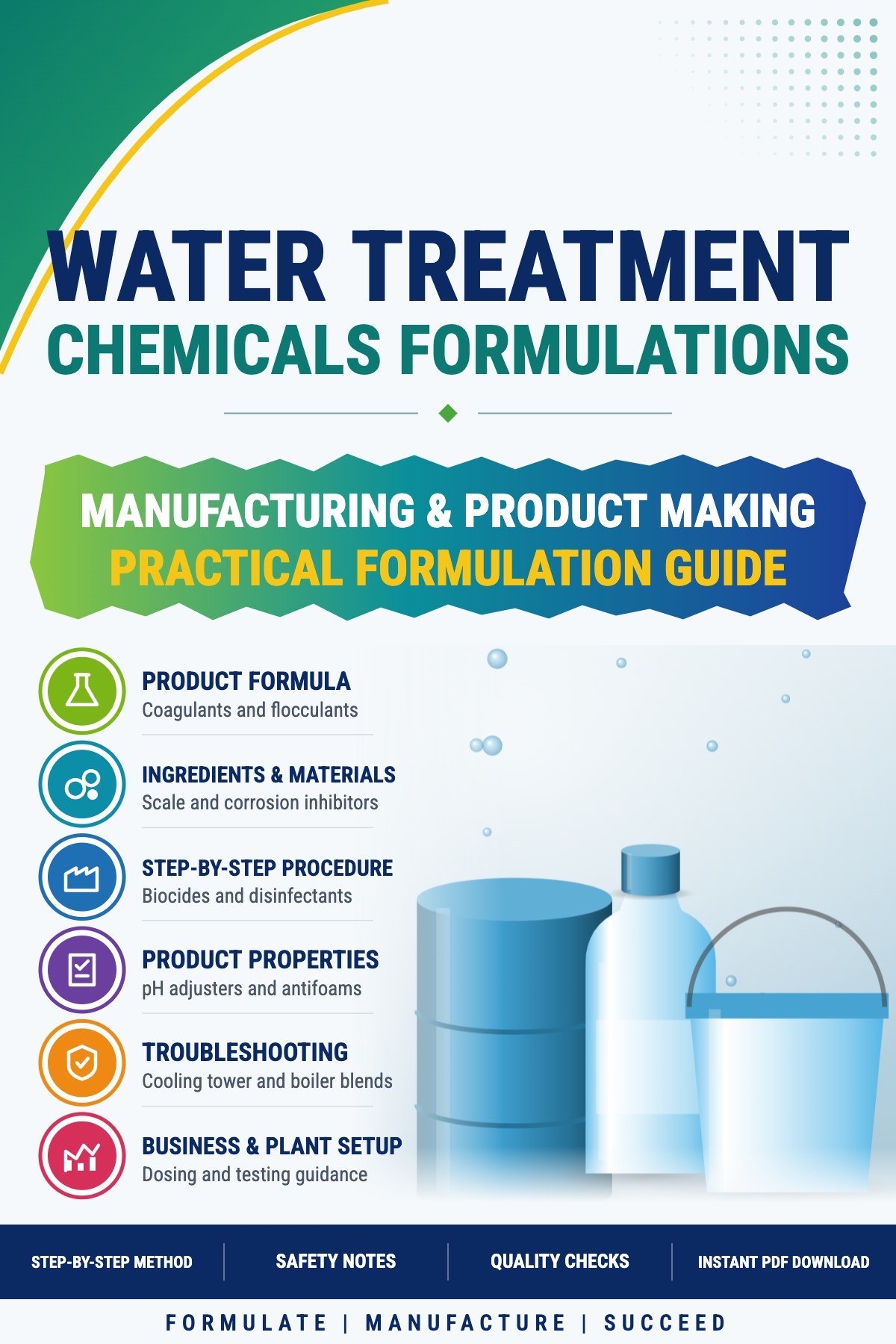

Water Treatment Chemicals Formulations
USD $75
PDF manual · Instant downloadWater Treatment Chemicals Formulations: a PDF guide to coagulants, flocculants, scale and corrosion inhibitors and biocides, with blending, dosing, testing and safety.
Payment Methods
Refund Policy
Custom Formulation Services
Formulation Consultation
Contact Us
Water is one of the most vital resources for human survival and industrial progress. Population growth, industrial expansion and rising pollution put heavy pressure on water quality, which makes efficient, reliable treatment more important than ever. Water Treatment Chemicals Formulations is a practical PDF guide from CFS for chemical blenders, water treatment service companies, startups and entrepreneurs. This page explains the main product families, how a water treatment chemicals formula is built for coagulation, scale control, corrosion control and microbial control, how blends are made and tested, and how to sell them with proper safety and regulatory care.
This guide is published by Chemical Formulation Services, the formulation publishing and consultancy business of CFS Formulation Services Ltd in Sheffield, United Kingdom. It is written for people who want to understand the product from the raw material to the finished pack, and it keeps its claims practical rather than promotional.
At a glance
- Product: Water Treatment Chemicals Formulations, a digital PDF Product Making Guide.
- Also searched as: water treatment chemicals formula, cooling tower chemicals, boiler water treatment, coagulant flocculant, scale inhibitor blend.
- Families: coagulants, flocculants, scale and corrosion inhibitors, biocides, pH adjusters, antifoams, cleaners.
- Key goals: clear water, protected equipment, safe dosing, low cost per cubic metre and compliance.
- Who it is for: chemical blenders, water service companies, plant engineers and entrepreneurs.
- Delivery: instant PDF download after payment is confirmed.
- Publisher: CFS Formulation Services Ltd, England and Wales company number 16678503.
Where water treatment chemicals are used
- Drinking water and municipal plants: coagulation, flocculation, pH correction and disinfection.
- Cooling towers and chillers: scale, corrosion and biological control.
- Boilers and steam systems: oxygen scavenging, alkalinity and scale control.
- Wastewater and effluent plants: solids removal, dewatering, odour and nutrient control.
- Swimming pools and spas: sanitiser, algaecide and clarifier.
- Reverse osmosis systems: antiscalants and membrane cleaners.
Main product families
Coagulants
Aluminium sulfate (alum), polyaluminium chloride, ferric chloride and ferric sulfate neutralise the charge on fine suspended particles so they clump. Dose and pH are critical, and jar tests set the right amount.
Flocculants
High-molecular-weight polyacrylamides (anionic, cationic or non-ionic) bridge the clumps into large flocs that settle or float. They are supplied as powders, emulsions or solutions and need careful dissolving to avoid fish-eyes.
Scale and corrosion inhibitors
Phosphonates (HEDP, ATMP, PBTC), polyacrylates and maleic copolymers keep hardness salts in solution and stop crystal growth. Zinc, molybdate, silicates and organic filming agents protect steel. Azoles such as tolyltriazole protect copper alloys.
Biocides
Oxidising types include chlorine, sodium hypochlorite, bromine donors and chlorine dioxide. Non-oxidising types include isothiazolinones, glutaraldehyde, DBNPA and quaternary compounds. They are rotated to prevent resistance.
Boiler chemicals
Sulfite, hydrazine alternatives (DEHA, carbohydrazide) to remove oxygen; amines for condensate pH; phosphate and polymer dispersants for hardness.
pH adjusters and antifoams
Sodium hydroxide, soda ash, acids and silicone or polyglycol antifoams.
What is inside the Water Treatment Chemicals Formulations guide
The guide begins from the point that water remains one of the most vital resources for human survival and industrial progress, with population growth, industrial expansion and pollution pressuring water quality and making efficient, reliable water treatment more important than ever. It then offers practical formulations, blending steps, dosing guidance, testing and safety notes.
Example blending: cooling tower inhibitor
Step 1: Water and polymer
Charge soft water to a plastic or stainless tank. Add polyacrylate dispersant and stir.
Step 2: Phosphonate
Add phosphonate solution slowly, then adjust pH with caustic to the specified window so the blend stays clear.
Step 3: Corrosion inhibitors
Add tolyltriazole pre-dissolved in alkali, zinc or molybdate if used, and mix until clear.
Step 4: Tracer, dye and filtration
Add an inert fluorescent tracer if dosing control requires it, filter and fill into drums or totes.
Dosing and monitoring
Products are dosed by chemical feed pumps, controlled by conductivity, flow, pH or tracer fluorescence. Cooling towers run at set cycles of concentration, bleeding off water as it concentrates. Boilers need regular blowdown and testing of alkalinity, hardness, sulfite and conductivity. Pools need residual sanitiser and pH checks several times a day. Always use jar tests, test kits and logbooks, and adjust doses seasonally.
Testing and quality control
- Active content, pH, density and clarity.
- Jar test performance for coagulants and flocculants.
- Scale inhibition by static calcium carbonate tests.
- Corrosion rate on steel and copper coupons.
- Biocide efficacy by microbial counts.
- Stability at low and high temperature.
- Heavy metal and impurity limits, especially for drinking water grades.
Troubleshooting
Cloudy water after coagulant
Wrong pH or dose. Run jar tests and adjust.
Scale in exchangers
Low inhibitor or too many cycles. Increase dose or bleed.
Corrosion and red water
Low pH or inhibitor loss. Restore programme and check oxygen.
Slime and odour
Biofilm. Shock dose biocide and clean the system.
Foaming
Organics or surfactants. Add antifoam and find the source.
Product separates in drum
Incompatibility or wrong pH. Adjust order of addition and pH.
Safety, regulation and environment
Many water chemicals are hazardous: chlorine and hypochlorite are corrosive and release toxic gas if mixed with acids or ammonia; acids and caustics burn; biocides are sensitisers and toxic to aquatic life. Drinking water chemicals must meet recognised purity standards and be certified for potable use. Biocidal products require registration in many regions. Store incompatible chemicals separately, use bunded storage, provide eyewash stations and train staff. Treat and discharge blowdown according to permits, and never release untreated effluent.
Packaging and business opportunity
Supply 25 kilogram bags, 20 litre pails, 200 litre drums and 1000 litre totes. Customers include factories, hotels, hospitals, commercial buildings, textile and food plants, municipal operators and pool owners. Package a service: chemicals, dosing pumps, test kits, scheduled visits and reports. Recurring service contracts give stable income, and documented savings from lower energy, water and maintenance costs justify your fees.
Explore related guides in the Cleaning Products, Detergent Formulations, Industrial Reports and Metal Treatment categories, and see Metal Ultrasonic Cleaners Formula, , EDTA-Chelated Zinc Fertilizers Formulations, , Copper Sulfate Industrial Manufacturing Report and .
Getting started
Pick one segment, such as cooling tower or pool chemicals. Learn the water chemistry, buy a test kit and jar-test equipment, blend a small trial batch and trial it on a friendly site. Record results, set safe storage, and add products and services as customers ask.
How to get the best results from this guide
Treat the guide as a tested starting point rather than a finished factory. Begin with a small trial batch in the laboratory or on a bench, using the exact raw materials you plan to buy, and record every weight, temperature, mixing time and observation. Compare the result with the quality checks in the guide, change only one thing at a time, and keep a note of what each change did. Once a small batch is consistently good, repeat it several times, then scale up in stages, because mixing, heating and cooling behave differently in larger vessels. Keep retained samples of every batch, write simple standard operating procedures for your team, and build relationships with two suppliers for each key raw material. Finally, check the labelling, safety and product rules in the country where you will sell, and ask a qualified person to review your process. This careful, documented approach is what turns a good formulation into a reliable product and a trusted brand.
Who should buy this guide?
The guide is written for practical readers. It suits manufacturers who want to add a new product to an existing plant, startups choosing their first product, private-label brands that need to understand what they are buying, technical staff who must set specifications and train operators, and consultants and students who want a structured, plain-language reference. It is less suitable for anyone looking for a quick shortcut or a guarantee, because every formulation still needs testing with your own materials, equipment and local rules. If you are unsure whether it matches your project, send a short question through the contact page before you order, and we will tell you honestly whether it fits.
What is inside the Water Treatment Chemicals Formulations guide
Every Product Making Guide in our shop follows the same structure so you know where to look. This guide includes the product formula, the ingredients and materials, the procedure and preparations, the industrial requirements and the technical specifications. In practice you receive:
- The formulation, written so you can follow it at the bench and scale it up.
- Ingredients and materials, with the job of each material and advice on grades and suppliers.
- The manufacturing procedure, including order of addition, mixing and preparations.
- Industrial requirements, covering equipment, space and packaging.
- Technical specifications, describing what a good finished product should look like and how it should behave.
- Troubleshooting for the faults that makers meet most often.
- Business guidance, to help you take the product from the bench to the market.
These Product Making Guides of chemical formulations and formulas are for manufacturers, startups and entrepreneurs. Every guide contains industrially tested, practical formulations. Anyone who buys a guide can make the product by following its step-by-step instructions. Raw materials vary between suppliers, so always confirm your results with a small trial batch before scaling up.
Who stands behind this guide?
Chemical Formulation Services is the trading name of CFS Formulation Services Ltd, registered in England and Wales under company number 16678503, with its office at Unit F, Winston Business Park, Churchill Way, Sheffield S35 2PS. The business was founded by George Enrick and publishes formulation manuals, technical guides and industry reports. You can check our details on the Companies House register, read about us, or contact us with any question before you order.
A written formulation cannot replace testing with your own raw materials, equipment and climate, and we say so plainly. What the guide does give you is a tested, structured starting point that can save you months of trial and error. Our terms and conditions explain what a purchase from us covers.
How to order
- Select Add to cart to keep browsing, or Buy Now to go straight to checkout.
- Pay with PayPal, Stripe, Xoom by PayPal, Payoneer, payment links for debit and credit cards, or Western Union, Ria and all money exchanges.
- If you pay through a money exchange, email your payment slip to Info@chemicalformulationservices.com. After confirmation, your instant download link is emailed to you.
- For online payments, the PDF is available as soon as the payment is confirmed.
All products are digital downloads and all payments are nonrefundable once the file is delivered, so please read the refund policy and the FAQs before you order. You can compare this guide with others in the formula shop or browse our industrial project reports.
Frequently asked questions about water treatment chemicals formulations
What are the Water Treatment Chemicals Formulations?
A digital PDF Product Making Guide to coagulants, flocculants, scale and corrosion inhibitors, biocides and related blends, with blending, dosing, testing and safety.
What is a jar test?
A small-scale test that finds the best coagulant dose and pH.
Why rotate biocides?
To prevent microbes becoming resistant.
Can I mix chlorine with acid?
No. It releases toxic chlorine gas.
Do drinking water chemicals need certification?
Yes. They must meet potable water standards in your region.
How do I receive the guide?
You receive an instant PDF download after payment is confirmed. For money exchanges, email your payment slip to Info@chemicalformulationservices.com and the link is emailed after we confirm it.
Is the payment refundable?
All payments are nonrefundable because the product is an instant digital download. See the refund policy for details.
Can you help with a custom formulation?
CFS Formulation Services Ltd offers formulation and product development consultancy. Send a short brief through the Contact page.
Last reviewed: November 2026. This page is general information about a digital product. It is not a safety data sheet or professional advice, and any formulation should be tested and reviewed by a qualified person before commercial use.