Mosquito Repellent Sticks Formula
USD $65
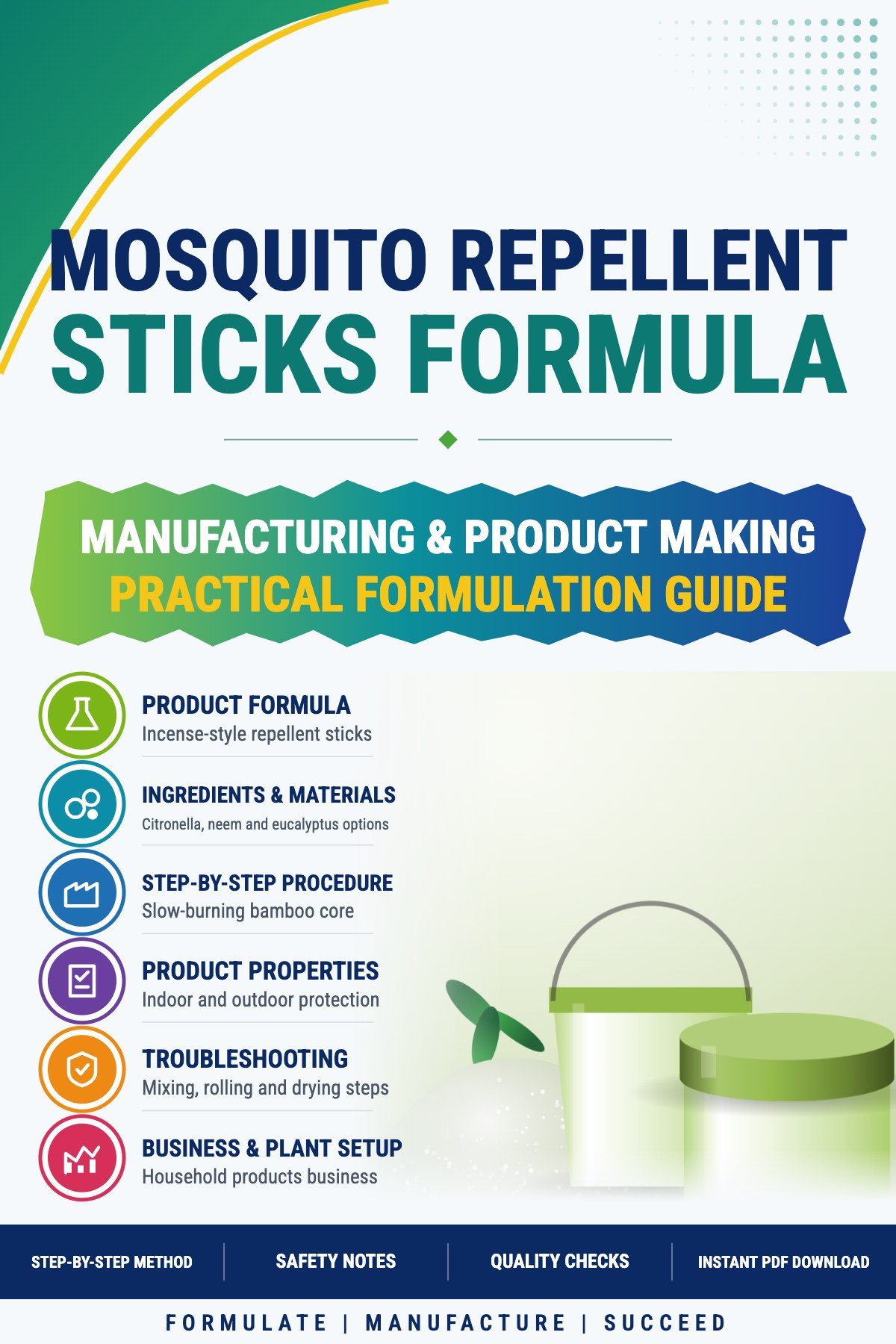
PDF manual · Instant downloadMosquito Repellent Sticks Formula: a PDF guide to incense-style mosquito repellent sticks, with ingredients, rolling and drying, testing, safety and registration notes.
Payment Methods
Refund Policy
Custom Formulation Services
Formulation Consultation
Contact Us
Mosquito Repellent Sticks Formula refers to the specific blend of natural or synthetic ingredients designed to repel mosquitoes when burned in the form of sticks. These formulas resemble incense sticks and are infused with active agents such as citronella, neem, eucalyptus or pyrethroids to deter mosquitoes in indoor and outdoor settings. This PDF guide is for household-product manufacturers, incense and coil makers, startups and entrepreneurs. This page explains how a mosquito repellent sticks formulation works, what goes into a mosquito repellent sticks formula, how the sticks are made, dried and tested, and the registration, safety and smoke-exposure issues every maker must understand.
This guide is published by Chemical Formulation Services, the formulation publishing and consultancy business of CFS Formulation Services Ltd in Sheffield, United Kingdom. It is written for people who want to understand the product from the raw material to the finished pack, and it keeps its claims practical rather than promotional.
At a glance
- Product: Mosquito Repellent Sticks Formula, a digital PDF Product Making Guide.
- Also searched as: mosquito repellent sticks formulation, mosquito stick incense, natural mosquito repellent sticks, citronella sticks, mosquito coil alternative.
- Form: slow-burning sticks, usually on a bamboo core.
- Active options: citronella, neem, eucalyptus, other botanicals or registered synthetic actives.
- Who it is for: household-product makers, incense producers, rural enterprises and entrepreneurs, subject to local registration.
- Delivery: instant PDF download after payment is confirmed.
- Publisher: CFS Formulation Services Ltd, England and Wales company number 16678503.
How burning repellent sticks work
A repellent stick is a slow-burning composition. When lit, the tip smoulders, not flames, and gives off a continuous thin smoke, vapourising the active ingredient mixed into the stick. The vapours spread in the surrounding air and either drive mosquitoes away by making the area unattractive, interfere with their ability to find a host, or in the case of synthetic pyrethroid actives, disorient and knock down insects. A stick may burn for thirty minutes to several hours, depending on length and composition, giving protection in a limited zone such as a porch, balcony, garden table or tent opening.
Sticks are similar to mosquito coils but in a straight form. They are popular because they are cheap, portable, easy to light and made from locally available materials. They are also relevant to rural enterprise, because the basic technology, mixing powders and binders, rolling and drying, needs little equipment.
Core components
- Combustible base: fine powders of wood, sawdust, coconut shell charcoal, coconut husk, rice husk or pyrethrum marc, which burn slowly and steadily.
- Binder: natural binders such as makko (tabu) powder, jigat powder, guar gum, starch or other mucilage that turns the powder into a dough and holds the shape. Makko is a classic incense binder with good burning behaviour.
- Active ingredient: botanical oils and extracts such as citronella, lemongrass, eucalyptus, neem, clove, cedar, geranium, or dried pyrethrum flower powder. Synthetic pyrethroids such as allethrin, transfluthrin or metofluthrin are used in registered commercial products at very low levels.
- Burn-rate modifiers: small amounts of oxidiser such as potassium nitrate are used in some sticks to maintain smouldering, but they must be used with care and within safe, regulated limits.
- Core: thin bamboo sticks for rolled incense-style products, or the dough extruded as a solid stick without core.
- Fragrance and dyes: to mask the odour and add appeal, kept modest.
- Preservative or anti-mould agent (optional): for storage in humid climates.
Botanical actives: what they can and cannot do
Citronella, lemongrass, eucalyptus, neem, clove, geranium, cedarwood and peppermint are the best known plant-based repellents. Laboratory and field studies show that some of them give a measurable effect, but the protection is generally shorter and less reliable than that of registered synthetic actives, partly because essential oils evaporate quickly and partly because smoke from burning sticks disperses unevenly in open air. Dried pyrethrum flower powder, from Chrysanthemum cinerariifolium, contains natural pyrethrins that are genuinely insecticidal and have a long history in mosquito coils, but they are also regulated and toxic to fish and bees. A responsible maker explains honestly what the stick does, avoids claims of disease prevention and recommends combining sticks with nets, screens and clothing in disease areas.
Burn behaviour: the science of a steady smoulder
A good stick does not flame. It smoulders at a steady rate because the heat from the glowing tip is just enough to keep the next layer of material glowing. If the stick is too dense, the ember starves of oxygen and goes out. If it is too loose or contains too much fast-burning fuel, it burns hot and fast and may flare. Charcoal powder provides a controllable, even ember. Wood and husk powders contribute volatile matter and smoke, and binders such as makko burn smoothly with little odour. Some makers add small amounts of potassium nitrate to sustain the burn, though this must be well mixed and kept to low levels because too much can cause sparking and flare-ups. Measure burn rate in millimetres per minute on sample sticks and keep it within a tight range from batch to batch.
Equipment for a small-scale unit
A small business needs a grinder or pulveriser, sieves, a powder mixer or a clean mixing table, a dough kneader, a stick-rolling or extruding machine, drying racks or a ventilated drying room with low heat, a weighing scale and packing materials. Bamboo sticks, sourced in bundles, can be pre-cut and sanded. A moisture meter helps check dryness. Dust control is important when grinding, with extraction and masks protecting workers. A small laboratory corner with a stopwatch, ruler and balance lets you test burn time and weight loss.
Packaging and presentation
Customers buy by look and smell, so attractive printed boxes, tubes or sleeves matter. Include a simple stand or holder, which prevents tipping and keeps hot ash off surfaces. Seal sticks in plastic film or foil to hold fragrance and block moisture. Print the active ingredients, directions for use, warnings, batch number, manufacturer and contact details. Provide icon-based instructions for customers who may not read the local language easily.
Costing, pricing and distribution
Raw materials are cheap, so the main costs are labour, packaging and marketing. Work out the cost per stick, add overhead and margin, and compare with competing products. Sell through local shops, markets, supermarkets, wholesalers and online platforms. Seasonal promotion before the rainy season, and bundling with holders and candles, builds sales. Export markets may require certification and documentation.
What is inside the Mosquito Repellent Sticks Formula guide
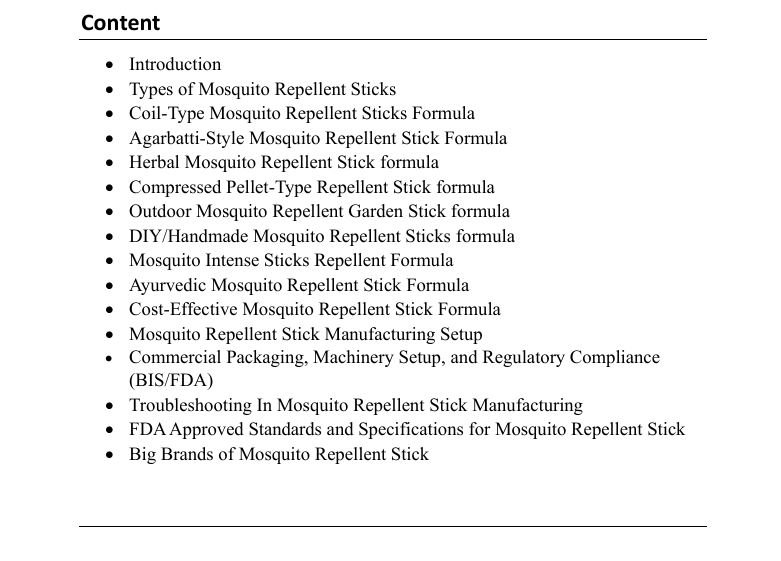
The guide explains the blends of natural and synthetic ingredients used in repellent sticks, how sticks often resemble incense sticks and may be infused with agents such as citronella, neem, eucalyptus or pyrethroids to deter mosquitoes indoors and outdoors. It then provides recipes, a production method, drying and quality guidance, burn-rate and safety tests and advice on registering and marketing the product.
How the sticks are made
Preparing the powders
Dry and grind the combustible materials to a fine, uniform powder and sieve. Moisture should be low and particle size consistent, since coarse particles cause uneven burning.
Preparing the active mix
Blend essential oils or approved actives with a small amount of carrier or powder so that they spread evenly in the dough. Add fragrance. Mix botanicals thoroughly.
Making the dough
Dry mix the powders and binder, then add water gradually, kneading to a smooth, firm dough that holds its shape without sticking. Add the active mix and knead evenly.
Forming the sticks
Roll the dough around bamboo sticks using a stick-rolling machine or by hand, or extrude it through a die for solid sticks. Keep thickness uniform, because thickness controls burn rate.
Drying
Dry the sticks in shade, in a ventilated room or low-temperature dryer, turning to avoid warping. Direct strong sun and fast heat cause cracking. Dry thoroughly, since damp sticks smoulder poorly.
Packing
Pack in moisture-barrier bags or tubes, with holders or stands. Seal well to keep active oils from evaporating and the sticks dry.
Quality and performance tests
- Burn time and consistency: time to burn a stick completely, stability of smouldering with no flame or going out.
- Strength: resistance to breaking in handling.
- Moisture content.
- Active ingredient content: verified analytically for registered synthetic actives.
- Efficacy: test in a closed room or chamber with mosquitoes using recognised protocols, or field evaluation.
- Smoke and ash: visible smoke, odour and residue.
- Storage stability: loss of oil and fragrance, mould growth.
Troubleshooting
Stick goes out or burns unevenly
Dough too wet, uneven density or too little burning aid. Dry fully, mix evenly and compress consistently.
Burns too fast
Too much fine charcoal, thin diameter or too much oxidiser. Adjust composition and size.
Stick breaks easily
Not enough binder or drying too fast. Raise binder level and dry slowly.
Weak repellent effect
Too little active, poor distribution or oil loss. Use proven actives at effective levels and seal packaging.
Mould growth in storage
Moisture and organic binders. Dry well, add anti-mould agent and pack in moisture-barrier materials.
Heavy smoke and odour
Wrong materials or too much oil. Adjust the base and reduce oil.
Health, safety and regulation
Burning any material makes smoke, and breathing smoke indoors is a health concern, particularly for children, older people and people with asthma or heart and lung disease. Use sticks in ventilated places, not in closed bedrooms, and never leave them unattended. Fire safety matters: sticks must sit in stable holders away from fabrics and flammables. Insecticidal actives in repellent sticks are biocides that are regulated in most countries; you generally need product registration, approved actives, safety and efficacy data and compliant labelling before selling. Natural claims do not remove regulatory requirements. Warnings should cover ventilation, keeping out of reach of children and pets, not inhaling smoke directly and safe disposal of ash. Handle powders with dust masks and keep the drying area clear of ignition sources.
Business opportunity
Demand for mosquito repellents is strong in tropical and subtropical regions, in rural and urban markets, and during rainy seasons and outdoor events. Sticks suit gardens, restaurants, resorts, campsites and homes. They can be produced as a small rural industry, creating jobs, using local materials such as coconut shells, sawdust and aromatic plants. Packs may vary from small retail boxes to bulk packs for hotels and distributors. Branding around natural ingredients, fragrance variants and attractive holders helps sales, but honest claims and regulatory compliance are essential. Offer complementary products such as repellent creams, sprays, candles and coils.
Related CFS guides help you build an insect-repellent and household range. Browse the Cleaning Products and Personal Care Products categories, and see , Firelighter Cubes Formulation, , Liquid Hand Soap Formula and Party Snow Spray Formulation. For agricultural pest knowledge, browse Herbicide Formulations.
Getting started
Begin with a botanical stick using sawdust or coconut shell powder, makko binder and citronella or lemongrass oil. Make small batches, dry them, and test burn time, smoke and strength. Check local rules on registration and efficacy requirements early. Prepare packaging with clear safety warnings, and, where required, arrange tests and registration. Then trial with local shops and gather feedback before expanding production.
How to get the best results from this guide
Treat the guide as a tested starting point rather than a finished factory. Begin with a small trial batch in the laboratory or on a bench, using the exact raw materials you plan to buy, and record every weight, temperature, mixing time and observation. Compare the result with the quality checks in the guide, change only one thing at a time, and keep a note of what each change did. Once a small batch is consistently good, repeat it several times, then scale up in stages, because mixing, heating and cooling behave differently in larger vessels. Keep retained samples of every batch, write simple standard operating procedures for your team, and build relationships with two suppliers for each key raw material. Finally, check the labelling, safety and product rules in the country where you will sell, and ask a qualified person to review your process. This careful, documented approach is what turns a good formulation into a reliable product and a trusted brand.
Who should buy this guide?
The guide is written for practical readers. It suits manufacturers who want to add a new product to an existing plant, startups choosing their first product, private-label brands that need to understand what they are buying, technical staff who must set specifications and train operators, and consultants and students who want a structured, plain-language reference. It is less suitable for anyone looking for a quick shortcut or a guarantee, because every formulation still needs testing with your own materials, equipment and local rules. If you are unsure whether it matches your project, send a short question through the contact page before you order, and we will tell you honestly whether it fits.
What is inside the Mosquito Repellent Sticks Formula guide
Every Product Making Guide in our shop follows the same structure so you know where to look. This guide includes the product formula, the ingredients and materials, the procedure and preparations, the industrial requirements and the technical specifications. In practice you receive:
- The formulation, written so you can follow it at the bench and scale it up.
- Ingredients and materials, with the job of each material and advice on grades and suppliers.
- The manufacturing procedure, including order of addition, mixing and preparations.
- Industrial requirements, covering equipment, space and packaging.
- Technical specifications, describing what a good finished product should look like and how it should behave.
- Troubleshooting for the faults that makers meet most often.
- Business guidance, to help you take the product from the bench to the market.
These Product Making Guides of chemical formulations and formulas are for manufacturers, startups and entrepreneurs. Every guide contains industrially tested, practical formulations. Anyone who buys a guide can make the product by following its step-by-step instructions. Raw materials vary between suppliers, so always confirm your results with a small trial batch before scaling up.
Who stands behind this guide?
Chemical Formulation Services is the trading name of CFS Formulation Services Ltd, registered in England and Wales under company number 16678503, with its office at Unit F, Winston Business Park, Churchill Way, Sheffield S35 2PS. The business was founded by George Enrick and publishes formulation manuals, technical guides and industry reports. You can check our details on the Companies House register, read about us, or contact us with any question before you order.
A written formulation cannot replace testing with your own raw materials, equipment and climate, and we say so plainly. What the guide does give you is a tested, structured starting point that can save you months of trial and error. Our terms and conditions explain what a purchase from us covers.
How to order
- Select Add to cart to keep browsing, or Buy Now to go straight to checkout.
- Pay with PayPal, Stripe, Xoom by PayPal, Payoneer, payment links for debit and credit cards, or Western Union, Ria and all money exchanges.
- If you pay through a money exchange, email your payment slip to Info@chemicalformulationservices.com. After confirmation, your instant download link is emailed to you.
- For online payments, the PDF is available as soon as the payment is confirmed.
All products are digital downloads and all payments are nonrefundable once the file is delivered, so please read the refund policy and the FAQs before you order. You can compare this guide with others in the formula shop or browse our industrial project reports.
Frequently asked questions about mosquito repellent sticks formula
What is the Mosquito Repellent Sticks Formula guide?
It is a digital PDF Product Making Guide to incense-style mosquito repellent sticks, with ingredients, production, testing and regulatory notes.
What binds the powders together?
Natural binders such as makko (tabu) powder, jigat, guar gum or starch.
Is the smoke harmful?
Smoke can irritate lungs, so use in ventilated areas and avoid prolonged exposure, especially for children and people with respiratory conditions.
Do I need registration?
Insect repellents are regulated as biocides in many countries, so check requirements before selling.
Why do sticks go out?
Dough too wet, uneven density or too little burning aid. Dry thoroughly and mix evenly.
How do I receive the guide?
You receive an instant PDF download after payment is confirmed. For money exchanges, email your payment slip to Info@chemicalformulationservices.com and the link is emailed after we confirm it.
Is the payment refundable?
All payments are nonrefundable because the product is an instant digital download. See the refund policy for details.
Can you help with a custom formulation?
CFS Formulation Services Ltd offers formulation and product development consultancy. Send a short brief through the Contact page.
Last reviewed: November 2026. This page is general information about a digital product. It is not a safety data sheet or professional advice, and any formulation should be tested and reviewed by a qualified person before commercial use.