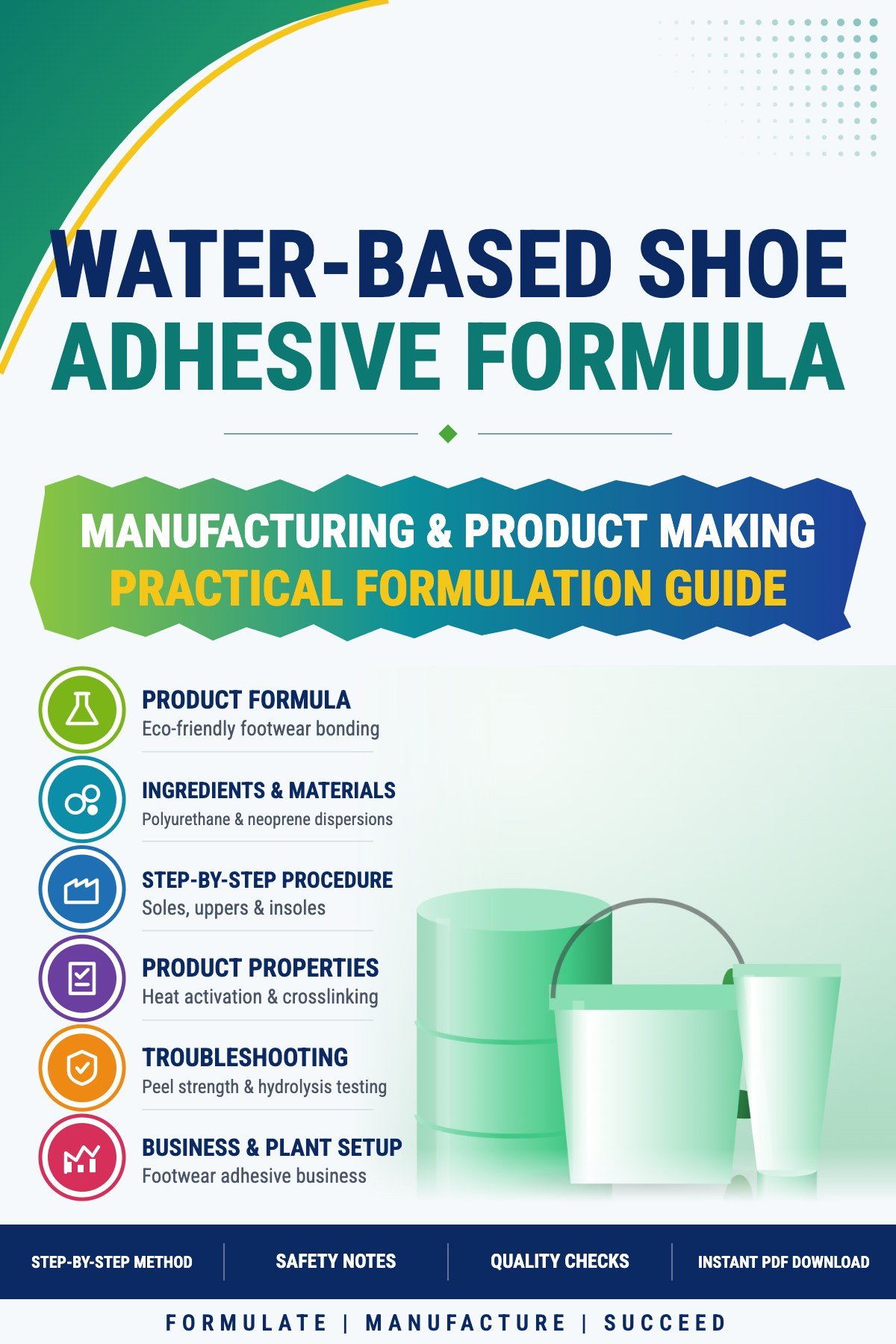

Water-Based Shoe Adhesive Formula
USD $50
PDF manual · Instant downloadWater-Based Shoe Adhesive Formula: a PDF guide to eco-friendly water-based footwear adhesives, with PU and neoprene dispersions, crosslinkers, factory application, testing and troubleshooting.
Payment Methods
Refund Policy
Custom Formulation Services
Formulation Consultation
Contact Us
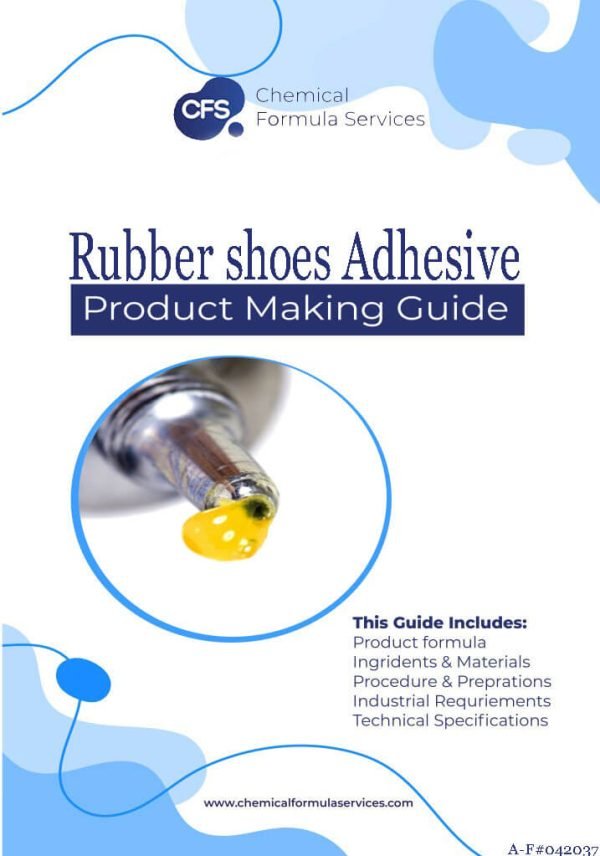
Water-Based Shoe Adhesive Formula is a practical PDF guide for chemists, formulators, footwear manufacturers and adhesive entrepreneurs who want to create eco-friendly, high-performance adhesives for shoe production. Footwear factories have traditionally relied on solvent-based adhesives, but pressure to cut VOC emissions, protect workers and meet brand sustainability goals has pushed the industry toward water-based systems that bond soles, uppers, insoles and linings without flammable solvents. This page explains how a water-based shoe adhesive formula works, what the guide covers and how a water-based shoe adhesive formulation is designed, made, applied and tested, so you can decide whether it suits your business.
This guide is published by Chemical Formulation Services, the formulation publishing and consultancy business of CFS Formulation Services Ltd in Sheffield, United Kingdom. It is written for people who want to understand the product from the raw material to the finished pack, and it keeps its claims practical rather than promotional.
At a glance
- Product: Water-Based Shoe Adhesive Formula, a digital PDF Product Making Guide.
- Also searched as: water-based shoe adhesive formulation, waterborne shoe glue, PU dispersion shoe adhesive, neoprene latex footwear adhesive.
- What it covers: dispersion chemistry, crosslinkers, additives, manufacturing, shoe-factory application and testing.
- Key goals: strong sole bonds, low VOC, heat activation, hydrolysis resistance and factory-friendly processing.
- Who it is for: adhesive chemists, formulators, footwear manufacturers and entrepreneurs.
- Delivery: instant PDF download after payment is confirmed.
- Publisher: CFS Formulation Services Ltd, England and Wales company number 16678503.
Why footwear is a demanding adhesive application
A shoe is a hard-working product. The sole is bonded to the upper, and the bond must withstand repeated flexing at every step, impact, sweat, water, temperature changes and, in many cases, years of wear. The materials are varied: leather, synthetic leather, textiles, rubber, thermoplastic rubber (TPR), polyurethane (PU), ethylene vinyl acetate (EVA) foam, PVC, EVA and rubber soles, each with different surface energy and chemistry. Some are smooth and hard to wet, some are porous. Plasticisers in PVC and some soles migrate into adhesive films. The factory process is fast, with conveyor lines, heat tunnels and presses, so the adhesive must dry, activate and bond quickly and reliably. For all these reasons, shoe adhesives are among the most sophisticated industrial adhesives.
From solvent-based to water-based
For decades, shoe factories used solvent-based polychloroprene and polyurethane adhesives, which wet surfaces quickly, dry fast and bond strongly. But these adhesives release large amounts of organic solvents such as toluene, acetone, ethyl acetate, methyl ethyl ketone and hexane. Those solvents are flammable, harmful to workers’ health and a major source of VOC emissions. Regulations in many countries, brand restricted-substance programmes and worker-safety concerns now push manufacturers to move toward water-based adhesives. Water-based systems replace the solvent with water. They have no flammable vapours, lower odour, reduced fire risk, and lower emissions, and they can be used in the same shoe-making steps once the process is adapted.
Types of water-based shoe adhesive
Polyurethane dispersion (PUD) adhesives
The leading technology for premium footwear bonding. PUDs are water-based dispersions of polyurethane particles, often crystalline polymers that melt when heated. After application and drying, the adhesive film is reactivated by heat to become tacky, then the sole and upper are pressed together. They give strong, flexible bonds, excellent hydrolysis resistance (with the right polyol), good heat resistance and excellent adhesion to many materials. Isocyanate-based crosslinkers are added just before use to increase heat and water resistance.
Polychloroprene (neoprene) latex adhesives
Water-based dispersions of polychloroprene offer high initial tack and fast bonding with the familiar behaviour of contact cement, and good adhesion to leather, rubber and textiles. They are widely used for rubber soles and lower-cost footwear. Resin dispersions and metal oxides are added to adjust tack and heat resistance.
Acrylic dispersion adhesives
Low in cost and easy to use, they suit insoles, linings and lighter-duty bonding, with additional tackifiers.
EVA and vinyl acetate dispersions
Used for insoles, counters, box toes and lamination of textiles and foams.
Hybrid and special systems
PU-acrylic hybrids, silane-modified dispersions and functionalised polymers meet specific requirements.
Main components of a water-based shoe adhesive
Polymer dispersion
The base, usually 40 to 60 percent solids. Properties such as crystallisation rate, activation temperature, glass transition, particle size and surface chemistry determine open time, heat activation and bond strength.
Crosslinker (hardener)
Water-dispersible isocyanates, carbodiimides or aziridines, mixed in at a few percent just before use, form chemical bonds between polymer chains and between adhesive and substrate, giving high heat resistance and durability. The adhesive has a limited pot life once the crosslinker is added.
Tackifier resins
Dispersed rosin esters or hydrocarbon resins improve tack and adhesion to difficult substrates.
Thickeners
Associative or acrylic thickeners adjust viscosity for brush, roller or spray application.
Wetting agents and defoamers
Wetting agents help the adhesive wet low-energy soles and uppers, and defoamers prevent bubbles that cause weak spots.
Fillers (for some grades)
Fine fillers adjust body and cost in non-critical uses.
pH adjusters, biocides and stabilisers
Maintain stability and prevent microbial growth in the water-containing product.
Colourants
Tints help operators see adhesive coverage.
What is inside the Water-Based Shoe Adhesive Formula guide
The guide is a comprehensive technical guide designed for chemists, formulators and manufacturers who aim to create eco-friendly, high-performance water-based adhesives for footwear. It explains the technology, gives practical formulations for different shoe constructions, describes step-by-step manufacturing, application in the shoe factory, quality control, troubleshooting and business ideas. It follows the CFS style of clear, industrially minded instructions.
How the adhesive is formulated and made
Many formulators buy polymer dispersions from resin suppliers and formulate them into finished adhesives. The outline below shows the general sequence. The guide gives full details.
Step 1: Select and check the dispersion
The base dispersion is checked for solids, pH, viscosity and particle size, and tested for storage stability. Compatibility with additives is tested in small samples.
Step 2: Charge and stir gently
The dispersion is charged to a clean mixing vessel and stirred at low shear to avoid shock, foaming or coagulation.
Step 3: Add pH adjuster and wetting agent
These are added slowly, and the pH is checked, as many dispersions are sensitive to pH changes.
Step 4: Add tackifier dispersion and thickener
Tackifier is blended in gradually, followed by thickener, until the target viscosity is reached.
Step 5: Add defoamer, biocide and colour
Functional additives are added and mixed.
Step 6: Test and filter
The adhesive is tested for solids, viscosity, pH, drying, activation temperature and peel strength on shoe materials, then filtered.
Step 7: Pack
The adhesive is filled into pails or drums with tight lids, protected from frost and heat, with the crosslinker supplied separately and labelled with mixing ratio and pot life.
Equipment requirements
Production needs stainless steel or plastic mixing vessels with slow-speed agitators, accurate scales or meters, filters, filling equipment and storage protected from freezing. A laboratory needs a viscometer, pH meter, solids oven, peel testing machine, a hot-air oven or infrared activator for testing, and sample shoe materials, as well as accelerated ageing equipment. In the shoe factory, adhesive application uses brushes, rollers or spray systems, drying tunnels or infrared lamps, activators and presses.
Shoe factory process notes
Surfaces are first cleaned and, for some soles, chemically treated with primers or halogenation solutions to improve adhesion. Adhesive is applied to both the upper and the sole and dried at moderate temperature until clear and dry to touch. The dried film is heat-activated, typically at 50 to 80 degrees Celsius using an infrared activator, which makes it tacky. The sole and upper are then joined quickly and pressed under pressure for a few seconds. Good bonds develop within minutes, and full strength arrives after a day. Drying is the critical step with water-based adhesives. Insufficient drying traps water and gives poor bonds, so the dryer, air flow and humidity must be controlled. Water-based adhesive must not freeze in storage or transport, because freezing coagulates the dispersion.
Quality control for every batch
- Solids, viscosity and pH.
- Drying time: at standard conditions.
- Activation temperature and open time: window for bonding after activation.
- Initial and final peel strength: on typical shoe materials, such as leather to PU sole, rubber to textile, TPR to leather.
- Heat resistance: bond held at elevated temperature under load.
- Hydrolysis and water resistance: aged in hot, humid conditions, then peel tested.
- Plasticiser migration resistance: aged bonds on PVC and soft soles.
- Freeze-thaw and storage stability.
- Crosslinker pot life: time after mixing before performance falls.
Troubleshooting
Poor initial grab
Film not dry enough, activation temperature too low, or open time exceeded. Adjust the drying and activation settings.
Low final peel strength
Poor surface preparation, no crosslinker, or wrong adhesive for the material. Improve cleaning, use primer and crosslinker.
Bubbles or blisters
Trapped water from insufficient drying, or foam. Improve drying and defoamer.
Bond fails after humidity or heat
Hydrolysis-prone polymer or inadequate crosslinking. Use polyether or polycarbonate-based PUD and correct crosslinker level.
Adhesive coagulates or lumps
Freezing, pH shock, incompatible additives or high shear. Protect from frost, add additives slowly and use low shear.
Poor adhesion to certain soles
Surface contamination or mould release. Clean, roughen or prime.
Short pot life after adding crosslinker
Too much crosslinker or high temperature. Mix small amounts and use within the stated time.
Safety, health and regulation
Water-based adhesives reduce fire and solvent hazards, but they are not free of hazards. Isocyanate crosslinkers are respiratory sensitisers and skin irritants, and require ventilation, gloves and eye protection. Biocides can sensitise skin. Provide safety data sheets and hazard labels. Footwear sold in many markets must meet chemical restrictions, such as limits for formaldehyde, phthalates, chromium VI, azo dyes and other substances, and brands apply restricted-substance lists, so adhesive ingredients and residual monomers must comply. Wastewater and cleaning water from adhesive plants require treatment. Frost protection and prompt use help avoid waste.
The business opportunity
Billions of pairs of shoes are made every year, mainly in Asia, but also in Europe, the Americas and Africa. Footwear brands increasingly demand water-based, low-VOC adhesives from their factories. Adhesive suppliers who can offer reliable water-based systems with technical support in the factory have a significant advantage. Customers include shoe factories, sandals and slipper makers, safety footwear producers, repair shops and leather goods makers. Manufacturers can start by supplying water-based adhesives for simpler constructions, such as sandals, slippers and insoles, then develop systems for higher-performance sports and leather shoes. Offering primers, cleaners, crosslinkers and training builds a complete system.
Related CFS guides help build an adhesive range. Browse the Industrial Adhesive Formulations category, and see Contact Adhesive Formulations, , PU Textile Lamination Adhesive Formulations, Car Upholstery Adhesives Formula, IMUTHANE Prepolymers Formula and Reziance 310 Liquid Resin Formulation. For rubber knowledge, see CR Rubber Additives Formulation and the Rubber Goods Making category.
Getting started
Begin by sourcing a polyurethane dispersion and a neoprene latex from reputable suppliers, and learning to formulate basic adhesives. Make small batches, test peel strength on typical shoe materials, and run activation and drying trials. Compare with solvent-based and commercial water-based adhesives, and adjust. Work with a shoe factory or repair workshop for trials, record every parameter and gather feedback. Prepare data sheets, safety documents and training materials, then scale up gradually.
How to get the best results from this guide
Treat the guide as a tested starting point rather than a finished factory. Begin with a small trial batch in the laboratory or on a bench, using the exact raw materials you plan to buy, and record every weight, temperature, mixing time and observation. Compare the result with the quality checks in the guide, change only one thing at a time, and keep a note of what each change did. Once a small batch is consistently good, repeat it several times, then scale up in stages, because mixing, heating and cooling behave differently in larger vessels. Keep retained samples of every batch, write simple standard operating procedures for your team, and build relationships with two suppliers for each key raw material. Finally, check the labelling, safety and product rules in the country where you will sell, and ask a qualified person to review your process. This careful, documented approach is what turns a good formulation into a reliable product and a trusted brand.
Who should buy this guide?
The guide is written for practical readers. It suits manufacturers who want to add a new product to an existing plant, startups choosing their first product, private-label brands that need to understand what they are buying, technical staff who must set specifications and train operators, and consultants and students who want a structured, plain-language reference. It is less suitable for anyone looking for a quick shortcut or a guarantee, because every formulation still needs testing with your own materials, equipment and local rules. If you are unsure whether it matches your project, send a short question through the contact page before you order, and we will tell you honestly whether it fits.
What is inside the Water-Based Shoe Adhesive Formula guide
Every Product Making Guide in our shop follows the same structure so you know where to look. This guide includes the product formula, the ingredients and materials, the procedure and preparations, the industrial requirements and the technical specifications. In practice you receive:
- The formulation, written so you can follow it at the bench and scale it up.
- Ingredients and materials, with the job of each material and advice on grades and suppliers.
- The manufacturing procedure, including order of addition, mixing and preparations.
- Industrial requirements, covering equipment, space and packaging.
- Technical specifications, describing what a good finished product should look like and how it should behave.
- Troubleshooting for the faults that makers meet most often.
- Business guidance, to help you take the product from the bench to the market.
These Product Making Guides of chemical formulations and formulas are for manufacturers, startups and entrepreneurs. Every guide contains industrially tested, practical formulations. Anyone who buys a guide can make the product by following its step-by-step instructions. Raw materials vary between suppliers, so always confirm your results with a small trial batch before scaling up.
Who stands behind this guide?
Chemical Formulation Services is the trading name of CFS Formulation Services Ltd, registered in England and Wales under company number 16678503, with its office at Unit F, Winston Business Park, Churchill Way, Sheffield S35 2PS. The business was founded by George Enrick and publishes formulation manuals, technical guides and industry reports. You can check our details on the Companies House register, read about us, or contact us with any question before you order.
A written formulation cannot replace testing with your own raw materials, equipment and climate, and we say so plainly. What the guide does give you is a tested, structured starting point that can save you months of trial and error. Our terms and conditions explain what a purchase from us covers.
How to order
- Select Add to cart to keep browsing, or Buy Now to go straight to checkout.
- Pay with PayPal, Stripe, Xoom by PayPal, Payoneer, payment links for debit and credit cards, or Western Union, Ria and all money exchanges.
- If you pay through a money exchange, email your payment slip to Info@chemicalformulationservices.com. After confirmation, your instant download link is emailed to you.
- For online payments, the PDF is available as soon as the payment is confirmed.
All products are digital downloads and all payments are nonrefundable once the file is delivered, so please read the refund policy and the FAQs before you order. You can compare this guide with others in the formula shop or browse our industrial project reports.
Frequently asked questions about water-based shoe adhesive formula
What is the Water-Based Shoe Adhesive Formula guide?
It is a digital PDF Product Making Guide to formulating eco-friendly water-based adhesives for footwear, covering polyurethane dispersions, neoprene latex, crosslinkers, manufacturing, factory application and testing.
Why switch from solvent-based to water-based shoe glue?
Water-based adhesives cut VOC emissions, odour and fire risk, protect workers and meet brand sustainability and regulatory requirements.
What is heat activation?
The dried adhesive film is warmed, usually by infrared, so it turns tacky and bonds when the sole and upper are pressed together.
Why is a crosslinker added?
Isocyanate or similar crosslinkers form chemical bonds in the film, improving heat, water and durability, but they limit pot life once mixed.
Can water-based adhesive freeze?
Freezing can coagulate the dispersion and ruin it, so protect from frost in storage and transport.
How do I receive the guide?
You receive an instant PDF download after payment is confirmed. For money exchanges, email your payment slip to Info@chemicalformulationservices.com and the link is emailed after we confirm it.
Is the payment refundable?
All payments are nonrefundable because the product is an instant digital download. See the refund policy for details.
Can you help with a custom formulation?
CFS Formulation Services Ltd offers formulation and product development consultancy. Send a short brief through the Contact page.
Last reviewed: November 2026. This page is general information about a digital product. It is not a safety data sheet or professional advice, and any formulation should be tested and reviewed by a qualified person before commercial use.