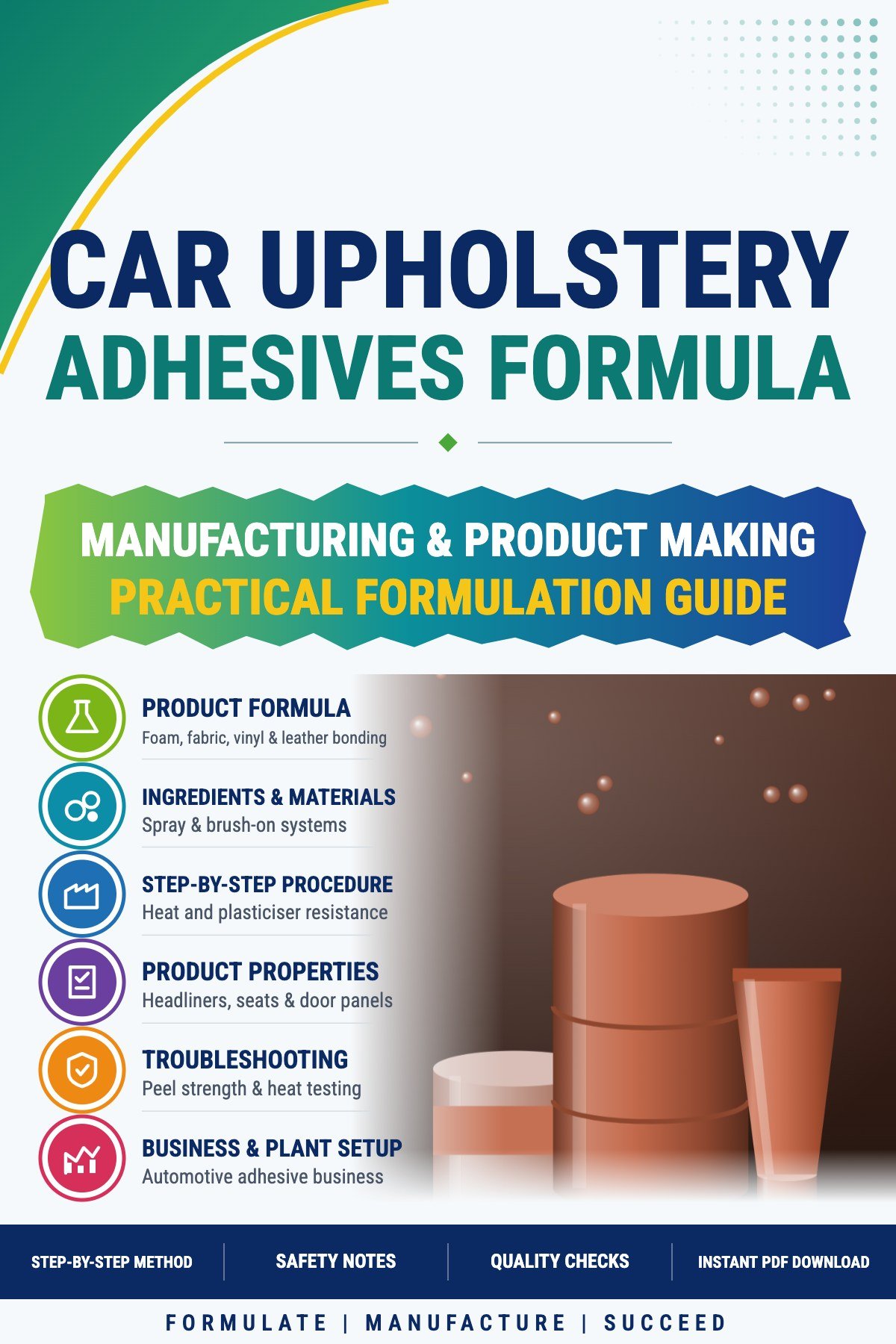

Car Upholstery Adhesives Formula
USD $75
PDF manual · Instant downloadCar Upholstery Adhesives Formula: a PDF guide to making automotive contact and spray adhesives for foam, fabric, vinyl and leather, with chemistries, manufacturing, application and testing.
Payment Methods
Refund Policy
Custom Formulation Services
Formulation Consultation
Contact Us
Car Upholstery Adhesives Formula is a practical PDF guide for automotive-adhesive manufacturers, upholstery suppliers, trim shops and entrepreneurs who want a production-ready adhesive for bonding foam, fabric, vinyl and leather in vehicle interiors. Car seats, headliners, door panels, dashboards, carpets and boot linings all depend on adhesive that grips firmly, resists heat and plasticiser migration, and stays flexible for years. This page explains how a car upholstery adhesives formula works, what the guide covers and how a car upholstery adhesives formulation is designed for superior bonding strength, durability and ease of application, made and tested, so you can decide whether it suits your business.
This guide is published by Chemical Formulation Services, the formulation publishing and consultancy business of CFS Formulation Services Ltd in Sheffield, United Kingdom. It is written for people who want to understand the product from the raw material to the finished pack, and it keeps its claims practical rather than promotional.
At a glance
- Product: Car Upholstery Adhesives Formula, a digital PDF Product Making Guide.
- Also searched as: car upholstery adhesives formulation, headliner adhesive, automotive spray adhesive, foam and fabric glue for cars.
- What it covers: polymer systems, solvents, tackifiers, additives, spray and brush grades, manufacturing and testing.
- Key goals: strong bond, heat and plasticiser resistance, flexibility, no bleed-through and easy application.
- Who it is for: adhesive makers, automotive trim and upholstery suppliers, repair shops and entrepreneurs.
- Delivery: instant PDF download after payment is confirmed.
- Publisher: CFS Formulation Services Ltd, England and Wales company number 16678503.
Why car interiors are hard on adhesives
The inside of a car is a harsh place for glue. On a sunny day, a parked car can reach interior temperatures of seventy degrees Celsius or more at the dashboard and headliner, and in winter it can drop far below freezing. Materials move, stretch and vibrate constantly. Seats are sat on, entered and cleaned. Vinyl and some foams contain plasticisers that migrate into the adhesive over time and soften it, causing the bond to creep and fail. Headliner foam deteriorates and powders. A good upholstery adhesive has to remain strong, flexible and unaffected by these stresses for the life of the vehicle, and it has to be easy for trimmers to apply.
Common automotive upholstery jobs
- Headliners: bonding fabric-faced foam to the roof board, where heat resistance and no bleed-through are critical.
- Seat covers and cushions: bonding leather, vinyl or fabric to foam, with flexible, durable bonds.
- Door panels and trim: fixing fabric, vinyl or carpet to plastic or fibre boards.
- Dashboards and consoles: wrapping vinyl or leather over foam or hard plastic.
- Carpets and boot liners: fixing carpet to metal floors and rigid trim.
- Sound and heat insulation: bonding felt, foam and mats.
- Repairs and restoration: reattaching sagging headliners, torn trim and loose coverings.
Types of adhesive
Solvent-based polychloroprene contact adhesive
The classic choice, delivering high initial grab, strong peel strength and good heat resistance, usually with phenolic resin and metal oxides. It is applied to both surfaces, dried until tacky and pressed together.
Spray-grade contact adhesives
Lower viscosity versions in aerosol cans or spray guns give a fine, even web on large areas such as headliners and carpets. They are fast and economical, and high-temperature grades are used for headliners.
Polyurethane adhesives
Solvent-based or reactive polyurethanes give excellent heat, plasticiser and migration resistance, which suits PVC and leather bonding in vehicles.
Water-based adhesives
Polychloroprene latex, polyurethane dispersions and acrylic dispersions provide low-VOC and low-odour alternatives, increasingly required in automotive factories and many markets.
Hot-melt and reactive hot-melt adhesives
Used in factory lamination of trim parts, with high speed and clean processing.
Pressure-sensitive adhesives and tapes
Double-sided tapes and sprayable pressure-sensitive adhesives for light-duty trim fixing.
Main components of the formulation
Base polymer
Polychloroprene gives a broad balance of strength and heat resistance. SBS and SIS block copolymer rubbers provide high tack and are economical for spray adhesives. Polyurethane polymers improve migration resistance. The polymer controls strength, flexibility and application.
Tackifying and reinforcing resins
Phenolic, terpene-phenolic, rosin ester and hydrocarbon resins raise tack, adhesion and heat resistance.
Metal oxides and stabilisers
Magnesium oxide and zinc oxide protect polychloroprene and react with phenolic resin for heat resistance. Antioxidants prevent ageing.
Solvents or water
Solvent blends of esters, ketones and hydrocarbons control viscosity and drying. For automotive use, solvent systems exclude restricted solvents and are chosen to reduce odour and VOCs. Water-based types use water as the carrier.
Crosslinkers
Isocyanate crosslinkers added before use improve heat and chemical resistance in high-demand uses.
Fillers and colourants
Fine fillers adjust viscosity and cost, and dyes help applicators see coverage. Light-coloured or transparent grades avoid staining light fabrics.
Propellants (aerosols)
Spray products use hydrocarbon or other propellants, filled using certified equipment.
What is inside the Car Upholstery Adhesives Formula guide
The guide is a high-performance, production-ready formula designed for superior bonding strength, durability and ease of application, developed by industry experts so that entrepreneurs and manufacturers can create premium-grade adhesives for the automotive trade. It describes the chemistry, ingredient roles, practical formulations for brush and spray grades, step-by-step manufacturing, packaging, application, quality control, troubleshooting and business advice. It follows the CFS style of clear, industrially minded instructions.
How the adhesive is made
The outline below shows the general sequence. The guide gives full details.
Step 1: Mill the rubber
Polychloroprene or other rubber is softened and cut on a two-roll mill, where metal oxides and antioxidants are blended in.
Step 2: Prepare the resin solution
Tackifying resins are dissolved in part of the solvent. Phenolic resin may be reacted with magnesium oxide to form a resinate.
Step 3: Dissolve the rubber
Milled rubber is dissolved in the solvent blend in a strong sealed mixer, such as a sigma-blade kneader or double-planetary mixer, until smooth.
Step 4: Combine and adjust
The resin solution, additional solvent and additives are blended in, and viscosity and solids are adjusted for the application method.
Step 5: Test
Samples are tested for solids, viscosity, open time, peel strength and heat resistance, and the formula is tuned.
Step 6: Filter and fill
The adhesive is filtered and filled into drums, pails, cans or aerosol containers, sealed and labelled.
Equipment requirements
A plant needs a two-roll mill, explosion-proof mixers for viscous solutions, solvent-resistant tanks, accurate scales, filtration, filling lines, flammable storage and ventilation. A laboratory needs a viscometer, solids oven, peel and shear testers, a heat oven for creep tests and sample fabrics, foams, vinyl, leather and boards. Aerosol production requires specialised, certified filling facilities.
Application guidance
Surfaces should be clean, dry and free of dust, oil and release agents. Old adhesive and crumbling foam are removed. The adhesive is applied evenly to both surfaces, as a thin web by spray or by brush, and allowed to become tacky. For headliners, the web should be light and consistent to avoid bleed-through. Surfaces are pressed together smoothly from the centre outwards with a roller or by hand, eliminating wrinkles and air bubbles, because the bond is immediate. Heat can help reactivate and conform adhesive around curves. Work in a ventilated area, with doors open, and follow the manufacturer’s directions on temperature, since cold and damp conditions slow drying and weaken bonds.
Quality control for every batch
- Solids and viscosity: matched to the application method.
- Spray pattern: even web without spitting for spray grades.
- Open time: adequate working window.
- Peel strength: on foam-to-fabric, vinyl-to-foam and board bonds, at room temperature and after ageing.
- Heat resistance: bond held under load at elevated temperature, typically up to 80 degrees Celsius or higher.
- Plasticiser migration resistance: aged bonds on vinyl.
- Bleed-through: check that adhesive does not stain light fabrics.
- Odour and VOC: within automotive limits.
- Storage stability: no gelling or phase separation.
Troubleshooting
Headliner sags or bubbles
Adhesive not heat resistant, applied too thin or on crumbling foam. Use high-temperature grades and remove old foam residue.
Bond creeps on vinyl
Plasticiser migration. Use polyurethane or specially formulated migration-resistant adhesives.
Bleed-through staining
Too heavy a coat or solvent soaking through thin fabric. Reduce coat weight and use a less aggressive solvent system.
Poor initial grab
Open time exceeded or surfaces contaminated. Apply fresh adhesive and clean surfaces.
Spray spitting or uneven web
Viscosity wrong or nozzle partly blocked. Adjust viscosity and pressure, and clean equipment.
Strong smell after installation
Slow solvent release. Choose faster-evaporating or low-odour solvents and ventilate the car.
Hard, stiff bond line
Too much resin or filler. Adjust ratios to maintain flexibility.
Safety, health and regulation
Solvent-based and aerosol adhesives are highly flammable, and vapours are harmful in the confined space of a vehicle. Never use them near sparks, pilot lights or smoking, keep doors and windows open, and use respirators suited to organic vapours in professional use. Many regions restrict toluene, n-hexane, methylene chloride and other solvents in consumer adhesives. Isocyanate crosslinkers are respiratory sensitisers. Automotive manufacturers often set strict limits on emissions of volatile compounds inside vehicles, and adhesives for original equipment must meet those standards. Provide safety data sheets, correct hazard labelling, and follow VOC and transport of dangerous goods rules. Aerosol cans need correct handling and disposal.
The business opportunity
Every car has several square metres of upholstery, trim and carpet held together with adhesive. Demand comes from trim shops, car repair centres, upholsterers, aftermarket restorers, vehicle assemblers and DIY owners with sagging headliners. Manufacturers can supply sprays for repair markets, bulk drums to trim shops, and engineered grades to component suppliers. High-temperature headliner adhesive, foam-to-vinyl contact adhesive and clear, non-staining sprays each form a product line. Technical support and demonstration help build confidence, and private-label supply to auto parts distributors extends reach.
Related CFS guides help build an adhesive and car-care range. See Contact Adhesive Formulations, Metal Bond Adhesive Formula, , Typical Epoxy Adhesive Formulation and PU Textile Lamination Adhesive Formulations, and browse the Industrial Adhesive Formulations category. For interior care products, see Leather Rubber Plastic Polish, Adhesive Remover Formula and the Auto Care Products category, and see CR Rubber Additives Formulation for chloroprene rubber compounding.
Getting started
Begin with a polychloroprene brush-grade contact adhesive and a sprayable high-temperature headliner grade. Make small batches, bond foam, fabric, vinyl and board samples, and measure open time, peel and heat resistance. Compare with respected automotive adhesives, adjust your resin and solvent balance and trial your products with a local trim shop. Gather feedback, refine your labels and safety documentation, and scale up with proper solvent handling.
How to get the best results from this guide
Treat the guide as a tested starting point rather than a finished factory. Begin with a small trial batch in the laboratory or on a bench, using the exact raw materials you plan to buy, and record every weight, temperature, mixing time and observation. Compare the result with the quality checks in the guide, change only one thing at a time, and keep a note of what each change did. Once a small batch is consistently good, repeat it several times, then scale up in stages, because mixing, heating and cooling behave differently in larger vessels. Keep retained samples of every batch, write simple standard operating procedures for your team, and build relationships with two suppliers for each key raw material. Finally, check the labelling, safety and product rules in the country where you will sell, and ask a qualified person to review your process. This careful, documented approach is what turns a good formulation into a reliable product and a trusted brand.
Who should buy this guide?
The guide is written for practical readers. It suits manufacturers who want to add a new product to an existing plant, startups choosing their first product, private-label brands that need to understand what they are buying, technical staff who must set specifications and train operators, and consultants and students who want a structured, plain-language reference. It is less suitable for anyone looking for a quick shortcut or a guarantee, because every formulation still needs testing with your own materials, equipment and local rules. If you are unsure whether it matches your project, send a short question through the contact page before you order, and we will tell you honestly whether it fits.
What is inside the Car Upholstery Adhesives Formula guide
Every Product Making Guide in our shop follows the same structure so you know where to look. This guide includes the product formula, the ingredients and materials, the procedure and preparations, the industrial requirements and the technical specifications. In practice you receive:
- The formulation, written so you can follow it at the bench and scale it up.
- Ingredients and materials, with the job of each material and advice on grades and suppliers.
- The manufacturing procedure, including order of addition, mixing and preparations.
- Industrial requirements, covering equipment, space and packaging.
- Technical specifications, describing what a good finished product should look like and how it should behave.
- Troubleshooting for the faults that makers meet most often.
- Business guidance, to help you take the product from the bench to the market.
These Product Making Guides of chemical formulations and formulas are for manufacturers, startups and entrepreneurs. Every guide contains industrially tested, practical formulations. Anyone who buys a guide can make the product by following its step-by-step instructions. Raw materials vary between suppliers, so always confirm your results with a small trial batch before scaling up.
Who stands behind this guide?
Chemical Formulation Services is the trading name of CFS Formulation Services Ltd, registered in England and Wales under company number 16678503, with its office at Unit F, Winston Business Park, Churchill Way, Sheffield S35 2PS. The business was founded by George Enrick and publishes formulation manuals, technical guides and industry reports. You can check our details on the Companies House register, read about us, or contact us with any question before you order.
A written formulation cannot replace testing with your own raw materials, equipment and climate, and we say so plainly. What the guide does give you is a tested, structured starting point that can save you months of trial and error. Our terms and conditions explain what a purchase from us covers.
How to order
- Select Add to cart to keep browsing, or Buy Now to go straight to checkout.
- Pay with PayPal, Stripe, Xoom by PayPal, Payoneer, payment links for debit and credit cards, or Western Union, Ria and all money exchanges.
- If you pay through a money exchange, email your payment slip to Info@chemicalformulationservices.com. After confirmation, your instant download link is emailed to you.
- For online payments, the PDF is available as soon as the payment is confirmed.
All products are digital downloads and all payments are nonrefundable once the file is delivered, so please read the refund policy and the FAQs before you order. You can compare this guide with others in the formula shop or browse our industrial project reports.
Frequently asked questions about car upholstery adhesives formula
What is the Car Upholstery Adhesives Formula guide?
It is a digital PDF Product Making Guide to making high-performance adhesives for bonding foam, fabric, vinyl and leather in vehicle interiors, including brush and spray grades.
Why do headliners sag?
Heat, ageing foam and an adhesive that cannot withstand high temperatures cause the bond to fail. High-temperature adhesives and removal of old foam prevent it.
What is plasticiser migration?
Plasticisers in vinyl and some foams move into the adhesive and soften it, causing creep. Migration-resistant polyurethane adhesives help.
How can bleed-through be avoided?
Apply a light, even coat, use a suitable solvent system and avoid overly heavy spraying on thin or light-coloured fabrics.
Are automotive adhesives hazardous?
Solvent-based and aerosol types are flammable and their vapours are harmful in enclosed vehicles, so use ventilation, avoid ignition sources and follow safety instructions.
How do I receive the guide?
You receive an instant PDF download after payment is confirmed. For money exchanges, email your payment slip to Info@chemicalformulationservices.com and the link is emailed after we confirm it.
Is the payment refundable?
All payments are nonrefundable because the product is an instant digital download. See the refund policy for details.
Can you help with a custom formulation?
CFS Formulation Services Ltd offers formulation and product development consultancy. Send a short brief through the Contact page.
Last reviewed: November 2026. This page is general information about a digital product. It is not a safety data sheet or professional advice, and any formulation should be tested and reviewed by a qualified person before commercial use.