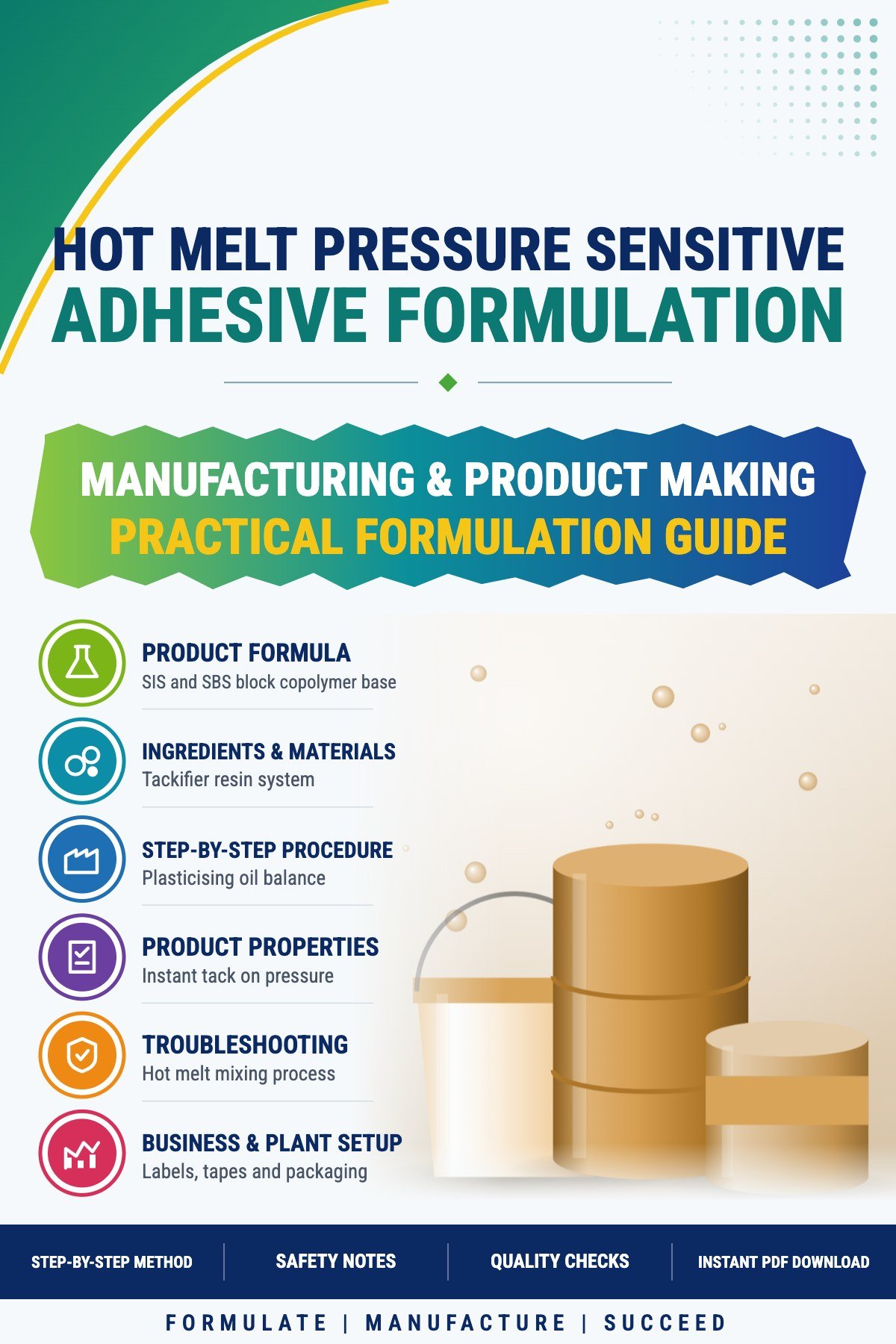

Hot Melt Pressure Sensitive Adhesive Formulation
USD $70
PDF manual · Instant downloadHot Melt Pressure Sensitive Adhesive Formulation: a PDF guide to making HMPSA from SIS or SBS, tackifier resin, oil and antioxidant, with processing and testing.
Payment Methods
Refund Policy
Custom Formulation Services
Formulation Consultation
Contact Us
Hot Melt Pressure Sensitive Adhesive Formulation is a practical PDF guide for adhesive manufacturers, label and tape converters, startups and entrepreneurs who want to make a hot melt pressure-sensitive adhesive, usually abbreviated HMPSA. This type of adhesive is solid at room temperature, melts when heated, can be applied to a backing, and then stays permanently tacky so that it bonds instantly when pressed against a surface. It is the adhesive behind many labels, tapes, sanitary products, packaging closures and mounting products. This page explains how a hot melt pressure sensitive adhesive formulation works, what goes into a hot melt pressure sensitive adhesive formula, how it is made and tested, and how it can become a product line.
This guide is published by Chemical Formulation Services, the formulation publishing and consultancy business of CFS Formulation Services Ltd in Sheffield, United Kingdom. It is written for people who want to understand the product from the raw material to the finished pack, and it keeps its claims practical rather than promotional.
At a glance
- Product: Hot Melt Pressure Sensitive Adhesive Formulation, a digital PDF Product Making Guide.
- Also searched as: hot melt pressure sensitive adhesive formula, HMPSA formulation, SIS hot melt adhesive, label adhesive formula, hot melt tape adhesive.
- Core system: block copolymer, tackifying resin, plasticising oil and antioxidant.
- Key goals: instant tack, balanced peel and shear, heat stability and clean coating.
- Who it is for: adhesive makers, label and tape converters, packaging suppliers and entrepreneurs.
- Delivery: instant PDF download after payment is confirmed.
- Publisher: CFS Formulation Services Ltd, England and Wales company number 16678503.
What makes an adhesive pressure sensitive
A pressure-sensitive adhesive (PSA) is a material that forms a bond when light pressure is applied, without needing water, solvent or heat at the moment of use. It needs a delicate balance. It must be soft enough to flow onto a surface and wet it, which gives tack, and strong enough internally to resist being pulled apart, which gives cohesion. Add too much softness and the adhesive oozes, leaves residue and has poor holding power. Add too much strength and the adhesive is hard, loses tack and fails to stick. Formulating an HMPSA is the craft of balancing these competing properties for a particular application.
The hot melt form has important advantages. It contains no solvent or water, so there is no drying oven, no solvent emissions and no solvent recovery. It is applied molten at a typical coating temperature, then cools and develops its properties almost at once. This makes high coating speeds possible and keeps plant costs and environmental burden low. The adhesive is solid, easy to store and ship in blocks, slabs or pillows and has long shelf life.
The four basic components
Elastomer, the strength backbone
Most HMPSA formulations are based on styrenic block copolymers, particularly styrene-isoprene-styrene (SIS) and styrene-butadiene-styrene (SBS), and sometimes SEBS or SEPS for better ageing resistance. These polymers have hard polystyrene end blocks and soft rubbery mid blocks. The hard domains act as physical crosslinks at room temperature, which gives the adhesive cohesion, and they soften on heating so the material melts and can be coated. SIS gives softer, higher-tack adhesives, common in labels and tapes, while SBS is stiffer and cheaper, often used in construction and assembly types.
Tackifying resin, the sticking agent
Tackifiers are low molecular weight resins that combine with the soft mid block to raise tack, change the glass transition temperature and improve adhesion to surfaces. They include hydrocarbon resins (C5 aliphatic, C9 aromatic, or hydrogenated types), rosin esters and terpene resins. They are the largest component, often around half the formulation. The choice affects tack, colour, odour, compatibility with the elastomer and ageing behaviour. Hydrogenated resins give better colour and stability for demanding applications.
Plasticising oil, the softener
Mineral oils, usually naphthenic or paraffinic white oils, soften the mid block, lower viscosity, adjust tack and reduce cost. Use of oil must be moderate to avoid bleed into the substrate, which can cause staining or loss of adhesion. In sensitive products such as hygiene or food-contact packaging, oil quality is carefully specified.
Antioxidants and stabilisers
Heating polymers in air causes oxidation, chain scission and discolouration, particularly with polyisoprene and polybutadiene mid blocks. A combination of primary phenolic antioxidant and secondary phosphite or thioester stabiliser protects the adhesive during manufacturing, coating and ageing. Small amounts have a large effect on pot life and shelf life.
Optional additives
Waxes can adjust viscosity and open time in some systems, UV stabilisers help outdoor products, fillers reduce cost in non-critical uses and pigments tint the adhesive. Each addition has side effects on tack and cohesion that must be tested.
Choosing raw materials and suppliers
Raw material quality controls HMPSA quality. Buy block copolymers by grade, checking styrene content, diblock content and melt flow, since a higher diblock fraction raises tack but lowers cohesion. Choose tackifier resins by softening point, colour (Gardner or Hazen) and compatibility data, and ask suppliers for starting-point formulations; most polymer and resin producers publish guide formulations for labels, tapes and assembly adhesives, which can shorten your development time. Select oils with low aromatic content and low volatility. Keep a approved supplier list, test every incoming lot against specification, and store polymers cool and dry, away from sunlight, since crumb can block together in warm warehouses.
Coating and conversion basics
Your customers will apply the adhesive by slot die or roll coaters onto paper, film, foam or nonwoven. They look at coat weight, edge definition, line speed and the heat the substrate can tolerate. Ask what coating temperature their equipment runs at and design the melt viscosity to suit, usually a few thousand to a few tens of thousands of centipoise at coating temperature. Offer guidance on tank temperature, pot life and cleaning purges, since overheated or stagnant adhesive in a tank degrades and causes streaks and gels. Helping a converter fix a line problem builds more loyalty than a lower price.
Packaging and storage of finished adhesive
Hot melt adhesive is packed in siliconised film or paper-lined cartons, drums or silicone-coated moulds, so it can be handled without sticking. Avoid contaminating the surface with dust, and keep the product cool, since stacked blocks can cold-flow and fuse together in a hot warehouse. Label every pack with grade, batch number, recommended melting temperature and safety advice, and keep retained samples for each lot.
What is inside the Hot Melt Pressure Sensitive Adhesive Formulation guide
The guide explains that HMPSA is a solid adhesive at room temperature which melts and becomes tacky when heated, delivering a strong, instant bond on many surfaces when pressure is applied. It sets out the method for creating the adhesive, with the formulation, the sequence of addition, the processing temperatures, quality tests and troubleshooting, in the practical CFS style intended for manufacturers.
How HMPSA is manufactured
The process is a hot blending operation. Batch plants use heated sigma-blade or planetary mixers, while larger plants use twin-screw extruders. The sequence below shows the general principle.
Heating and charging
The mixer is heated to the working temperature, commonly in the range of 150 to 180 degrees Celsius, and purged with inert gas, usually nitrogen, to limit oxidation. The plasticising oil and part of the resin are charged first.
Adding the elastomer
The block copolymer, in crumb or pellet form, is added gradually under mixing. It softens and disperses into the molten resin and oil. Adding it in stages avoids lumps and controls the torque.
Adding remaining resin and stabilisers
The rest of the resin and the antioxidants are added and mixing continues until the batch is completely smooth and free of unmelted particles. Mixing time and temperature are limited to avoid degradation.
Degassing and discharge
Entrapped air is removed, the melt is sampled for viscosity, and the adhesive is discharged into silicone-paper-lined trays, drums or moulds, or cast onto a cooling belt to form slabs or pillows.
Properties to measure
- Melt viscosity: measured with a Brookfield viscometer at the coating temperature. It must suit the coating equipment.
- Softening point: ring and ball method, indicating heat resistance.
- Loop tack: initial grab on a test surface.
- Peel adhesion: force to peel a coated strip from steel or other surfaces.
- Shear (holding power): time for a loaded strip to slip, showing cohesion.
- Colour and clarity: important for transparent labels.
- Thermal stability: viscosity and colour change after prolonged heating.
- Odour: especially for packaging and hygiene products.
Adjusting the balance for different jobs
Raise resin and oil to increase tack and soften the adhesive for labels that must stick to rough or cold surfaces. Raise the elastomer content or use a higher styrene grade to increase cohesion for tapes that must hold under load. Choose a high softening point resin where heat resistance is needed, such as in car interiors. Use hydrogenated resins and SEBS-based systems where light and heat ageing resistance and clear colour matter. For removable labels, lower the peel and keep the adhesive from building up on the surface over time. The guide explains how each lever behaves so you can adjust for your customers.
Troubleshooting
Low tack
Too little resin or oil, or resin that is incompatible. Raise tackifier or adjust the oil level.
Poor holding power
Too soft. Raise the elastomer, use higher styrene content or reduce oil.
Adhesive residue or oozing
Excess oil or low-cohesion formulation. Reduce oil, raise the elastomer or use a higher softening point resin.
Colour darkening and char in the pot
Over-heating or oxygen exposure. Reduce the temperature, use nitrogen and check antioxidant level.
Gel particles or fish eyes
Poor mixing or degraded polymer. Improve dispersion and avoid excess residence time at heat.
Oil bleed into the substrate
Too much oil or incompatible oil. Lower oil, change oil type or add barrier layers on the backing.
Viscosity too high for the coater
Increase oil or lower the elastomer, or raise the coating temperature within safe limits.
Safety and handling
Hot melts are processed at temperatures that cause deep burns on skin contact, and molten adhesive sticks to skin and keeps burning. Use heat-resistant gloves, face shields and aprons, and have cold water for cooling burns and prompt medical treatment, and do not try to peel adhesive from burned skin. Ventilate the area, since fumes from hot resin and oil can irritate. Dust from crumb polymer is combustible, so avoid dust clouds and ignition sources. Keep nitrogen systems safe and guard mixing equipment. Check food-contact and hygiene regulations when making adhesives for packaging or personal products, since resin and oil purity matter.
Where HMPSA sells
Markets include pressure-sensitive labels for food, logistics and consumer goods, packaging tapes and carton sealing, double-sided mounting tapes, hygiene products such as diaper construction and sanitary pads, bookbinding, automotive trim and assembly, and woodworking. Converters buy by the tonne and value consistent viscosity, colour and tack from batch to batch. A small producer can start with a niche such as carton-sealing or label adhesives and develop technical support, custom grades and reliable delivery. Selling in slabs, pillows or drums with technical data sheets and sample trials helps win approvals. Private-label manufacture for tape makers is another route.
Related CFS guides help you build an adhesives range. Browse the Industrial Adhesive Formulations category, and see Contact Adhesive Formulations, Metal Bond Adhesive Formula, , PU Textile Lamination Adhesive Formulations, Plastisol Foil Adhesive Formulations, Cyanoacrylate Adhesive Glue Formula and . For plastics and resin raw materials, see the Resin Manufacturing and Plastics Products categories.
Getting started
Start by choosing a single application, for example a general-purpose label adhesive. Make small batches in a laboratory mixer, coat on film or paper at a measured weight, and test tack, peel and shear against a commercial reference. Adjust the formulation until it matches or beats the reference, then scale up to a pilot mixer. Prepare data sheets with viscosity, softening point and recommended coating temperature, send samples to converters and refine based on their line trials. Build quality records for every batch to gain trust.
How to get the best results from this guide
Treat the guide as a tested starting point rather than a finished factory. Begin with a small trial batch in the laboratory or on a bench, using the exact raw materials you plan to buy, and record every weight, temperature, mixing time and observation. Compare the result with the quality checks in the guide, change only one thing at a time, and keep a note of what each change did. Once a small batch is consistently good, repeat it several times, then scale up in stages, because mixing, heating and cooling behave differently in larger vessels. Keep retained samples of every batch, write simple standard operating procedures for your team, and build relationships with two suppliers for each key raw material. Finally, check the labelling, safety and product rules in the country where you will sell, and ask a qualified person to review your process. This careful, documented approach is what turns a good formulation into a reliable product and a trusted brand.
Who should buy this guide?
The guide is written for practical readers. It suits manufacturers who want to add a new product to an existing plant, startups choosing their first product, private-label brands that need to understand what they are buying, technical staff who must set specifications and train operators, and consultants and students who want a structured, plain-language reference. It is less suitable for anyone looking for a quick shortcut or a guarantee, because every formulation still needs testing with your own materials, equipment and local rules. If you are unsure whether it matches your project, send a short question through the contact page before you order, and we will tell you honestly whether it fits.
What is inside the Hot Melt Pressure Sensitive Adhesive Formulation guide
Every Product Making Guide in our shop follows the same structure so you know where to look. This guide includes the product formula, the ingredients and materials, the procedure and preparations, the industrial requirements and the technical specifications. In practice you receive:
- The formulation, written so you can follow it at the bench and scale it up.
- Ingredients and materials, with the job of each material and advice on grades and suppliers.
- The manufacturing procedure, including order of addition, mixing and preparations.
- Industrial requirements, covering equipment, space and packaging.
- Technical specifications, describing what a good finished product should look like and how it should behave.
- Troubleshooting for the faults that makers meet most often.
- Business guidance, to help you take the product from the bench to the market.
These Product Making Guides of chemical formulations and formulas are for manufacturers, startups and entrepreneurs. Every guide contains industrially tested, practical formulations. Anyone who buys a guide can make the product by following its step-by-step instructions. Raw materials vary between suppliers, so always confirm your results with a small trial batch before scaling up.
Who stands behind this guide?
Chemical Formulation Services is the trading name of CFS Formulation Services Ltd, registered in England and Wales under company number 16678503, with its office at Unit F, Winston Business Park, Churchill Way, Sheffield S35 2PS. The business was founded by George Enrick and publishes formulation manuals, technical guides and industry reports. You can check our details on the Companies House register, read about us, or contact us with any question before you order.
A written formulation cannot replace testing with your own raw materials, equipment and climate, and we say so plainly. What the guide does give you is a tested, structured starting point that can save you months of trial and error. Our terms and conditions explain what a purchase from us covers.
How to order
- Select Add to cart to keep browsing, or Buy Now to go straight to checkout.
- Pay with PayPal, Stripe, Xoom by PayPal, Payoneer, payment links for debit and credit cards, or Western Union, Ria and all money exchanges.
- If you pay through a money exchange, email your payment slip to Info@chemicalformulationservices.com. After confirmation, your instant download link is emailed to you.
- For online payments, the PDF is available as soon as the payment is confirmed.
All products are digital downloads and all payments are nonrefundable once the file is delivered, so please read the refund policy and the FAQs before you order. You can compare this guide with others in the formula shop or browse our industrial project reports.
Frequently asked questions about hot melt pressure sensitive adhesive formulation
What is the Hot Melt Pressure Sensitive Adhesive Formulation guide?
It is a digital PDF Product Making Guide to making HMPSA from block copolymer, tackifier resin, oil and antioxidant, with processing, testing and troubleshooting.
What is HMPSA used for?
It is used for labels, tapes, hygiene products, packaging closures and mounting products, where an instant, permanent tack is needed.
Why is nitrogen used when mixing?
It limits oxidation of the polymer at high temperature, which protects colour, viscosity and shelf life.
How do I increase holding power?
Raise the elastomer content, use a higher styrene grade or reduce the plasticising oil.
Is making hot melt adhesive hazardous?
Molten adhesive causes severe burns, so use heat-resistant protective gear, ventilation and safe handling procedures.
How do I receive the guide?
You receive an instant PDF download after payment is confirmed. For money exchanges, email your payment slip to Info@chemicalformulationservices.com and the link is emailed after we confirm it.
Is the payment refundable?
All payments are nonrefundable because the product is an instant digital download. See the refund policy for details.
Can you help with a custom formulation?
CFS Formulation Services Ltd offers formulation and product development consultancy. Send a short brief through the Contact page.
Last reviewed: November 2026. This page is general information about a digital product. It is not a safety data sheet or professional advice, and any formulation should be tested and reviewed by a qualified person before commercial use.