Waterproofing Leak Seal Spray Formula
USD $75
PDF manual · Instant downloadWaterproofing Leak Seal Spray Formula: a PDF guide to rubberised leak sealing sprays, with film chemistry, solvents, propellants, filling, testing and troubleshooting.
Payment Methods
Refund Policy
Custom Formulation Services
Formulation Consultation
Contact Us
The Waterproofing Leak Seal Spray Formula is a specialised CFS guide for chemical formulators, product developers, entrepreneurs and manufacturers who want to produce high-performance waterproof sealants in aerosol or liquid sprayable form. The book dives into the formulation science behind leak sealing sprays: the chemistry, the film, the solvent and propellant balance, and the manufacturing and testing steps. This page explains how a waterproofing leak seal spray formulation works, what goes into it, how to make and fill it, and how to sell it.
This guide is published by Chemical Formulation Services, the formulation publishing and consultancy business of CFS Formulation Services Ltd in Sheffield, United Kingdom. It is written for people who want to understand the product from the raw material to the finished pack, and it keeps its claims practical rather than promotional.
At a glance
- Product: Waterproofing Leak Seal Spray Formula, a digital PDF Product Making Guide.
- Also searched as: waterproofing leak seal spray formulation, rubberised leak sealer spray, roof leak spray, flexible rubber coating aerosol, gutter sealant spray.
- Film types: synthetic rubber, SBS or acrylic elastomer, bitumen-modified or polyurethane films.
- Key goals: instant seal, adhesion to wet and dry surfaces, flexibility and UV resistance.
- Who it is for: aerosol fillers, sealant brands, hardware suppliers and entrepreneurs.
- Delivery: instant PDF download after payment is confirmed.
- Publisher: CFS Formulation Services Ltd, England and Wales company number 16678503.
What a leak seal spray does
A leak seal spray is applied to cracks, joints, pinholes and worn areas of roofs, gutters, pipes, tanks, vehicles and boats. It deposits a flexible, rubber-like film that bridges gaps, bonds to the surface and blocks water. In aerosol form it offers fast, tool-free repair. Its popularity comes from convenience, but its performance depends on formulation: the film must adhere to dirty, damp surfaces, stretch with movement, and resist sunlight, rain and temperature swings.
Film-forming chemistries
Synthetic rubber and SBS-based sprays
Styrene-butadiene block copolymers or similar elastomers dissolved in solvent form a tacky, flexible film on drying. They adhere well to a wide range of substrates and stay elastic, which makes them the usual basis for aerosol leak sealers.
Bitumen-modified systems
Bitumen, blended with elastomer, gives a black, highly water-resistant film that suits roofs and below-grade surfaces, though it softens in heat and stains.
Acrylic elastomers
Water-based systems offer low odour and light colours, with UV stability, but need dry weather for curing and are less often used in aerosol cans.
Polyurethane sprays
Moisture-curing urethane systems give tough, durable films, requiring careful packaging because of moisture sensitivity and isocyanate hazards.
Core ingredients of a solvent-based aerosol
- Elastomer: SBS, SEBS or synthetic rubber as the main film former.
- Tackifying resins: hydrocarbon or rosin resins for adhesion.
- Solvents: aliphatic and aromatic blends, or exempt solvents depending on VOC rules, selected for solvency, evaporation and flammability.
- Fillers and pigments: aluminium flake, carbon black, titanium dioxide or fine mineral fillers for colour and reflectivity.
- UV stabilisers and antioxidants: protect the rubber film.
- Thixotropic agents: to prevent sagging on vertical surfaces.
- Propellant: liquefied petroleum gas, dimethyl ether or compressed gas, chosen for pressure, solvency and safety.
Choosing the right leak seal product for the job
Leak repair is not one size fits all. A black bitumen-rubber spray suits rooftops, gutters and below-grade work where colour does not matter and heat resistance is moderate. A white or aluminium-coloured elastomer spray reflects sunlight for metal roofs, caravans and sheds, reducing heat and ageing. A clear spray protects joints and glass-to-metal seams where appearance matters, though its adhesion and thickness are usually lower. A thick brush-on or trowel-grade version in a tin handles wider gaps and larger areas. Selling these as a family with a simple selection chart on the label or website helps customers choose correctly and reduces returns.
Cold-weather, hot-weather and wet-surface performance
Repairs are often needed in bad weather, so the formula must cope. In cold conditions, aerosol pressure drops and solvents evaporate slowly, so the film may stay tacky; choose propellant and solvent blends with a wide working temperature range and say so on the pack. In heat, viscosity falls and sag increases, so thixotropes matter. On damp surfaces, tackifiers and special wetting resins help the rubber film bond through a thin water layer, but heavy standing water must be removed. Be honest in the instructions about limits to avoid disappointed customers.
Shelf life, storage and returns control
Aerosol leak sealers normally last two to three years if stored upright, cool and dry. Warn customers not to store cans in hot cars or near heaters, and to clean the valve by inverting and spraying briefly after use to prevent clogging. Keep batch and filling-date records, retain samples and monitor customer complaints by batch. A fast, fair replacement policy for faulty cans builds trust and protects online ratings.
What is inside the Waterproofing Leak Seal Spray Formula guide
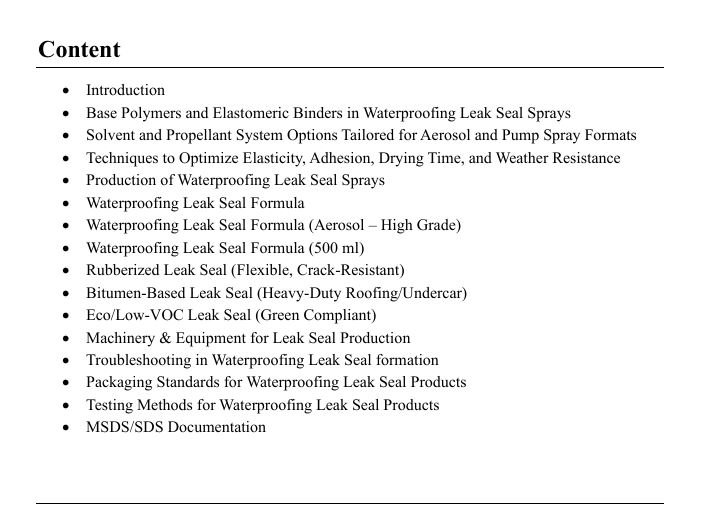
The guide is a specialised resource for chemical formulators, product developers, entrepreneurs and manufacturers seeking to innovate or produce high-performance waterproof sealants in aerosol or liquid sprayable form, with a deep dive into the formulation science behind leak sealing sprays. It provides recipes, process steps, filling guidance, tests and troubleshooting.
Manufacturing and filling process
Step 1: Dissolve the elastomer
In a closed, earthed mixer, add solvent and slowly add elastomer and tackifying resin. Stir or use a slow-speed dissolver until a smooth, lump-free solution forms, which can take several hours.
Step 2: Add fillers and additives
Disperse pigments and fillers into the solution, then add stabilisers and thixotrope. Pass through a mill if needed to avoid valve-clogging particles.
Step 3: Filter and fill
Filter the concentrate through a fine screen. Fill cans using an approved aerosol filling line with valve crimping and propellant gassing. Check weight and pressure.
Step 4: Testing and packing
Test spray pattern, valve function and leak tightness in a hot water bath, then label and pack.
Designing for aerosol performance
Viscosity, particle size and solvent balance determine whether a can sprays evenly or clogs. Choose valves and actuators with appropriate orifice sizes for medium-viscosity coatings, and avoid large flakes or coarse fillers. The propellant ratio controls spray pattern and pressure; too little leaves product in the can, too much causes thin, misty coverage. Dip tube diameter, can size and agitation balls also matter. Test at both low and high temperatures, because aerosols behave differently in a cold garage and a hot truck.
Application guidance
Clean the area of loose dirt, rust and flaking material, and remove standing water. Shake the can well. Hold 20 to 30 centimetres away and apply thin, overlapping coats, allowing each to dry before the next. Build up several coats for larger gaps, and use reinforcing mesh or tape for cracks wider than a few millimetres. Cure before heavy rain where specified. For permanent repair of structural damage, use appropriate repair materials, as a spray is generally for sealing and temporary-to-medium-term protection.
Testing and quality control
- Viscosity, solids and density of the concentrate.
- Spray pattern, delivery rate and can pressure.
- Film thickness and drying time.
- Adhesion to metal, concrete, tile, plastic and bitumen.
- Water-tightness under hydrostatic head.
- Flexibility at low temperature and elongation.
- Heat resistance and sag.
- UV ageing and weathering.
- Aerosol can safety tests such as hot water bath and pressure checks.
Troubleshooting
Clogged valve
Coarse particles or dried film. Filter better, mill finer and use a larger orifice.
Film stays tacky
Slow solvents or high tackifier. Adjust solvents and resin levels.
Poor adhesion on wet surfaces
Standing water or dirt. Dry and clean as much as possible, and use a formula designed for damp conditions.
Film sags
Too much material or low thixotropy. Apply thinner coats and raise thixotrope.
Cracks in cold weather
Elastomer too hard. Use a softer polymer or plasticiser.
Spitting and uneven spray
Propellant ratio or viscosity incorrect. Retune the formula.
Safety and regulation
Aerosol sprays contain flammable solvents and propellants. Operate filling in explosion-proof areas under aerosol safety rules, with gas detection, grounding and trained staff. Cans must be tested, labelled and transported under dangerous goods regulations, with warnings: flammable, pressurised container, do not puncture, keep from heat and flame, use in ventilated places, and avoid inhaling. Comply with VOC limits in your market and provide safety data sheets. Do not claim a permanent fix for structural leaks or use on potable water tanks unless certified.
Packaging and business opportunity
Common can sizes are 300 to 500 millilitres, in black, clear, white, grey or aluminium shades. Customers include homeowners, roofers, plumbers, caravan and boat owners, and maintenance teams. Sell through hardware stores, online marketplaces and trade distributors, and offer a brush-on liquid in tins for larger areas. Demonstration videos of leaks sealed under running water are powerful marketing, provided they are honest about limits. Private-label manufacturing for retail brands is a strong route.
Extend your catalogue with the Industrial Adhesive Formulations, Construction Chemicals, Coating Formulations and Rubber Goods Making categories, and see , , Polyurethane Adhesive Sealant Formulation, Flexible Glue Formula, and Aerosol Deodorant Spray Formula.
Getting started
Begin with a brush-on rubberised solution to prove adhesion and flexibility, then adapt it for aerosol filling with a suitable valve and propellant. Test on different surfaces and under water flow, and run safety checks. Prepare labels, instructions and data sheets, and run a small pilot batch with hardware retailers.
How to get the best results from this guide
Treat the guide as a tested starting point rather than a finished factory. Begin with a small trial batch in the laboratory or on a bench, using the exact raw materials you plan to buy, and record every weight, temperature, mixing time and observation. Compare the result with the quality checks in the guide, change only one thing at a time, and keep a note of what each change did. Once a small batch is consistently good, repeat it several times, then scale up in stages, because mixing, heating and cooling behave differently in larger vessels. Keep retained samples of every batch, write simple standard operating procedures for your team, and build relationships with two suppliers for each key raw material. Finally, check the labelling, safety and product rules in the country where you will sell, and ask a qualified person to review your process. This careful, documented approach is what turns a good formulation into a reliable product and a trusted brand.
Who should buy this guide?
The guide is written for practical readers. It suits manufacturers who want to add a new product to an existing plant, startups choosing their first product, private-label brands that need to understand what they are buying, technical staff who must set specifications and train operators, and consultants and students who want a structured, plain-language reference. It is less suitable for anyone looking for a quick shortcut or a guarantee, because every formulation still needs testing with your own materials, equipment and local rules. If you are unsure whether it matches your project, send a short question through the contact page before you order, and we will tell you honestly whether it fits.
What is inside the Waterproofing Leak Seal Spray Formula guide
Every Product Making Guide in our shop follows the same structure so you know where to look. This guide includes the product formula, the ingredients and materials, the procedure and preparations, the industrial requirements and the technical specifications. In practice you receive:
- The formulation, written so you can follow it at the bench and scale it up.
- Ingredients and materials, with the job of each material and advice on grades and suppliers.
- The manufacturing procedure, including order of addition, mixing and preparations.
- Industrial requirements, covering equipment, space and packaging.
- Technical specifications, describing what a good finished product should look like and how it should behave.
- Troubleshooting for the faults that makers meet most often.
- Business guidance, to help you take the product from the bench to the market.
These Product Making Guides of chemical formulations and formulas are for manufacturers, startups and entrepreneurs. Every guide contains industrially tested, practical formulations. Anyone who buys a guide can make the product by following its step-by-step instructions. Raw materials vary between suppliers, so always confirm your results with a small trial batch before scaling up.
Who stands behind this guide?
Chemical Formulation Services is the trading name of CFS Formulation Services Ltd, registered in England and Wales under company number 16678503, with its office at Unit F, Winston Business Park, Churchill Way, Sheffield S35 2PS. The business was founded by George Enrick and publishes formulation manuals, technical guides and industry reports. You can check our details on the Companies House register, read about us, or contact us with any question before you order.
A written formulation cannot replace testing with your own raw materials, equipment and climate, and we say so plainly. What the guide does give you is a tested, structured starting point that can save you months of trial and error. Our terms and conditions explain what a purchase from us covers.
How to order
- Select Add to cart to keep browsing, or Buy Now to go straight to checkout.
- Pay with PayPal, Stripe, Xoom by PayPal, Payoneer, payment links for debit and credit cards, or Western Union, Ria and all money exchanges.
- If you pay through a money exchange, email your payment slip to Info@chemicalformulationservices.com. After confirmation, your instant download link is emailed to you.
- For online payments, the PDF is available as soon as the payment is confirmed.
All products are digital downloads and all payments are nonrefundable once the file is delivered, so please read the refund policy and the FAQs before you order. You can compare this guide with others in the formula shop or browse our industrial project reports.
Frequently asked questions about waterproofing leak seal spray formula
What is the Waterproofing Leak Seal Spray Formula guide?
It is a digital PDF Product Making Guide to sprayable waterproof leak sealants in aerosol or liquid form, covering film chemistry, solvents, propellants, filling, testing and troubleshooting.
What film does the spray form?
Usually a flexible, rubber-like film based on elastomers such as SBS, sometimes bitumen-modified.
Can it seal wet surfaces?
Some formulas tolerate dampness, but standing water and dirt reduce adhesion, so clean and dry as far as possible.
Is it a permanent fix?
It is best for sealing small leaks and cracks. Structural problems need proper repair.
Are aerosol sprays hazardous?
Yes. They are flammable and pressurised, so filling and storage must follow aerosol safety rules.
How do I receive the guide?
You receive an instant PDF download after payment is confirmed. For money exchanges, email your payment slip to Info@chemicalformulationservices.com and the link is emailed after we confirm it.
Is the payment refundable?
All payments are nonrefundable because the product is an instant digital download. See the refund policy for details.
Can you help with a custom formulation?
CFS Formulation Services Ltd offers formulation and product development consultancy. Send a short brief through the Contact page.
Last reviewed: November 2026. This page is general information about a digital product. It is not a safety data sheet or professional advice, and any formulation should be tested and reviewed by a qualified person before commercial use.