Reziance 310 Liquid Resin Formulation
USD $75
PDF manual · Instant downloadReziance 310 Liquid Resin Formulation: a PDF guide to styrene-acrylic emulsion binders for water-based coatings, with emulsion polymerisation, testing, paint use and troubleshooting.
Payment Methods
Refund Policy
Custom Formulation Services
Formulation Consultation
Contact Us
Reziance 310 Liquid Resin Formulation is a practical PDF guide for resin and coating manufacturers, paint formulators, technical teams and entrepreneurs who want to understand and make a high-performance styrene-acrylic copolymer binder for water-based coatings. A binder is the part of a paint that actually forms the film, holding pigments to the surface and giving the dry coating its adhesion, flexibility, durability and weather resistance, and a good liquid resin is the foundation of architectural and industrial water-based paints. This page explains how a Reziance 310 liquid resin formula works, what the guide covers and how a Reziance 310 liquid resin formulation is designed, made and tested as a styrene-acrylic emulsion, so you can decide whether it suits your operation.
This guide is published by Chemical Formulation Services, the formulation publishing and consultancy business of CFS Formulation Services Ltd in Sheffield, United Kingdom. It is written for people who want to understand the product from the raw material to the finished pack, and it keeps its claims practical rather than promotional.
At a glance
- Product: Reziance 310 Liquid Resin Formulation, a digital PDF Product Making Guide.
- Also searched as: Reziance 310 liquid resin formula, styrene acrylic emulsion, acrylic paint binder, water-based paint resin, emulsion polymer.
- What it covers: monomers, emulsion polymerisation, process control, testing, use in paints and troubleshooting.
- Key goals: strong adhesion, flexible durable film, weather resistance and stable, low-grit emulsion.
- Who it is for: resin makers, paint and coating manufacturers, technical teams and entrepreneurs.
- Delivery: instant PDF download after payment is confirmed.
- Publisher: CFS Formulation Services Ltd, England and Wales company number 16678503.
What a styrene-acrylic binder is
Water-based paints are made of pigments, extenders, water, additives and a polymer emulsion. The emulsion polymer is the binder, and it consists of millions of tiny polymer particles, typically 80 to 200 nanometres across, suspended in water. When paint dries on a wall, water evaporates, the particles pack together and then fuse into a continuous film that locks the pigments in place. The polymer chemistry determines what that film is like: hard or soft, flexible or brittle, glossy or flat, sticky or tough, water-resistant or sensitive, weather-resistant or prone to chalking.
A styrene-acrylic copolymer is made from two main types of monomer. Acrylic monomers, such as butyl acrylate, 2-ethylhexyl acrylate and methyl methacrylate, give flexibility, adhesion and outdoor durability. Styrene is a hard, hydrophobic monomer that adds hardness, water resistance, gloss and lower cost, though it can make the film slightly more prone to yellowing and chalking in strong UV compared with pure acrylic. By balancing the two, formulators produce binders that offer a strong, flexible film with excellent adhesion to concrete, masonry, plaster, wood and metal, at a lower cost than pure acrylics. This makes styrene-acrylics the workhorse of the paint industry for exterior and interior architectural paints, primers, sealers, textured coatings, putties and industrial coatings.
Key properties the binder must deliver
- Adhesion: bonding to many substrates, wet and dry.
- Durability: resistance to cracking, peeling and wear.
- Weather resistance: stability against sunlight, rain, heat and temperature swings.
- Water resistance: low water sensitivity and good blister resistance.
- Alkali resistance: stability on fresh cement, plaster and masonry surfaces.
- Film flexibility: accommodating movement of substrates.
- Pigment binding: ability to hold high pigment and filler loadings for economical paints.
- Stability: shear, freeze-thaw and storage stability of the emulsion and the paint made with it.
- Low film-formation temperature: forming a continuous film at moderate temperatures, with or without a small amount of coalescent.
How the resin is made: emulsion polymerisation
Styrene-acrylic binders are made by emulsion polymerisation, a free-radical process carried out in water. The main steps and ingredients are as follows.
Monomers
Styrene, butyl acrylate, 2-ethylhexyl acrylate, methyl methacrylate and functional monomers such as acrylic acid, methacrylic acid and sometimes hydroxyl or crosslinking monomers provide the polymer backbone. The ratio of hard to soft monomers sets the glass transition temperature (Tg) of the polymer, the key property for film formation. Small amounts of acid monomers add colloidal stability and adhesion.
Surfactants (emulsifiers)
Anionic and non-ionic surfactants stabilise monomer droplets and growing polymer particles. They determine particle size and the stability of the emulsion, and they influence the water resistance of the film.
Initiator
Water-soluble persulphates (ammonium or potassium persulphate), sometimes combined with a reducing agent in redox systems, generate free radicals that start the reaction.
Buffers and chain transfer agents
Buffers keep the pH stable during polymerisation. Chain transfer agents control the molecular weight where needed.
Water
Deionised water is the continuous phase and is essential for quality.
Post additives
After polymerisation, the emulsion is cooled, neutralised with ammonia or amine to adjust pH, treated with a biocide, and sometimes with defoamer, residual monomer scavengers and coalescents.
What is inside the Reziance 310 Liquid Resin Formulation guide
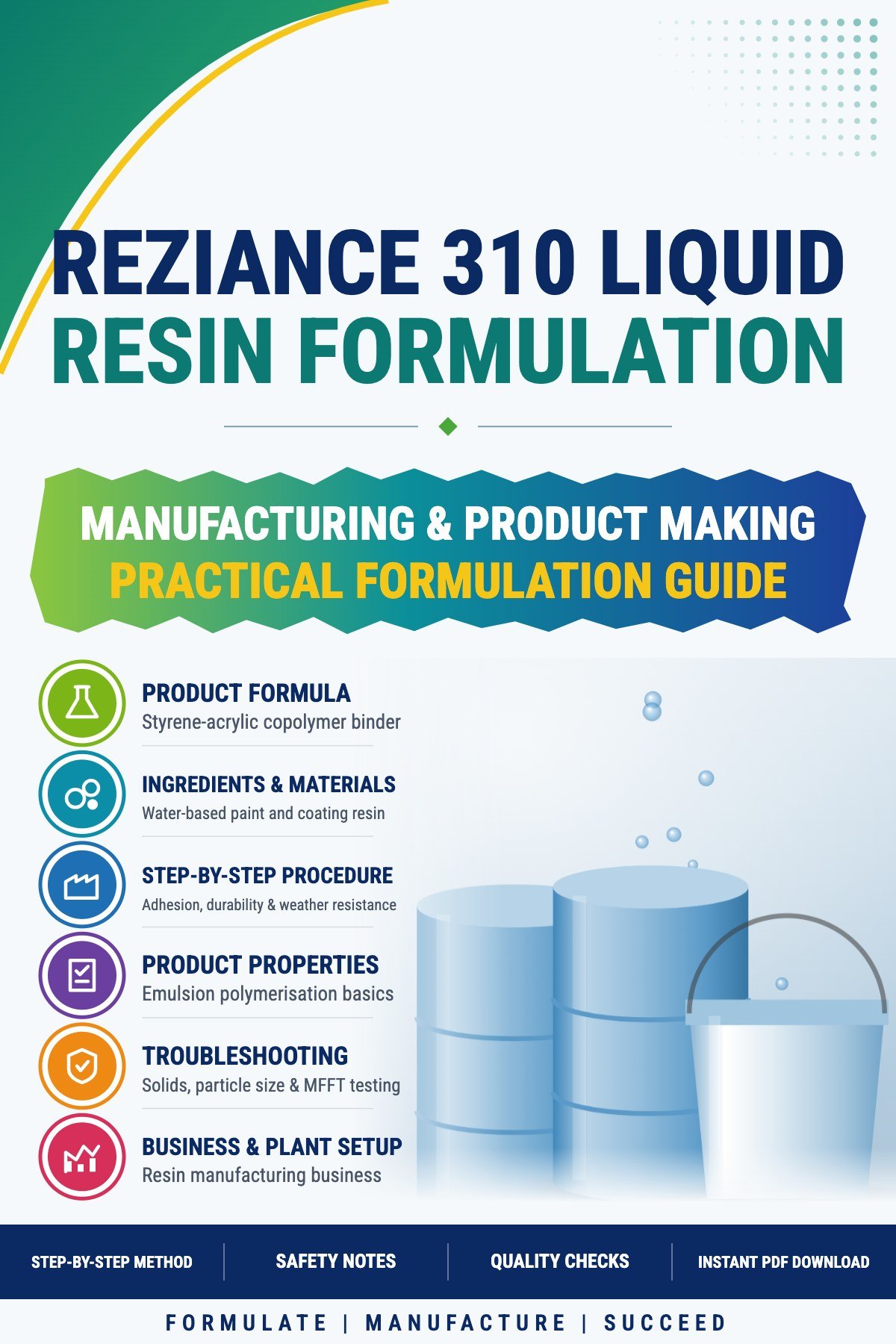
The guide is a professional-grade technical formulation data sheet for a styrene-acrylic copolymer binder designed for water-based coatings, offering adhesion, durability and weather resistance for demanding architectural and industrial paint applications. It explains the principles, raw materials, reactor operation, process steps, quality control, use in paints and coatings, troubleshooting and business advice. It follows the CFS style of clear, industrially minded instructions, written for technically qualified teams.
How the emulsion is produced
The outline below shows the general sequence. The guide gives full details, which must be followed only in a facility designed for monomer handling and exothermic reactions.
Step 1: Prepare the reactor
A clean, jacketed stainless steel or glass-lined reactor with an agitator, condenser, temperature probes and nitrogen inlet is purged with nitrogen to remove oxygen, which inhibits polymerisation.
Step 2: Prepare the pre-emulsion
Monomers are emulsified in water with surfactant in a separate tank under agitation, forming a stable pre-emulsion that will be fed to the reactor.
Step 3: Charge the initial reactor water and seed
Deionised water, buffer and a small amount of surfactant are charged to the reactor and heated to the reaction temperature. A small portion of the pre-emulsion and initiator is added to create seed particles.
Step 4: Feed the pre-emulsion
The remaining pre-emulsion and initiator solution are fed to the reactor over several hours at controlled rates, while the temperature is maintained by the cooling jacket. The reaction is exothermic, so feed rate and cooling control the safety and quality of the process. This semi-continuous feed method controls particle growth and composition.
Step 5: Hold and chase
After feeding, the batch is held at temperature to complete conversion. A chaser initiator system, often a redox pair, is added to reduce residual monomer.
Step 6: Cool and neutralise
The emulsion is cooled, pH is adjusted with ammonia or amine, and biocide and other post additives are added.
Step 7: Filter and test
The emulsion is filtered to remove coagulum and tested for solids, viscosity, pH, particle size, residual monomer, minimum film formation temperature (MFFT) and stability.
Step 8: Store and pack
The resin is filled into drums, IBCs or bulk tankers, with a label showing grade, batch, and safety information.
Equipment requirements
A resin plant needs a jacketed reactor with agitator and condenser, a pre-emulsion tank, metering pumps for monomers and initiator, a cooling and heating system, a nitrogen supply, filters, storage tanks and filling lines. A laboratory needs a solids oven, viscometer, pH meter, particle size analyser, MFFT bar, gas chromatograph or other analytical equipment for residual monomers, and facilities to test paints made with the resin. Safety systems for flammable monomers, including earthing, inert atmosphere, relief devices, gas detection and fire protection, are essential. Many companies begin by buying emulsion and formulating paints, then move to resin production as volume grows.
Use in paints and coatings
The binder is mixed with pigments, extenders, thickeners and additives in a letdown stage to make water-based paints. The ratio of binder to pigment, the pigment volume concentration, controls gloss, scrub resistance and cost. Lower binder levels make economical flat paints, and higher levels make gloss and exterior grades. The binder also finds use in primers, sealers, textured coatings, elastomeric wall coatings, cement-based paints, tile adhesives, putties, waterproofing slurries and paper and board coatings. Selection of coalescent, thickener and dispersant depends on the Tg and the application.
Quality control for every batch
- Solids content: measured by drying a sample, typically 45 to 55 percent.
- Viscosity: measured at standard temperature.
- pH: within the specified range for stability and compatibility.
- Particle size distribution: controls gloss, stability and film properties.
- Coagulum: amount retained on a screen, which should be minimal.
- Residual monomer: kept low for safety and odour.
- Minimum film formation temperature and glass transition: verified against target.
- Mechanical and freeze-thaw stability: resistance to shear and temperature cycles.
- Paint performance: scrub resistance, water resistance, alkali resistance, adhesion, weathering and gloss in a test paint.
- Storage stability: no settling, skinning or viscosity change.
Troubleshooting
Coagulum or grit in the batch
Too little surfactant, agitation problems or feed too fast. Adjust surfactant level, mixing and feed.
Reactor temperature runs away
Monomer accumulation or insufficient cooling. Slow the feed, improve cooling and ensure the initiator is active.
High residual monomer and strong odour
Incomplete conversion. Extend hold time and use chaser initiators.
Low solids or viscosity out of range
Weighing errors or incomplete conversion. Check charges and conversion.
Poor water resistance in paint
Too much surfactant, hydrophilic monomers or wrong Tg. Reformulate the polymer and surfactant package.
Film cracking or dirt pick-up
Tg too high or too low, respectively. Adjust the hard and soft monomer balance.
Instability on storage
Poor pH control, inadequate biocide or particle size too large. Control pH, add biocide and optimise recipe.
Safety, health and environment
Monomers such as styrene and acrylates are flammable and irritating, and styrene is suspected to be harmful to health with long exposure. Acrylic monomers are skin sensitisers and strong irritants. Persulphate initiators are oxidisers. Polymerisation is exothermic and can run away if cooling or feed control fails, producing dangerous pressure. Reactors need relief devices, monitoring and trained staff. Provide ventilation, gloves, goggles and respirators as required, and handle ammonia carefully. Waste water and rinse water contain polymer particles and surfactants, so they require treatment. Binders are subject to chemical registration, labelling and, for paints, VOC and alkylphenol ethoxylate restrictions in many markets, so choose surfactants and additives accordingly. Obtain permits and professional process safety review before building a resin plant.
The business opportunity
Styrene-acrylic emulsions are made in huge volumes worldwide and are used by paint makers of every size. Regional resin producers can supply local paint factories, putty and adhesive makers, textile and paper companies and construction-chemical firms. Consistent quality, short delivery times and technical help in troubleshooting paints are real advantages over imports. A company might begin by blending and distributing emulsions, before starting production with a small reactor. Linking resin supply with paint formulation expertise builds customer relationships.
Related CFS guides help you build a coatings and resin business. Browse the Resin Manufacturing, Paint Industry and Coating Formulations categories, and see , Flat Oil Paint Formula, , and Silica Sand Color Coating Formula. For adhesive resins, see IMUTHANE Prepolymers Formula, UF Resin Adhesive Formulation and Industrial Adhesive Formulations, and for construction products see Construction Chemicals.
Getting started
Begin by buying a commercial styrene-acrylic emulsion and learning how to formulate and test paints with it. Study the effects of Tg, solids and particle size on paint performance. If you plan to produce resin, start with a small laboratory reactor, practising semi-continuous emulsion polymerisation with safe monomer handling, and analyse every batch. Compare your resin with commercial grades in standard paints, refine the recipe and build safety systems before moving to production scale.
How to get the best results from this guide
Treat the guide as a tested starting point rather than a finished factory. Begin with a small trial batch in the laboratory or on a bench, using the exact raw materials you plan to buy, and record every weight, temperature, mixing time and observation. Compare the result with the quality checks in the guide, change only one thing at a time, and keep a note of what each change did. Once a small batch is consistently good, repeat it several times, then scale up in stages, because mixing, heating and cooling behave differently in larger vessels. Keep retained samples of every batch, write simple standard operating procedures for your team, and build relationships with two suppliers for each key raw material. Finally, check the labelling, safety and product rules in the country where you will sell, and ask a qualified person to review your process. This careful, documented approach is what turns a good formulation into a reliable product and a trusted brand.
Who should buy this guide?
The guide is written for practical readers. It suits manufacturers who want to add a new product to an existing plant, startups choosing their first product, private-label brands that need to understand what they are buying, technical staff who must set specifications and train operators, and consultants and students who want a structured, plain-language reference. It is less suitable for anyone looking for a quick shortcut or a guarantee, because every formulation still needs testing with your own materials, equipment and local rules. If you are unsure whether it matches your project, send a short question through the contact page before you order, and we will tell you honestly whether it fits.
What is inside the Reziance 310 Liquid Resin Formulation guide
Every Product Making Guide in our shop follows the same structure so you know where to look. This guide includes the product formula, the ingredients and materials, the procedure and preparations, the industrial requirements and the technical specifications. In practice you receive:
- The formulation, written so you can follow it at the bench and scale it up.
- Ingredients and materials, with the job of each material and advice on grades and suppliers.
- The manufacturing procedure, including order of addition, mixing and preparations.
- Industrial requirements, covering equipment, space and packaging.
- Technical specifications, describing what a good finished product should look like and how it should behave.
- Troubleshooting for the faults that makers meet most often.
- Business guidance, to help you take the product from the bench to the market.
These Product Making Guides of chemical formulations and formulas are for manufacturers, startups and entrepreneurs. Every guide contains industrially tested, practical formulations. Anyone who buys a guide can make the product by following its step-by-step instructions. Raw materials vary between suppliers, so always confirm your results with a small trial batch before scaling up.
Who stands behind this guide?
Chemical Formulation Services is the trading name of CFS Formulation Services Ltd, registered in England and Wales under company number 16678503, with its office at Unit F, Winston Business Park, Churchill Way, Sheffield S35 2PS. The business was founded by George Enrick and publishes formulation manuals, technical guides and industry reports. You can check our details on the Companies House register, read about us, or contact us with any question before you order.
A written formulation cannot replace testing with your own raw materials, equipment and climate, and we say so plainly. What the guide does give you is a tested, structured starting point that can save you months of trial and error. Our terms and conditions explain what a purchase from us covers.
How to order
- Select Add to cart to keep browsing, or Buy Now to go straight to checkout.
- Pay with PayPal, Stripe, Xoom by PayPal, Payoneer, payment links for debit and credit cards, or Western Union, Ria and all money exchanges.
- If you pay through a money exchange, email your payment slip to Info@chemicalformulationservices.com. After confirmation, your instant download link is emailed to you.
- For online payments, the PDF is available as soon as the payment is confirmed.
All products are digital downloads and all payments are nonrefundable once the file is delivered, so please read the refund policy and the FAQs before you order. You can compare this guide with others in the formula shop or browse our industrial project reports.
Frequently asked questions about reziance 310 liquid resin formulation
What is the Reziance 310 Liquid Resin Formulation guide?
It is a digital PDF Product Making Guide to a styrene-acrylic copolymer binder for water-based coatings, covering monomers, emulsion polymerisation, testing, use in paints and troubleshooting.
What is a styrene-acrylic copolymer?
A polymer made from styrene and acrylic monomers. Acrylics give flexibility and durability, while styrene adds hardness, water resistance and lower cost.
How is the resin made?
By emulsion polymerisation in water, where monomers are fed with surfactants and initiator to form small polymer particles suspended in water.
What is MFFT?
The minimum film formation temperature, below which the emulsion will not form a continuous film.
Is polymerisation dangerous?
It can be. The reaction is exothermic and uses flammable, irritating monomers, so cooling, feed control, relief devices and trained staff are essential.
How do I receive the guide?
You receive an instant PDF download after payment is confirmed. For money exchanges, email your payment slip to Info@chemicalformulationservices.com and the link is emailed after we confirm it.
Is the payment refundable?
All payments are nonrefundable because the product is an instant digital download. See the refund policy for details.
Can you help with a custom formulation?
CFS Formulation Services Ltd offers formulation and product development consultancy. Send a short brief through the Contact page.
Last reviewed: November 2026. This page is general information about a digital product. It is not a safety data sheet or professional advice, and any formulation should be tested and reviewed by a qualified person before commercial use.