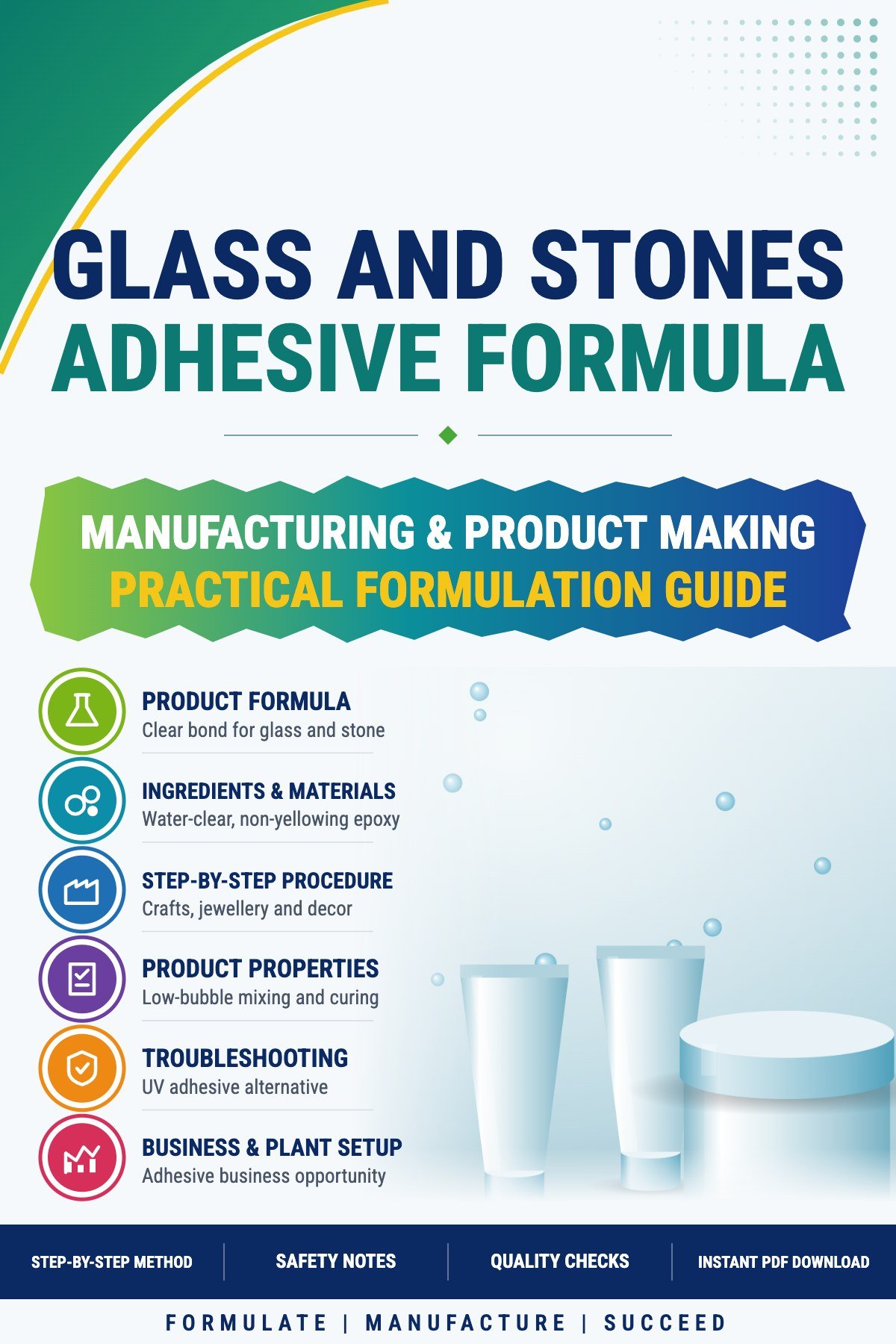

Glass and Stones Adhesive Formula
USD $60
PDF manual · Instant downloadGlass and Stones Adhesive Formula: a PDF guide to clear epoxy adhesives for glass and stones, with water-clear chemistry, bubble-free mixing, testing and troubleshooting.
Payment Methods
Refund Policy
Custom Formulation Services
Formulation Consultation
Contact Us
Glass and Stones Adhesive Formula is a practical PDF guide for adhesive manufacturers, craft and jewellery suppliers, glass and decor businesses, startups and entrepreneurs who want to produce epoxy resin adhesives for bonding glass and stones, a promising venture. The adhesive is versatile and transparent, providing a clear, almost invisible bond, which makes it ideal for glass crafts, mosaics, jewellery, vases, furniture, aquariums and decorative stone work. This page explains how a glass and stones adhesive formulation works, what goes into a glass and stones adhesive formula, how it is made, used and tested, and how to turn it into a profitable adhesive business.
This guide is published by Chemical Formulation Services, the formulation publishing and consultancy business of CFS Formulation Services Ltd in Sheffield, United Kingdom. It is written for people who want to understand the product from the raw material to the finished pack, and it keeps its claims practical rather than promotional.
At a glance
- Product: Glass and Stones Adhesive Formula, a digital PDF Product Making Guide.
- Also searched as: glass and stones adhesive formulation, clear epoxy for glass, glass to stone adhesive, transparent epoxy glue, mosaic and jewellery adhesive.
- Main chemistry: water-clear epoxy resin with cycloaliphatic or modified amine hardener.
- Key goals: clarity, non-yellowing, strong bond to smooth surfaces and low bubbles.
- Who it is for: craft and jewellery suppliers, glass and decor makers, adhesive brands and entrepreneurs.
- Delivery: instant PDF download after payment is confirmed.
- Publisher: CFS Formulation Services Ltd, England and Wales company number 16678503.
Why glass and stone are demanding to bond
Glass and many polished stones have smooth, hard, non-porous surfaces with no texture for adhesives to grip mechanically. Glass is also transparent, which means any adhesive line is visible and any bubble, yellow tinge or cloudy patch spoils the appearance. Stones such as quartz, agate, onyx, marble and granite vary in porosity and colour; some absorb adhesive and stain, while others are impervious. Joints between glass and stone, or between glass and metal, experience different thermal expansion, so a brittle adhesive may crack under temperature changes. Adhesives for these materials must therefore be crystal clear, bond tenaciously to smooth mineral surfaces, resist yellowing from light and age, tolerate water and moderate heat, and cure without bubbles or shrinkage.
Chemistry choices
Water-clear epoxy resin systems
Two-part epoxies made with low-colour bisphenol resin (often bisphenol F or hydrogenated types for better UV stability) and light-coloured cycloaliphatic or modified aliphatic amine hardeners give transparent, hard bonds. They have excellent adhesion to glass and stone, low shrinkage and good gap-filling. Their weakness is slow yellowing under strong UV and sunlight, so UV stabilisers or hydrogenated resins are used for outdoor or sun-exposed items.
UV-curing glass adhesives
One-component acrylate or methacrylate adhesives that cure in seconds under UV light, giving crystal-clear bonds. They are used in glass furniture, display cases and jewellery. They require UV light to reach the bond line, so are best for transparent glass joints, and have strict handling instructions.
Silicone and polyurethane options
Silicone sealants provide flexible, waterproof bonds for aquariums and glass panels, though they are not structural. Clear polyurethane adhesives are used for flexible bonding.
Cyanoacrylate glues
Fast, clear, but brittle and prone to blooming, they are used for quick repairs on small items.
Main ingredients of a clear epoxy glass-and-stone adhesive
- Epoxy resin: low-colour, low-viscosity bisphenol A or F, or hydrogenated bisphenol A resin, with minimal impurities.
- Reactive diluent: low-colour glycidyl ether to reduce viscosity and ease bubble release.
- Hardener: cycloaliphatic amine, polyetheramine or amidoamine of low colour, which gives clear, tough cure and resists amine blush.
- Accelerator: small amount to adjust cure speed.
- Adhesion promoter: epoxy-silane for bonding to glass and mineral surfaces, improving wet adhesion.
- UV absorber and hindered amine light stabiliser (HALS): to slow yellowing.
- Deaerator or defoamer: silicone-free types to reduce bubbles.
- Toughener (optional): to improve impact and thermal shock resistance, chosen to maintain clarity.
- Fillers (for putty types): fine silica or glass bubbles when opaque or semi-opaque bonds are acceptable.
Glass-to-glass, glass-to-metal and glass-to-stone joints
Different material pairs behave differently under load and temperature. Glass-to-glass joints in furniture and display cases are rigid, and the adhesive must be clear and strong, preferably UV-curing or a water-clear epoxy with a thin bond line. Glass-to-metal joints, such as glass shelf brackets, hinges and handles, experience different thermal expansion, so a slightly flexible adhesive or a toughened epoxy avoids cracks. Glass-to-stone joints, for example glass tops on stone bases, must tolerate weight and temperature changes. Stone-to-stone bonds, in decor and countertops, may need colour-matched or opaque adhesives. For each application, match the adhesive hardness and flexibility to the expected stress, use a thin and uniform bond line, avoid point loading and design the joint with sufficient overlap. Provide a short design guide in your technical data.
Jewellery, crafts and decorative stonework
Jewellery makers attach stones, crystals, pearls and glass cabochons to metal settings, and expect an invisible, durable bond that resists skin oils, sweat, soap and everyday knocks. Craft makers build mosaics, resin art, bottles, lamps and decorative pieces. Slow-curing clear epoxies allow time to position small parts, while fast-setting grades speed production. Provide small packs with fine tips, mixing sticks and detailed instructions. Colour-tinted and glitter versions let crafters create decorative effects. Clearly label items as not suitable for food contact or for children under a stated age unless tested, and provide cautions about small parts.
Aquariums, terrariums and wet environments
Glass aquariums are traditionally sealed with silicone sealant, which stays flexible and non-toxic after curing. Epoxy can be used for decorations and rock work in tanks, provided it is fully cured and certified as aquarium-safe. Uncured epoxy and some additives are toxic to fish, so recommend a thorough cure time and rinsing before immersion. Marine and freshwater environments pose special challenges: adhesive must resist water and salts. For these markets, supply adhesives with clear safe-use instructions and, where appropriate, product certification.
Optical clarity and refractive index matching
Glass has a refractive index around 1.5. An adhesive with a similar refractive index makes the bond line nearly invisible, because light passes straight through the interface without reflection. Many clear epoxies are close, at around 1.55, while acrylic UV adhesives may be around 1.48 to 1.52. Specialty optical adhesives are even more closely matched and used in optics, but for general glass bonding, a good clear epoxy provides an excellent appearance when bubbles and haze are controlled. Mention refractive index in the data sheet if measured, and, for customers in display and optical industries, offer low-haze, low-yellowing grades.
Storage, packaging and customer education
Store both parts tightly closed, at moderate temperature, away from sunlight. Clear epoxy resin can crystallise in the cold, producing cloudy resin that clears when gently warmed. Hardeners absorb carbon dioxide and moisture and should be sealed immediately. Label the pack with ratio, working time and cure time at standard temperatures. Instruct users to measure carefully and mix thoroughly, because off-ratio mixes remain soft or cloudy. Provide pictures of correct and incorrect bonds to help users learn.
What is inside the Glass and Stones Adhesive Formula guide
The guide explains why starting a business producing epoxy resin adhesives for bonding glass and stones is a promising venture, listing the features of the formula: versatility and transparency, being perfect for bonding glass and stones, and providing a clear, almost invisible bond. It then provides starter recipes, mixing and filling instructions, usage guidelines, testing and troubleshooting.
How the adhesive is made
Resin side (Part A)
Charge low-colour epoxy resin and reactive diluent into a clean vessel. Add adhesion promoter and UV stabilisers, mix gently, and de-aerate under vacuum. Work in clean conditions: dust and moisture reduce clarity.
Hardener side (Part B)
Charge hardener, accelerator and light stabiliser, mix gently and de-aerate. Protect from carbon dioxide and moisture.
Ratio, packing and labelling
Adjust to a simple ratio such as 1:1 or 2:1 by volume. Fill into syringes, twin tubes, bottles or kits. Seal tightly and label with the ratio, pot life, cure time and safety information.
How to bond glass and stone
Surfaces must be perfectly clean and dry. Wipe with isopropyl alcohol and a lint-free cloth to remove oil, dust and fingerprints. For smooth stone, a light abrasion may help, but glass is typically only cleaned. Measure and mix thoroughly but slowly to avoid bubbles; scrape sides and bottom of the mixing container. Allow the mix to rest for a minute so bubbles rise, then pop them with a gentle pass of warm air (heat gun at distance) if needed. Apply a thin, even film, join the parts, press to remove air and clamp or support without squeezing out all adhesive. Wipe excess immediately with a cloth moistened with alcohol. Cure at room temperature for the stated time; a gentle warm cure improves clarity and strength. Avoid moving the parts until fixture is reached.
Testing and quality control
- Colour and clarity: measure yellowness index and haze of cured film.
- Viscosity and bubble release.
- Pot life, gel time and cure time.
- Bond strength: lap shear and tensile strength on glass-glass and glass-stone pairs.
- Water and humidity resistance: immersion and condensation tests.
- Thermal cycling: hot and cold cycles without cracking or delamination.
- UV exposure: accelerated yellowing test.
- Refractive index compatibility: for near-invisible glass bonds.
- Shelf life: clarity and viscosity over time.
Troubleshooting
Cloudy or hazy bond line
Moisture in air or on surfaces, or amine blush. Work in dry conditions, clean surfaces and use blush-resistant hardener.
Bubbles in the bond
Air from mixing or surface. Mix slowly, de-aerate and apply gentle heat.
Yellowing over time
UV exposure and aromatic amines. Use cycloaliphatic hardeners and UV stabilisers, and avoid direct sun for non-stabilised products.
Bond fails when wet
Poor adhesion promoter or contamination. Use silane and clean thoroughly.
Cracks in glass joint
Brittle adhesive and thermal stress. Use toughened or flexible grades and thin bond lines.
Stains on porous stone
Adhesive bleeding into the stone. Seal stone or use thicker consistency.
Safety and handling
Epoxy resin and hardener can irritate and sensitise skin and eyes. Wear gloves and eye protection, ventilate the work area, avoid skin contact and keep out of the reach of children. UV-curing adhesives require UV-blocking eyewear and skin protection when using lamps. Keep adhesive away from heat and flames. Allow waste to cure before disposal. Provide safety data sheets and clear labels. Note that glass joints holding people or objects safely, such as shelves, table tops and balustrades, are safety-critical and should follow engineering standards and tested adhesive systems.
Business opportunity
Demand comes from craft shops, jewellery makers, mosaic artists, glass furniture and display makers, aquarium builders, lighting makers, interior designers, stone and tile workshops and DIY users. Products include small syringes and twin tubes for retail, 50 to 500 gram kits for studios and larger packs for factories. UV-cure glass adhesives and lamps can be sold as a system. Private-label supply to craft brands and hardware chains works well. Strong marketing images of invisible bonds and creative projects, along with clear instructions, help sell the product.
Related CFS guides help you build an adhesives range. Browse the Industrial Adhesive Formulations category, and see , Granite Marble & Stone Bonding Formula, , General Purpose Epoxy Adhesives, , Cyanoacrylate Adhesive Glue Formula and Car Glass Coating Hydrophobic Formula.
Getting started
Select a low-colour bisphenol resin and a cycloaliphatic or polyetheramine hardener, and make small 1:1 batches. Bond glass slides and polished stone samples, cure at room temperature, and inspect clarity and bubbles. Test strength, water resistance and UV yellowing. Compare with a commercial clear epoxy and refine. Prepare packaging, instructions and safety data, and offer sample kits to craft and glass businesses.
How to get the best results from this guide
Treat the guide as a tested starting point rather than a finished factory. Begin with a small trial batch in the laboratory or on a bench, using the exact raw materials you plan to buy, and record every weight, temperature, mixing time and observation. Compare the result with the quality checks in the guide, change only one thing at a time, and keep a note of what each change did. Once a small batch is consistently good, repeat it several times, then scale up in stages, because mixing, heating and cooling behave differently in larger vessels. Keep retained samples of every batch, write simple standard operating procedures for your team, and build relationships with two suppliers for each key raw material. Finally, check the labelling, safety and product rules in the country where you will sell, and ask a qualified person to review your process. This careful, documented approach is what turns a good formulation into a reliable product and a trusted brand.
Who should buy this guide?
The guide is written for practical readers. It suits manufacturers who want to add a new product to an existing plant, startups choosing their first product, private-label brands that need to understand what they are buying, technical staff who must set specifications and train operators, and consultants and students who want a structured, plain-language reference. It is less suitable for anyone looking for a quick shortcut or a guarantee, because every formulation still needs testing with your own materials, equipment and local rules. If you are unsure whether it matches your project, send a short question through the contact page before you order, and we will tell you honestly whether it fits.
What is inside the Glass and Stones Adhesive Formula guide
Every Product Making Guide in our shop follows the same structure so you know where to look. This guide includes the product formula, the ingredients and materials, the procedure and preparations, the industrial requirements and the technical specifications. In practice you receive:
- The formulation, written so you can follow it at the bench and scale it up.
- Ingredients and materials, with the job of each material and advice on grades and suppliers.
- The manufacturing procedure, including order of addition, mixing and preparations.
- Industrial requirements, covering equipment, space and packaging.
- Technical specifications, describing what a good finished product should look like and how it should behave.
- Troubleshooting for the faults that makers meet most often.
- Business guidance, to help you take the product from the bench to the market.
These Product Making Guides of chemical formulations and formulas are for manufacturers, startups and entrepreneurs. Every guide contains industrially tested, practical formulations. Anyone who buys a guide can make the product by following its step-by-step instructions. Raw materials vary between suppliers, so always confirm your results with a small trial batch before scaling up.
Who stands behind this guide?
Chemical Formulation Services is the trading name of CFS Formulation Services Ltd, registered in England and Wales under company number 16678503, with its office at Unit F, Winston Business Park, Churchill Way, Sheffield S35 2PS. The business was founded by George Enrick and publishes formulation manuals, technical guides and industry reports. You can check our details on the Companies House register, read about us, or contact us with any question before you order.
A written formulation cannot replace testing with your own raw materials, equipment and climate, and we say so plainly. What the guide does give you is a tested, structured starting point that can save you months of trial and error. Our terms and conditions explain what a purchase from us covers.
How to order
- Select Add to cart to keep browsing, or Buy Now to go straight to checkout.
- Pay with PayPal, Stripe, Xoom by PayPal, Payoneer, payment links for debit and credit cards, or Western Union, Ria and all money exchanges.
- If you pay through a money exchange, email your payment slip to Info@chemicalformulationservices.com. After confirmation, your instant download link is emailed to you.
- For online payments, the PDF is available as soon as the payment is confirmed.
All products are digital downloads and all payments are nonrefundable once the file is delivered, so please read the refund policy and the FAQs before you order. You can compare this guide with others in the formula shop or browse our industrial project reports.
Frequently asked questions about glass and stones adhesive formula
What is the Glass and Stones Adhesive Formula guide?
It is a digital PDF Product Making Guide to clear epoxy adhesives for bonding glass and stones, covering chemistry, ingredients, manufacture, bonding technique, testing and troubleshooting.
Why does clear epoxy yellow?
UV light and aromatic amines cause yellowing, so use cycloaliphatic hardeners and UV stabilisers.
How do I avoid bubbles?
Mix slowly, let the mixture rest, de-aerate and use gentle warmth.
Is UV adhesive better for glass?
It cures in seconds and is very clear, but needs UV light to reach the bond line.
Is glass bonding safety-critical?
For load-bearing glass such as shelves and balustrades, yes, so use tested systems and engineering guidance.
How do I receive the guide?
You receive an instant PDF download after payment is confirmed. For money exchanges, email your payment slip to Info@chemicalformulationservices.com and the link is emailed after we confirm it.
Is the payment refundable?
All payments are nonrefundable because the product is an instant digital download. See the refund policy for details.
Can you help with a custom formulation?
CFS Formulation Services Ltd offers formulation and product development consultancy. Send a short brief through the Contact page.
Last reviewed: November 2026. This page is general information about a digital product. It is not a safety data sheet or professional advice, and any formulation should be tested and reviewed by a qualified person before commercial use.