
Party Snow Spray Formulation
USD $75
PDF manual · Instant downloadParty Snow Spray Formulation: a PDF guide to making festive aerosol snow spray, with polymers, foaming agents, propellants, filling, testing and aerosol safety.
Payment Methods
Refund Policy
Custom Formulation Services
Formulation Consultation
Contact Us
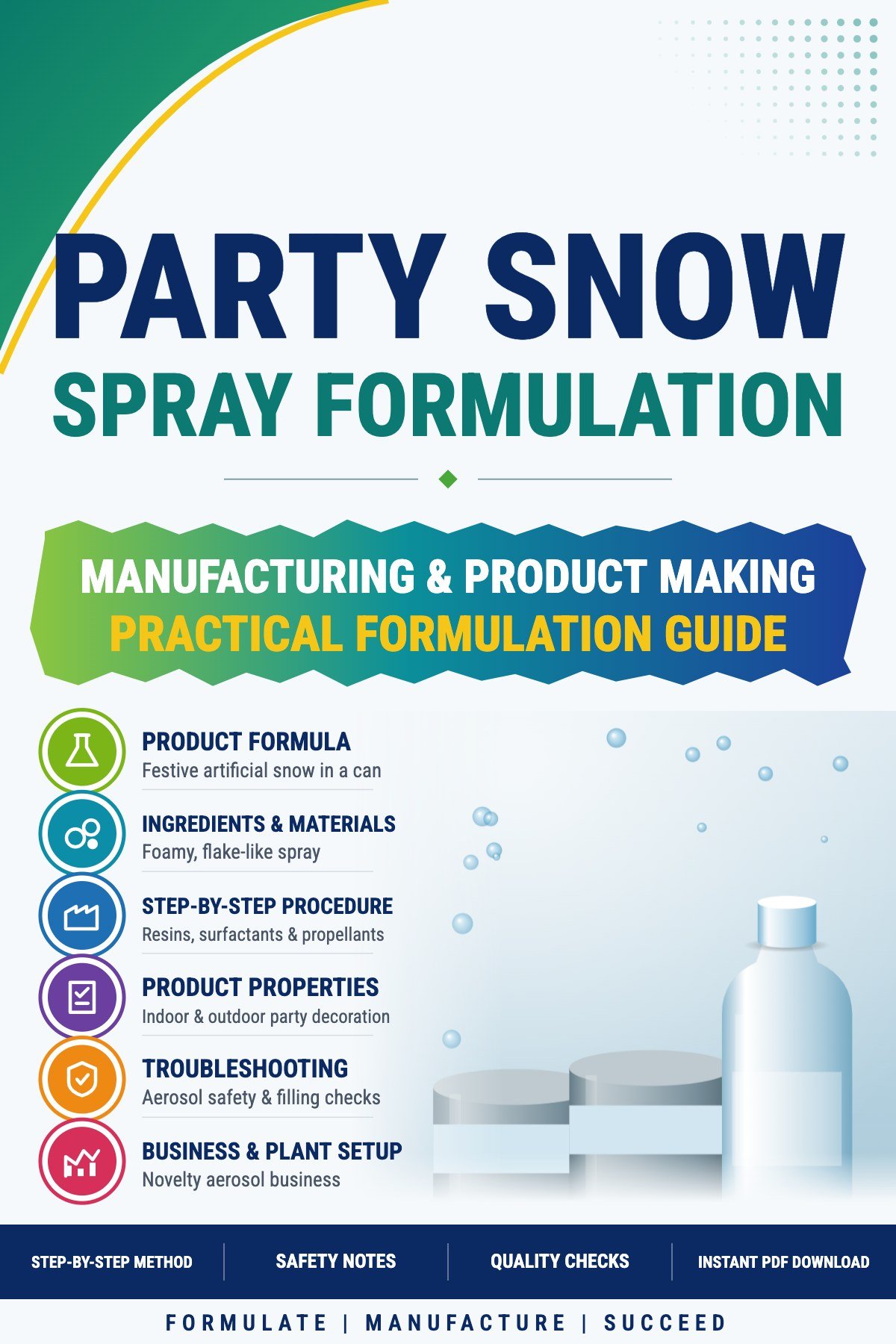
Party Snow Spray Formulation is a practical PDF guide for novelty-aerosol manufacturers, party-supply brands, seasonal-product companies and entrepreneurs who want to make a festive spray that creates the look of falling snow or a frosty scene at parties, in shop windows and on decorations. Party snow comes in a pressurised can, and when it is sprayed it produces a light, foamy substance that looks like snowflakes and then settles into a white, frosted layer. This page explains how a party snow spray formulation works, what the guide covers and how a party snow spray formula is designed, filled and tested, so you can decide whether it suits your business. Because it is an aerosol product, safety and regulation are central.
This guide is published by Chemical Formulation Services, the formulation publishing and consultancy business of CFS Formulation Services Ltd in Sheffield, United Kingdom. It is written for people who want to understand the product from the raw material to the finished pack, and it keeps its claims practical rather than promotional.
At a glance
- Product: Party Snow Spray Formulation, a digital PDF Product Making Guide.
- Also searched as: party snow spray formula, artificial snow spray, snow in a can, festive aerosol snow, window frost spray.
- What it covers: film formers, foaming agents, propellants, additives, filling, quality control and safety.
- Key goals: fluffy flakes, white opacity, easy removal, stable aerosol and compliance with safety rules.
- Who it is for: novelty and seasonal product makers, aerosol fillers, party brands and entrepreneurs.
- Delivery: instant PDF download after payment is confirmed.
- Publisher: CFS Formulation Services Ltd, England and Wales company number 16678503.
What party snow spray is
Party snow spray is a seasonal and celebration product used to decorate Christmas trees, windows, shop displays, stage sets, parties and weddings. When the can is shaken and the valve pressed, the contents come out as a light, white foam or mist of tiny particles that cling to surfaces and look like snow. On windows and mirrors, the spray leaves a frosted white layer that can be shaped with stencils, and it is removed later by wiping with a damp cloth. Some versions fly into the air like confetti and then fall as flakes, creating a snowfall effect, but all of them rely on the same underlying idea: a white, quick-drying film forming material carried by a propellant.
How the effect is created
Foam-type snow
The most common product contains a film-forming polymer, usually an acrylic or similar resin, dissolved or dispersed in a carrier, along with surfactants and a propellant. When released, the propellant expands and creates a foam of tiny bubbles stabilised by the surfactants. The foam sticks where sprayed, and as the carrier evaporates, the polymer sets as a delicate white matte layer that retains the texture of snow. Fillers and white pigment give opacity.
Flake-type snow
Some products spray light, powdery particles or solid flakes together with a binder. The flakes cling to surfaces and give a coarser, sparkling snow look.
Frost-effect window sprays
These produce a fine, translucent white film that mimics frost on glass. They typically use solvents, white pigment or a matting agent and a binder, and are designed to be removable.
Main components of the formulation
Film-forming polymer
Acrylic or vinyl polymers form the dry snow layer. They need to dry quickly, bond lightly to surfaces without damaging them, and remain soft and removable. The polymer type and level decide how long the snow lasts and how easily it wipes off.
White pigment and fillers
Titanium dioxide gives brilliant white opacity, and fillers such as calcium carbonate, talc substitutes or silica create body and a snowy, matte texture. Fine particle size ensures that spray nozzles do not clog.
Surfactants and foaming agents
These produce and stabilise the foam as it leaves the can and allow the pigment to disperse. The surfactant blend controls how stiff or light the foam is.
Solvents or water
Some party snow sprays are solvent-based and dry in seconds, while water-based versions are gentler and safer. Water-based formulations include humectants and corrosion inhibitors to protect the metal can.
Propellant
Liquefied petroleum gases such as propane, butane and isobutane, or dimethyl ether, are common aerosol propellants. They are flammable. Compressed gases such as nitrogen or carbon dioxide are non-flammable alternatives with different spray behaviour. The propellant choice affects foam quality, spray pattern, safety classification and filling procedure.
Additives
Corrosion inhibitors, buffers, preservatives for water-based types, fragrance if wanted and anti-clogging agents complete the formula.
What is inside the Party Snow Spray Formulation guide
The guide is a technical formulation data sheet for a festive aerosol product designed to create the illusion of falling snow or a snowy atmosphere in indoor or outdoor party settings. It explains the components, gives practical formulations for foam, flake and frost types, describes manufacturing and aerosol filling steps, covers quality control, safety, labelling, troubleshooting and business advice. It follows the CFS style of clear, industrially minded instructions.
How the product is made
The outline below shows the general sequence. The guide gives full details, and aerosol filling must be done only in a properly equipped and licensed facility.
Step 1: Make the concentrate
The polymer is dissolved or dispersed in the carrier, then surfactants, pigment and fillers are added under high-shear dispersion until smooth. The pigment must be well dispersed to avoid nozzle blockage.
Step 2: Filter and adjust
The concentrate is passed through fine filters to remove coarse particles and adjusted for viscosity and solids.
Step 3: Fill the can with concentrate
Aerosol cans, usually tinplate or aluminium with suitable linings, are filled accurately with concentrate. Valves with the right orifice size and dip tubes are chosen for foam or spray.
Step 4: Crimp the valve
The valve is fitted and crimped on, often after vacuum is drawn to remove air.
Step 5: Add propellant
The propellant is added through the valve under pressure, with accurate dosing by weight or volume.
Step 6: Test and check
Cans pass through a hot water bath to detect leaks and are weight-checked. Samples are tested for spray pattern, foam, drying and snow quality.
Step 7: Label and pack
Cans are fitted with actuators and caps, labelled with hazard symbols, warnings and instructions, packed and stored in approved aerosol storage.
Equipment requirements
A snow spray line needs mixing and dispersion tanks, filtration, an aerosol concentrate filler, a vacuum crimper, a propellant filling station with explosion-proof design and gas detection, a hot water leak-test bath, labelling and packing equipment. A laboratory needs a balance, viscometer, spray testing booth, pressure gauges and weight-check scales. Aerosol filling carries serious fire risks and needs appropriate buildings, ventilation, earthing, fire protection and trained staff. Many small companies use contract aerosol fillers instead of building their own plant.
Using the product
Shake the can well, test on a hidden area, spray from a distance of about twenty to thirty centimetres in short bursts, and let it dry. Use in ventilated spaces and keep away from heat, flames and sparks. On glass, use a stencil or masking tape to create patterns and remove with a damp cloth or window cleaner. Do not spray on fabrics, painted walls, wooden furniture or delicate surfaces that may stain, unless the label says so. Do not spray toward faces, animals or electrical equipment, and keep out of reach of children.
Quality control for every batch
- Concentrate quality: solids, viscosity, fineness of grind and colour.
- Fill weights: accurate concentrate and propellant fill in each can.
- Leak and pressure tests: hot-bath test and pressure check for safety.
- Spray pattern and foam: consistent texture, flake size and expansion.
- Drying time and adhesion: sets quickly yet removes easily.
- Surface safety: trials on glass, wood, plastic and fabric for staining or damage.
- Valve performance: no clogging or sputtering.
- Shelf life: samples stored warm and checked for separation, corrosion and loss of spray quality.
Troubleshooting
Valve clogging
Coarse pigment, dried polymer or wrong valve size. Improve filtration, adjust solids and select a suitable valve.
Weak or watery foam
Too little surfactant, propellant ratio too low or concentrate too thin. Adjust the surfactant and propellant balance.
Snow does not stick
Polymer level too low or the surface unsuitable. Adjust the binder and recommend smooth surfaces.
Snow will not wipe off
Binder too strong. Reduce the polymer or use more easily removable resin.
Stains on surfaces
Solvents or dyes in the formula. Use gentler carriers and test on common surfaces.
Can corrosion or rusting
Water-based formula without adequate inhibitors. Add corrosion inhibitors and use lined cans.
Spitting or uneven spray
Poor mixing or wrong valve. Improve dispersion and match valve and actuator.
Safety, regulation and responsible use
Aerosols are pressurised containers, and many contain flammable propellants. They can burst if heated, so they must be stored below the temperature on the label, away from sunlight and heat sources, and never be punctured or burned. Filling flammable propellants requires licensed premises and strict safety measures. Aerosol products are regulated in most markets under rules on labelling, pressure, filling, transport and quality, and some countries set special rules for decorative sprays, particularly regarding age restrictions and flammability. Certain solvents and propellants, such as methylene chloride and some chlorinated or fluorinated gases, are banned or restricted in consumer sprays. The spray must not be inhaled, as inhaling aerosol vapours and particles is dangerous, and misuse of aerosols causes harm and deaths each year, so labels should warn clearly. Some governments restrict the sale of novelty sprays to minors. Include safety data, correct hazard pictograms and a statement about use in ventilated areas. Comply with all packaging, waste and recycling rules.
The business opportunity
Seasonal products have strong, predictable demand, with peaks at Christmas, New Year, winter festivals, Halloween, weddings and parties. Retailers, supermarkets, party shops, discount chains, online marketplaces and decoration suppliers buy large quantities in the run-up. Manufacturers can supply them under their own brand or private label, offer different can sizes and colours, and extend into related products such as glitter spray, silly string, window colour and decoration sprays. Early planning and production before the season, safe packaging and eye-catching can design are essential. Because the product is simple and low in cost, volume and reliable delivery decide success.
Related CFS guides expand a novelty and seasonal range. Browse the Industrial Adhesive Formulations category, and see Car Upholstery Adhesives Formula and Contact Adhesive Formulations for spray adhesives. For colour and decoration, see Body & Face Paint Formula, Bronze Gold Ink Formulation and Photoluminescent Line Marking Paint Formula, and for coatings see Paint Industry. For aerosol-related fuels and propellant safety, see Chafing Fuel Gel Formulation and Oxygenated Octane Boosters Formula.
Getting started
Start by deciding whether you will fill cans yourself or work with a contract aerosol filler. Develop the concentrate in the laboratory, test its spray in small trial cans and tune the foam and drying. Check surface compatibility, safety and removal, then arrange pressure and leak testing. Prepare compliant labels and safety data, and plan production ahead of the season. Begin with one white snow product, test the market and expand into colours and other effects.
How to get the best results from this guide
Treat the guide as a tested starting point rather than a finished factory. Begin with a small trial batch in the laboratory or on a bench, using the exact raw materials you plan to buy, and record every weight, temperature, mixing time and observation. Compare the result with the quality checks in the guide, change only one thing at a time, and keep a note of what each change did. Once a small batch is consistently good, repeat it several times, then scale up in stages, because mixing, heating and cooling behave differently in larger vessels. Keep retained samples of every batch, write simple standard operating procedures for your team, and build relationships with two suppliers for each key raw material. Finally, check the labelling, safety and product rules in the country where you will sell, and ask a qualified person to review your process. This careful, documented approach is what turns a good formulation into a reliable product and a trusted brand.
Who should buy this guide?
The guide is written for practical readers. It suits manufacturers who want to add a new product to an existing plant, startups choosing their first product, private-label brands that need to understand what they are buying, technical staff who must set specifications and train operators, and consultants and students who want a structured, plain-language reference. It is less suitable for anyone looking for a quick shortcut or a guarantee, because every formulation still needs testing with your own materials, equipment and local rules. If you are unsure whether it matches your project, send a short question through the contact page before you order, and we will tell you honestly whether it fits.
What is inside the Party Snow Spray Formulation guide
Every Product Making Guide in our shop follows the same structure so you know where to look. This guide includes the product formula, the ingredients and materials, the procedure and preparations, the industrial requirements and the technical specifications. In practice you receive:
- The formulation, written so you can follow it at the bench and scale it up.
- Ingredients and materials, with the job of each material and advice on grades and suppliers.
- The manufacturing procedure, including order of addition, mixing and preparations.
- Industrial requirements, covering equipment, space and packaging.
- Technical specifications, describing what a good finished product should look like and how it should behave.
- Troubleshooting for the faults that makers meet most often.
- Business guidance, to help you take the product from the bench to the market.
These Product Making Guides of chemical formulations and formulas are for manufacturers, startups and entrepreneurs. Every guide contains industrially tested, practical formulations. Anyone who buys a guide can make the product by following its step-by-step instructions. Raw materials vary between suppliers, so always confirm your results with a small trial batch before scaling up.
Who stands behind this guide?
Chemical Formulation Services is the trading name of CFS Formulation Services Ltd, registered in England and Wales under company number 16678503, with its office at Unit F, Winston Business Park, Churchill Way, Sheffield S35 2PS. The business was founded by George Enrick and publishes formulation manuals, technical guides and industry reports. You can check our details on the Companies House register, read about us, or contact us with any question before you order.
A written formulation cannot replace testing with your own raw materials, equipment and climate, and we say so plainly. What the guide does give you is a tested, structured starting point that can save you months of trial and error. Our terms and conditions explain what a purchase from us covers.
How to order
- Select Add to cart to keep browsing, or Buy Now to go straight to checkout.
- Pay with PayPal, Stripe, Xoom by PayPal, Payoneer, payment links for debit and credit cards, or Western Union, Ria and all money exchanges.
- If you pay through a money exchange, email your payment slip to Info@chemicalformulationservices.com. After confirmation, your instant download link is emailed to you.
- For online payments, the PDF is available as soon as the payment is confirmed.
All products are digital downloads and all payments are nonrefundable once the file is delivered, so please read the refund policy and the FAQs before you order. You can compare this guide with others in the formula shop or browse our industrial project reports.
Frequently asked questions about party snow spray formulation
What is the Party Snow Spray Formulation guide?
It is a digital PDF Product Making Guide to making festive aerosol snow spray that foams into white, flake-like snow for parties, windows and decorations, with formulation, filling, testing and safety.
How does snow spray work?
A film-forming polymer, white pigment and surfactants are carried by a propellant, which expands into a foam that dries to a light white snow layer.
Is snow spray safe?
It is safe when used as directed, but aerosols are pressurised and often flammable and must not be inhaled, heated or punctured.
Can I fill aerosol cans at home?
Not safely or legally in most places. Filling flammable propellants requires licensed premises and equipment, so many businesses use contract fillers.
How is it removed?
Most snow spray wipes off glass and smooth surfaces with a damp cloth or window cleaner, but test first on delicate surfaces.
How do I receive the guide?
You receive an instant PDF download after payment is confirmed. For money exchanges, email your payment slip to Info@chemicalformulationservices.com and the link is emailed after we confirm it.
Is the payment refundable?
All payments are nonrefundable because the product is an instant digital download. See the refund policy for details.
Can you help with a custom formulation?
CFS Formulation Services Ltd offers formulation and product development consultancy. Send a short brief through the Contact page.
Last reviewed: November 2026. This page is general information about a digital product. It is not a safety data sheet or professional advice, and any formulation should be tested and reviewed by a qualified person before commercial use.