White Oil Production
USD $90
PDF manual · Instant downloadWhite Oil Production: a PDF technical guide to producing and grading white mineral oil, covering refining routes, quality control, safety and the business case.
Payment Methods
Refund Policy
Custom Formulation Services
Formulation Consultation
Contact Us
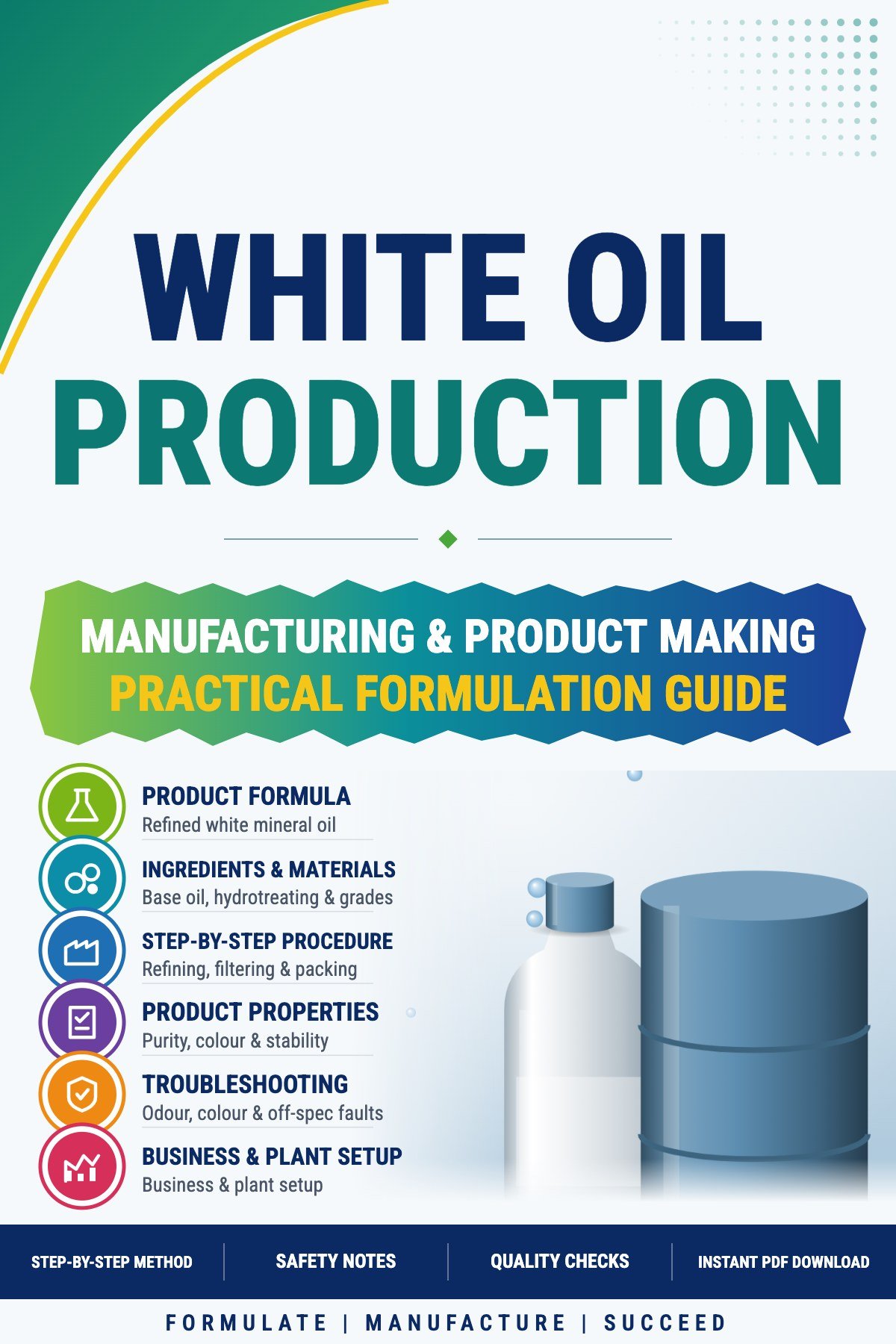
White Oil Production is a practical PDF technical guide for lubricant manufacturers, blenders, entrepreneurs and industrial investors who want to understand how white oil is made, graded and sold. White oil, also known as liquid paraffin or white mineral oil, is a highly refined, colourless, odourless and tasteless hydrocarbon liquid. Its purity and stability make it useful in pharmaceuticals, cosmetics, personal care, plastics, food processing, textiles and many other industries. This page explains how white oil production works, what the guide covers and how to judge whether it fits your plans. If you are searching for a reliable white oil production formula, the sections below describe the technology, the grades and the responsibilities involved.
This guide is published by Chemical Formulation Services, the formulation publishing and consultancy business of CFS Formulation Services Ltd in Sheffield, United Kingdom. It is written for people who want to understand the product from the raw material to the finished pack, and it keeps its claims practical rather than promotional.
At a glance
- Product: White Oil Production, a digital PDF technical guide.
- Also searched as: white oil production formula, liquid paraffin manufacturing, white mineral oil process, technical and medicinal white oil.
- What it covers: raw materials, refining routes, grades, quality control, packaging and business planning for white oil.
- Typical grades: technical grade and pharmaceutical, cosmetic and food-contact grades at different viscosities.
- Who it is for: lubricant blenders, chemical entrepreneurs, traders and investors in the oil and specialty chemicals sector.
- Delivery: instant PDF download after payment is confirmed.
- Publisher: CFS Formulation Services Ltd, England and Wales company number 16678503.
What is white oil?
White oil is a mineral oil that has been refined so thoroughly that almost everything that gives ordinary mineral oil its colour, smell and reactivity has been taken out. Crude oil and base oils contain aromatic compounds, sulphur and nitrogen compounds and unsaturated molecules. These make oil yellow or brown, give it a smell and let it react with air and other chemicals over time. White oil is what is left when those components have been removed or converted, so the result is a clear, water-white liquid made of stable saturated hydrocarbons.
The oil is sold in different viscosity grades, from very thin to thick, and in different purity levels. Technical grades are used in industry, for example as plasticiser carriers, processing aids and lubricants. Food, cosmetic and pharmaceutical grades must meet much stricter purity standards, because they may come into contact with skin, food or medicines. Understanding which grade you plan to make is the first decision in any project.
Why white oil is valuable
White oil has a combination of properties that few other materials can match. It is chemically inert, so it does not react with the products it is mixed with. It is colourless and odourless, so it does not change the appearance or smell of a finished product. It is stable to heat, light and oxygen, so it ages slowly. It is an effective lubricant and release agent, and it forms a protective, water-repelling film. For these reasons, it appears in baby oils and moisturisers, ointments and laxatives, food-machine lubricants and bakery release agents, polystyrene and other plastics, textile fibre lubricants, insecticide carriers, electrical insulation and many other applications.
How white oil is produced
Commercial white oil is made by deeply refining a suitable base oil or similar petroleum stream. There are two main routes, and the guide explains both, along with the equipment and economics of each.
Hydrotreating and hydrogenation route
Modern plants rely mostly on catalytic hydrogenation. The feedstock is heated and passed with hydrogen over a catalyst at high pressure and temperature. The process saturates aromatic and unsaturated molecules, converting them into stable saturated hydrocarbons, and removes sulphur and nitrogen compounds. A single stage can make technical white oil, and a second, deeper stage is used to produce the highest purity pharmaceutical and food grades. This route gives high yields, consistent quality and less waste.
Acid treatment route
The older route treats the oil with strong sulphuric acid or oleum, which reacts with the aromatics and impurities and turns them into sludge that can be separated. The treated oil is then neutralised, washed, clarified and filtered. The acid process can produce good white oil but creates acid sludge that must be handled and disposed of, so it is less attractive under modern environmental rules, and it has largely been replaced by hydrogenation in new plants.
Finishing steps
Whatever the route, finishing steps matter. The oil is stripped of light components to adjust flash point and viscosity, filtered through clay or adsorbents to polish colour and remove traces of polar compounds, and dried. Antioxidants may be added to some grades to protect the oil in storage, provided they are allowed for the intended use. Finally, the oil is tested against specification and packed.
Grades and standards
White oils are sold to specifications that depend on the end use. Technical grades are specified mainly by viscosity, colour, flash point and density. Food and pharmaceutical grades must also pass tests for readily carbonisable substances, polycyclic aromatic hydrocarbons and other impurities, and must comply with pharmacopoeia and food regulations such as those of the United States Pharmacopeia, the European Pharmacopoeia and the relevant food-contact rules. Cosmetic grades follow cosmetic ingredient requirements. A producer must know which standards a target customer requires and design the plant and quality system to meet them, because failing a purity test can render a whole batch unsaleable for the high-value uses.
Choosing viscosity grades for your range
White oil is not a single product. A very light grade, with a viscosity similar to a thin lamp oil, is used where low viscosity and fast spreading matter, for example in insecticide carriers, cosmetic oils and some textile lubricants. Medium grades are the workhorses of the personal care and pharmaceutical markets, appearing in baby oils, ointment bases, laxatives and moisturisers. Heavier grades are used as processing oils and plasticiser carriers in plastics, in polystyrene manufacture, in food-machine lubricants and in electrical applications that need stable, clean oil. A new producer or blender should start with two or three popular grades, learn their customers and quality requirements thoroughly, and add others as the business grows.
Packaging is part of the product. Drums, intermediate bulk containers and small retail bottles each suit different customers, and the right packaging protects the oil from contamination, moisture and light. Food and pharmaceutical customers expect clean, dedicated packaging, tamper-evident closures and full batch documentation. Smaller customers may buy through distributors, who value dependable delivery and consistent labels. Spending time on logistics, packaging and paperwork is as important as the oil itself, because customers judge a supplier by how reliably and cleanly the product arrives.
Finally, price is linked to the crude oil and base oil markets, so margins can move quickly. Many successful businesses protect themselves with long-term supply agreements, careful inventory control and a mix of higher-value specialty grades alongside the technical grades, so that a swing in one market does not destroy the whole business.
What is inside the White Oil Production guide
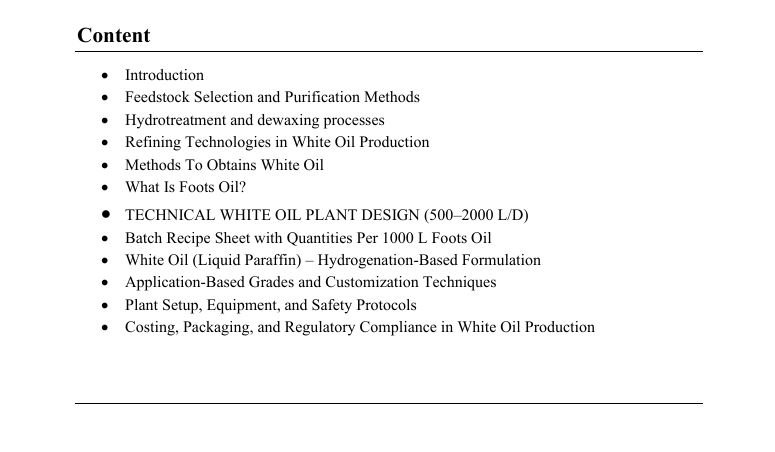
The guide is a technical document that explains the products, raw materials, process routes and quality requirements for white oil production. It covers the basic principles of refining, the main equipment, typical process conditions, product grades and testing. It also provides advice on packaging, storage, safety and the business case, to help readers decide whether and how to enter the industry.
Plant and equipment requirements
A white oil plant is a petroleum refining operation, which means it is capital-intensive and highly regulated. A hydrogenation unit needs high-pressure reactors, a hydrogen supply, heat exchangers, separators and strippers, filters and storage tanks, together with safety systems for flammable and high-pressure operation. Smaller businesses often start with blending, filtering and packing white oil bought from large refiners, which needs far less investment, and then consider production later. Others partner with existing refineries through toll processing. The guide discusses these routes and helps you compare the options and risks.
Quality control for every batch
- Appearance and colour: water-white and clear, measured on a standard colour scale.
- Odour and taste: free of odour and taste, particularly for food and pharmaceutical grades.
- Viscosity and density: measured at specified temperatures to confirm the grade.
- Flash point and pour point: measured for handling and performance.
- Purity tests: readily carbonisable substances, polycyclic aromatic hydrocarbons, sulphur and acidity as required by the standard.
- Stability: oxidation and storage stability tests, particularly where antioxidants are used.
- Contamination control: checks for water, particles and cross-contamination from other products in tanks and lines.
- Traceability: batch records linking each lot to feedstock, process conditions and test results.
Troubleshooting white oil production
Yellow tint or poor colour
Residual aromatics or incomplete hydrogenation usually cause colour. Review catalyst activity, temperature, pressure and hydrogen supply, or improve clay filtration.
Odour or taste in the product
Traces of sulphur compounds, light aromatics or oxidation products cause odour. Improve stripping, hydrogenation severity and tank hygiene.
Failing purity tests
Failure of carbonisable substances or polycyclic aromatic tests points to incomplete saturation of aromatics. Increase process severity or use a second stage, and check feedstock quality.
Viscosity or flash point out of specification
Adjust stripping and blending, or choose a feedstock cut that better matches the target grade.
Haze or water contamination
Dry and filter the oil, and check tanks and lines for moisture ingress.
Cross-contamination
Use dedicated lines and tanks for food and pharmaceutical grades, and follow strict cleaning and changeover procedures.
Safety, environment and regulation
Hydrocarbon refining involves flammable liquids, hydrogen, high pressures and high temperatures, so process safety, fire protection, pressure-vessel inspection and trained operators are essential. Acid-based routes add corrosive and sludge-handling hazards. Environmental permits cover emissions, effluent and waste, and food and pharmaceutical grades add good manufacturing practice and documentation requirements. Check the licensing, safety, environmental and product-quality rules where you plan to operate and sell, and involve qualified process engineers and regulatory advisers. You remain responsible for meeting all safety, labelling and legal requirements, and a qualified person should review your project before you invest.
The business opportunity in white oil
White oil is a specialty product with steady demand from cosmetic, pharmaceutical, food, plastics and textile industries, and buyers value consistent quality and reliable supply. Entrepreneurs can enter through blending and packing, supplying small and medium customers who cannot buy bulk tankers, or through value-added products such as ready-to-use lubricants, release agents and personal care oils. Traders can build businesses by sourcing quality white oil, certifying it and serving regional markets. Margins improve as you move toward pharmaceutical and food grades, but so do the quality and documentation demands.
White oil is closely related to lubricants and other oil products. You may find our guides on ATF Transmission Fluid Formulations, Mold Release Spray Formula, Sewing Machine Oil Formula, Envelope Lubricant Formula, Tyre Fitting Lube Formula, Gasoline Fuel Treatment Formulation, Diesel Injector Cleaner (PEA-Based) Formulation, Polymer-Based Diesel Gel Formulation and Wood Furniture Polish (Classic) Formulations useful. Browse the Lubricant Formula and Grease Making categories for more.
Starting a white oil business
Begin by choosing your grades and customers, then decide whether you will refine, blend or trade. Secure quality feedstock and a reliable laboratory partner, and build the documentation system that customers will demand. Start with technical grades, prove consistency, and move toward higher grades as your systems mature. The White Oil Production guide gives you the technical and business foundation, so you can plan with realistic expectations.
How to get the best results from this guide
Treat the guide as a tested starting point rather than a finished factory. Begin with a small trial batch in the laboratory or on a bench, using the exact raw materials you plan to buy, and record every weight, temperature, mixing time and observation. Compare the result with the quality checks in the guide, change only one thing at a time, and keep a note of what each change did. Once a small batch is consistently good, repeat it several times, then scale up in stages, because mixing, heating and cooling behave differently in larger vessels. Keep retained samples of every batch, write simple standard operating procedures for your team, and build relationships with two suppliers for each key raw material. Finally, check the labelling, safety and product rules in the country where you will sell, and ask a qualified person to review your process. This careful, documented approach is what turns a good formulation into a reliable product and a trusted brand.
What is inside the White Oil Production guide
Every Product Making Guide in our shop follows the same structure so you know where to look. This guide includes the product formula, the ingredients and materials, the procedure and preparations, the industrial requirements and the technical specifications. In practice you receive:
- The formulation, written so you can follow it at the bench and scale it up.
- Ingredients and materials, with the job of each material and advice on grades and suppliers.
- The manufacturing procedure, including order of addition, mixing and preparations.
- Industrial requirements, covering equipment, space and packaging.
- Technical specifications, describing what a good finished product should look like and how it should behave.
- Troubleshooting for the faults that makers meet most often.
- Business guidance, to help you take the product from the bench to the market.
These Product Making Guides of chemical formulations and formulas are for manufacturers, startups and entrepreneurs. Every guide contains industrially tested, practical formulations. Anyone who buys a guide can make the product by following its step-by-step instructions. Raw materials vary between suppliers, so always confirm your results with a small trial batch before scaling up.
Who stands behind this guide?
Chemical Formulation Services is the trading name of CFS Formulation Services Ltd, registered in England and Wales under company number 16678503, with its office at Unit F, Winston Business Park, Churchill Way, Sheffield S35 2PS. The business was founded by George Enrick and publishes formulation manuals, technical guides and industry reports. You can check our details on the Companies House register, read about us, or contact us with any question before you order.
A written formulation cannot replace testing with your own raw materials, equipment and climate, and we say so plainly. What the guide does give you is a tested, structured starting point that can save you months of trial and error. Our terms and conditions explain what a purchase from us covers.
How to order
- Select Add to cart to keep browsing, or Buy Now to go straight to checkout.
- Pay with PayPal, Stripe, Xoom by PayPal, Payoneer, payment links for debit and credit cards, or Western Union, Ria and all money exchanges.
- If you pay through a money exchange, email your payment slip to Info@chemicalformulationservices.com. After confirmation, your instant download link is emailed to you.
- For online payments, the PDF is available as soon as the payment is confirmed.
All products are digital downloads and all payments are nonrefundable once the file is delivered, so please read the refund policy and the FAQs before you order. You can compare this guide with others in the formula shop or browse our industrial project reports.
Frequently asked questions about white oil production
What is the White Oil Production guide?
It is a digital PDF technical guide explaining how white oil is produced, graded and tested, with raw materials, process routes, equipment, quality control, safety and business guidance.
What is white oil used for?
It is used in cosmetics, pharmaceuticals, food-machine lubrication, plastics, textiles, electrical insulation and as a carrier or processing aid in many industries.
How is white oil made?
By deeply refining base oil, mainly through catalytic hydrogenation that saturates aromatics and removes sulphur and nitrogen compounds, followed by stripping and filtration. Older plants use acid treatment.
What is the difference between technical and pharmaceutical white oil?
Pharmaceutical and food grades must pass stricter purity tests and follow pharmacopoeia and food regulations, while technical grades are mainly specified by viscosity, colour and flash point.
Can a small business enter the white oil market?
Many start with blending, filtering and packing purchased white oil, which needs far less investment than refining, and some use toll processing before building their own plant.
How do I receive the guide?
You receive an instant PDF download after payment is confirmed. For money exchanges, email your payment slip to Info@chemicalformulationservices.com and the link is emailed after we confirm it.
Is the payment refundable?
All payments are nonrefundable because the product is an instant digital download. See the refund policy for details.
Can you help with a custom formulation?
CFS Formulation Services Ltd offers formulation and product development consultancy. Send a short brief through the Contact page.
Last reviewed: November 2026. This page is general information about a digital product. It is not a safety data sheet or professional advice, and any formulation should be tested and reviewed by a qualified person before commercial use.