
Tyre Fitting Lube Formula
USD $69
PDF manual · Instant downloadTyre Fitting Lube Formula: a PDF guide to water-based tyre mounting lubricants, with soap, glycol and thickener systems, making, testing, rim and rubber safety.
Payment Methods
Refund Policy
Custom Formulation Services
Formulation Consultation
Contact Us
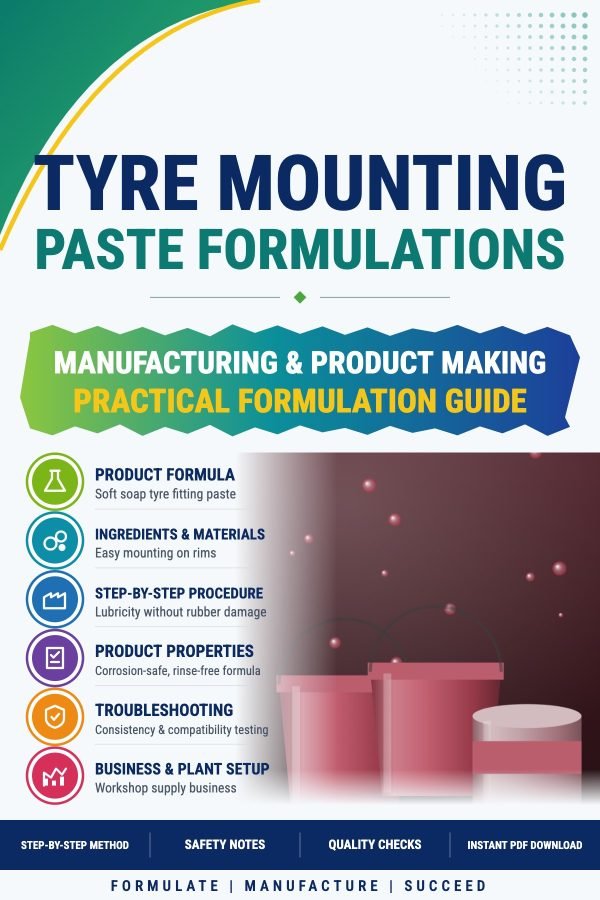
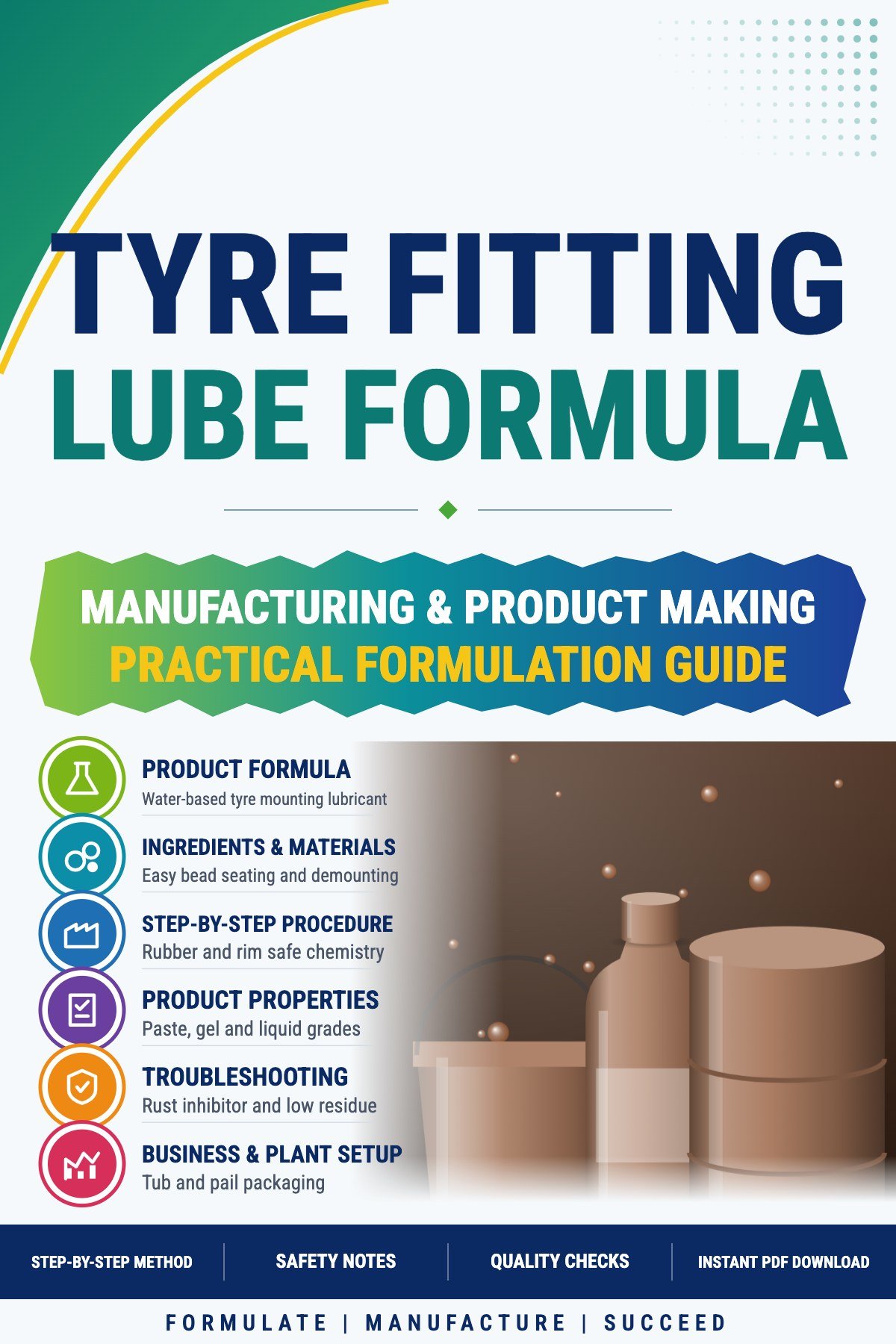
The Tyre Fitting Lube Formula from CFS is a high-performance, water-based lubricant made to make tyre mounting, demounting and bead seating fast, safe and damage-free. It is designed for professional tyre shops, service stations, fleet workshops and industrial users, so tyre installation is smooth while tyres, rims and equipment stay protected. This practical PDF guide is for lubricant blenders, automotive chemical makers, startups and entrepreneurs. This page explains how a tyre fitting lube formulation works, why water-based chemistry is preferred, which ingredients are used, how pastes and liquids are made and tested, and how to sell them.
This guide is published by Chemical Formulation Services, the formulation publishing and consultancy business of CFS Formulation Services Ltd in Sheffield, United Kingdom. It is written for people who want to understand the product from the raw material to the finished pack, and it keeps its claims practical rather than promotional.
At a glance
- Product: Tyre Fitting Lube Formula, a digital PDF Product Making Guide.
- Also searched as: tyre fitting lube formulation, tire mounting paste, tyre bead lubricant, tyre changer lube, tyre mounting gel.
- Type: water-based paste, gel or liquid with soap-type or polymer lubricants.
- Key goals: slip, bead seating, rubber safety, rim corrosion control and easy clean-up.
- Who it is for: lubricant makers, tyre shops, fleet workshops, garage suppliers and entrepreneurs.
- Delivery: instant PDF download after payment is confirmed.
- Publisher: CFS Formulation Services Ltd, England and Wales company number 16678503.
Why tyres need a special lubricant
A tyre bead, the stiff rubber edge reinforced with steel wires, must stretch over the rim flange and then seat firmly against the rim in an airtight fit. Without lubrication, high friction makes fitting difficult, can tear or abrade the bead, damages rims, and can leave a poor seal. Lubricant reduces friction so the bead slides into place, then dries or is wiped away so the tyre does not slip on the rim when driving or braking. Modern tyres, run-flat designs, low-profile tyres and large truck tyres are stiff, and sensors (TPMS) and delicate alloy wheels increase the need for careful fitting.
Why water-based chemistry is preferred
Petroleum oils, greases, silicone products and solvents can swell or degrade rubber, contaminate beads, cause tyres to slip on the rim and attract dirt and debris. Water-based lubricants are compatible with natural and synthetic rubber, wash away easily, dry to a thin film that does not leave greasy residue, and are safer for the workshop environment. Many tyre makers recommend water-based tyre mounting compounds. Paste and gel formats cling to the bead and do not drip, while liquid versions are sprayed or brushed for fast application.
Typical ingredients
- Soap or fatty acid salts: potassium oleate or sodium stearate, which are classic lubricating soaps and give slip with easy clean-up.
- Non-ionic and anionic surfactants: help wetting and spreading.
- Glycols and glycerin: humectants that keep the film slippery during fitting and lower freezing point.
- Thickeners: bentonite clay, cellulose derivatives, xanthan gum or polyacrylate thickener to build paste or gel consistency.
- Polymeric lubricants: polyethylene glycols and water-soluble polyalkylene glycols for lasting slip.
- Corrosion inhibitors: to protect steel rims and equipment from rust, especially important with aluminium alloy wheels.
- Preservatives: to prevent microbial growth in water-rich pastes.
- Dye and fragrance: to give a recognisable colour (often white, pink, blue or red) and a pleasant scent.
- Water.
Passenger car, truck and agricultural tyre grades
A single tyre lube rarely suits every job. Passenger car and light truck shops work quickly on modern alloy wheels and low-profile tyres, so they prefer clean gels or liquids that do not stain rims and wipe away easily. Truck and bus depots handle heavy, stiff beads and large rims, so they prefer robust pastes that cling and lubricate for longer, even with tubeless and tube-type tyres. Agricultural and earthmover tyres have huge beads and sometimes need extra-slippery, high-solids compounds that still dry safely. Retreading plants use specially formulated compounds compatible with their processes. Offering grades clearly named for each use, with simple labels and different colours, avoids misuse and boosts perceived professionalism.
TPMS sensors, alloy wheels and run-flat tyres
Modern wheels add sensitivities. Tyre pressure monitoring sensors and valve stems can be damaged by aggressive solvents or abrasive pastes, and alloy wheels can stain or corrode if left with residue. Run-flat tyres have stiffer sidewalls and harder beads that need more thorough lubrication. Make sure your formulation is free from chlorides and aggressive alkalis, include corrosion inhibitors suited to aluminium and steel, and test on real wheel samples and valve components. A short note on the pack stating suitability for alloy wheels and sensors reassures workshops and wheel manufacturers.
Workshop supply, repeat orders and pricing
Tyre lubricant is a consumable bought repeatedly, so pricing, availability and service matter. Quote clear prices per kilogram, offer volume discounts and standing orders, and make delivery reliable. A technician who finds the paste always on the shelf, consistent in texture and safe on wheels will not switch brands for a small saving. Consider selling tubs with attached brushes, branded lids and wall charts showing best practice for mounting, which supports safety and strengthens brand recall in the workshop.
What is inside the Tyre Fitting Lube Formula guide
The guide presents CFS Tyre Fitting Lube Formula as a high-performance, water-based lubricant specially formulated to make tyre mounting, demounting and bead seating fast, safe and damage-free, designed for professional tyre shops, service stations, fleet workshops and industrial users, and protecting tyres, rims and equipment. It adds paste, gel and liquid recipes, process steps, tests and packaging guidance.
Making a tyre fitting paste
Step 1: Thickener dispersion
Disperse bentonite or other thickener in water with high-shear mixing until it hydrates fully, forming a smooth gel. Allow it to stand until fully swollen.
Step 2: Soap formation
Heat fatty acid with the alkali (potassium hydroxide) and water until saponified, or add pre-made soap. Control temperature, then blend into the gel.
Step 3: Add glycols and surfactants
Add glycerin, glycol and surfactants under moderate stirring until uniform.
Step 4: Inhibitors, preservative and colour
Add corrosion inhibitor, preservative, colour and fragrance. Adjust pH to the range recommended for rubber and metals, typically slightly alkaline but not strongly so.
Step 5: Consistency and filling
Adjust the consistency with water or thickener, de-aerate, and fill into tubs or pails with wide mouths so workers can use brushes or sponges.
Liquid and spray versions
Liquid mounting lubricants use lower solids, with soap or polymer, surfactants, glycol and inhibitors, designed to be sprayed or brushed. They suit fast-moving fleet shops and truck tyres. Concentrates can be diluted with water at the workshop to reduce shipping cost. Gel types are intermediate and popular for passenger car tyres and alloy wheels.
Use and workshop practice
Apply lubricant to both beads and rim edges using a brush, sponge or sprayer, avoiding the tread, sidewalls and the rim seat flats where excessive amounts can cause slippage. Fit the tyre, inflate to seat the beads, then wipe away excess lubricant before final inflation. For run-flat tyres, extra attention to complete lubrication prevents bead damage. Do not use lubricants containing mineral oil, silicone or solvents. Keep containers closed and clean to avoid grit contamination, which can scratch rims.
Testing and quality control
- Appearance, colour, pH and consistency using a penetrometer or flow test.
- Lubricity: friction measurement between rubber and metal, or simple sliding test.
- Bead slip test: check that tyres do not rotate on the rim after drying.
- Rubber compatibility: swelling and hardness change tests on tyre rubber samples.
- Corrosion tests on steel and aluminium strips.
- Dry time and residue.
- Freeze-thaw and heat stability.
- Microbial stability.
Troubleshooting
Paste dries too fast
Not enough humectant. Increase glycol or glycerin.
Tyre slips on rim
Too much lubricant or non-drying film. Use less, wipe excess and choose a formula that dries to a grippy film.
Rim corrosion
Weak inhibitor or high chloride. Add inhibitors and use soft water.
Separation or hard crust
Unstable thickener or evaporation. Adjust thickener and use tight lids.
Mould or odour
Weak preservative. Increase preservation and keep tubs clean.
Hard to brush
Too stiff. Reduce thickener or add water.
Safety and environment
Water-based tyre lubes are generally low in hazard, but soap-containing pastes can irritate eyes and skin, so provide gloves and eye protection recommendations. Keep containers out of reach of children and label with batch numbers. Wash-off water should be treated like workshop wastewater and not discharged to drains without suitable separation. Avoid claims like “non-toxic” unless supported. Tyre fitting itself has hazards, including explosive tyre bursts during inflation, so advise users to follow proper safety procedures and use cage and clip-on inflation tools. Provide safety data sheets and follow transport regulations.
Packaging and business opportunity
Tubs of 1 to 5 kilograms, pails of 10 to 25 kilograms and drums are common. Customers include tyre shops, garages, service stations, truck and bus depots, agricultural and mining operations, and tyre retreaders. Colour-coded products for passenger cars, trucks and special tyres help staff. Bundle with brushes, valve tools, valve stems and wheel weights as a workshop kit. Private-label supply to tyre wholesalers and auto parts distributors is a strong route, and competitive bulk pricing wins repeat contracts.
Extend your workshop range with the Lubricant Formula, Grease Making, Auto Care Products and Rubber Goods Making categories, and see White Grease Lubricant Formula, , Power Steering Fluid Formula, Envelope Lubricant Formula, and .
Getting started
Make a small batch of potassium oleate soap paste with glycerin and bentonite. Test it on tyre and rim samples for slip, residue and corrosion, tune the consistency and drying, and compare with a commercial paste. Prepare labels, instructions and samples for local tyre shops.
How to get the best results from this guide
Treat the guide as a tested starting point rather than a finished factory. Begin with a small trial batch in the laboratory or on a bench, using the exact raw materials you plan to buy, and record every weight, temperature, mixing time and observation. Compare the result with the quality checks in the guide, change only one thing at a time, and keep a note of what each change did. Once a small batch is consistently good, repeat it several times, then scale up in stages, because mixing, heating and cooling behave differently in larger vessels. Keep retained samples of every batch, write simple standard operating procedures for your team, and build relationships with two suppliers for each key raw material. Finally, check the labelling, safety and product rules in the country where you will sell, and ask a qualified person to review your process. This careful, documented approach is what turns a good formulation into a reliable product and a trusted brand.
Who should buy this guide?
The guide is written for practical readers. It suits manufacturers who want to add a new product to an existing plant, startups choosing their first product, private-label brands that need to understand what they are buying, technical staff who must set specifications and train operators, and consultants and students who want a structured, plain-language reference. It is less suitable for anyone looking for a quick shortcut or a guarantee, because every formulation still needs testing with your own materials, equipment and local rules. If you are unsure whether it matches your project, send a short question through the contact page before you order, and we will tell you honestly whether it fits.
What is inside the Tyre Fitting Lube Formula guide
Every Product Making Guide in our shop follows the same structure so you know where to look. This guide includes the product formula, the ingredients and materials, the procedure and preparations, the industrial requirements and the technical specifications. In practice you receive:
- The formulation, written so you can follow it at the bench and scale it up.
- Ingredients and materials, with the job of each material and advice on grades and suppliers.
- The manufacturing procedure, including order of addition, mixing and preparations.
- Industrial requirements, covering equipment, space and packaging.
- Technical specifications, describing what a good finished product should look like and how it should behave.
- Troubleshooting for the faults that makers meet most often.
- Business guidance, to help you take the product from the bench to the market.
These Product Making Guides of chemical formulations and formulas are for manufacturers, startups and entrepreneurs. Every guide contains industrially tested, practical formulations. Anyone who buys a guide can make the product by following its step-by-step instructions. Raw materials vary between suppliers, so always confirm your results with a small trial batch before scaling up.
Who stands behind this guide?
Chemical Formulation Services is the trading name of CFS Formulation Services Ltd, registered in England and Wales under company number 16678503, with its office at Unit F, Winston Business Park, Churchill Way, Sheffield S35 2PS. The business was founded by George Enrick and publishes formulation manuals, technical guides and industry reports. You can check our details on the Companies House register, read about us, or contact us with any question before you order.
A written formulation cannot replace testing with your own raw materials, equipment and climate, and we say so plainly. What the guide does give you is a tested, structured starting point that can save you months of trial and error. Our terms and conditions explain what a purchase from us covers.
How to order
- Select Add to cart to keep browsing, or Buy Now to go straight to checkout.
- Pay with PayPal, Stripe, Xoom by PayPal, Payoneer, payment links for debit and credit cards, or Western Union, Ria and all money exchanges.
- If you pay through a money exchange, email your payment slip to Info@chemicalformulationservices.com. After confirmation, your instant download link is emailed to you.
- For online payments, the PDF is available as soon as the payment is confirmed.
All products are digital downloads and all payments are nonrefundable once the file is delivered, so please read the refund policy and the FAQs before you order. You can compare this guide with others in the formula shop or browse our industrial project reports.
Frequently asked questions about tyre fitting lube formula
What is the Tyre Fitting Lube Formula guide?
It is a digital PDF Product Making Guide to water-based tyre mounting lubricants, covering soaps, glycols, thickeners, making, testing and troubleshooting.
Why avoid oil or silicone lubricants?
They can swell rubber, contaminate beads and make tyres slip on the rim.
Paste, gel or liquid?
Paste clings to beads, gel balances cling and speed, and liquids suit fast application in fleet shops.
Does it cause rim corrosion?
Good formulas include inhibitors, but wiping excess and using clean water helps.
Is tyre fitting dangerous?
Inflation can be hazardous, so proper equipment and procedures are essential.
How do I receive the guide?
You receive an instant PDF download after payment is confirmed. For money exchanges, email your payment slip to Info@chemicalformulationservices.com and the link is emailed after we confirm it.
Is the payment refundable?
All payments are nonrefundable because the product is an instant digital download. See the refund policy for details.
Can you help with a custom formulation?
CFS Formulation Services Ltd offers formulation and product development consultancy. Send a short brief through the Contact page.
Last reviewed: November 2026. This page is general information about a digital product. It is not a safety data sheet or professional advice, and any formulation should be tested and reviewed by a qualified person before commercial use.