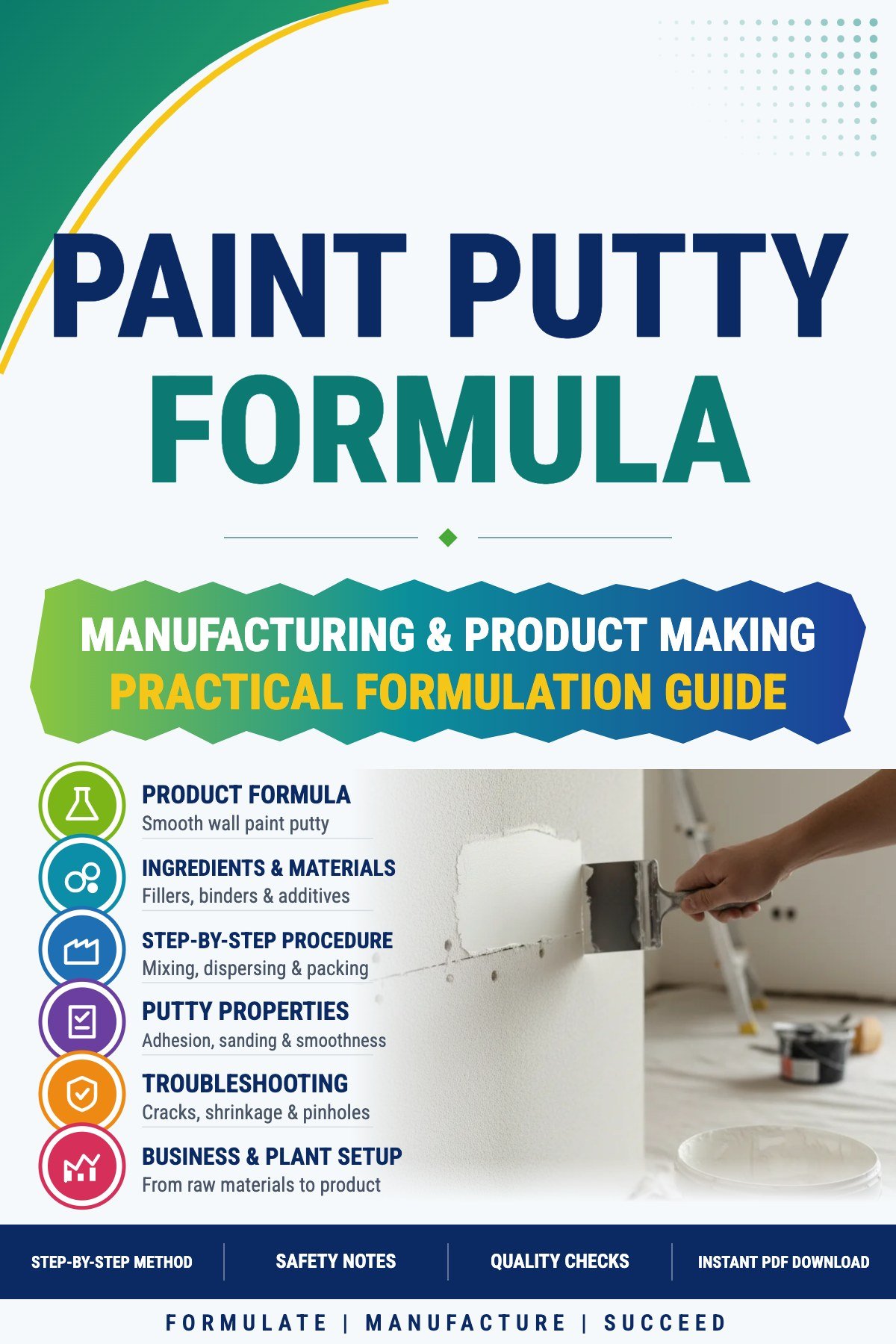

Paint Putty Formula
USD $75
PDF manual · Instant downloadPaint Putty Formula: a practical PDF guide to the paint putty formulation for walls, covering fillers, binders, additives, manufacturing steps, quality control and troubleshooting for manufacturers and startups.
Payment Methods
Refund Policy
Custom Formulation Services
Formulation Consultation
Contact Us
Paint Putty Formula is a practical PDF guide for manufacturers, startups and entrepreneurs who want to make their own paint putty, the smooth white filler that painters apply to walls before painting. Putty fills holes, cracks, dents and the tiny pores of plaster and concrete, then sands down to a flat, even surface so the final paint coat looks clean and lasts longer. This page explains what goes into a good paint putty formulation, what the guide covers, and how to decide whether it fits the business you are planning.
The guide comes from Chemical Formulation Services, the formulation publishing and consultancy business of CFS Formulation Services Ltd in Sheffield, United Kingdom. It covers scratch and chip putty, the everyday product painters, carpenters and renovation crews rely on to repair surfaces before they paint.
At a glance
- Product: Paint Putty Formula, a digital PDF Product Making Guide.
- Also searched as: paint putty formulation, wall putty formula, scratch and chip putty formulation, wall filler making.
- What it makes: a smooth, sandable putty for filling holes, dents, scratches and pores in walls before painting.
- Surfaces covered: plaster, concrete, brick and wood, with water-resistant variants for damp-prone areas.
- Who it is for: manufacturers, startups and entrepreneurs entering the building materials market.
- Delivery: instant PDF download after payment is confirmed.
- Publisher: CFS Formulation Services Ltd, England and Wales company number 16678503.
What is paint putty, and why do painters depend on it?
Walls are rarely perfect. Plaster has pinholes and hairline cracks, concrete has small voids, and every building collects dents, nail holes and scuffs. If paint goes straight onto these flaws, they show through, and the finish looks patchy under side light. Putty solves the problem by filling the defects and levelling the surface. After it dries, the painter sands it smooth and the wall is ready for primer and paint.
Good putty does more than hide flaws. By closing the pores of the surface, it reduces how much paint soaks in, which helps the paint spread evenly. It gives the paint a uniform base to grip, so the finish resists peeling and flaking. A firm, stable layer also helps the painted wall cope with temperature changes and everyday humidity.
Putty is sold to many kinds of buyers: individual painters, contractors, hardware shops, paint dealers and building-material wholesalers. It is a high-volume, repeat-purchase product, which is one reason many small manufacturers start with it. The raw materials are widely available, the equipment is modest, and every building project needs it.
The building blocks of a paint putty formulation
Most paint putties are made from the same groups of materials. The guide sets out proportions, grades and order of addition. Here is what each group does, so you can see why a formula is built the way it is.
Fillers
Fillers are the bulk of any putty. Fine mineral powders, such as calcium carbonate and similar white fillers, give body, whiteness and a smooth sanding surface. Particle size matters a great deal. Coarse particles leave a gritty film and are hard to sand, while very fine ones raise water demand and can make the putty sticky. A blend of sizes often packs best.
Binders
The binder holds the filler together and ties the putty to the wall. Depending on the product, it may be a polymer emulsion, a redispersible polymer powder or a cement-based system. The choice determines adhesion, flexibility, water resistance and cost. An interior putty and a water-resistant exterior putty rely on quite different binder systems, and the guide helps you understand both.
Thickeners and water-retention agents
Cellulose-type thickeners control consistency and keep water in the putty long enough for it to be worked and to cure properly. Without enough water retention, putty can dry too fast on an absorbent wall, lose bond strength and crack. Too much thickener makes the mixture heavy and hard to spread.
Dispersants, defoamers and preservatives
Dispersing agents help powders wet out and mix evenly. Defoamers keep air bubbles from forming during mixing, which would show later as pinholes. In wet or ready-mixed putty, preservatives protect the product from spoilage in the tub. These materials are used in small amounts but have a large effect on quality.
Water-resistant and special variants
Some putties are formulated for kitchens, bathrooms, basements and exterior walls. They use binders and additives chosen to resist water and to bond to damp-prone surfaces. The guide discusses how these variants differ from standard interior putty so you can decide whether to offer them.
Putty is part of a wider paint system, and many manufacturers sell it next to primers and paints. You can explore related guides such as the Paint Primers Formula, the Contractors PVA Paint Formula and the Advanced Water-Based Paint Formulation to build a complete range.
Key features and benefits the formulation is built around
- Smoothing surfaces. The putty levels irregularities, so the painted wall looks even and uniform.
- Better paint adhesion. By filling pores and gaps in plaster and concrete, it gives the paint a sound base and helps prevent peeling, flaking and blistering.
- Durability. A stable, resilient base layer copes with temperature changes and normal humidity without damaging the finish above it.
- Easy application. It spreads by hand or with a putty knife or trowel, and dries quickly enough to keep a job moving.
- Versatility. It suits plaster, concrete, brick and wood, in homes, offices and commercial buildings.
- Sandable and paintable. Once dry it sands to a fine finish and takes water-based and oil-based paints.
- Water-resistant options. Variants for kitchens, bathrooms and exterior walls add protection against moisture.
A formulation can deliver all of these only if the materials are balanced, which is why a tested starting formula saves so much time.
What is inside the Paint Putty Formula guide
Every Product Making Guide in our shop follows the same structure so you know where to look. This guide includes the product formula, the ingredients and materials, the procedure and preparations, the industrial requirements and the technical specifications. In practice you receive:
- The formulation, written so you can follow it at the bench and scale it up.
- Ingredients and materials, with the job of each material and advice on choosing grades and suppliers.
- The manufacturing procedure, including order of addition, mixing and preparations.
- Industrial requirements, covering equipment, space, utilities and packaging.
- Technical specifications, so you know what good finished putty should look like and how it should behave.
- Troubleshooting for the problems putty makers meet most often.
- Business guidance, to help you take the product from the bench to the market.
These Product Making Guides of chemical formulations and formulas are for manufacturers, startups and entrepreneurs. Every guide contains industrially tested, practical formulations. Anyone who buys a guide can make the product by following its step-by-step instructions. Raw materials differ between suppliers, so always confirm your results with a small trial batch before scaling up.
How paint putty is manufactured
The full method is in the guide. The outline below shows what the work looks like, so you can judge your readiness.
Step 1: Check and weigh the materials
Fillers, binders and additives are checked against specification and weighed accurately. Consistent weighing is the single biggest factor in batch-to-batch consistency, so use calibrated scales and write every weight down.
Step 2: Pre-mix the liquid phase or the dry blend
Wet putty starts with water and the liquid additives, while dry putty starts with a thorough blend of powders. In either case, additives that need time to dissolve or wet out should go in early.
Step 3: Add the fillers gradually
Fillers go in a little at a time under mixing. Dumping a whole load of powder at once creates lumps and traps air. A slow, steady addition builds a smooth paste.
Step 4: Disperse, adjust and de-aerate
The batch is mixed until the paste is uniform. Consistency is checked and adjusted with small additions of water or thickener, and air is allowed to escape so the finished putty will not show pinholes.
Step 5: Test, pack and label
A sample is tested for spreadability, drying and sanding before the batch is released. The putty is then packed into tubs, buckets or bags, sealed against moisture and labelled with batch code, date and safety information.
Equipment and plant requirements
A putty plant can start small. You need accurate scales, a mixer that can handle thick paste or dry powder, containers and tools that are clean and corrosion-resistant, a packing area and dry storage. Dust control is an important point: powders create airborne dust, so ventilation, dust extraction where practical and proper respiratory protection protect your staff. A modest plant can grow in stages by adding larger mixers and semi-automatic filling as demand rises.
Putty customers often need related repair products, and offering them in one range makes your brand easier to buy. The Wall Patching Adhesive Formula and the Construction Bonding Agent Formula sit naturally next to putty, while the Construction Water Proofing Chemicals Formulation and the Transparent Waterproofing Agent Formula serve customers who want to protect the wall after repair. If you work with cement-based materials, take a look at the Construction Cementation Material Formulations.
Quality control for every batch
- Appearance and colour: white, uniform and free of lumps or specks.
- Consistency: a repeatable feel that spreads smoothly without dragging or slumping.
- Solids content: confirms the batch contains the intended amount of filler and binder.
- Application test: apply a coat to a test board and check workability, open time and edge feathering.
- Drying and shrinkage: check how long it takes to dry and whether the film cracks or shrinks.
- Sanding: after drying, sand the film and confirm it produces a smooth, fine surface rather than a gritty or gummy one.
- Adhesion: confirm the dried putty bonds to the test substrate and does not powder or flake off.
- Paint compatibility: paint over the putty with the paint types your customers use and check for even absorption.
- Retention samples: keep a sample of every batch and check stability on the shelf.
Keep your results in a batch record. When a customer reports a problem, the batch code tells you exactly which materials and tests are involved.
Directions for painters and customers
Putty only performs on a properly prepared wall. Instructions on your pack should tell users to remove loose paint, dust and grease first, and to dampen very absorbent surfaces as the product directs. They should press the putty firmly into holes and cracks with a knife, build up in thin layers rather than one thick coat, let each coat dry fully, and then sand lightly before priming and painting. A good label also warns against applying putty in extreme heat or in rain, and says how long to wait before painting.
Troubleshooting paint putty making
Cracking and shrinkage
Cracks usually come from thick coats, too little binder, poor water retention or very fast drying. Review the binder level and thickener, and recommend thin layers on the pack.
Pinholes and air bubbles
Air trapped during mixing becomes pinholes in the dried film. Add fillers gradually, use a defoamer where needed and let the batch rest before packing.
Poor adhesion
If putty peels from the wall, the cause is often a dusty or greasy surface, too little binder or the wrong binder for the substrate. Check preparation advice and test on the surfaces your customers use.
Powdering or chalking
A surface that rubs off as powder has too little binder or has been over-diluted. Adjust the binder balance and check how the putty is stored.
Difficult sanding
Putty that is gritty, gummy or too hard to sand points to filler size, binder level or drying conditions. Review the filler blend and the binder-to-filler ratio.
Slow or uneven drying
High humidity, thick layers or too much water slow drying. Check the water level, and give clear drying times for different conditions.
Discolouration and mould
Yellowing or spotting in the tub or on the wall can come from poor preservation or dampness. Review preservatives, pack hygiene and storage conditions.
Poor water resistance
If a putty softens in damp areas, it needs a binder and additive system chosen for water resistance. Make sure bathroom and exterior grades are formulated and labelled separately.
Safety, labelling and responsible claims
Putty making involves fine mineral dust and sometimes alkaline cement-based materials, so protect your team with ventilation, gloves, eye protection and suitable dust masks. Read the safety data sheet for each raw material, store powders dry and label packaging with the hazard information and batch details that apply in your market. Describe your product honestly, for example by naming the surfaces it suits, the coat thickness it handles and the drying times you have tested. You remain responsible for meeting the safety, labelling and construction-product rules where you manufacture and sell, and a qualified person should review your process before commercial production. Our terms and conditions explain what a purchase from us covers.
The business opportunity in paint putty
Every house, office, school and shop that gets painted needs surface preparation, which is why putty has dependable, year-round demand. Renovation and repainting work continues even when new construction slows, and buyers range from large construction firms to individual painters and DIY customers. A manufacturer can sell through hardware shops, paint dealers, building-material merchants and directly to contractors, and can also supply private-label brands.
The route that works best is simple: start with one or two reliable grades, document your tests, price fairly and pack in sizes that your customers actually buy. Then grow into a wider range of paints and related products. The paint industry category in our shop lists many guides that fit a decorative-coatings business, including the Paint Formulation Handbook, the Acrylic Emulsion Formulations, the Reziance 310 Liquid Resin Formulation, the Paint Matting Agent Formula and the Architectural Acrylic Paint Manufacturing guide. For other repair markets, there are the Car Body Filler Putty Formula, the Marine Boat Putty Formulation and the Microcement Flooring Bathroom Walls guide.
If you want the market and costing picture before you commit, our industrial project reports cover raw materials, equipment, investment and the business case for a range of chemical products.
Who stands behind this guide?
Chemical Formulation Services is the trading name of CFS Formulation Services Ltd, registered in England and Wales under company number 16678503, with its office at Unit F, Winston Business Park, Churchill Way, Sheffield S35 2PS. The business was founded by George Enrick and publishes formulation manuals, technical guides and industry reports. You can check our details on the Companies House register, read about us, or contact us with any question before you order.
A written formulation cannot replace testing with your own raw materials, equipment and climate, and we say so plainly. What the guide does give you is a tested, structured starting point that can save you months of trial and error.
How to order
- Select Add to cart to keep browsing, or Buy Now to go straight to checkout.
- Pay with PayPal, Stripe, Xoom by PayPal, Payoneer, payment links for debit and credit cards, or Western Union, Ria and all money exchanges.
- If you pay through a money exchange, email your payment slip to Info@chemicalformulationservices.com. After confirmation, your instant download link is emailed to you.
- For online payments, the PDF is available as soon as the payment is confirmed.
All products are digital downloads and all payments are nonrefundable once the file is delivered, so please read the refund policy and the FAQs before you order. You can compare this guide with others in the formula shop.
Frequently asked questions
What is the Paint Putty Formula guide?
It is a digital PDF Product Making Guide that explains how to formulate and manufacture paint putty for walls, including materials, procedure, specifications, troubleshooting and business guidance.
What is paint putty made of?
Typically fine mineral fillers, a binder such as a polymer emulsion, redispersible powder or cement-based system, thickeners for consistency and water retention, and small amounts of dispersants, defoamers and preservatives.
Which surfaces can the putty be used on?
Paint putty is used on plaster, concrete, brick and wood, subject to the grade. Water-resistant variants suit kitchens, bathrooms and exterior walls.
Do I need a large factory?
No. A putty plant can start small with accurate scales, a suitable mixer, a packing area and dry storage, and grow in stages as sales increase.
Can I sell the putty under my own brand?
Yes. Once you make it yourself you can brand, label and sell it, subject to the safety, labelling and construction-product rules in your market.
How do I receive the guide?
You receive an instant PDF download after payment is confirmed. For money exchanges, email your payment slip to Info@chemicalformulationservices.com and the link is emailed after we confirm it.
Is the payment refundable?
All payments are nonrefundable because the product is an instant digital download. See the refund policy for details.
Can you help with a custom formulation?
CFS Formulation Services Ltd offers formulation and product development consultancy. Send a short brief through the Contact page.
Last reviewed: November 2026. This page is general information about a digital product. It is not a safety data sheet or professional advice, and any formulation should be tested and reviewed by a qualified person before commercial use.