
Hydrochrome Paint Formulation
USD $90
PDF manual · Instant downloadHydrochrome Paint Formulation: a practical PDF guide to the hydrochrome paint formula, covering the base coat, silvering system, top coat, manufacturing steps, quality control, safety and troubleshooting.
Payment Methods
Refund Policy
Custom Formulation Services
Formulation Consultation
Contact Us
Hydrochrome Paint Formulation is a practical PDF guide for manufacturers, startups and entrepreneurs who want to make their own hydrochrome paint, the chrome-effect or mirror-effect coating that gives plastic, metal, glass and other parts a bright, reflective, metallic finish. Instead of electroplating, the finish is built by spraying a base coat, a silvering system and a protective clear top coat, and it needs far less equipment than a plating line. This page explains how a good hydrochrome paint formula works, what the guide teaches and how to judge whether it fits your business plan.
The guide is published by Chemical Formulation Services, the formulation publishing and consultancy business of CFS Formulation Services Ltd in Sheffield, United Kingdom. Mirror-effect coatings are one of the more demanding products in the paint field, because the finish only looks right when every layer is flawless. The guide breaks the system down into parts you can understand, test and control.
At a glance
- Product: Hydrochrome Paint Formulation, a digital PDF Product Making Guide.
- Also searched as: hydrochrome paint formula, chrome-effect paint, mirror-effect paint, spray chrome coating, silvering paint system.
- System parts: a smooth dark base coat, a silvering solution with its reducer, and a clear protective top coat.
- Troubleshooting: eight common faults, from base-coat adhesion to uneven silver effect.
- Suitable for: industrial-scale and small-scale production.
- Who it is for: manufacturers, startups and entrepreneurs entering decorative and industrial coatings.
- Delivery: instant PDF download after payment is confirmed.
- Publisher: CFS Formulation Services Ltd, England and Wales company number 16678503.
What is hydrochrome paint?
Hydrochrome paint is a coating system designed to look like polished chrome. It does not contain chromium metal. Instead, it builds a very thin, continuous layer of metallic silver on a perfectly smooth dark surface, and then locks that layer in with a clear protective coat. Because the silver layer is so thin and so smooth, it reflects light like a mirror, and because the surface underneath is dark, the reflection looks deep and bright.
The appearance depends on the whole stack of layers. A glossy, defect-free base coat gives the silver a flat surface to lie on. A silvering step then deposits a uniform film of metal. A clear top coat seals it against air, moisture, handling and abrasion. If any layer is wrong, the mirror is lost: a rough base coat shows as orange peel, an uneven silver film looks cloudy or patchy, and a weak top coat lets the finish tarnish and wear away.
People use chrome-effect coatings on automotive trim, motorcycle parts, wheel centre caps, bottle closures, cosmetics packaging, signage, model kits, lighting parts, craft items and decorative products. Customers like the look and the price compared with electroplating, which needs tanks, rectifiers, effluent treatment and a licence in many places. That is why small manufacturers ask how to make chrome-effect paint themselves.
The three-layer structure of a hydrochrome system
The guide treats the system as three layers, each with a specific job. Here is what each layer does and why it matters.
Layer 1: the base coat
The base coat is usually black or another very dark colour, and it must be smooth, opaque and defect-free. It provides the surface the silver will lie on, and it supplies the depth that makes the finished reflection look bright and mirror-like. Any texture, dust, pinhole or orange peel in the base coat will be copied and magnified by the mirror finish, so this layer is formulated for outstanding flow and levelling, strong adhesion to the part and a very high gloss. The base coat chemistry is typically a polyurethane, acrylic or similar resin system chosen for the substrate.
Layer 2: the silvering solution
The silvering step deposits a thin film of metallic silver on the base coat. It uses a solution containing a silver compound and a separate reducer. The two parts are applied together or mixed just before use, and when they meet on the surface the silver is reduced to metal and forms a reflective film. This is the part of the system that gives the mirror effect, and it is also the part that needs the greatest care, both for quality and for safety. Silver compounds are hazardous materials, they stain skin and surfaces, and they must be handled, stored and disposed of according to the rules where you operate. The guide explains this stage in practical terms for the manufacturer.
Layer 3: the clear top coat
The silver layer is extremely thin and soft, so it must be protected. A clear top coat seals the film against oxidation, abrasion, fingerprints, moisture and ultraviolet light. It may be water-based or solvent-based, and it is often applied in more than one coat to build up protection and gloss. Choosing a top coat that does not attack the silver, does not yellow with age and bonds firmly is essential to the lifespan of the finish.
For a deeper look at the related technology, see our Hydrochrome Spray Coating Solution guide, which covers the spray system, and the Decorative Chromium Plating Formulation, which explains the electroplating alternative.
Raw material families in a hydrochrome paint system
The exact materials, grades and proportions are in the guide. The groups below show what is involved.
- Base coat resins and solvents. Binders that give high gloss, hardness and adhesion, with solvents or water carriers chosen for flow and levelling.
- Black or dark pigment. Fine, well-dispersed pigment that gives an opaque, deep base.
- Flow and levelling additives. Small amounts that remove orange peel and craters and help the base coat dry to a mirror-smooth film.
- Silvering components. A silver-bearing solution and a reducing solution, kept separate until use.
- Surface activators or sensitisers. Materials that prepare the surface so the silver film forms evenly.
- Clear top coat resins. Non-yellowing binders with strong adhesion to silver, good scratch resistance and ultraviolet stability.
- Top coat additives. Ultraviolet absorbers, levelling agents and slip additives for durability and appearance.
- Cleaners and primers. Products that prepare the part for the base coat so it bonds well.
A chrome-effect line builds well on top of other coating technology. The Paint Formulation Handbook, Automotive Paints Formula, Solvent-Based PU Top Coat Formulation and PU Paint Coating Formula help you understand the resins and finishes behind each layer, and the Paint Primers Formula and Red Oxide Metal Primer Formula cover surface preparation on metal.
What is inside the Hydrochrome Paint Formulation guide
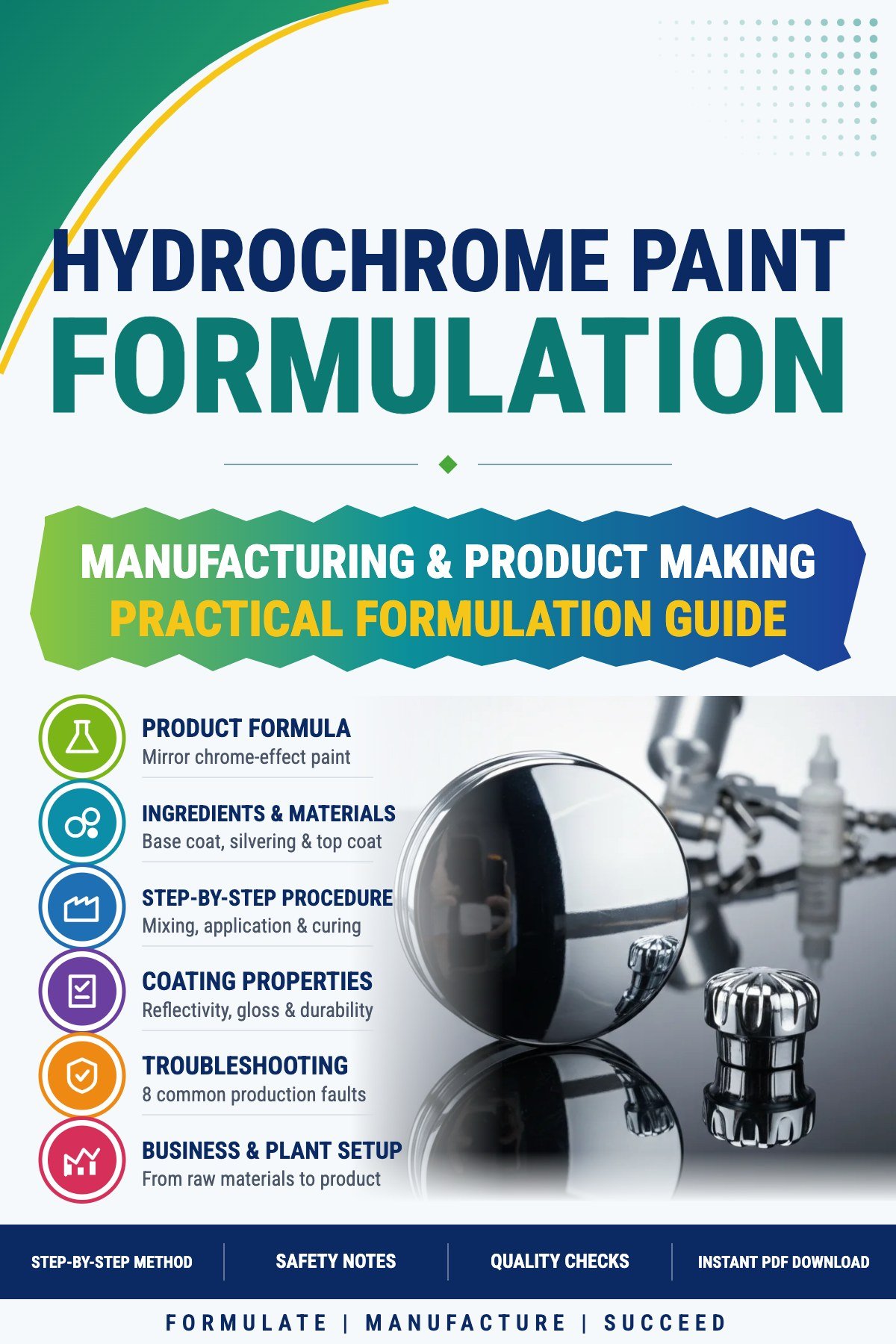
Every Product Making Guide in our shop follows the same structure so you know where to look. This guide includes the product formula, the ingredients and materials, the procedure and preparations, the industrial requirements and the technical specifications. In practice you receive:
- The formulation for the base coat, silvering system and top coat, written so you can follow it at the bench and scale it up.
- Ingredients and materials, with the job of each material and advice on grades and suppliers.
- The manufacturing and application procedure, covering ingredient selection, mixing and application techniques.
- Industrial requirements, covering equipment, space, spray set-up and curing.
- Technical specifications, describing what a good chrome-effect finish should look like and how it should perform.
- Troubleshooting for the faults that chrome-effect makers meet most often.
- Business guidance, to help you take the product from the bench to the market, at small or industrial scale.
These Product Making Guides of chemical formulations and formulas are for manufacturers, startups and entrepreneurs. Every guide contains industrially tested, practical formulations. Anyone who buys a guide can make the product by following its step-by-step instructions. Raw materials vary between suppliers, so always confirm your results with a small trial batch before scaling up.
How hydrochrome paint is made and applied
The detailed method is in the guide. The outline below shows the shape of the work.
Step 1: Prepare the part
Parts are cleaned, degreased and, where needed, sanded and primed. The surface must be clean, smooth and dust-free, because the mirror finish will show every flaw.
Step 2: Apply and cure the base coat
The dark base coat is sprayed in thin, even layers in a clean, dust-controlled area, then flashed and cured as directed. The aim is a high-gloss, glass-smooth film that is fully cured before silvering. Light polishing of the base may be used to remove any remaining nibs.
Step 3: Apply the silvering solution
The silvering components are applied by the method the formula specifies, usually with a dedicated spray gun that mixes or deposits both parts on the surface. The film forms within seconds. The surface is then rinsed according to the instructions to remove reaction by-products, and dried carefully.
Step 4: Apply the protective top coat
The clear top coat is applied promptly over the dry silver in controlled coats. Proper cure is vital, because the top coat is the only thing shielding the silver from air and wear.
Step 5: Inspect and pack
Finished parts are inspected under strong light for clarity, reflectivity, haze, spots and orange peel before they are packed or shipped. If you are selling the paint components themselves, kits are packed with clear labelling that keeps the components separate and carries safety and handling information.
Equipment and plant requirements
A hydrochrome operation is compact compared with plating, but it still needs a controlled environment. You need a clean, dust-controlled spray area, spray guns suited to each layer, accurate scales and mixing equipment for the base and top coats, a drying or curing oven or cure area, and storage that keeps the silver and reducing solutions separate. Ventilation and extraction are required. Water supply, rinsing and waste handling matter more than people expect, because silver-bearing waste must be collected and treated or disposed of in line with local rules rather than poured away. If you plan to sell paint kits, you will also need filling equipment and tamper-evident packaging.
Quality control for every batch and every part
- Base coat gloss and smoothness: inspect a test panel for orange peel, craters, nibs and gloss, since the silver layer will magnify these.
- Adhesion: cross-hatch the base coat on the substrate before silvering, and the finished system after cure.
- Silver film uniformity: check test panels for even reflectivity, clouding and streaks.
- Reflectivity and appearance: compare each batch against a reference panel under controlled light.
- Top coat clarity: check for yellowing, haze and bubbles, and confirm gloss.
- Durability tests: abrasion, scratch, humidity and chemical exposure on test panels, with the results recorded.
- Solution stability: check storage life and condition of each component, and discard anything that has aged beyond the guide’s limits.
- Batch records: record batch numbers, test results and application conditions, so any problem can be traced.
Troubleshooting hydrochrome paint making
Poor adhesion of the base coat
Usually a result of contaminated or glossy substrates, wrong primer, or an incompletely cured film. Improve cleaning, check primer compatibility and confirm cure conditions.
Inconsistent silver layer reflectivity
Patchy or cloudy mirror effect comes from an uneven base coat, contamination, old or weak solutions, wrong ratios or poor spray technique. Check the base coat, solution freshness and the spray set-up.
Orange peel or rough texture
Orange peel in the base or top coat is magnified by the mirror. Adjust viscosity, solvent balance, gun settings and flow additives, and spray in the right temperature range.
Yellowing of the top coat
Yellowing points to a top coat resin that is not ultraviolet-stable or not suited to the silver. Choose a non-yellowing system and test for ageing.
Bubbling or pinholes
Trapped air, solvent pop from thick coats or moisture on the part cause bubbling. Apply thinner coats, allow flash-off time and make sure parts are dry and free of contamination.
Cracking or delamination
Layers that peel or crack are usually incompatible, over-baked, applied too thickly or poorly bonded. Review layer compatibility, thickness and cure schedules.
Poor durability or scratch resistance
Chrome-effect finishes are delicate until protected. Improve the top coat hardness, thickness and cure, and give customers care instructions.
Difficulty achieving a uniform silver effect
Check surface activation, solution temperature, application technique and rinsing steps. Standardise the process and train operators.
Safety, regulations and responsible claims
Silvering chemistry deserves respect. Silver compounds are hazardous to health and the environment, stain skin and clothes, and are toxic to aquatic life. Some silvering solutions can form dangerous compounds if mixed incorrectly or left to stand, so they must be prepared and used exactly as the formula directs, never stored once mixed unless the guide says so, and never combined with other chemicals. Spray coatings add solvent vapours, isocyanates in some polyurethane systems and overspray, so use extraction, a suitable respirator, gloves and eye protection, and keep ignition sources away. Read the safety data sheet for every material, collect silver-bearing waste for proper disposal, and check transport, labelling and environmental rules before selling kits or shipping chemicals.
Be honest with claims. A chrome-effect paint finish looks like chrome but does not have the same hardness or lifetime as electroplated chrome, and it is vulnerable to harsh scrubbing, aggressive cleaners and strong solvents. State what the finish is suited to, give care directions, and avoid claims you cannot support with test data. You remain responsible for meeting the safety, labelling, environmental and consumer-product rules where you manufacture and sell, and a qualified person should review your process before commercial production. Our terms and conditions explain what a purchase from us covers.
The business opportunity in chrome-effect coatings
Mirror finishes appeal to anyone who wants a premium look without the cost of plating. Customers include automotive trim and aftermarket shops, motorcycle and bicycle parts makers, packaging and cosmetics manufacturers, sign makers, toy and model makers, lighting manufacturers and craft businesses. Some customers need the finished coated part, others want the paint system to apply themselves, and many are happy to pay well for quality and consistency. You can supply coating services, sell kits, or do both.
It pays to start small and prove quality on a few products before you scale. Document your tests, standardise your process and train your operators, because skill and consistency are what make a mirror finish saleable. Explore the paint industry category for more coatings guides, and related metallic and decorative technology in the Chrome Polish Formula, the Nickel Chrome Polish Formulations, the Bright Gold Ink Formulations, the Bright Brushing Gold Glass Formula and the Fluorescent Paint Formula. The Advanced Water-Based Paint Formulation and Acrylic Emulsion Formulations guides help if you want a water-based base or top coat, and the Black Tyre Paint & Tyre Coating Technology guide pairs well with automotive trim products. If you want the market and costing picture before you commit, our industrial project reports cover raw materials, equipment, investment and the business case for a range of chemical products.
Who stands behind this guide?
Chemical Formulation Services is the trading name of CFS Formulation Services Ltd, registered in England and Wales under company number 16678503, with its office at Unit F, Winston Business Park, Churchill Way, Sheffield S35 2PS. The business was founded by George Enrick and publishes formulation manuals, technical guides and industry reports. You can check our details on the Companies House register, read about us, or contact us with any question before you order.
A written formulation cannot replace testing with your own raw materials, equipment and climate, and we say so plainly. What the guide does give you is a tested, structured starting point that can save you months of trial and error.
How to order
- Select Add to cart to keep browsing, or Buy Now to go straight to checkout.
- Pay with PayPal, Stripe, Xoom by PayPal, Payoneer, payment links for debit and credit cards, or Western Union, Ria and all money exchanges.
- If you pay through a money exchange, email your payment slip to Info@chemicalformulationservices.com. After confirmation, your instant download link is emailed to you.
- For online payments, the PDF is available as soon as the payment is confirmed.
All products are digital downloads and all payments are nonrefundable once the file is delivered, so please read the refund policy and the FAQs before you order. You can compare this guide with others in the formula shop.
Frequently asked questions
What is the Hydrochrome Paint Formulation guide?
It is a digital PDF Product Making Guide that explains how to formulate and make hydrochrome (chrome-effect) paint, including the base coat, silvering system and top coat, with specifications, troubleshooting and business guidance.
Does hydrochrome paint contain chrome?
No. The mirror effect comes from a thin film of metallic silver deposited on a dark base coat and sealed with a clear top coat. It looks like chrome but is not chromium plating.
How is it different from electroplated chrome?
Electroplating deposits metal in tanks with electricity and gives a harder, more durable finish. Hydrochrome is sprayed in layers, needs far less equipment, but the finish is softer and needs a protective top coat and careful handling.
Which parts can be coated?
Plastic, metal, glass and other parts can be coated when they are properly cleaned and given a suitable base coat, including trim, caps, packaging, models and decorative items.
Is silvering chemistry dangerous?
Silver compounds and reducers are hazardous, and some silvering mixtures can become unstable if prepared or stored incorrectly. Follow the guide and the safety data sheets, use protective equipment and dispose of waste properly.
How do I receive the guide?
You receive an instant PDF download after payment is confirmed. For money exchanges, email your payment slip to Info@chemicalformulationservices.com and the link is emailed after we confirm it.
Is the payment refundable?
All payments are nonrefundable because the product is an instant digital download. See the refund policy for details.
Can you help with a custom formulation?
CFS Formulation Services Ltd offers formulation and product development consultancy. Send a short brief through the Contact page.
Last reviewed: November 2026. This page is general information about a digital product. It is not a safety data sheet or professional advice, and any formulation should be tested and reviewed by a qualified person before commercial use.