Automotive Paints Formula
USD $75
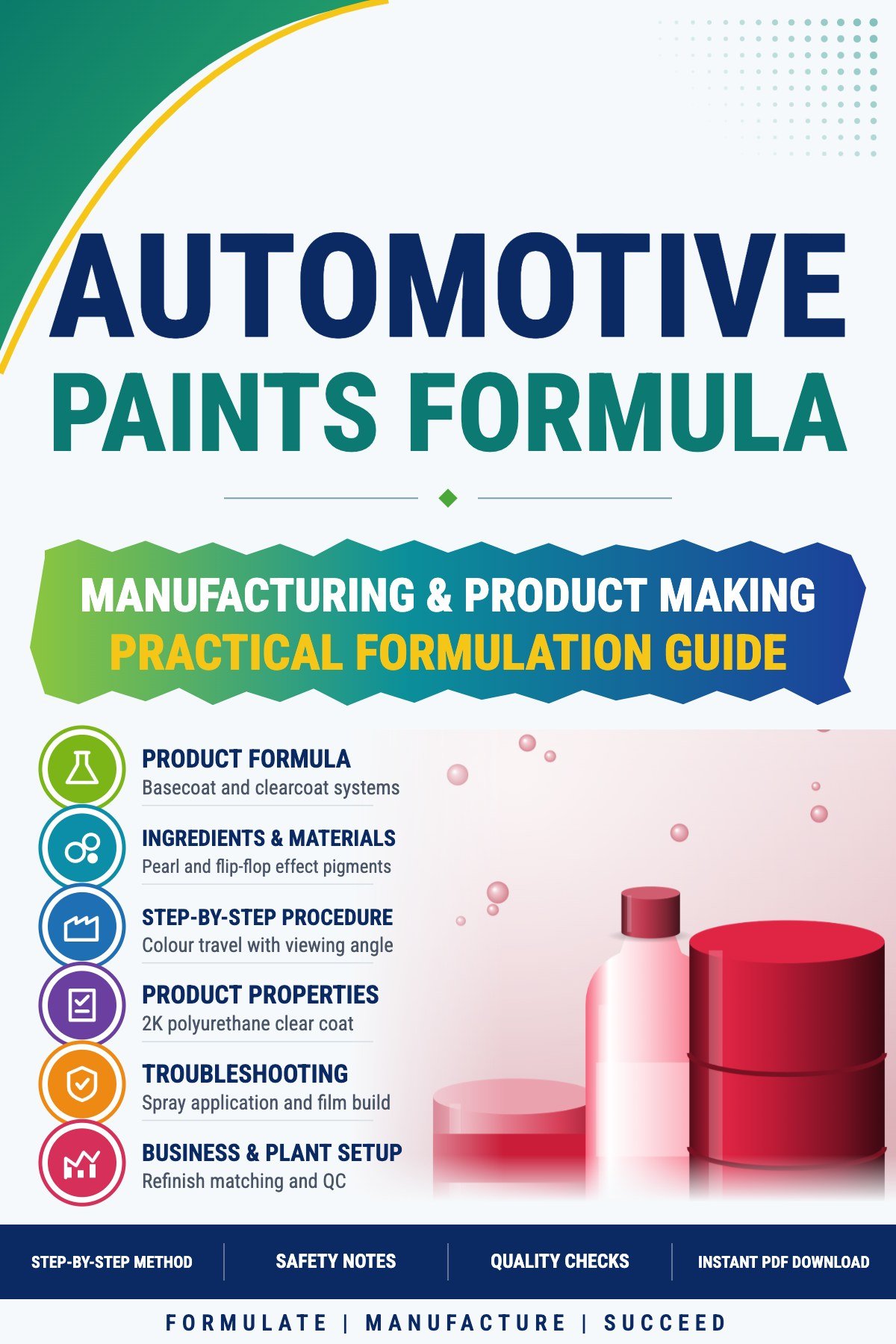
PDF manual · Instant downloadAutomotive Paints Formula: a PDF guide to basecoat, effect pigment and clearcoat automotive paints, with resins, making, application, testing, safety and business tips.
Payment Methods
Refund Policy
Custom Formulation Services
Formulation Consultation
Contact Us
Automotive paints are no longer judged only on protection and durability. Colour movement, visual depth and special effects now define market leadership, and customers expect finishes that change with light, angle and motion. Manufacturers who deliver these effects first gain a clear competitive advantage. The Automotive Paints Formula guide by CFS was developed to support that vision. This page explains how a modern automotive paints formulation is layered, which resins, pigments and additives are used, how basecoats and clearcoats are made, applied and tested, and how to build a refinish or specialty paint business.
This guide is published by Chemical Formulation Services, the formulation publishing and consultancy business of CFS Formulation Services Ltd in Sheffield, United Kingdom. It is written for people who want to understand the product from the raw material to the finished pack, and it keeps its claims practical rather than promotional.
At a glance
- Product: Automotive Paints Formula, a digital PDF Product Making Guide.
- Also searched as: automotive paints formulation, car paint formula, basecoat clearcoat, metallic car paint, pearl effect automotive paint.
- System: primer, basecoat with effect pigments and clearcoat, often 2K polyurethane or acrylic.
- Key goals: colour depth, flop, gloss, weathering, chip resistance and repairability.
- Who it is for: automotive refinish makers, custom paint studios, coating chemists and entrepreneurs.
- Delivery: instant PDF download after payment is confirmed.
- Publisher: CFS Formulation Services Ltd, England and Wales company number 16678503.
The multi-layer automotive finish
A modern car body finish is a stack of thin layers, each with a job. A pretreatment (phosphate or thin-film coating) prepares the metal. An electrocoat primer, applied by electrical deposition, provides corrosion protection. A primer-surfacer fills small defects, gives chip resistance and creates a uniform surface. A basecoat supplies colour and special effects. A clearcoat on top provides gloss, UV protection and resistance to scratches, acid rain and chemicals. In refinish and custom paint shops the stack is rebuilt in a spray booth using solvent-borne or waterborne systems. The artistry and chemistry lie in the basecoat and clearcoat.
Colour and effect pigments
Solid colours
Based on titanium dioxide, carbon black, organic pigments and iron oxides, giving uniform colour without sparkle.
Metallic colours
Aluminium flake pigments of controlled size and shape give a glittering, metal-like look. Fine flakes yield smooth, silky metallics; coarse flakes yield sparkle. The orientation of the flakes in the film creates “flop”, the change in lightness from face-on to grazing angles.
Pearlescent pigments
Mica or glass flakes coated with titanium dioxide or iron oxide produce soft, lustrous colours by light interference and reflection, with pearl white, champagne and bronze shades.
Interference and colour-shift pigments
Thin-film effect pigments make the colour change with viewing angle, for example green to purple. Chromatic flip-flop finishes rely on multilayer flakes with carefully controlled thickness.
Special effect additives
Glass flakes, ceramic microspheres, fluorescent and photochromic pigments, and sparkle particles create unique looks for custom and show cars.
Resin systems
- Acrylic lacquers: thermoplastic, fast-drying and easy to polish, used in some refinish and custom applications.
- Acrylic polyol with isocyanate hardener (2K polyurethane): the standard for durable clearcoats and topcoats with excellent gloss, chemical resistance and weathering.
- Polyester and alkyd modifications: improve flow, build and cost balance.
- Waterborne basecoats: polyurethane or acrylic dispersions, mandated or favoured in regions with strict VOC limits.
- UV-curable clearcoats and basecoats: offer very fast cure in specific repair or industrial lines.
Waterborne basecoats and VOC compliance
Environmental rules have pushed the industry strongly toward waterborne basecoats, especially in Europe and North America, where original equipment makers and many refinish shops have switched. Waterborne basecoats use polyurethane or acrylic dispersions with water as the main carrier and small amounts of co-solvents. They need good airflow and sometimes infrared or warm-air drying to flash off water, and they require more careful control of humidity in the booth. Effect pigments for waterborne systems are specially coated to resist gassing and corrosion in water. Producers entering this field should plan for stainless steel equipment, tight pH control and thorough training, since waterborne paints behave differently from solvent-borne ones in mixing, application and clean-up.
Custom, motorcycle and aerosol markets
Not every customer is a large body shop. Custom painters, motorcycle builders, bicycle framers and hobby model makers want vivid effects in small batches, often in aerosol cans, small tins or ready-to-spray kits. These customers value unique colours, special effect pigments, clear instructions and small order quantities. Aerosol paint demands fine pigment grinds and careful filling, but opens retail channels through hardware stores and online marketplaces. Many successful small paint brands begin with a handful of striking effect colours promoted through videos and social media, then add primers, clears and accessories.
Durability testing and warranty thinking
Automotive customers expect finishes to look good for many years. Run accelerated weathering in QUV or Xenon chambers, humidity cabinets and salt spray tests, and also expose panels outdoors in strong sun for real-time data. Record gloss retention, colour change, cracking and chalking. Test chip resistance with gravelometer methods and chemical resistance with fuel, brake fluid and cleaning agents. Reliable data helps you write truthful warranties and explain limits, such as the importance of correct surface preparation and curing.
What is inside the Automotive Paints Formula guide
The guide begins from the premise that automotive paints are no longer judged only by protection and durability, and that colour movement, visual depth and special effects now define market leadership, with customers expecting finishes that change with light, angle and motion. It then provides basecoat, effect and clearcoat recipes, preparation methods, application guidance, testing and troubleshooting for manufacturers aiming at these results.
Making a metallic or pearl basecoat
Step 1: Binder and solvent let-down
Charge the binder solution and solvents into a stirred tank. Add additives such as wetting agents, anti-settling aids and flow improvers.
Step 2: Gentle incorporation of effect pigment
Pre-wet aluminium or pearl pigment with solvent and a little binder in a separate container to form a paste. Add slowly under low-shear mixing. Avoid high shear and long grinding, which bend or break flakes and ruin the effect.
Step 3: Colour pigment dispersions
Add finely ground tinting pastes for colour, matching the target shade. Use ready-made mill bases for reproducibility.
Step 4: Adjust viscosity and film behaviour
Adjust to spraying viscosity with solvent. Tune the evaporation profile so that the film flashes off at the right rate to align flakes. Add rheology control agents for good flake orientation and sag resistance.
Step 5: Filter and pack
Filter through suitable mesh that does not damage flakes. Fill into lined cans, label and store with agitation requirements noted on the label.
Clearcoat production
A 2K clearcoat comprises a polyol component with UV absorber, hindered amine light stabilisers, flow agents and catalyst, and a separate isocyanate hardener. The polyol side is blended, filtered and filled. The hardener, usually an aliphatic polyisocyanate such as HDI trimer, is packed under dry conditions. Customers mix them at the specified ratio and spray within pot life. Scratch-resistant and ceramic-modified clearcoats include nanoparticles or silane-modified resins for more durability.
Application basics
Surface preparation determines success: clean, degrease, sand, prime and mask. Apply basecoat in thin, even coats with controlled flash time, keeping gun distance and overlap consistent, because variation changes flake orientation and causes cloudiness or stripes. Apply clearcoat in wet coats, flash off and cure at the recommended temperature, either air-dried or baked. Polish only after full cure. In refinish work, blend the new colour into adjacent panels so slight differences disappear.
Colour matching and consistency
Matching a factory colour requires the paint code, a spectrophotometer reading and sprayed test cards. Effect colours need multi-angle readings. Professional refinish systems use formula databases and mixing machines holding standard tints. Keep tinting pastes consistent, record formulas, and store retained samples for future matches.
Testing and quality control
- Viscosity, solids, density and fineness.
- Colour and flop by multi-angle spectrophotometer.
- Gloss and distinctness of image.
- Adhesion, hardness and chip resistance.
- Weathering: UV exposure, humidity and salt spray tests.
- Chemical resistance to fuel, acid and bird droppings tests.
- Pot life and drying times for 2K products.
- Storage stability and re-dispersion of settled flakes.
Troubleshooting
Cloudy or mottled metallic finish
Uneven application or flake damage. Control gun technique and avoid high shear in paint production.
Colour does not match panel
Wrong tint or application differences. Spray test cards under the same conditions and adjust.
Solvent pop and pinholes
Film too thick or flash time too short. Apply thinner coats and allow flash-off.
Dull clearcoat
Poor flow or contamination. Adjust additives and clean the booth.
Peeling between layers
Recoat window missed or surface contaminated. Follow overcoat times and scuff.
Fish-eyes
Silicone contamination. Clean thoroughly and use silicone-free products.
Safety and regulation
Isocyanate hardeners are respiratory sensitisers and can cause occupational asthma, so spraying must be done in ventilated booths with supplied-air respirators, gloves and protective clothing. Solvents are flammable and harmful. Some pigments contain heavy metals and are restricted. Metal powders and dry pigments form dust hazards. Follow VOC regulations, which are strict for refinish paints in many regions, and provide safety data sheets and labelling. Staff require training, and waste paint and solvents need licensed disposal.
Business opportunity
Opportunities include refinish paint for body shops, custom colour and effect kits for hobbyists and show-car builders, motorcycle and bicycle paint, aerosol touch-up paint, and industrial coatings for fleets. Private-label basecoat and clearcoat systems for regional distributors are a stable route. Technical training, colour databases and quick delivery build customer loyalty. Social media demonstrations of colour travel effects can rapidly attract custom paint customers.
Explore more in the Auto Care Products, Paint Industry, Lacquer Products and Coating Formulations categories, and see , , , Metal Paint Clear Coat Formula, Synthetic Enamel Paint Formula and Car Wash and Wax Formulation.
Getting started
Begin with an acrylic polyol 2K clearcoat and a solvent-borne metallic basecoat. Spray test panels, evaluate flop, gloss and durability, and refine the flake handling. Add pearl and colour-shift effects, develop colour cards and prepare safety documentation. Offer sample kits to local painters and gather feedback before scaling.
How to get the best results from this guide
Treat the guide as a tested starting point rather than a finished factory. Begin with a small trial batch in the laboratory or on a bench, using the exact raw materials you plan to buy, and record every weight, temperature, mixing time and observation. Compare the result with the quality checks in the guide, change only one thing at a time, and keep a note of what each change did. Once a small batch is consistently good, repeat it several times, then scale up in stages, because mixing, heating and cooling behave differently in larger vessels. Keep retained samples of every batch, write simple standard operating procedures for your team, and build relationships with two suppliers for each key raw material. Finally, check the labelling, safety and product rules in the country where you will sell, and ask a qualified person to review your process. This careful, documented approach is what turns a good formulation into a reliable product and a trusted brand.
Who should buy this guide?
The guide is written for practical readers. It suits manufacturers who want to add a new product to an existing plant, startups choosing their first product, private-label brands that need to understand what they are buying, technical staff who must set specifications and train operators, and consultants and students who want a structured, plain-language reference. It is less suitable for anyone looking for a quick shortcut or a guarantee, because every formulation still needs testing with your own materials, equipment and local rules. If you are unsure whether it matches your project, send a short question through the contact page before you order, and we will tell you honestly whether it fits.
What is inside the Automotive Paints Formula guide
Every Product Making Guide in our shop follows the same structure so you know where to look. This guide includes the product formula, the ingredients and materials, the procedure and preparations, the industrial requirements and the technical specifications. In practice you receive:
- The formulation, written so you can follow it at the bench and scale it up.
- Ingredients and materials, with the job of each material and advice on grades and suppliers.
- The manufacturing procedure, including order of addition, mixing and preparations.
- Industrial requirements, covering equipment, space and packaging.
- Technical specifications, describing what a good finished product should look like and how it should behave.
- Troubleshooting for the faults that makers meet most often.
- Business guidance, to help you take the product from the bench to the market.
These Product Making Guides of chemical formulations and formulas are for manufacturers, startups and entrepreneurs. Every guide contains industrially tested, practical formulations. Anyone who buys a guide can make the product by following its step-by-step instructions. Raw materials vary between suppliers, so always confirm your results with a small trial batch before scaling up.
Who stands behind this guide?
Chemical Formulation Services is the trading name of CFS Formulation Services Ltd, registered in England and Wales under company number 16678503, with its office at Unit F, Winston Business Park, Churchill Way, Sheffield S35 2PS. The business was founded by George Enrick and publishes formulation manuals, technical guides and industry reports. You can check our details on the Companies House register, read about us, or contact us with any question before you order.
A written formulation cannot replace testing with your own raw materials, equipment and climate, and we say so plainly. What the guide does give you is a tested, structured starting point that can save you months of trial and error. Our terms and conditions explain what a purchase from us covers.
How to order
- Select Add to cart to keep browsing, or Buy Now to go straight to checkout.
- Pay with PayPal, Stripe, Xoom by PayPal, Payoneer, payment links for debit and credit cards, or Western Union, Ria and all money exchanges.
- If you pay through a money exchange, email your payment slip to Info@chemicalformulationservices.com. After confirmation, your instant download link is emailed to you.
- For online payments, the PDF is available as soon as the payment is confirmed.
All products are digital downloads and all payments are nonrefundable once the file is delivered, so please read the refund policy and the FAQs before you order. You can compare this guide with others in the formula shop or browse our industrial project reports.
Frequently asked questions about automotive paints formula
What is the Automotive Paints Formula guide?
It is a digital PDF Product Making Guide to automotive basecoat, effect and clearcoat paints, covering resins, effect pigments, making, application, testing and troubleshooting.
What creates the metallic look?
Aluminium flake pigments aligned in the film reflect light and create flop.
Why avoid high shear for effect pigments?
It bends and breaks flakes, dulling the effect.
Are 2K paints hazardous?
Isocyanate hardeners are sensitisers, so ventilated booths and supplied-air respirators are required.
Can I make colour-shift finishes?
Yes, with special interference pigments and careful application, as covered in the guide.
How do I receive the guide?
You receive an instant PDF download after payment is confirmed. For money exchanges, email your payment slip to Info@chemicalformulationservices.com and the link is emailed after we confirm it.
Is the payment refundable?
All payments are nonrefundable because the product is an instant digital download. See the refund policy for details.
Can you help with a custom formulation?
CFS Formulation Services Ltd offers formulation and product development consultancy. Send a short brief through the Contact page.
Last reviewed: November 2026. This page is general information about a digital product. It is not a safety data sheet or professional advice, and any formulation should be tested and reviewed by a qualified person before commercial use.