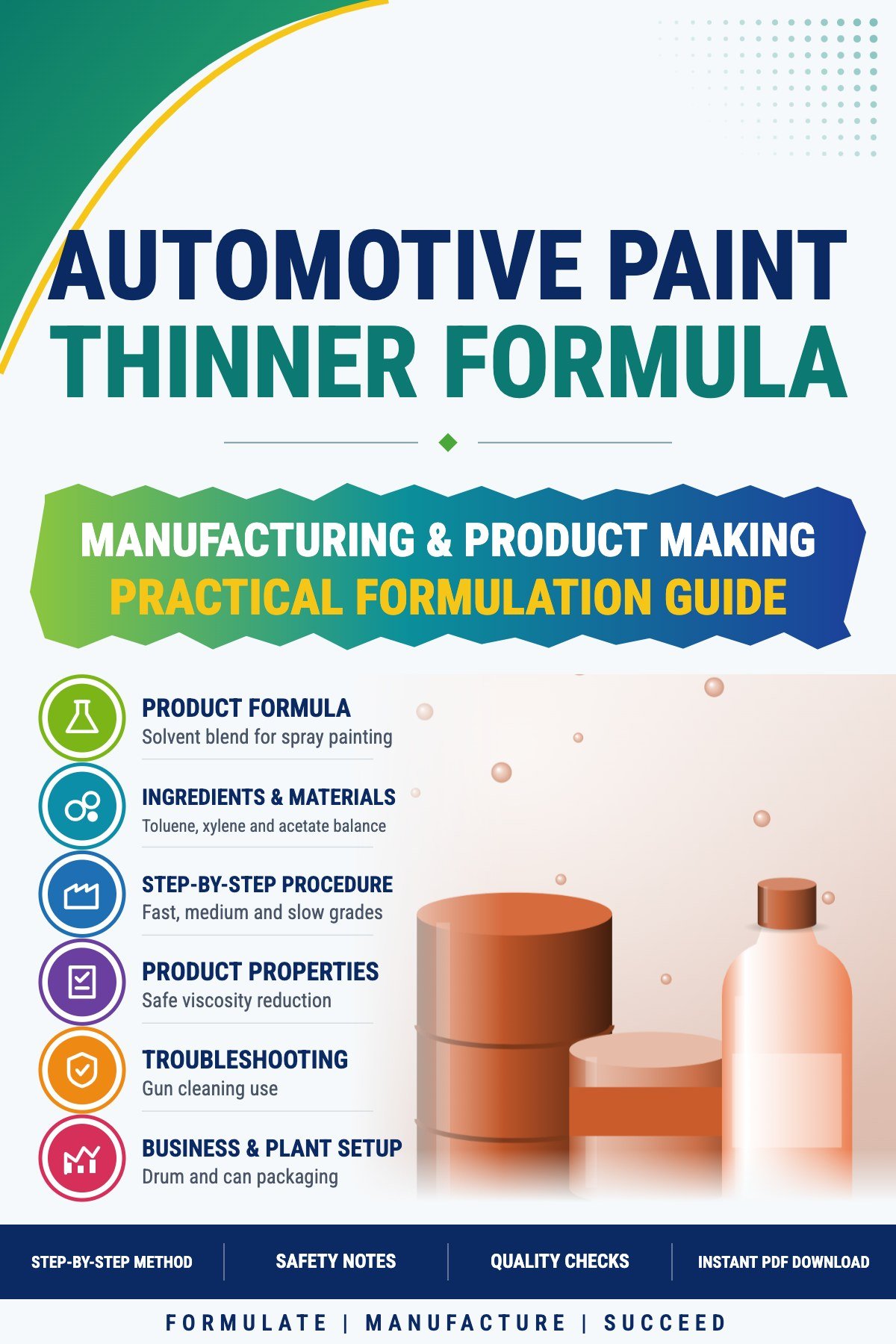

Automotive Paint Thinner Formula
USD $70
PDF manual · Instant downloadAutomotive Paint Thinner Formula: a PDF guide to solvent thinners for car paint, with solvent families, fast, medium and slow grades, blending, testing and safety.
Payment Methods
Refund Policy
Custom Formulation Services
Formulation Consultation
Contact Us
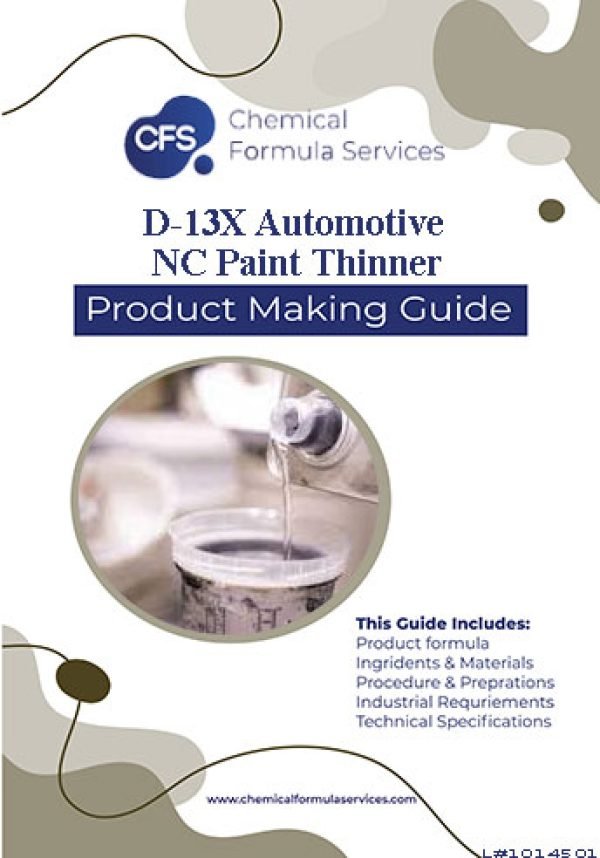
Automotive paint thinner is a premium solvent blend designed for automotive painting. It reduces the viscosity of automotive paints so they spray or brush smoothly, and it cleans spray guns and equipment afterwards. A good Automotive Paint Thinner Formula balances strong solvents such as toluene, xylene, acetone and butyl acetate so the paint stays in solution, flows out and dries without defects. This practical PDF guide by CFS is for solvent blenders, paint suppliers, startups and entrepreneurs. This page explains how an automotive paint thinner formulation is designed, how it is blended safely, how it is tested, and how it is sold.
This guide is published by Chemical Formulation Services, the formulation publishing and consultancy business of CFS Formulation Services Ltd in Sheffield, United Kingdom. It is written for people who want to understand the product from the raw material to the finished pack, and it keeps its claims practical rather than promotional.
At a glance
- Product: Automotive Paint Thinner Formula, a digital PDF Product Making Guide.
- Also searched as: automotive paint thinner formulation, car paint thinner, lacquer thinner for auto paint, spray gun thinner, reducer for car paint.
- Blend: ketones, esters and aromatic hydrocarbons with alcohol or retarder as needed.
- Key goals: solvency, evaporation balance, blush resistance, odour and cost.
- Who it is for: solvent blenders, auto paint distributors, body shops and entrepreneurs.
- Delivery: instant PDF download after payment is confirmed.
- Publisher: CFS Formulation Services Ltd, England and Wales company number 16678503.
What the thinner does in a paint system
Automotive paint is supplied at a viscosity higher than needed for good spraying. The painter adds thinner or reducer until the paint passes through the gun at the right flow, atomises into fine droplets, lands on the panel, flows out to a smooth film and dries at a controlled rate. The thinner must dissolve the paint resin completely, evaporate in step with the paint’s drying needs, avoid cooling the film so much that moisture condenses, and leave no residue. If the thinner is too fast, the surface skins before it levels, causing orange peel or dry spray. If it is too slow, paint sags and runs and dust sticks.
The solvent families used
Aromatic hydrocarbons
Toluene and xylene are strong, relatively cheap diluents with medium to slow evaporation. They dissolve many resins and improve flow. Their health and environmental profiles drive restrictions in many regions, so alternatives such as solvent naphtha or reformulated blends are used.
Ketones
Acetone and methyl ethyl ketone are fast, powerful solvents for acrylic and nitrocellulose lacquers. They can attack underlying coatings if used on old paint, and evaporate quickly, so they are blended carefully.
Esters
Butyl acetate and ethyl acetate are classic automotive solvents, dissolving a wide range of resins and giving good flow. Butyl acetate is the key medium-speed solvent in many reducers.
Alcohols and glycol ethers
Latent solvents and retarders: isopropanol, butanol and glycol ether acetates adjust evaporation and reduce blush, but should be avoided in 2K polyurethane systems because alcohols react with isocyanates.
Fast, medium and slow grades
- Fast thinner: richer in acetone, MEK and ethyl acetate; for cool weather, small repairs and spot work.
- Medium thinner: balanced blend for normal shop temperatures around 18 to 25 degrees Celsius.
- Slow thinner: richer in butyl acetate, xylene and glycol ether acetates; for hot weather, large panels and full resprays.
- Extra slow retarder: small additions to stop blushing and to improve gloss in very hot or humid conditions.
Spray gun cleaning and flush thinners
Not every thinner needs to be premium. A good body shop uses a cheaper, strong “gun wash” thinner to flush guns, cups, hoses and tools, and a cleaner, more carefully balanced reducer in the paint itself. Gun wash blends use more recycled or lower-grade aromatic and ketone cuts, sometimes with glycol ether to soften dried paint, and are not meant to go into a paint. Label them clearly as cleaning thinners, in different coloured cans if possible, so painters never pour them into paint by mistake. Offering both products lets you win more of the shop’s solvent spend and keeps the painting grade pure.
Solvent recovery and sustainability
Used thinner can be recovered by distillation in approved, safe equipment, which reduces cost and waste. Recovered solvent is suitable for cleaning and flushing, but should not be sold as new product unless it meets full specifications. Regulations on VOC and hazardous waste are tightening, so larger customers increasingly ask for lower-VOC reducers, exempt solvents and recycling programmes. Suppliers who can explain options and offer collection of used solvent gain a competitive edge, particularly with fleet operators and dealer groups.
Technical advice for painters
Printed guidance on the can helps: add thinner in small steps while stirring and testing flow time in a viscosity cup, follow the paint maker’s reduction ratio, match thinner speed to temperature, avoid spraying in direct sun or draughts, and allow adequate flash time between coats. A phone number or QR code to technical support and a simple selection chart for thinner grade and paint type builds trust and reduces misuse. Painters who succeed with your thinner will recommend it to colleagues.
What is inside the Automotive Paint Thinner Formula guide
The guide introduces CFS automotive paint thinner as a premium solvent blend designed for automotive painting, effectively reducing paint viscosity for smooth application with a spray gun or brush, with a mix of toluene, xylene, acetone and butyl acetate for strong solvency. It then provides blend tables, safety practice, tests and troubleshooting.
Blending process
Step 1: Set up safe equipment
Use earthed, closed, stainless steel or lined carbon steel tanks with explosion-proof pumps and motors, vapour extraction and spill control. Prohibit ignition sources in the area.
Step 2: Charge solvents in order
Pump filtered solvents into the tank in the planned order, usually the largest components first, then smaller components, recirculating or stirring gently. Avoid splash filling, which builds static.
Step 3: Sample and test
Check density, evaporation behaviour and compatibility with a standard paint. Adjust the blend if needed.
Step 4: Filter and fill
Filter into cans, drums or bulk containers with bonding and grounding. Label correctly, with batch number and type (fast, medium, slow).
Matching the thinner to the paint system
Lacquer and acrylic lacquers accept ketone-ester-aromatic thinners. Solvent-borne basecoats use dedicated reducers that avoid strong ketones. 2K polyurethane primers and clearcoats need urethane-grade reducers with no alcohols or water, and low acid values, since these interfere with the isocyanate cure. Waterborne paints need water-based reducers, not solvent thinners. Cellulose products may use cheaper, hydrocarbon-rich thinners. Tell customers which thinner to use with which paint, and do not recommend a general thinner for all systems.
Testing and quality control
- Density, refractive index and colour.
- Distillation range and evaporation rate.
- Water content by Karl Fischer.
- Acid value and non-volatile residue.
- Dilution ratio and compatibility with typical paints.
- Blush resistance in a humid chamber.
- Flash point and odour.
- Spray test panels for flow and levelling.
Troubleshooting
Blushing or milky film
Moisture condensing as solvent cools the film. Use slower thinner or retarder and drier air.
Orange peel
Evaporation too fast. Use a slower thinner or more dilution.
Paint turns cloudy when thinned
Poor solvency or water contamination. Choose a stronger solvent blend and keep drums sealed.
Runs and sags
Too slow thinner or too much thinning. Use a faster thinner and lighter coats.
Lifting of underlying paint
Strong ketones. Use a milder thinner on old finishes.
Poor 2K cure
Wrong thinner with alcohol or water. Use urethane grade reducer.
Safety, storage and regulation
Automotive thinners are highly flammable and their vapours harmful. Use grounding and bonding, ventilation, explosion-proof electrics and non-sparking tools. Wear gloves, eye protection and respirators during blending and spraying. Toluene and xylene have health effects including nervous system and reproductive concerns, so limit exposure and respect regional restrictions. Follow VOC, dangerous goods, storage and transport laws, and obtain permits for flammable liquid storage. Provide safety data sheets and label with hazard pictograms. Dispose of waste solvent through licensed handlers and never pour it into drains. Do not decant into drink bottles.
Packaging and business opportunity
Pack in 1, 4 and 5 litre cans, 20 litre pails and 200 litre drums. Customers include body shops, paint distributors, car dealerships, fleet workshops, furniture finishers and hobbyists. Offer a matched range of fast, medium and slow thinners, urethane reducers and gun cleaner. Private-label supply to paint stores is common, and consistency of blend and odour is the key to repeat orders. Training sessions and simple charts of temperature versus thinner grade help customers.
Explore more in the Lacquer Products, Varnish Making, Paint Industry and Auto Care Products categories, and see Industrial Lacquer Thinner Formulations, N C Thinner Commercial formula, Automotive Paints Formula, , and Cellulose Acetate Lacquer Formula.
Getting started
Blend a medium thinner from butyl acetate, xylene, acetone and a small amount of retarder. Test with a standard automotive lacquer on spray panels at several temperatures, adjust, and create fast and slow grades. Set up compliant storage and ventilation, prepare labels and data sheets, and provide samples to body shops.
How to get the best results from this guide
Treat the guide as a tested starting point rather than a finished factory. Begin with a small trial batch in the laboratory or on a bench, using the exact raw materials you plan to buy, and record every weight, temperature, mixing time and observation. Compare the result with the quality checks in the guide, change only one thing at a time, and keep a note of what each change did. Once a small batch is consistently good, repeat it several times, then scale up in stages, because mixing, heating and cooling behave differently in larger vessels. Keep retained samples of every batch, write simple standard operating procedures for your team, and build relationships with two suppliers for each key raw material. Finally, check the labelling, safety and product rules in the country where you will sell, and ask a qualified person to review your process. This careful, documented approach is what turns a good formulation into a reliable product and a trusted brand.
Who should buy this guide?
The guide is written for practical readers. It suits manufacturers who want to add a new product to an existing plant, startups choosing their first product, private-label brands that need to understand what they are buying, technical staff who must set specifications and train operators, and consultants and students who want a structured, plain-language reference. It is less suitable for anyone looking for a quick shortcut or a guarantee, because every formulation still needs testing with your own materials, equipment and local rules. If you are unsure whether it matches your project, send a short question through the contact page before you order, and we will tell you honestly whether it fits.
What is inside the Automotive Paint Thinner Formula guide
Every Product Making Guide in our shop follows the same structure so you know where to look. This guide includes the product formula, the ingredients and materials, the procedure and preparations, the industrial requirements and the technical specifications. In practice you receive:
- The formulation, written so you can follow it at the bench and scale it up.
- Ingredients and materials, with the job of each material and advice on grades and suppliers.
- The manufacturing procedure, including order of addition, mixing and preparations.
- Industrial requirements, covering equipment, space and packaging.
- Technical specifications, describing what a good finished product should look like and how it should behave.
- Troubleshooting for the faults that makers meet most often.
- Business guidance, to help you take the product from the bench to the market.
These Product Making Guides of chemical formulations and formulas are for manufacturers, startups and entrepreneurs. Every guide contains industrially tested, practical formulations. Anyone who buys a guide can make the product by following its step-by-step instructions. Raw materials vary between suppliers, so always confirm your results with a small trial batch before scaling up.
Who stands behind this guide?
Chemical Formulation Services is the trading name of CFS Formulation Services Ltd, registered in England and Wales under company number 16678503, with its office at Unit F, Winston Business Park, Churchill Way, Sheffield S35 2PS. The business was founded by George Enrick and publishes formulation manuals, technical guides and industry reports. You can check our details on the Companies House register, read about us, or contact us with any question before you order.
A written formulation cannot replace testing with your own raw materials, equipment and climate, and we say so plainly. What the guide does give you is a tested, structured starting point that can save you months of trial and error. Our terms and conditions explain what a purchase from us covers.
How to order
- Select Add to cart to keep browsing, or Buy Now to go straight to checkout.
- Pay with PayPal, Stripe, Xoom by PayPal, Payoneer, payment links for debit and credit cards, or Western Union, Ria and all money exchanges.
- If you pay through a money exchange, email your payment slip to Info@chemicalformulationservices.com. After confirmation, your instant download link is emailed to you.
- For online payments, the PDF is available as soon as the payment is confirmed.
All products are digital downloads and all payments are nonrefundable once the file is delivered, so please read the refund policy and the FAQs before you order. You can compare this guide with others in the formula shop or browse our industrial project reports.
Frequently asked questions about automotive paint thinner formula
What is the Automotive Paint Thinner Formula guide?
It is a digital PDF Product Making Guide to solvent thinners for automotive paints, covering solvent families, grades, blending, testing, safety and troubleshooting.
Why are there fast, medium and slow thinners?
To match evaporation speed to temperature and panel size, preventing orange peel, blush and runs.
Can any thinner be used with 2K paint?
No. 2K polyurethane systems need urethane-grade reducers with no alcohol or water.
Why does paint blush?
Fast solvent evaporation cools the film and condenses moisture. A retarder or slower thinner helps.
Is thinner dangerous?
Yes. It is highly flammable and the vapours are harmful, so ventilation, grounding and PPE are essential.
How do I receive the guide?
You receive an instant PDF download after payment is confirmed. For money exchanges, email your payment slip to Info@chemicalformulationservices.com and the link is emailed after we confirm it.
Is the payment refundable?
All payments are nonrefundable because the product is an instant digital download. See the refund policy for details.
Can you help with a custom formulation?
CFS Formulation Services Ltd offers formulation and product development consultancy. Send a short brief through the Contact page.
Last reviewed: November 2026. This page is general information about a digital product. It is not a safety data sheet or professional advice, and any formulation should be tested and reviewed by a qualified person before commercial use.