Optics Lens Cleaning Solution Formula
USD $70
PDF manual · Instant downloadOptics Lens Cleaning Solution Formula: a PDF guide to coating-safe lens cleaners for glasses, cameras and optics, with ingredients, filtration, testing, packaging and care tips.
Payment Methods
Refund Policy
Custom Formulation Services
Formulation Consultation
Contact Us
An Optics Lens Cleaning Solution Formula is a specially made cleaner for the lenses of cameras, telescopes, microscopes, binoculars and eyeglasses. It removes dirt, dust, fingerprints, smudges and other debris without damaging or scratching delicate optical surfaces. These solutions contain ingredients that dissolve and lift contaminants, leaving a clear, streak-free surface. This practical PDF guide is for cleaning product manufacturers, optical retailers, startups and entrepreneurs. This page explains how an optics lens cleaning solution formulation works, which ingredients are safe for coated lenses, how it is made, tested and packed, and how to sell it.
This guide is published by Chemical Formulation Services, the formulation publishing and consultancy business of CFS Formulation Services Ltd in Sheffield, United Kingdom. It is written for people who want to understand the product from the raw material to the finished pack, and it keeps its claims practical rather than promotional.
At a glance
- Product: Optics Lens Cleaning Solution Formula, a digital PDF Product Making Guide.
- Also searched as: optics lens cleaning solution formulation, lens cleaner, eyeglass cleaner, camera lens cleaning fluid, coating-safe lens spray.
- Base: deionised water, isopropanol and trace surfactant.
- Key goals: residue-free drying, coating safety, plastic lens safety and low odour.
- Who it is for: optical shops, camera accessory brands, cleaning product makers and entrepreneurs.
- Delivery: instant PDF download after payment is confirmed.
- Publisher: CFS Formulation Services Ltd, England and Wales company number 16678503.
Why lens cleaning needs special chemistry
Optical surfaces are made of glass or plastics such as CR-39, polycarbonate and high-index polymers, often with thin multilayer coatings: anti-reflective, hydrophobic, oleophobic, scratch-resistant, UV and blue-light filters. These coatings are only nanometres thick and easily damaged by strong solvents, abrasive particles, ammonia and aggressive cleaners. Fingerprints and skin oils are particularly stubborn. A lens cleaner must dissolve oils without attacking coatings or plastic, evaporate evenly without leaving rings or streaks, and be safe on skin and eyes in case of accidental contact.
Core ingredients
Deionised or distilled water
The main carrier, free of minerals so it dries without spots. Typically 60 to 90 percent of the formula.
Isopropyl alcohol (IPA) or ethanol
Dissolves oily fingerprints and evaporates quickly, preventing streaks. Typical levels are 5 to 30 percent. Higher alcohol levels clean faster, but extreme levels can stress some plastic lenses and coatings, so moderate levels are best for eyeglasses. Use high-purity grades with no denaturants that leave residues.
Mild surfactant
A trace of non-ionic surfactant (for example, a low-residue alcohol ethoxylate or alkyl polyglucoside, around 0.01 to 0.1 percent) improves wetting and lifts grease. Too much surfactant leaves film and streaks.
Optional additives
A tiny amount of glycol ether for stubborn grease, or a trace of anti-fog or anti-static agent for products marketed as anti-fog cleaners. Preservative is rarely needed in alcohol-rich solutions but is used in water-heavy sprays. Fragrance is generally avoided or very light, since scent can leave film and irritate eyes.
Ingredients to avoid
Ammonia, strong acids and alkalis, acetone, chlorinated solvents, abrasive particles, silicones, waxes and dyes that leave films, and household glass cleaners, which may contain harmful ingredients for coatings and plastics.
Lens cleaning for different devices and coatings
Customers use cleaners on many kinds of optics, and each has quirks. Spectacle lenses with anti-reflective and oleophobic coatings tolerate gentle alcohol-water mixtures, but plastic frames and some sports lenses can be stressed by strong solvents. Camera lenses have delicate coatings and sealed housings, so spray should go on a cloth, not the glass. Microscope and telescope optics may have cemented elements and special coatings, and manufacturers often recommend only specific solvents. Screens on phones and tablets carry oleophobic layers that wear faster with harsh cleaners. Providing a short compatibility chart on the pack, and recommending a hidden-spot test when in doubt, builds trust and prevents damage claims.
Cloth quality and accessories
The cleaner is only half of the system. A fine, tightly woven microfibre cloth lifts oil without scratching, but poor, coarse or dirty cloths trap grit and cause fine scratches. Offer a cloth with each bottle, include washing instructions, and sell replacements. Add a soft brush or air blower for dust removal, and a small case for the cloth. Bundles of cleaner, cloth and brush increase order value and give customers a better experience, which means better reviews.
Selling through opticians, camera stores and online
Opticians are trusted advisers and often give cleaners to new glasses wearers, so private-label bottles with the shop’s logo are valuable. Camera stores recommend cleaners to photographers and sell accessories in sets. Online sellers need compelling, honest photos and videos showing smudge removal under light, plus clear information on safe use for coated lenses. Seek reviews from opticians or photographers, and avoid unsupported claims such as “permanent protection” or “repairs scratches”, which damage credibility.
What is inside the Optics Lens Cleaning Solution Formula guide
The guide describes the optics lens cleaning solution formula as one specially formulated to clean lenses in optical devices such as cameras, telescopes, microscopes, binoculars and eyeglasses, effectively removing dirt, dust, fingerprints, smudges and other debris without causing damage or scratching, and typically containing ingredients that dissolve and lift contaminants. It adds recipes for spray and wipe formats, process steps, tests and care instructions.
Manufacturing process
Step 1: Clean equipment
Use dedicated stainless steel or high-density polyethylene tanks and filling lines cleaned thoroughly with deionised water and IPA to avoid contamination by oils or particles. Work in a clean, low-dust room.
Step 2: Charge water and surfactant
Pump deionised water into the tank and add surfactant dissolved in a little water. Mix gently to avoid foam.
Step 3: Add alcohol
Add high-purity IPA or ethanol slowly with stirring. Keep ignition sources away; the blend is flammable at higher alcohol levels.
Step 4: Filter
Pass the solution through a 0.2 to 1.0 micrometre filter to remove particles that could scratch lenses. This step is very important for optical cleaners.
Step 5: Fill
Fill into clean spray bottles with fine-mist triggers or pump sprays, dropper bottles or wipe packets. Seal and label.
Formats
- Fine-mist spray bottles of 30 to 120 millilitres, popular with eyeglass wearers, usually sold with a microfibre cloth.
- Pre-moistened lens wipes individually sealed, convenient for travel; they require non-woven material compatible with the solution and sealed foil packs.
- Dropper or pen-style cleaners for camera lenses and microscope optics.
- Concentrate or refills for optical shops that clean many pairs of glasses daily.
- Specialty formulations for scientific lenses and filters, with tighter purity and low-residue requirements.
Cleaning method to print on the pack
First, blow off or brush away loose dust and grit, because wiping dry particles scratches lenses. Second, spray a small amount of cleaner onto a clean microfibre cloth rather than directly onto the lens when cleaning camera or instrument optics, to prevent liquid from running into the housing. Third, wipe gently in circular motions from the centre outward. Fourth, finish with a dry portion of the cloth. Wash microfibre cloths regularly without fabric softener. Do not use paper towels, tissues or clothing, which scratch and leave lint.
Testing and quality control
- Appearance and clarity; no haze or particles.
- Purity checks: conductivity of the water and non-volatile residue on evaporation.
- Cleaning efficiency on lenses or glass slides contaminated with standard fingerprint oils.
- Streaking and residue after drying, under strong light.
- Coating compatibility: repeated cleaning cycles on sample lenses with various coatings, with checks for peeling, haze or discolouration.
- Plastic compatibility: stress cracking or crazing checks on polycarbonate and acrylic samples.
- Flash point and spray pattern.
- Particle counts for high-purity grades.
Troubleshooting
Streaks after cleaning
Surfactant too high, hard water or dirty cloth. Lower surfactant, use deionised water and fresh cloths.
Hazy film on coated lenses
Residue from impure ingredients or fragrance. Remove additives and filter.
Cracks or crazing in plastic lenses
Alcohol level too high or contaminants. Lower alcohol and test materials.
Spray leaves large droplets
Wrong nozzle or low alcohol. Use fine-mist sprayers.
Cloudy solution
Poor water quality or incompatible surfactant. Use deionised water and tested raw materials.
Fogging soon after cleaning
Residual moisture. Dry thoroughly or use anti-fog formulation.
Safety and regulation
Alcohol-containing sprays are flammable, so label them accordingly and store them away from heat and flames. Avoid spraying toward eyes and keep out of reach of children. For pre-moistened wipes, sealed foil prevents drying and leaks. Follow cosmetic or general consumer product regulations in your market, label ingredients and net contents, and provide a batch code. Do not claim that the solution is suitable for all lenses without testing; add a note to check manufacturer guidance for special coatings. For medical or scientific optics, follow relevant standards.
Packaging and business opportunity
Combine the spray with a microfibre cloth in a retail pack for optical shops, camera stores, pharmacies, electronics stores and online sellers. Offer private-label supply to optical chains and eyewear brands, wipes in dispenser boxes for offices and schools, and large refill containers for opticians. Sell related products like screen cleaners for phones, tablets and monitors, using the same chemistry with similar testing. Clear instructions and gentle messaging build trust with customers who value their expensive lenses.
Extend your cleaning range with the Cleaning Products, Detergent Formulations, Auto Care Products and Metal Treatment categories, and see Car Glass Cleaner Formula, , , Metal Ultrasonic Cleaners Formula, Printing Plate Cleaner Formula and .
Getting started
Blend deionised water, a moderate level of isopropanol and a trace of mild surfactant, filter finely, and test on glass slides and sample lenses with coatings. Compare streaking and residue against commercial cleaners, adjust, and then prepare labels, instructions and cloth packs. Provide samples to optical shops for feedback.
How to get the best results from this guide
Treat the guide as a tested starting point rather than a finished factory. Begin with a small trial batch in the laboratory or on a bench, using the exact raw materials you plan to buy, and record every weight, temperature, mixing time and observation. Compare the result with the quality checks in the guide, change only one thing at a time, and keep a note of what each change did. Once a small batch is consistently good, repeat it several times, then scale up in stages, because mixing, heating and cooling behave differently in larger vessels. Keep retained samples of every batch, write simple standard operating procedures for your team, and build relationships with two suppliers for each key raw material. Finally, check the labelling, safety and product rules in the country where you will sell, and ask a qualified person to review your process. This careful, documented approach is what turns a good formulation into a reliable product and a trusted brand.
Who should buy this guide?
The guide is written for practical readers. It suits manufacturers who want to add a new product to an existing plant, startups choosing their first product, private-label brands that need to understand what they are buying, technical staff who must set specifications and train operators, and consultants and students who want a structured, plain-language reference. It is less suitable for anyone looking for a quick shortcut or a guarantee, because every formulation still needs testing with your own materials, equipment and local rules. If you are unsure whether it matches your project, send a short question through the contact page before you order, and we will tell you honestly whether it fits.
What is inside the Optics Lens Cleaning Solution Formula guide
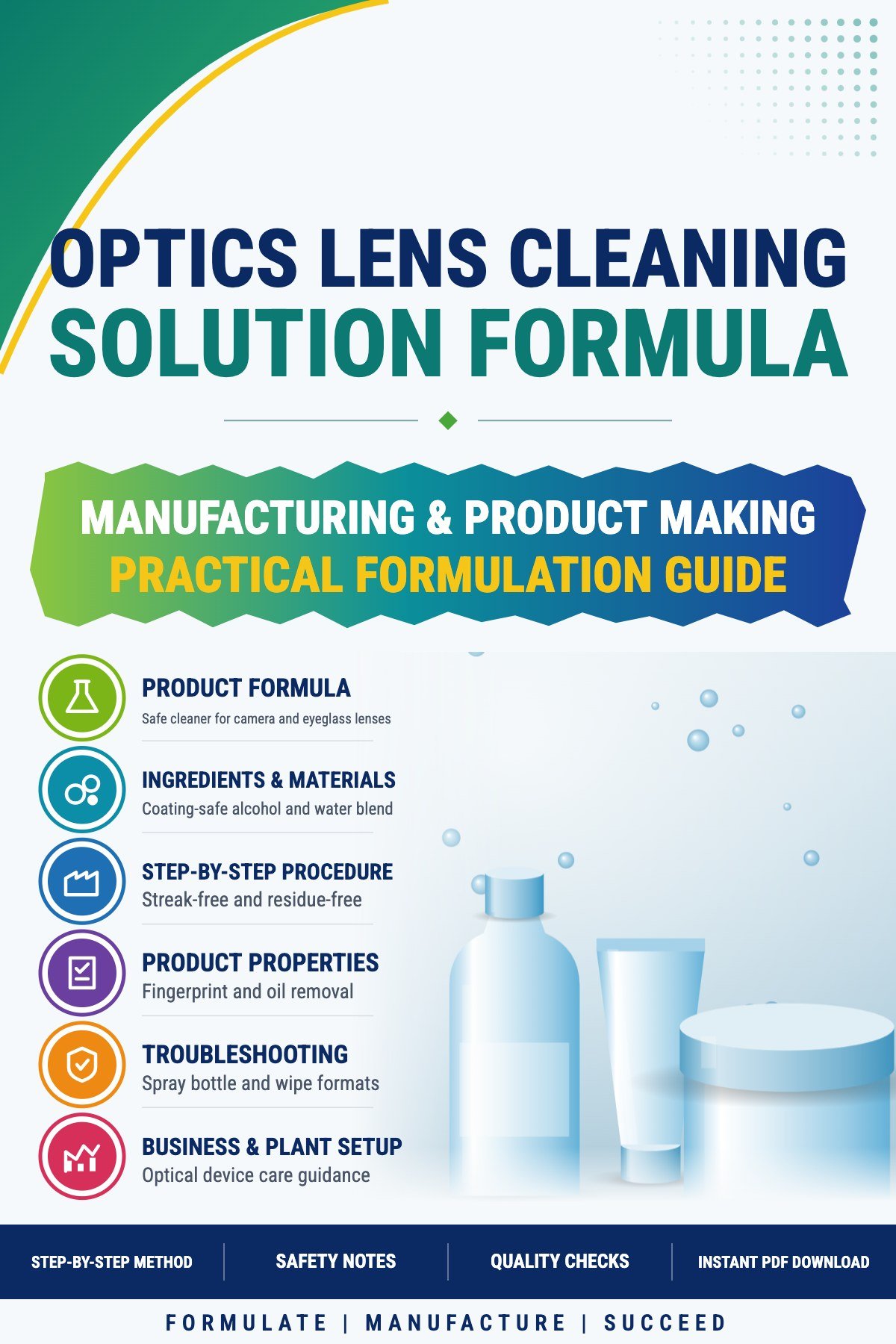
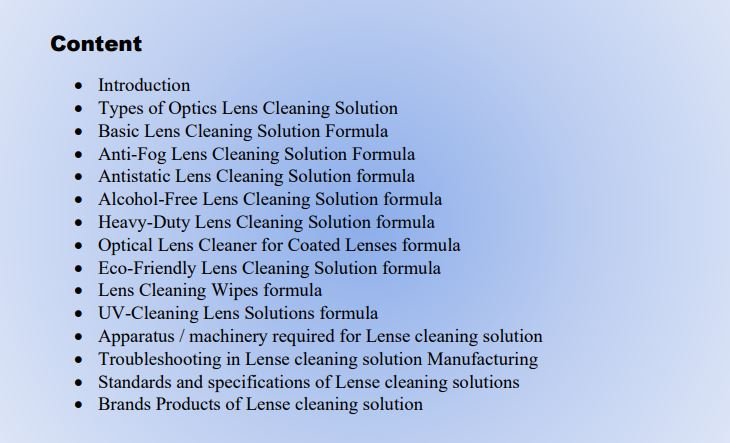
Every Product Making Guide in our shop follows the same structure so you know where to look. This guide includes the product formula, the ingredients and materials, the procedure and preparations, the industrial requirements and the technical specifications. In practice you receive:
- The formulation, written so you can follow it at the bench and scale it up.
- Ingredients and materials, with the job of each material and advice on grades and suppliers.
- The manufacturing procedure, including order of addition, mixing and preparations.
- Industrial requirements, covering equipment, space and packaging.
- Technical specifications, describing what a good finished product should look like and how it should behave.
- Troubleshooting for the faults that makers meet most often.
- Business guidance, to help you take the product from the bench to the market.
These Product Making Guides of chemical formulations and formulas are for manufacturers, startups and entrepreneurs. Every guide contains industrially tested, practical formulations. Anyone who buys a guide can make the product by following its step-by-step instructions. Raw materials vary between suppliers, so always confirm your results with a small trial batch before scaling up.
Who stands behind this guide?
Chemical Formulation Services is the trading name of CFS Formulation Services Ltd, registered in England and Wales under company number 16678503, with its office at Unit F, Winston Business Park, Churchill Way, Sheffield S35 2PS. The business was founded by George Enrick and publishes formulation manuals, technical guides and industry reports. You can check our details on the Companies House register, read about us, or contact us with any question before you order.
A written formulation cannot replace testing with your own raw materials, equipment and climate, and we say so plainly. What the guide does give you is a tested, structured starting point that can save you months of trial and error. Our terms and conditions explain what a purchase from us covers.
How to order
- Select Add to cart to keep browsing, or Buy Now to go straight to checkout.
- Pay with PayPal, Stripe, Xoom by PayPal, Payoneer, payment links for debit and credit cards, or Western Union, Ria and all money exchanges.
- If you pay through a money exchange, email your payment slip to Info@chemicalformulationservices.com. After confirmation, your instant download link is emailed to you.
- For online payments, the PDF is available as soon as the payment is confirmed.
All products are digital downloads and all payments are nonrefundable once the file is delivered, so please read the refund policy and the FAQs before you order. You can compare this guide with others in the formula shop or browse our industrial project reports.
Frequently asked questions about optics lens cleaning solution formula
What is the Optics Lens Cleaning Solution Formula guide?
It is a digital PDF Product Making Guide to lens cleaning solutions for glasses, cameras and optical instruments, covering ingredients, making, testing, coating safety and packaging.
Why avoid ammonia on lenses?
It can damage anti-reflective and other coatings and some plastics.
Is isopropanol safe on glasses?
Moderate levels are commonly used, but very high levels can stress some plastics and coatings.
Why filter the solution?
To remove particles that could scratch the lens during wiping.
Should I spray directly on camera lenses?
Spray onto a microfibre cloth instead, to keep liquid out of the housing.
How do I receive the guide?
You receive an instant PDF download after payment is confirmed. For money exchanges, email your payment slip to Info@chemicalformulationservices.com and the link is emailed after we confirm it.
Is the payment refundable?
All payments are nonrefundable because the product is an instant digital download. See the refund policy for details.
Can you help with a custom formulation?
CFS Formulation Services Ltd offers formulation and product development consultancy. Send a short brief through the Contact page.
Last reviewed: November 2026. This page is general information about a digital product. It is not a safety data sheet or professional advice, and any formulation should be tested and reviewed by a qualified person before commercial use.