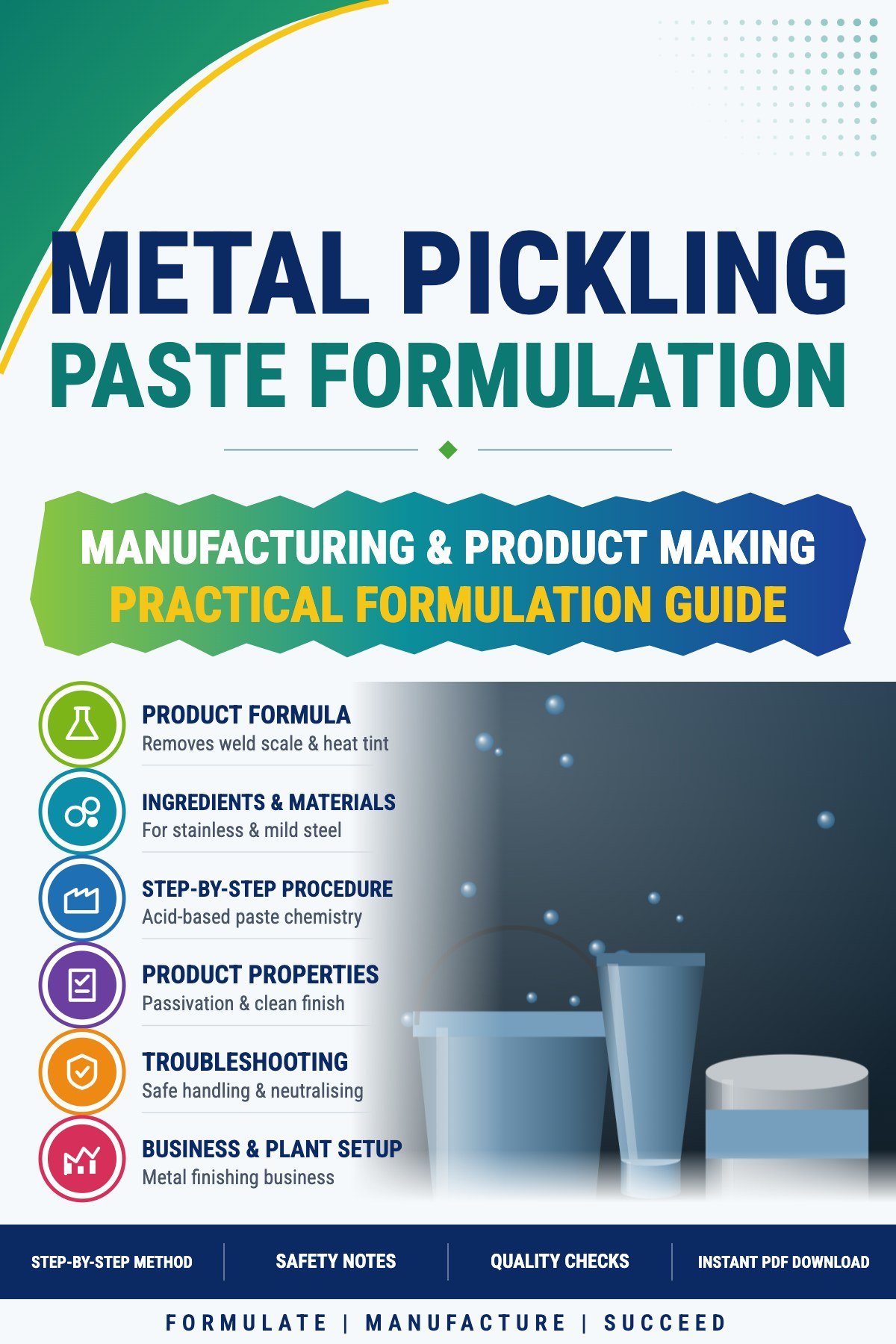

Metal Pickling Paste Formulation
USD $65
PDF manual · Instant downloadMetal Pickling Paste Formulation: a PDF guide to making an acid pickling paste for stainless and mild steel weld cleaning, with chemistry, manufacturing, use, testing and safety.
Payment Methods
Refund Policy
Custom Formulation Services
Formulation Consultation
Contact Us
Metal Pickling Paste Formulation is a practical PDF guide for metal-finishing chemical manufacturers, fabrication workshops, welding contractors and entrepreneurs who want to make a high-performance pickling paste for stainless steel, mild steel and alloy surfaces. A pickling paste is a thick, brushable acid gel that removes heat tint, weld scale, rust and stubborn oxides, restoring a clean, corrosion-resistant and uniform metal finish with little labour. This page explains how a metal pickling paste formulation works, what the guide covers and how a metal pickling paste formula is made, used and tested, so you can decide whether it suits your plans. Because the chemistry involves strong acids, safety is treated as seriously as performance.
This guide is published by Chemical Formulation Services, the formulation publishing and consultancy business of CFS Formulation Services Ltd in Sheffield, United Kingdom. It is written for people who want to understand the product from the raw material to the finished pack, and it keeps its claims practical rather than promotional.
At a glance
- Product: Metal Pickling Paste Formulation, a digital PDF Product Making Guide.
- Also searched as: metal pickling paste formula, stainless steel weld cleaning paste, weld scale remover, pickling gel.
- What it covers: inorganic acid systems, thickeners, inhibitors, wetting agents, manufacturing, use and neutralisation.
- Key goals: remove weld oxides and heat tint, restore corrosion resistance, easy brush-on use.
- Who it is for: chemical manufacturers, fabricators, welders, finishers and entrepreneurs, with proper safety training.
- Delivery: instant PDF download after payment is confirmed.
- Publisher: CFS Formulation Services Ltd, England and Wales company number 16678503.
The problem pickling paste solves
Welding and heat treating metal changes its surface. When stainless steel is welded, the heat creates a coloured band of oxide, called heat tint, next to the weld, ranging from straw yellow through blue to dark grey. The metal beneath that oxide layer is depleted of chromium, which is the element that normally makes stainless steel resist corrosion. The result is a zone that looks poor and can rust or pit in service, defeating the purpose of using stainless steel in the first place. Mild and alloy steels develop scale and rust when heated or exposed to moisture. In all these cases, the contaminated surface layer has to be removed to expose clean base metal.
Pickling is the chemical process that does this. It dissolves the oxide layer and a very thin layer of metal beneath it. Traditional pickling uses tanks of acid into which parts are dipped, but large fabrications, fixed pipework, tanks, welds in the field and awkward shapes cannot be dipped. A pickling paste solves this because it is applied by brush, spatula or spray to just the area that needs treatment.
How a pickling paste works
A pickling paste is a thickened acid mixture. The acid components attack metal oxides, scale and the chromium-depleted layer. The thickener makes the paste cling to vertical and overhead surfaces and keeps it where it is applied, so that the acid has time to act without running off. After a set contact time, usually from several minutes to a few hours depending on the paste and the severity of the contamination, the paste is rinsed off thoroughly with water. The metal underneath is left clean and bright, and, for stainless steel, a new chromium-rich passive layer re-forms naturally on exposure to air, restoring corrosion resistance.
Main components of a pickling paste formula
Inorganic acids
Nitric acid and hydrofluoric acid mixtures have long been the standard for stainless steel pickling because of their strong action on chromium oxides. Because hydrofluoric acid is extremely hazardous, many modern pastes seek to reduce or replace it with safer combinations, using phosphoric acid, sulphuric acid, fluoride salts such as ammonium bifluoride or other systems. The balance of acids decides speed, surface finish and safety. The guide explains how these systems are structured and the trade-offs between aggressive and gentle formulations.
Thickeners and gelling agents
Fine silica, certain polymers and clays make the paste thick enough to adhere to vertical surfaces. The thickener has to remain stable in strong acid and not break down during storage.
Corrosion inhibitors
Inhibitors reduce attack on the clean base metal once the oxide has dissolved, helping to avoid over-etching and keeping the surface smooth.
Wetting agents
Acid-stable surfactants help the paste wet the surface evenly and penetrate oxide layers.
Oxidisers and stabilisers
Some formulations add oxidising agents to support passivation or to control the dissolving action. Stabilisers prevent breakdown of the paste during storage.
Water and fillers
Water adjusts concentration and consistency. Inert fillers help bulk and structure the paste.
Colourants
A visible dye helps users see where paste has been applied and can improve rinse control.
Which metals and defects it addresses
- Stainless steel welds: removes heat tint and weld oxides, restoring the passive layer.
- Mild steel: removes rust and mill scale before painting, coating or further processing.
- Alloy steels: removes scale after heat treatment.
- Fabricated equipment: treatment of tanks, pipes, food-processing and pharmaceutical equipment, handrails and architectural metalwork.
- Welded joints in the field: treatment on site where dipping is impossible.
Pickling pastes are not suitable for every metal. Aluminium, copper, brass and galvanised surfaces can be damaged by acid pastes designed for steel, so the guide emphasises correct selection and testing on a small area.
What is inside the Metal Pickling Paste Formulation guide
The guide is a technical formulation data sheet for a commercial-grade product. It describes the chemistry of pickling and passivation, the components of the paste, a practical formulation with a balanced combination of inorganic acids and additives, a step-by-step manufacturing method, application and rinsing instructions, quality control tests, safety and waste handling, troubleshooting and business ideas. It follows the CFS approach of clear, industrially minded instructions that trained manufacturers can follow.
How the paste is made
The outline below shows the general sequence. The guide gives the full method, which should only be performed in a properly equipped facility by trained people.
Step 1: Prepare acid-resistant equipment
Mixing vessels, agitators, pumps and containers must be made of acid-resistant materials such as suitable plastics. Glass and metals can be attacked by fluoride-containing acids.
Step 2: Charge water and acids carefully
Acids are added to water, never the reverse, slowly and with cooling, because dilution generates heat. The order of addition is specified in the method.
Step 3: Add inhibitors and wetting agents
These are blended in under gentle stirring until dissolved.
Step 4: Thicken to paste
Thickener is dispersed gradually under high shear in the acid medium until the desired gel consistency is reached and lumps are gone.
Step 5: Test the batch
A sample is tested for consistency, acid content, pickling speed on test welds and rinse behaviour.
Step 6: Fill and label
The paste is filled into acid-resistant containers with sealed closures and labelled with hazard information and instructions.
Equipment requirements
The plant needs acid-resistant tanks and mixers, ventilated and extracted areas, acid-resistant pumps and fittings, filling equipment, spill containment, an emergency shower and eyewash station, personal protective equipment and a laboratory with a balance, pH tools and test coupons. Waste treatment facilities for acidic and fluoride-containing effluent are essential.
Application guidance
The area should be degreased and any heavy oil or paint removed first, because pickling paste cannot work through grease. The paste is applied evenly with an acid-resistant brush or spatula, left for the recommended contact time while watching progress, then rinsed thoroughly with plenty of clean water, preferably under low pressure, until all residue is gone. A neutralising wash may follow. For stainless steel, the surface should be allowed to passivate in air or through a passivation treatment, and tested to confirm results. Never leave paste on the metal beyond the recommended time, and always test a small area first.
Quality control for every batch
- Acid content: titration to verify concentration of each acid.
- Consistency: paste thick enough to cling, easy to apply and rinse.
- Pickling speed: time to remove heat tint from standard test welds.
- Surface result: inspection for even finish, no etching or smut.
- Passivity check: ferroxyl or other accepted tests for free iron on stainless steel, or corrosion tests.
- Storage stability: samples held in sealed containers and checked for separation, gas generation and loss of strength.
- Container compatibility: confirm packaging resists the paste.
Troubleshooting
Paste runs off vertical surfaces
Not thick enough. Increase thickener or adjust acid concentration.
Slow or incomplete removal
Low acid strength, cold surface, short contact time or contamination with oil. Clean the surface, extend contact time or increase strength.
Etching or dull surface
Too aggressive or left on too long. Reduce strength, add inhibitor and shorten contact time.
White or grey residues after rinsing
Insufficient rinsing or salts left on the surface. Rinse more thoroughly with clean water.
Paste separates or hardens in the container
Thickener instability or wrong storage conditions. Review the thickener system and packaging.
Pressure build-up in containers
Gas release from slow reactions. Use vented closures if suitable, and check formulation compatibility.
Safety, health, environment and law
This is a hazardous product. Nitric acid is corrosive and a strong oxidiser, hydrofluoric acid and fluorides are acutely toxic and can cause severe, deep burns that may not hurt immediately, and fumes from pickling can harm lungs and eyes. Anyone making or using these pastes needs proper training, acid-resistant gloves and clothing, face shields, respirators where required, ventilation and emergency facilities including calcium gluconate gel where hydrofluoric acid is present. Never mix acid products with other chemicals. Rinse water and waste are acidic and may contain fluoride and metals, so they must be neutralised and treated according to local environmental law before discharge. Many countries classify these products as dangerous goods for transport and impose strict labelling and licensing. Obtain all required permits, seek a qualified safety review, and consider lower-hazard alternatives where they meet the need. You remain responsible for complying with every safety and legal requirement.
The business opportunity
Stainless steel fabrication is a large industry serving food and beverage, dairy, pharmaceuticals, chemicals, architecture, marine, transport and water treatment. Each welded joint needs cleaning and passivation, so pickling pastes are used repeatedly by fabricators, welding contractors and maintenance teams. Manufacturers can supply industrial distributors, welding supply stores, fabrication companies and equipment makers. Success rests on consistent quality, proper safety data and training, and the ability to advise customers on use. Related products, such as passivating solutions, weld cleaning electrolytes and polishing compounds, make natural additions to the range.
Related CFS guides cover the surrounding processes. Browse the Metal Treatment category for more treatment chemicals, the Metal Polishing Formula category for polishing compounds, and the Electroplating Formula category for plating baths, which also depend on well-prepared metal. See Zinc Plating Bath Formulation for a plating process that follows pickling, and the Cleaning Products category for degreasers.
Getting started
Begin only after setting up safe premises, protective equipment and waste handling. Make small trial batches of a lower-hazard system, test them on offcuts of the metals you intend to treat, and compare with established commercial pastes. Record contact time, finish and rinse results, and have your safety documents and labels prepared by a qualified professional. Grow carefully, with training and quality control at the centre of the business.
How to get the best results from this guide
Treat the guide as a tested starting point rather than a finished factory. Begin with a small trial batch in the laboratory or on a bench, using the exact raw materials you plan to buy, and record every weight, temperature, mixing time and observation. Compare the result with the quality checks in the guide, change only one thing at a time, and keep a note of what each change did. Once a small batch is consistently good, repeat it several times, then scale up in stages, because mixing, heating and cooling behave differently in larger vessels. Keep retained samples of every batch, write simple standard operating procedures for your team, and build relationships with two suppliers for each key raw material. Finally, check the labelling, safety and product rules in the country where you will sell, and ask a qualified person to review your process. This careful, documented approach is what turns a good formulation into a reliable product and a trusted brand.
Who should buy this guide?
The guide is written for practical readers. It suits manufacturers who want to add a new product to an existing plant, startups choosing their first product, private-label brands that need to understand what they are buying, technical staff who must set specifications and train operators, and consultants and students who want a structured, plain-language reference. It is less suitable for anyone looking for a quick shortcut or a guarantee, because every formulation still needs testing with your own materials, equipment and local rules. If you are unsure whether it matches your project, send a short question through the contact page before you order, and we will tell you honestly whether it fits.
What is inside the Metal Pickling Paste Formulation guide
Every Product Making Guide in our shop follows the same structure so you know where to look. This guide includes the product formula, the ingredients and materials, the procedure and preparations, the industrial requirements and the technical specifications. In practice you receive:
- The formulation, written so you can follow it at the bench and scale it up.
- Ingredients and materials, with the job of each material and advice on grades and suppliers.
- The manufacturing procedure, including order of addition, mixing and preparations.
- Industrial requirements, covering equipment, space and packaging.
- Technical specifications, describing what a good finished product should look like and how it should behave.
- Troubleshooting for the faults that makers meet most often.
- Business guidance, to help you take the product from the bench to the market.
These Product Making Guides of chemical formulations and formulas are for manufacturers, startups and entrepreneurs. Every guide contains industrially tested, practical formulations. Anyone who buys a guide can make the product by following its step-by-step instructions. Raw materials vary between suppliers, so always confirm your results with a small trial batch before scaling up.
Who stands behind this guide?
Chemical Formulation Services is the trading name of CFS Formulation Services Ltd, registered in England and Wales under company number 16678503, with its office at Unit F, Winston Business Park, Churchill Way, Sheffield S35 2PS. The business was founded by George Enrick and publishes formulation manuals, technical guides and industry reports. You can check our details on the Companies House register, read about us, or contact us with any question before you order.
A written formulation cannot replace testing with your own raw materials, equipment and climate, and we say so plainly. What the guide does give you is a tested, structured starting point that can save you months of trial and error. Our terms and conditions explain what a purchase from us covers.
How to order
- Select Add to cart to keep browsing, or Buy Now to go straight to checkout.
- Pay with PayPal, Stripe, Xoom by PayPal, Payoneer, payment links for debit and credit cards, or Western Union, Ria and all money exchanges.
- If you pay through a money exchange, email your payment slip to Info@chemicalformulationservices.com. After confirmation, your instant download link is emailed to you.
- For online payments, the PDF is available as soon as the payment is confirmed.
All products are digital downloads and all payments are nonrefundable once the file is delivered, so please read the refund policy and the FAQs before you order. You can compare this guide with others in the formula shop or browse our industrial project reports.
Frequently asked questions about metal pickling paste formulation
What is the Metal Pickling Paste Formulation guide?
It is a digital PDF Product Making Guide to formulating and making an acid-based pickling paste that removes weld scale, heat tint, rust and oxides from stainless steel, mild steel and alloys.
What does pickling do to stainless steel?
It dissolves the oxide layer and the chromium-depleted surface, exposing clean metal that then re-forms a protective passive film, restoring corrosion resistance.
Why use a paste instead of a pickling bath?
A paste can be applied to welds, large fabrications and installed equipment that cannot be dipped, treating only the area needed.
Is pickling paste dangerous?
Yes. It may contain nitric and hydrofluoric acid or other strong acids, so training, protective equipment, ventilation, emergency facilities and proper waste treatment are essential.
Can I use it on aluminium or galvanised metal?
Usually not. Pastes made for steel can damage aluminium, copper, brass and galvanised surfaces, so always test and follow product instructions.
How do I receive the guide?
You receive an instant PDF download after payment is confirmed. For money exchanges, email your payment slip to Info@chemicalformulationservices.com and the link is emailed after we confirm it.
Is the payment refundable?
All payments are nonrefundable because the product is an instant digital download. See the refund policy for details.
Can you help with a custom formulation?
CFS Formulation Services Ltd offers formulation and product development consultancy. Send a short brief through the Contact page.
Last reviewed: November 2026. This page is general information about a digital product. It is not a safety data sheet or professional advice, and any formulation should be tested and reviewed by a qualified person before commercial use.