
Ink Softening Gel Formula
USD $75
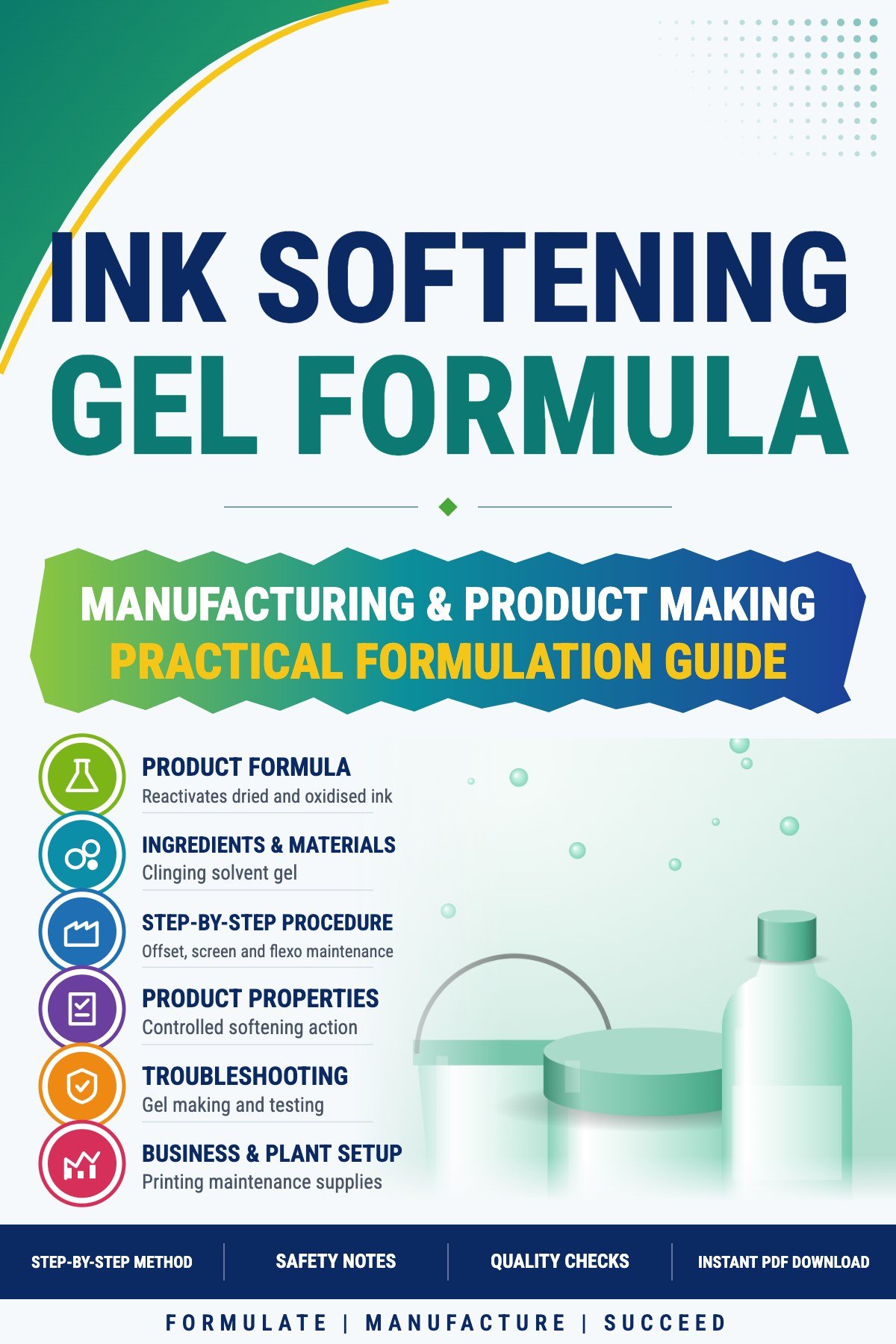
PDF manual · Instant downloadInk Softening Gel Formula: a PDF guide to solvent gels that soften dried and oxidised printing ink on presses and equipment, with ingredients, making, use and testing.
Payment Methods
Refund Policy
Custom Formulation Services
Formulation Consultation
Contact Us
Ink Softening Gel Formula from Chemical Formulation Services (CFS) is a professionally engineered, solvent-based reactivation system for the controlled softening of dried, oxidised and thickened printing inks in offset printing, screen printing and flexographic operations. It is designed for industrial maintenance environments, where ink builds up on rollers, ducts, blankets, screens, plates, anilox rolls, trays and equipment and needs to be softened without damaging the surface. This page explains how an ink softening gel formulation works, what goes into an ink softening gel formula, how it is made and tested, and how to turn it into a printing-maintenance product line.
This guide is published by Chemical Formulation Services, the formulation publishing and consultancy business of CFS Formulation Services Ltd in Sheffield, United Kingdom. It is written for people who want to understand the product from the raw material to the finished pack, and it keeps its claims practical rather than promotional.
At a glance
- Product: Ink Softening Gel Formula, a digital PDF Product Making Guide.
- Also searched as: ink softening gel formulation, ink remover gel, dried ink softener, ink reactivator, press maintenance ink gel.
- Form: thickened solvent gel that clings to vertical and overhead surfaces.
- Key goals: soften dried ink, stay in place, rinse or wipe clean and protect surfaces.
- Who it is for: printing chemical makers, pressroom suppliers, maintenance teams and entrepreneurs.
- Delivery: instant PDF download after payment is confirmed.
- Publisher: CFS Formulation Services Ltd, England and Wales company number 16678503.
The problem of dried and oxidised ink
Printing inks are designed to dry. Oil-based offset and letterpress inks harden by oxidation, solvent-based flexo and gravure inks dry by evaporation, water-based inks dry by water loss and absorption, and UV inks cure under light. When ink dries where it should not, such as in the ink duct, on rollers, in tanks, on screens, in plate cylinders or around guards, it becomes a hard, crusty or rubbery layer that ordinary washes cannot dissolve. Over time, ink film thickens, hardens through oxidation and bonds to the surface, causing roller glazing, ink starvation, poor transfer, streaks, contamination of new ink and costly downtime. Pressroom crews scrape, scrub and soak parts for hours. A softening gel reactivates the dried ink so that it can be wiped or rinsed away.
Why a gel instead of a liquid
Liquid solvents run off vertical surfaces, evaporate quickly and need frequent reapplication. A gel clings. Applied as a thick coating to a dried ink deposit, it stays in contact for the full dwell time, minimising solvent evaporation and giving deep, uniform softening. This makes gels ideal for press frames, duct blades, side guards, drip trays, rollers in situ, screens laid vertically, filter housings and other awkward spots. The gel’s thick consistency also reduces splashing and vapour emissions, and lets the operator brush it on precisely, without wetting adjacent parts.
Core components
- Active solvents: blends of glycol ethers, benzyl alcohol, esters, ketones or other solvents selected to penetrate and dissolve oxidised ink resins and drying oils. The choice depends on ink type: oxidised offset inks need strong, slow-evaporating solvents, while resin-based flexo inks respond to esters and alcohols.
- Swelling or penetrating agents: help the solvent infiltrate cracked dried layers.
- Thickener: fumed silica, organoclay, cellulose derivatives or polymer thickeners create a gel structure that thins when brushed and rethickens at rest (thixotropy).
- Surfactants: aid wetting, penetration and later rinsing.
- Alkaline or acidic boosters (optional): in some formulas, mild amines or alkaline builders break down binders in specific inks.
- Corrosion inhibitors: protect metal parts during contact.
- Water or co-solvents: in semi-aqueous formulas, to improve rinsing and reduce VOC.
Matching solvent power to the ink and the surface
Dried inks are not all alike, and a good softening gel is matched to the kind of ink and the surface under it. Oxidised offset and letterpress inks have cured by reaction of drying oils with oxygen, forming a tough crosslinked film that resists simple solvents, so they respond best to glycol ethers, benzyl alcohol and similar slow, strong solvents with a long dwell. Solvent-based flexo and gravure inks are based on nitrocellulose, polyamide or acrylic resins and dissolve in ketone, ester and alcohol blends. Water-based inks that have dried on equipment soften with alkaline, surfactant-rich gels. UV-cured inks are crosslinked and cannot truly be dissolved, only swollen and lifted, so a specialist gel with strong swelling solvents and mechanical help is necessary. Describe on the product label which ink types each grade suits, and test on real ink samples from your customers’ presses before supply.
Where the gel is used in a plant
Typical uses include the ink duct and ink fountain of offset presses where ink has skinned or hardened, roller ends and bearer areas, doctor-blade chambers and ink pumps in flexo presses, ink trays and drip pans, sieves and screens in ink factories, mixers and kettles in ink and paint plants, filter housings, floors and platforms around presses, and the outside of ink containers. Each place has different materials, from steel and aluminium to rubber, plastics and painted metal, so check compatibility. Provide guidance such as “for steel and aluminium parts only” or “for use on rollers rated for strong solvents”, and recommend water-based or mild alternatives for sensitive items.
Operator training and procedures
A softening gel is only as safe and effective as the procedure behind it. Write simple, illustrated instructions covering when to use the gel, how much to apply, how long to leave it, how to remove it, and what personal protective equipment to wear. Remind operators not to use heat guns or open flames near solvent gel, to wipe spills at once and to place used wipes in closed metal bins. Teach them to recognise signs of damage, such as swollen rollers, so that they stop and seek advice. Training sessions at the plant strengthen your relationship with maintenance managers and reduce misuse.
Economy of use and waste reduction
Gels allow targeted application, so less solvent is used than in bulk soaking or washing. Operators can measure product with a spatula, reduce waste and recover usable volume. Encourage customers to keep the lid closed to avoid evaporation, and to reuse gel left on the scraper for further cleaning. Collect used gel and dissolved ink for disposal through authorised waste contractors, and, where possible, consolidate waste to reduce disposal costs. Present total cost of cleaning, including labour savings, to show the value of the gel, not only the price per kilogram.
Packaging, storage and shelf life
Pack in wide-mouth plastic or lined metal tubs with tight lids and tamper-evident seals. Label with solvent type, recommended uses, flash point, hazard pictograms, batch number and safety statements. Store in a cool, ventilated area away from ignition sources and direct sunlight. Shelf life is usually one to two years if the lid is kept closed. Stir lightly if slight separation occurs. Keep retained samples and test old stock for viscosity and cling before sale.
What is inside the Ink Softening Gel Formula guide
The guide describes a professionally engineered, solvent-based reactivation system developed for controlled softening of dried, oxidised and thickened printing inks used in offset printing, screen printing and flexographic operations, designed for industrial maintenance environments where ink build-up occurs. It provides several formulation grades, step-by-step gel making, application instructions, testing, safety and troubleshooting.
How the gel is made
Preparing the solvent blend
In a ventilated, earthed vessel, blend the solvents and surfactants with gentle stirring until clear. Use clean, solvent-resistant equipment.
Adding the thickener
Disperse the thickener into the solvent blend under high-shear mixing. Fumed silica must be wetted carefully to avoid dust and lumps. Allow time for the structure to develop. Some systems need a small amount of polar additive, water or glycol, to activate.
Adding inhibitors and finishing agents
Blend in corrosion inhibitor, fragrance or masking agent if desired, and any alkaline or acid boosters. Adjust viscosity to the target for brush or spatula application.
De-aeration and filling
Let the gel stand to release air, or use mild vacuum. Fill into wide-mouth tubs, jars or pails with sealed lids. Label with directions and hazard information.
Using the gel
Wear gloves and eye protection and ensure ventilation. Apply a generous layer of gel with a brush or spatula to the dried ink, covering it completely. Allow the dwell time, which may be from a few minutes to an hour depending on how thick and old the ink is. Agitate gently with a plastic scraper or brush, then wipe off with a cloth or rinse with a suitable washup or water-based cleaner. Repeat for thick deposits. Do not use on surfaces that may be damaged by the solvents, such as rubber rollers or blankets not rated for them, or certain plastics and paints. Test on a hidden area first. After cleaning, wash with an appropriate roller or press wash to remove traces of gel and solvent.
Testing and quality control
- Softening efficiency: apply to test panels with dried oxidised ink (aged by baking) and measure time for softening and removal.
- Cling and sag: gel on vertical plates should not run for stated time.
- Viscosity and thixotropy.
- Rubber and surface compatibility: swelling and hardness change of press rubber, plastics, paint and metals.
- Evaporation loss: weight loss over dwell time.
- Rinsability and residue.
- Flash point and VOC content.
- Storage stability: phase separation, thickening or thinning.
Troubleshooting
Gel does not soften the ink
Solvent not suited to the ink type, or too short a dwell. Adjust solvent blend and extend contact time.
Gel runs or sags
Low thickener or low thixotropy. Increase thickener and adjust structure.
Gel too stiff to apply
Excess thickener or evaporation. Reduce thickener and add solvent.
Rubber parts swell or harden
Aggressive solvents. Choose compatible solvents, shorten contact time or avoid rubber surfaces.
Residue and tackiness
Slow solvents or surfactant. Rinse well and use a final wash.
Separation or syneresis in storage
Unstable gel network. Re-evaluate thickener and mixing.
Safety, health and environment
Solvent-based gels are flammable and release vapours that irritate eyes, skin and airways and can affect the nervous system. Provide ventilation, wear gloves and eye protection, store away from ignition sources, and keep lids closed. Rags and scrapers contaminated with gel and ink should be kept in closed metal bins to avoid fire from solvent vapour and drying oils. Choose low-VOC, low-aromatic solvents where possible and comply with limits. Collect waste ink and gel as hazardous waste. Provide safety data sheets and handling instructions.
Business opportunity
Every printing plant needs maintenance chemicals, and ink softening gels sell steadily. They serve offset and flexo pressrooms, screen print shops, packaging converters, paint and ink factories (cleaning mixers and tanks) and industrial maintenance teams. Products come in tubs of 1 and 5 kilograms and pails of 20 kilograms. A range with different solvent strengths and low-VOC options, together with roller wash, blanket wash, plate cleaners and anilox cleaners, forms a pressroom maintenance line. Selling through printing supply distributors and offering on-site demonstrations builds a customer base.
Related CFS guides help you build a printing-maintenance range. Browse the Ink Formulations category, and see Press Room Cleaning & Maintenance Chemicals Formulations, Printing Plate Cleaner Formula, , Offset Plate Protective Gum Formula, Adhesive Remover Formula and .
Getting started
Select two ink types common in your area, for example oxidised offset ink and solvent flexo ink. Make small batches of gels with different solvents and thickener levels. Test on aged ink films, measure softening time, cling and rubber compatibility, and compare with a commercial product. Prepare safety sheets and instructions and offer sample tubs to pressroom managers for feedback.
How to get the best results from this guide
Treat the guide as a tested starting point rather than a finished factory. Begin with a small trial batch in the laboratory or on a bench, using the exact raw materials you plan to buy, and record every weight, temperature, mixing time and observation. Compare the result with the quality checks in the guide, change only one thing at a time, and keep a note of what each change did. Once a small batch is consistently good, repeat it several times, then scale up in stages, because mixing, heating and cooling behave differently in larger vessels. Keep retained samples of every batch, write simple standard operating procedures for your team, and build relationships with two suppliers for each key raw material. Finally, check the labelling, safety and product rules in the country where you will sell, and ask a qualified person to review your process. This careful, documented approach is what turns a good formulation into a reliable product and a trusted brand.
Who should buy this guide?
The guide is written for practical readers. It suits manufacturers who want to add a new product to an existing plant, startups choosing their first product, private-label brands that need to understand what they are buying, technical staff who must set specifications and train operators, and consultants and students who want a structured, plain-language reference. It is less suitable for anyone looking for a quick shortcut or a guarantee, because every formulation still needs testing with your own materials, equipment and local rules. If you are unsure whether it matches your project, send a short question through the contact page before you order, and we will tell you honestly whether it fits.
What is inside the Ink Softening Gel Formula guide
Every Product Making Guide in our shop follows the same structure so you know where to look. This guide includes the product formula, the ingredients and materials, the procedure and preparations, the industrial requirements and the technical specifications. In practice you receive:
- The formulation, written so you can follow it at the bench and scale it up.
- Ingredients and materials, with the job of each material and advice on grades and suppliers.
- The manufacturing procedure, including order of addition, mixing and preparations.
- Industrial requirements, covering equipment, space and packaging.
- Technical specifications, describing what a good finished product should look like and how it should behave.
- Troubleshooting for the faults that makers meet most often.
- Business guidance, to help you take the product from the bench to the market.
These Product Making Guides of chemical formulations and formulas are for manufacturers, startups and entrepreneurs. Every guide contains industrially tested, practical formulations. Anyone who buys a guide can make the product by following its step-by-step instructions. Raw materials vary between suppliers, so always confirm your results with a small trial batch before scaling up.
Who stands behind this guide?
Chemical Formulation Services is the trading name of CFS Formulation Services Ltd, registered in England and Wales under company number 16678503, with its office at Unit F, Winston Business Park, Churchill Way, Sheffield S35 2PS. The business was founded by George Enrick and publishes formulation manuals, technical guides and industry reports. You can check our details on the Companies House register, read about us, or contact us with any question before you order.
A written formulation cannot replace testing with your own raw materials, equipment and climate, and we say so plainly. What the guide does give you is a tested, structured starting point that can save you months of trial and error. Our terms and conditions explain what a purchase from us covers.
How to order
- Select Add to cart to keep browsing, or Buy Now to go straight to checkout.
- Pay with PayPal, Stripe, Xoom by PayPal, Payoneer, payment links for debit and credit cards, or Western Union, Ria and all money exchanges.
- If you pay through a money exchange, email your payment slip to Info@chemicalformulationservices.com. After confirmation, your instant download link is emailed to you.
- For online payments, the PDF is available as soon as the payment is confirmed.
All products are digital downloads and all payments are nonrefundable once the file is delivered, so please read the refund policy and the FAQs before you order. You can compare this guide with others in the formula shop or browse our industrial project reports.
Frequently asked questions about ink softening gel formula
What is the Ink Softening Gel Formula guide?
It is a digital PDF Product Making Guide to solvent-gel systems that soften dried and oxidised printing ink on presses and equipment, with ingredients, making, use and testing.
Why use a gel rather than a liquid?
A gel clings to vertical and overhead surfaces and holds solvent in contact longer.
Can the gel damage rubber rollers?
Strong solvents can swell or harden rubber, so test and choose compatible formulas.
What thickeners are used?
Fumed silica, organoclays, cellulose derivatives and polymer thickeners.
Is it flammable?
Many solvent gels are, so keep away from ignition sources and ventilate well.
How do I receive the guide?
You receive an instant PDF download after payment is confirmed. For money exchanges, email your payment slip to Info@chemicalformulationservices.com and the link is emailed after we confirm it.
Is the payment refundable?
All payments are nonrefundable because the product is an instant digital download. See the refund policy for details.
Can you help with a custom formulation?
CFS Formulation Services Ltd offers formulation and product development consultancy. Send a short brief through the Contact page.
Last reviewed: November 2026. This page is general information about a digital product. It is not a safety data sheet or professional advice, and any formulation should be tested and reviewed by a qualified person before commercial use.