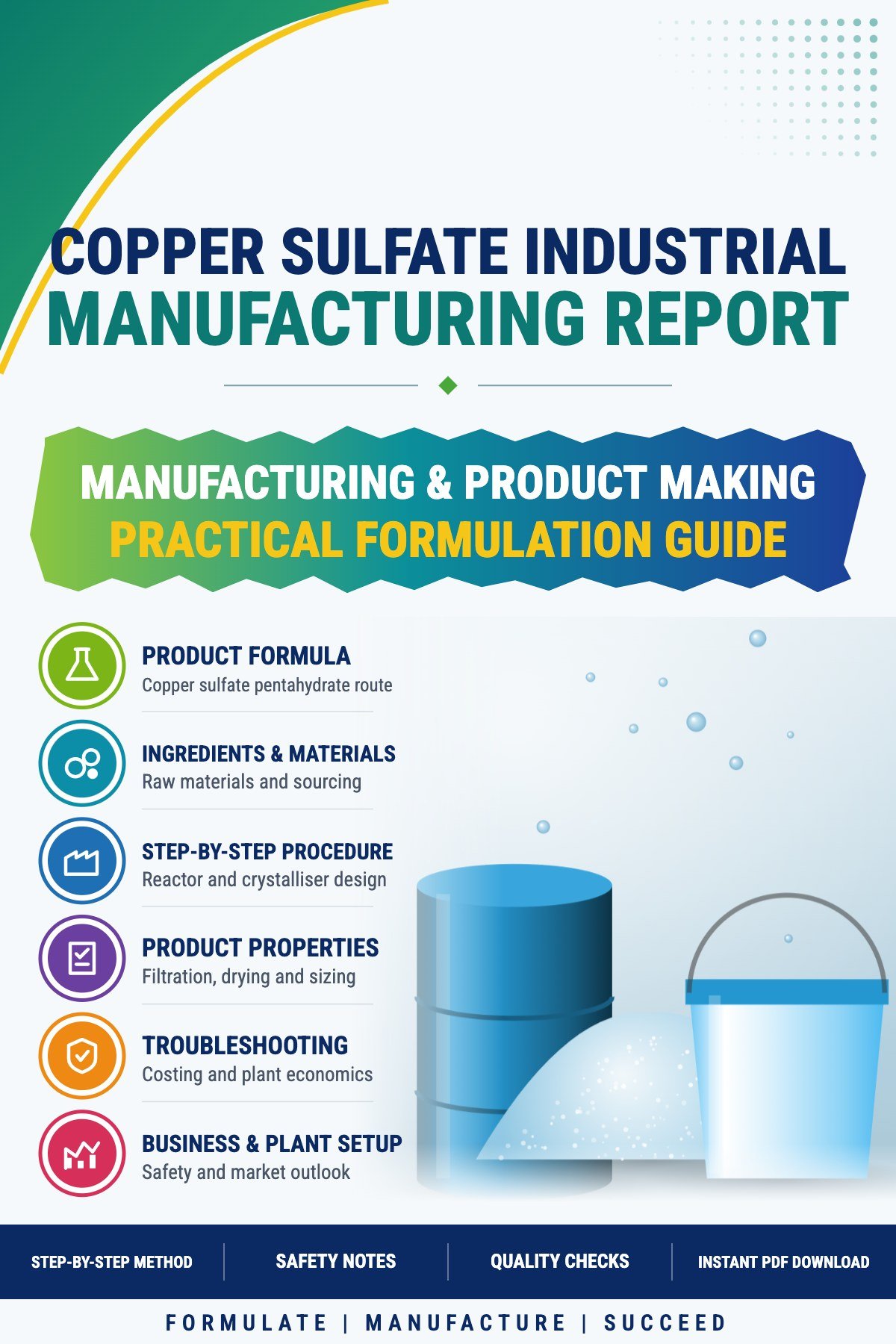
Copper Sulfate Industrial Manufacturing Report
USD $75
PDF manual · Instant downloadCopper Sulfate Industrial Manufacturing Report: a PDF guide to making copper sulfate, with process routes, equipment, quality control, plant economics, safety and market tips.
Payment Methods
Refund Policy
Custom Formulation Services
Formulation Consultation
Contact Us
The Copper Sulfate Industrial Manufacturing Report from CFS is a professional PDF guide to making copper sulfate, from a small-scale startup to full industrial production. It is designed for entrepreneurs, traders and manufacturers who want realistic process, equipment, cost and market information rather than theory. This page walks through the chemistry, the main production routes, the equipment, quality control, safety and the business side, and shows how the Copper Sulfate Industrial Manufacturing Report Formula style of guidance (process recipes, ratios and operating windows) helps you plan a plant with confidence.
This guide is published by Chemical Formulation Services, the formulation publishing and consultancy business of CFS Formulation Services Ltd in Sheffield, United Kingdom. It is written for people who want to understand the product from the raw material to the finished pack, and it keeps its claims practical rather than promotional.
At a glance
- Product: Copper Sulfate Industrial Manufacturing Report, a digital PDF Industrial Report.
- Also searched as: copper sulphate manufacturing, bluestone production, CuSO4 pentahydrate process, copper sulfate plant, copper sulfate business.
- Main routes: copper metal or scrap with sulfuric acid and air, or copper oxide with sulfuric acid.
- Key goals: purity, crystal size, yield, safe operation and cost control.
- Who it is for: entrepreneurs, chemical traders, agrochemical and feed suppliers, and plant managers.
- Delivery: instant PDF download after payment is confirmed.
- Publisher: CFS Formulation Services Ltd, England and Wales company number 16678503.
What copper sulfate is and why it sells
Copper sulfate, also written copper sulphate, is most commonly traded as the blue crystalline pentahydrate, CuSO4.5H2O, often called bluestone or blue vitriol. It is also sold as a monohydrate or anhydrous powder for special uses. It dissolves in water to give a bright blue solution. Its steady demand comes from agriculture, animal nutrition, mining, electroplating, wood protection, water treatment, pigments and chemicals manufacture, so a producer can serve several markets from one plant.
Major uses
- Agriculture: fungicide, including Bordeaux mixture with lime, and copper micronutrient in fertilisers, a link to the Fertilizers and Herbicide Formulations guides.
- Animal feed: trace-mineral supplement for poultry, pigs and cattle, relevant to Poultry Veterinary Livestock buyers.
- Mining: activator in froth flotation of zinc and other ores.
- Electroplating and metal finishing: copper plating baths and etching, see Electroplating Formula and Metal Treatment.
- Water treatment: algaecide in reservoirs, ponds and swimming facilities, used under local regulation.
- Wood preservation: copper-based preservatives.
- Chemicals and pigments: intermediate for other copper compounds, dyes and catalysts.
Choosing the right scale for a first plant
New entrants often ask how big to start. A sensible first step is a pilot unit producing one to two tonnes of crystals per month, which is enough to prove the process, build a customer list and learn the cost structure without tying up large capital. A medium plant of ten to thirty tonnes a month needs proper crystallisation and centrifuge capacity, a laboratory and a trained operator team. Industrial plants beyond that add continuous crystallisation, heat recovery, automated packing and full effluent treatment. Because copper is the major cost, measure copper recovery carefully at each stage and treat losses in mother liquor, filter cake and washings as a direct profit leak.
Recovering value from by-products and residues
Insoluble residues from scrap dissolution contain lead, tin and precious traces, and may be valuable to a smelter or refiner if collected and stored safely. Mother liquor bleed streams can be neutralised to precipitate copper hydroxide or carbonate for sale or recycling, so very little copper leaves the plant as waste. Spent filter cloths and sludge are hazardous wastes and must go to licensed handlers. A well-run plant keeps a metal balance each month and investigates any gap between copper in and copper out.
Packing, labelling and transport
Use polyethylene-lined woven bags or fibre drums that resist moisture. Labels should show product name, grade, net weight, batch number, hazard pictograms and handling advice in the language of the market. For export, prepare the safety data sheet, certificate of analysis and the transport classification, since copper sulfate is classed as environmentally hazardous for transport. Store bags off the floor, away from alkalis, strong reducing agents and food, and never stack in humid areas where caking and leaks will occur.
What is inside the Copper Sulfate Industrial Manufacturing Report
The report is described as a complete, practical guide to manufacturing copper sulfate from small-scale startup to full industrial production, for entrepreneurs, traders and manufacturers. It covers raw materials, process routes, equipment, quality control, plant economics, safety and marketing, with a focus on real operating conditions.
Production routes
Route 1: Copper metal or scrap with sulfuric acid and air
Clean copper scrap, turnings or cathode offcuts are placed in acid-resistant towers or tanks. Dilute sulfuric acid is circulated over the copper while air is blown in. Copper does not dissolve in dilute sulfuric acid by itself, but in the presence of oxygen it oxidises to copper oxide and then dissolves as copper sulfate. The reaction is slow and benefits from warm liquor, good air distribution and a large copper surface area. This route suits small and medium plants with accessible scrap.
Route 2: Copper oxide with sulfuric acid
Copper oxide, from roasting scrap, from ore concentrate or from purchased black oxide, dissolves rapidly in sulfuric acid, giving a clean, efficient reaction with little gas. Control temperature and acid strength to avoid undissolved lumps and to reach the target concentration. This route offers steady output and simpler control.
Route 3: From copper-bearing wastes and etching solutions
Spent copper etchants, copper-bearing sludges and ore leach liquors can be converted to copper sulfate after purification. This lowers raw material cost but demands careful impurity control, particularly for feed and food-contact related grades.
Process steps from reaction to crystals
Dissolution and clarification
The reaction liquor is brought to a controlled density and temperature, then settled or filtered to remove insoluble matter such as lead, tin and silica from scrap. Polishing filters protect later equipment.
Purification
Iron, nickel, zinc and other metals follow copper in many feeds. Depending on grade, makers adjust pH, oxidise iron and filter it out, or recrystallise the product. Higher grades for feed and electronics need tighter impurity limits.
Crystallisation
The clear hot solution is concentrated by evaporation, then cooled in crystallisers. Slow, controlled cooling gives large, regular blue crystals; rapid cooling gives fine “snow” crystals. Seeding and agitation control crystal size distribution to match market needs, from large lump crystals to small and fine powders.
Separation, washing and drying
Crystals are separated in centrifuges or filters, washed lightly with cold water or mother liquor and dried gently. Over-drying at high temperature loses crystal water and turns the product pale or white, so temperature must be limited when pentahydrate is the target. Mother liquor is recycled to the dissolution step to improve yield.
Screening and packing
Screen into size grades, and pack in lined bags of 25 and 50 kilograms or bulk bags. Keep packs sealed, because the product absorbs moisture and cakes.
Equipment overview
- Reaction tanks or towers: acid-resistant materials such as rubber-lined steel, fibre-reinforced plastic or lead-lined vessels, chosen against sulfuric acid at temperature.
- Air blowers or compressors and distribution pipework.
- Pumps and heat exchangers built from corrosion-resistant materials.
- Filters and settlers.
- Evaporators and crystallisers.
- Centrifuges and dryers.
- Scrubbers for acid mist and dust control.
- Effluent treatment for neutralisation and metals recovery.
Quality control
- Copper sulfate pentahydrate assay by titration or instrumental analysis.
- Insolubles in water.
- Free acid and pH of solution.
- Heavy metal and iron impurities by atomic absorption or ICP.
- Moisture and crystal water content.
- Particle size and caking tendency.
- Grade-specific checks for feed, agricultural and technical specifications.
Troubleshooting
Low yield from scrap
Insufficient air, cold liquor or poor contact. Increase aeration, temperature and surface area.
Green or brown liquor
Iron or organic contamination. Oxidise and filter iron, and sort scrap.
Fine, powdery crystals
Cooling too fast or too much agitation. Slow cooling and seed carefully.
White or pale product
Overheated in the dryer. Lower drying temperature.
Caking in storage
Residual moisture or humid storage. Dry properly and use sealed liners.
Safety, environment and regulation
Copper sulfate is harmful if swallowed, irritating to eyes and skin, and very toxic to aquatic life. Hot sulfuric acid is corrosive and reacts violently if mishandled, so acid dilution must always be done by adding acid to water slowly. Use gloves, goggles, aprons, ventilation and eyewash stations. Contain spills and never discharge liquor to drains or watercourses; treat effluent to remove copper before release. Classification, labelling, transport rules and licensing for agricultural, feed and biocidal uses vary by country, so confirm local requirements before selling into each market. Feed grade products need specific purity and registration.
Plant economics and business planning
Costs divide into raw materials (copper source and sulfuric acid), energy for heating and evaporation, labour, maintenance, packaging, effluent handling and regulatory compliance. Copper price swings affect margin directly, so many producers buy scrap contracts, hold copper stocks carefully and index selling prices to the metal. Small plants can begin with a few reaction tanks, a crystalliser and a centrifuge, selling to local farmers, feed mills and platers, then expand into feed and technical grades. Packaging in small retail packs for gardeners and in bulk for industry gives two margin levels. Build customer trust with certificates of analysis, consistent crystal appearance and reliable delivery.
Market outlook and marketing
Demand follows agriculture seasons, mining activity and electronics plating. Target agrochemical distributors, feed manufacturers, mining suppliers, electroplating shops and water treatment companies. Export markets are strong but need documents such as safety data sheets, certificates of origin and compliance with import rules. Differentiate on purity, crystal size, packaging and service rather than price alone.
Explore related industrial reports and guides in the Industrial Reports, Fertilizers, Electroplating Formula and Metal Treatment categories, including Color Gold Plating Solutions Formula and .
Getting started
Start with a pilot reactor using clean copper oxide or scrap, document acid strength, temperature and air rate, and crystallise a few batches to learn the crystal size behaviour. Send samples to a laboratory for assay and impurity analysis, then approach local buyers with a certificate of analysis. Prepare effluent treatment and safety procedures before scaling production.
How to get the best results from this guide
Treat the guide as a tested starting point rather than a finished factory. Begin with a small trial batch in the laboratory or on a bench, using the exact raw materials you plan to buy, and record every weight, temperature, mixing time and observation. Compare the result with the quality checks in the guide, change only one thing at a time, and keep a note of what each change did. Once a small batch is consistently good, repeat it several times, then scale up in stages, because mixing, heating and cooling behave differently in larger vessels. Keep retained samples of every batch, write simple standard operating procedures for your team, and build relationships with two suppliers for each key raw material. Finally, check the labelling, safety and product rules in the country where you will sell, and ask a qualified person to review your process. This careful, documented approach is what turns a good formulation into a reliable product and a trusted brand.
Who should buy this guide?
The guide is written for practical readers. It suits manufacturers who want to add a new product to an existing plant, startups choosing their first product, private-label brands that need to understand what they are buying, technical staff who must set specifications and train operators, and consultants and students who want a structured, plain-language reference. It is less suitable for anyone looking for a quick shortcut or a guarantee, because every formulation still needs testing with your own materials, equipment and local rules. If you are unsure whether it matches your project, send a short question through the contact page before you order, and we will tell you honestly whether it fits.
What is inside the Copper Sulfate Industrial Manufacturing Report guide
Every Product Making Guide in our shop follows the same structure so you know where to look. This guide includes the product formula, the ingredients and materials, the procedure and preparations, the industrial requirements and the technical specifications. In practice you receive:
- The formulation, written so you can follow it at the bench and scale it up.
- Ingredients and materials, with the job of each material and advice on grades and suppliers.
- The manufacturing procedure, including order of addition, mixing and preparations.
- Industrial requirements, covering equipment, space and packaging.
- Technical specifications, describing what a good finished product should look like and how it should behave.
- Troubleshooting for the faults that makers meet most often.
- Business guidance, to help you take the product from the bench to the market.
These Product Making Guides of chemical formulations and formulas are for manufacturers, startups and entrepreneurs. Every guide contains industrially tested, practical formulations. Anyone who buys a guide can make the product by following its step-by-step instructions. Raw materials vary between suppliers, so always confirm your results with a small trial batch before scaling up.
Who stands behind this guide?
Chemical Formulation Services is the trading name of CFS Formulation Services Ltd, registered in England and Wales under company number 16678503, with its office at Unit F, Winston Business Park, Churchill Way, Sheffield S35 2PS. The business was founded by George Enrick and publishes formulation manuals, technical guides and industry reports. You can check our details on the Companies House register, read about us, or contact us with any question before you order.
A written formulation cannot replace testing with your own raw materials, equipment and climate, and we say so plainly. What the guide does give you is a tested, structured starting point that can save you months of trial and error. Our terms and conditions explain what a purchase from us covers.
How to order
- Select Add to cart to keep browsing, or Buy Now to go straight to checkout.
- Pay with PayPal, Stripe, Xoom by PayPal, Payoneer, payment links for debit and credit cards, or Western Union, Ria and all money exchanges.
- If you pay through a money exchange, email your payment slip to Info@chemicalformulationservices.com. After confirmation, your instant download link is emailed to you.
- For online payments, the PDF is available as soon as the payment is confirmed.
All products are digital downloads and all payments are nonrefundable once the file is delivered, so please read the refund policy and the FAQs before you order. You can compare this guide with others in the formula shop or browse our industrial project reports.
Frequently asked questions about copper sulfate industrial manufacturing report
What is the Copper Sulfate Industrial Manufacturing Report?
It is a digital PDF industrial report on making copper sulfate from startup scale to industrial production, covering routes, equipment, quality control, costs and safety.
Which raw materials can I use?
Copper scrap, cathode offcuts or copper oxide, with sulfuric acid, and in some plants copper-bearing wastes after purification.
Why does my product turn white?
Overheating in the dryer drives off crystal water. Use gentler drying temperatures.
Is copper sulfate hazardous?
Yes. It is harmful if swallowed, irritating and very toxic to aquatic life, so safe handling and effluent control are essential.
Who buys copper sulfate?
Farmers and agrochemical distributors, feed mills, mining companies, electroplaters and water treatment firms.
How do I receive the guide?
You receive an instant PDF download after payment is confirmed. For money exchanges, email your payment slip to Info@chemicalformulationservices.com and the link is emailed after we confirm it.
Is the payment refundable?
All payments are nonrefundable because the product is an instant digital download. See the refund policy for details.
Can you help with a custom formulation?
CFS Formulation Services Ltd offers formulation and product development consultancy. Send a short brief through the Contact page.
Last reviewed: November 2026. This page is general information about a digital product. It is not a safety data sheet or professional advice, and any formulation should be tested and reviewed by a qualified person before commercial use.