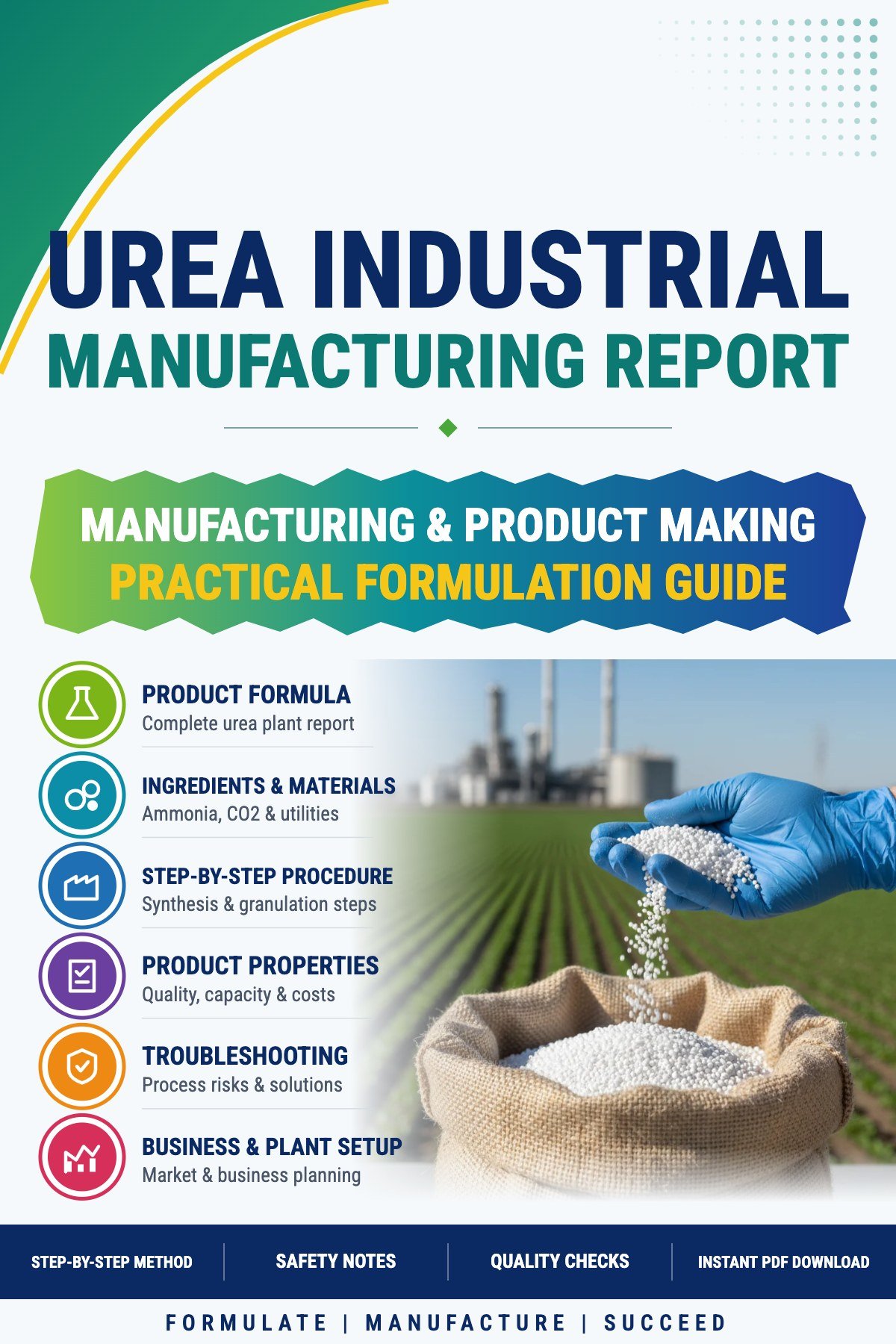
Urea Industrial Manufacturing Report
USD $75
PDF manual · Instant downloadUrea Industrial Manufacturing Report: a PDF industrial report on urea production, covering raw materials, process, plant equipment, quality, safety and business planning.
Payment Methods
Refund Policy
Custom Formulation Services
Formulation Consultation
Contact Us
Urea Industrial Manufacturing Report is a practical PDF report for entrepreneurs, chemical traders and manufacturers who want to understand how urea is made at industrial scale and whether a urea business could work for them. Urea is the most widely used solid nitrogen fertiliser in the world, and it is also an input for resins, adhesives, animal feed supplements and diesel exhaust fluid. This page explains what the report covers, how an industrial urea manufacturing plant is organised, and how to judge whether the project fits your plans. If you are searching for a urea industrial manufacturing report formula style of guide, this is the kind of document that sets the technical and business picture before any money is committed.
This guide is published by Chemical Formulation Services, the formulation publishing and consultancy business of CFS Formulation Services Ltd in Sheffield, United Kingdom. It is written for people who want to understand the product from the raw material to the finished pack, and it keeps its claims practical rather than promotional.
At a glance
- Product: Urea Industrial Manufacturing Report, a digital PDF industrial report.
- Also searched as: urea manufacturing report, urea plant project report, urea production process, urea business startup guide.
- What it covers: raw materials, process route, plant equipment, quality control, risks and the business case for urea production.
- Main uses of urea: fertiliser, resins and adhesives, animal feed, technical grade urea and diesel exhaust fluid.
- Who it is for: entrepreneurs, traders, investors and manufacturers studying the fertiliser and chemical industry.
- Delivery: instant PDF download after payment is confirmed.
- Publisher: CFS Formulation Services Ltd, England and Wales company number 16678503.
Why urea matters
Almost every large food-producing country depends on nitrogen fertiliser, and urea is the cheapest and most concentrated solid form of it. A standard fertiliser-grade urea contains a little over 46 percent nitrogen, which makes it easy to store, transport and spread compared with other nitrogen sources. That is why global demand stays high and why governments in many countries watch urea supply closely.
Outside agriculture, technical-grade urea is used in the manufacture of urea-formaldehyde resins for wood panels and adhesives, in some cosmetics and pharmaceuticals, in animal feed as a non-protein nitrogen source for ruminants, and in the water solution used to treat diesel exhaust. A producer who understands these markets can choose where to sell, instead of depending on a single customer group.
How urea is made at industrial scale
Commercial urea is produced from two raw materials, ammonia and carbon dioxide. In the basic process, the two react at high pressure and temperature to form ammonium carbamate, and part of the carbamate then loses water to form urea. This is usually called the Bosch-Meiser process. The reaction does not go all the way, so the mixture leaving the reactor contains urea, unreacted carbamate, ammonia and water. The plant must separate these streams, recycle the unreacted material and concentrate the urea solution.
The stages that follow are conventional chemical engineering. The urea solution is concentrated by evaporation, and it is then turned into a solid. Two common routes exist. Prilling lets droplets of molten urea fall through a tall tower while cooling air solidifies them into small round pellets. Granulation builds larger, harder granules in a fluidised bed, and these handle better in bulk and in fertiliser blending. Finished urea is cooled, screened, treated with an anti-caking or conditioning agent where needed, and weighed into bags or bulk storage.
Ammonia is the biggest cost item, and the ammonia is usually made from natural gas, which is why large urea plants sit close to a gas supply and an ammonia unit. The carbon dioxide comes as a by-product of ammonia production, so the two plants are naturally linked. The report discusses what this means for a new entrant, including the very different economics of a fully integrated plant and a smaller operation that buys ammonia or works with a different business model.
What a good industrial report should tell you
An industrial report is not a formulation recipe. It is a planning document, and it should help you answer practical questions before you spend money. The report is organised to cover the following topics, and you can use this list as a checklist when you read it.
- Raw materials and utilities. What is needed, in what quantities per tonne of product, and how supply and price risk should be managed.
- Process description. The main reaction and separation stages, the equipment that carries them out and the typical operating conditions.
- Plant machinery and layout. The main vessels, pumps, compressors, evaporators, prilling or granulation units and storage areas, and how they fit together on a site.
- Product grades and quality. Typical specifications for fertiliser-grade and technical-grade urea, such as nitrogen content, biuret level, moisture and particle size.
- Safety and environment. The hazards of ammonia and high-pressure systems, dust and ammonia emissions, effluent handling and the permits normally required.
- Business plan elements. Capacity choices, indicative investment categories, operating costs, pricing logic and routes to market.
Because every country has its own gas prices, subsidies, import duties and fertiliser policies, you should treat any report figures as a starting point and rebuild the numbers with local quotations before making an investment decision.
Quality points that matter to buyers
Buyers of urea look at a short list of numbers. Nitrogen content shows the strength of the product. Biuret, a by-product formed when urea is overheated, is harmful to many crops at high levels, so fertiliser grades set a low limit, and some foliar and fruit-crop uses demand very low biuret. Moisture affects caking and storage, and particle size and crushing strength decide how well the product handles, stores and spreads. Technical and feed grades have their own purity specifications. A plant that controls temperature carefully in the later stages and dries and cools the product properly will usually make fewer quality complaints.
Safety and regulation
Urea itself is a fairly benign solid, but the plant that makes it is not a simple facility. Ammonia is toxic and corrosive, the synthesis section works at high pressure and temperature, and carbamate solutions are highly corrosive to ordinary steels, so materials of construction and inspection programmes matter. Dust from prilling and handling needs control, and ammonia and dust emissions are regulated in most countries. Fertilisers can also be subject to security and licensing controls in some regions because of their nitrogen content. Before you invest, check the environmental, safety, fertiliser and chemical-handling rules that apply in your country, and involve qualified process engineers and safety professionals in the project.
Who should read this report
The report suits several kinds of reader. Entrepreneurs and investors can use it to judge whether the industry, the capital needs and the risks match their plans. Traders and distributors can learn how the product is made, graded and priced, so they can buy and sell with more confidence. Chemical manufacturers who already make related products can see where urea fits into a wider portfolio. Students and consultants can use it as a structured overview of the industry. Our industrial project reports collection shows how reports for other chemicals are organised.
Related reports and guides
Many readers explore several industries before they commit to one. If you are interested in the broader fertiliser field, our guides include Liquid Phosphorus Fertilizers Formulations, Liquid Potassium Fertilizers Formulations, Water-Soluble Solid NPK Fertilizers Formulation, Amino Acid Chelated Fertilizers Formulation, Humic & Fulvic Acid Fertilizers Formulation, Calcium & Calcium Nitrate Fertilizers Formulation, Boron Fertilizers Formulation and Magnesium Fertilizers Formulation. For chelated micronutrients, see EDTA-Chelated Iron Fertilizers (Liquid & Powder) Formulations, EDTA-Chelated Copper Fertilizers Formulation and EDDHA-Chelated Iron Fertilizers Formulations.
If you prefer to compare other industrial reports first, take a look at the Oxalic Acid Industrial Manufacturing Report, Copper Sulfate Industrial Manufacturing Report, Zinc Oxide Manufacturing & Business Startup Guide, Baking Powder Industrial Manufacturing Report and CITRIC ACID MANUFACTURING REPORT. Each follows the same plain approach: what the product is, how it is made, what it needs and how the business case looks.
Is a urea project right for you?
Large urea plants cost a great deal and depend on cheap gas, so a typical new entrant has to think carefully about scale and strategy. Some choose to start with distribution, blending or packing, and move upstream later. Others focus on specialised products such as technical urea or solutions, where smaller plants can compete. Whatever the route, the right first step is a clear understanding of the process, the costs and the market, which is what a good report provides. You are welcome to contact us if you want to ask whether this report suits your plans before you order.
The urea process stage by stage
It helps to follow the material through the plant, because the stages explain both the equipment list and the places where quality problems start. The notes below describe a conventional once-through and recycle layout, and the report goes into the practical detail of each section.
Synthesis section
Liquid ammonia and compressed carbon dioxide meet in a high-pressure reactor. Ammonium carbamate forms very quickly, and a portion of it converts to urea and water more slowly. Reactor temperature, pressure and the ratio of ammonia to carbon dioxide decide how much urea is formed per pass. Because carbamate is highly corrosive, this section uses special stainless steel or other resistant materials, and a small amount of oxygen is often added to keep the metal surface protected. Operators watch temperature and pressure closely, since upsets in this section are the most serious.
Decomposition and recycle
The reactor outlet is reduced in pressure and heated, so unreacted carbamate breaks down back into ammonia and carbon dioxide. These gases are separated, recondensed and returned to the reactor. Efficient recovery saves large quantities of raw material and energy, so modern plants invest heavily in this section. The urea solution leaving it still contains water and traces of ammonia.
Evaporation and finishing
The solution is concentrated by vacuum evaporation until it is nearly pure molten urea. Temperature and residence time are kept short in this stage, because prolonged heating forms biuret. The melt then goes to a prilling tower or a granulator, where it is turned into solid particles, cooled with air and screened. Oversize pieces are crushed and returned, undersize material is recycled, and the on-grade product goes to storage.
Treatment of process water
Water formed in the reaction carries traces of ammonia and urea. Plants treat this process condensate by hydrolysis and stripping, so the water can be reused or released within environmental limits. This is an important area for compliance, because ammonia in effluent is closely regulated.
Understanding the economics of urea
The cost of producing urea is dominated by the price of the feedstock and energy used to make ammonia, so the final price of urea follows gas and energy prices closely. Labour is a small part of operating cost in a modern plant, and maintenance and catalyst or utility costs add to the total. This means the location of a plant matters more than almost any other decision. A producer with cheap gas can make urea cheaply, while one that buys ammonia or energy at market prices faces more risk.
Urea prices also swing with agricultural seasons, crop prices, trade policy and shipping costs. Governments in some countries subsidise fertiliser or control prices, which affects margins and sales channels. For this reason, serious project planning looks at the full chain, from raw material supply to final customer, and tests the numbers under high, low and average price scenarios. A report can describe the structure of the costs and the main drivers, but you should work with local data and professional advice for any investment decision.
Routes to market
Urea reaches farmers through a chain of importers, distributors, blenders and retailers. Large producers sell in bulk to distributors and export markets. Smaller businesses often succeed by serving a particular region, offering bagging, blending or technical services, or focusing on technical-grade products for resin makers, feed manufacturers and diesel exhaust fluid producers. Packaging size, brand trust, delivery reliability and seasonal stock planning all affect success. In many markets, selling through established dealers and building direct relationships with large farms and cooperatives are the two main routes.
Value-added products give you a way to compete without the scale of the largest plants. Examples include urea blended into compound fertilisers, coated or stabilised products, and water-soluble nutrient mixes. Our fertiliser guides show how nitrogen products can be combined with other nutrients to serve specific crops, and the formulations covered in Water-Soluble Solid NPK Fertilizers Formulation and Humic & Fulvic Acid Fertilizers Formulation are good examples of this approach.
Risks to understand before investing
- Feedstock risk. Gas supply interruptions or price spikes can change plant economics quickly.
- Technology and scale risk. Choosing the wrong process route, licensor or capacity can leave a plant uncompetitive.
- Corrosion and safety risk. Poor materials, weak inspection or inadequate operator training can lead to leaks, outages or accidents.
- Market and policy risk. Subsidy changes, import competition and export rules can reduce margins.
- Environmental and permit risk. Emissions, effluent and land-use rules can delay or change a project.
- Quality risk. Off-spec biuret, moisture or particle size leads to complaints, price discounts and lost customers.
None of these risks is a reason to avoid the industry, but each needs a written plan. A good report puts them on the table early, so you can price them into the business case.
Questions to ask before you invest
- Where will the ammonia and carbon dioxide come from, and at what cost and reliability?
- Which process licence, equipment suppliers and engineering partners will you use?
- What capacity matches your market and your financing?
- Which grades will you sell, and to which customers, in which regions?
- What permits, safety approvals and environmental studies are required, and how long will they take?
- How will you handle storage, bagging, transport and seasonal demand swings?
- What happens to your margins if gas, ammonia or urea prices move against you?
Working through these questions with the help of the report, local advisers and equipment suppliers will give you a far clearer picture than any single headline number can. The goal of the Urea Industrial Manufacturing Report is to give you the structured foundation to do exactly that, so that your next steps are based on process knowledge rather than assumptions.
What is inside the Urea Industrial Manufacturing Report guide
Every Product Making Guide in our shop follows the same structure so you know where to look. This guide includes the product formula, the ingredients and materials, the procedure and preparations, the industrial requirements and the technical specifications. In practice you receive:
- The formulation, written so you can follow it at the bench and scale it up.
- Ingredients and materials, with the job of each material and advice on grades and suppliers.
- The manufacturing procedure, including order of addition, mixing and preparations.
- Industrial requirements, covering equipment, space and packaging.
- Technical specifications, describing what a good finished product should look like and how it should behave.
- Troubleshooting for the faults that makers meet most often.
- Business guidance, to help you take the product from the bench to the market.
These Product Making Guides of chemical formulations and formulas are for manufacturers, startups and entrepreneurs. Every guide contains industrially tested, practical formulations. Anyone who buys a guide can make the product by following its step-by-step instructions. Raw materials vary between suppliers, so always confirm your results with a small trial batch before scaling up.
Who stands behind this guide?
Chemical Formulation Services is the trading name of CFS Formulation Services Ltd, registered in England and Wales under company number 16678503, with its office at Unit F, Winston Business Park, Churchill Way, Sheffield S35 2PS. The business was founded by George Enrick and publishes formulation manuals, technical guides and industry reports. You can check our details on the Companies House register, read about us, or contact us with any question before you order.
A written formulation cannot replace testing with your own raw materials, equipment and climate, and we say so plainly. What the guide does give you is a tested, structured starting point that can save you months of trial and error. Our terms and conditions explain what a purchase from us covers.
How to order
- Select Add to cart to keep browsing, or Buy Now to go straight to checkout.
- Pay with PayPal, Stripe, Xoom by PayPal, Payoneer, payment links for debit and credit cards, or Western Union, Ria and all money exchanges.
- If you pay through a money exchange, email your payment slip to Info@chemicalformulationservices.com. After confirmation, your instant download link is emailed to you.
- For online payments, the PDF is available as soon as the payment is confirmed.
All products are digital downloads and all payments are nonrefundable once the file is delivered, so please read the refund policy and the FAQs before you order. You can compare this guide with others in the formula shop or browse our industrial project reports.
Frequently asked questions about urea industrial manufacturing report
What is the Urea Industrial Manufacturing Report?
It is a digital PDF industrial report that explains how urea is made at industrial scale, with raw materials, process, equipment, quality, safety and business guidance.
What raw materials are used to make urea?
Industrial urea is made from ammonia and carbon dioxide. The ammonia is usually produced from natural gas, and the carbon dioxide is a by-product of ammonia production.
What is the difference between prilled and granular urea?
Prilled urea is made by letting molten droplets solidify while falling through a tower, producing small round pellets. Granular urea is built in a fluidised bed and gives larger, harder granules that handle better in bulk.
Why is biuret important in urea?
Biuret forms when urea is overheated, and high levels can harm crops. Fertiliser grades set limits, and some foliar uses require very low biuret.
Can a small company start a urea business?
A full synthesis plant needs heavy investment and cheap gas, so many small companies begin with trading, blending, packing or specialised products. The report helps you compare these routes.
How do I receive the guide?
You receive an instant PDF download after payment is confirmed. For money exchanges, email your payment slip to Info@chemicalformulationservices.com and the link is emailed after we confirm it.
Is the payment refundable?
All payments are nonrefundable because the product is an instant digital download. See the refund policy for details.
Can you help with a custom formulation?
CFS Formulation Services Ltd offers formulation and product development consultancy. Send a short brief through the Contact page.
Last reviewed: November 2026. This page is general information about a digital product. It is not a safety data sheet or professional advice, and any formulation should be tested and reviewed by a qualified person before commercial use.