
CFS Gear Oil Formulation
USD $75
PDF manual · Instant downloadCFS Gear Oil Formulation: a PDF handbook for blending mineral, semi-synthetic and synthetic gear oils for automotive and industrial use, with additives, testing and standards.
Payment Methods
Refund Policy
Custom Formulation Services
Formulation Consultation
Contact Us
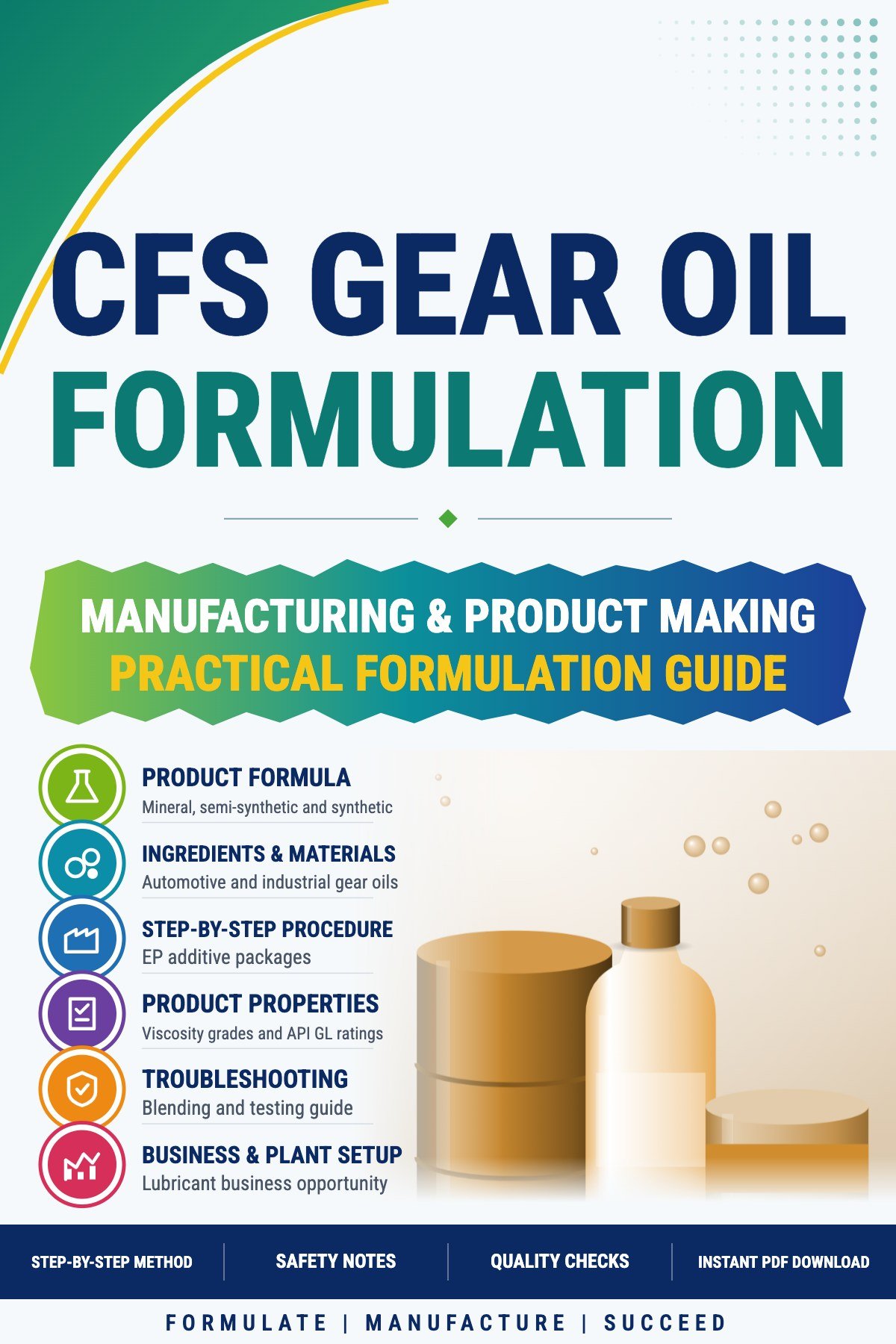
CFS Gear Oil Formulation is a practical PDF handbook for lubricant blenders, manufacturers, private-label brands and entrepreneurs who want to formulate, produce and commercialise high-performance gear oils for automotive and industrial applications. The CFS Gear Oil Formulation Handbook covers mineral, semi-synthetic and fully synthetic gear oil formulations, together with step-by-step blending and quality guidance. This page explains how a CFS gear oil formulation works, what goes into a CFS gear oil formula, how the oils are blended and tested, which standards apply and how to turn the knowledge into a lubricant business.
This guide is published by Chemical Formulation Services, the formulation publishing and consultancy business of CFS Formulation Services Ltd in Sheffield, United Kingdom. It is written for people who want to understand the product from the raw material to the finished pack, and it keeps its claims practical rather than promotional.
At a glance
- Product: CFS Gear Oil Formulation, a digital PDF Product Making Guide (handbook).
- Also searched as: CFS gear oil formula, gear oil blending, EP gear oil formulation, 80W-90 gear oil, 75W-90 synthetic gear oil, industrial gear oil.
- Oil types: mineral, semi-synthetic and fully synthetic.
- Applications: manual transmissions, differentials, axles, industrial gearboxes.
- Who it is for: lubricant blenders, private-label brands, workshops and entrepreneurs.
- Delivery: instant PDF download after payment is confirmed.
- Publisher: CFS Formulation Services Ltd, England and Wales company number 16678503.
What gear oil has to do
Gears transmit power through tooth contact, where pressures are enormous and sliding and rolling happen at once. In a differential with hypoid gears, the teeth slide across each other under heavy load, creating extreme pressure and shear in a thin oil film. A gear oil must keep metal surfaces apart, carry away heat, protect against wear, scuffing and pitting, resist foaming and oxidation, protect against rust and corrosion, be compatible with seals and yellow metals such as bronze synchroniser rings, and flow at low temperatures. Different gearboxes impose different demands, so gear oils come in a range of viscosity grades, performance levels and chemistries.
Viscosity grades and performance classifications
Automotive gear oils
Automotive manual transmissions, transaxles and axles use gear oils graded by SAE J306 viscosity, such as 75W-80, 75W-90, 80W-90, 85W-90 and 85W-140. Performance is classified by API service categories: GL-4 for moderate loads in manual transmissions and some spiral-bevel axles, and GL-5 for severe conditions in hypoid differentials. GL-5 oils contain higher levels of extreme-pressure additives, and can be incompatible with the yellow metals in some manual transmissions, so the right grade matters. Manufacturers also publish their own specifications.
Industrial gear oils
Industrial gearboxes use ISO viscosity grades such as ISO VG 100, 150, 220, 320, 460 and 680. Standards such as AGMA and DIN 51517 define performance classes. Industrial gear oils for enclosed gear drives are commonly formulated as CKC (mineral with anti-wear and rust inhibition), CKD (with extreme-pressure additives) or CKT for higher temperatures, and synthetic polyalphaolefin (PAO) or polyglycol (PAG) oils for high load, high temperature or long drain intervals. Open-gear lubricants are a separate category.
Base oils
- Mineral base oils: solvent-refined or hydroprocessed Group I, II and III oils, economical and widely used in conventional gear oils.
- Semi-synthetic: blends of mineral and synthetic oils, providing improved low-temperature flow and oxidation life at moderate cost.
- Fully synthetic: polyalphaolefin (PAO), esters and polyalkylene glycols (PAG), giving wide temperature range, longer life and better efficiency. PAGs are not miscible with mineral oils and are incompatible with some seals and paints, so specific handling is required.
- Bright stock and heavy fractions: used to reach high viscosity grades such as 85W-140 or ISO VG 680.
Additive components
- Extreme-pressure and anti-wear additives: sulphur-phosphorus compounds form a protective film under severe contact, preventing welding and scuffing. The balance between sulphur and phosphorus decides performance and yellow-metal compatibility.
- Viscosity index improvers: polymers (polymethacrylates or olefin copolymers) allow multigrade behaviour, though shear stability matters in gear drives.
- Pour point depressants: maintain flow at low temperatures.
- Antioxidants: hindered phenols and amines extend oil life.
- Rust and corrosion inhibitors: protect ferrous and non-ferrous metals.
- Friction modifiers: in limited-slip differentials, to prevent chatter, and in synchronised transmissions to give smooth shifts.
- Seal swell agents: keep elastomer seals supple.
- Anti-foam agents: silicone or non-silicone to control foam.
- Demulsifiers: in industrial oils, to separate water.
Choosing a complete additive package versus individual additives
Blenders face a basic choice. A complete additive package from a major additive company contains the right ratio of EP, anti-wear, antioxidant, corrosion inhibitor, demulsifier and anti-foam agents, tested together and certified for a defined performance level such as API GL-5 or an industrial gear specification. You add it at the stated treat rate to suitable base oils and reach the claimed performance with confidence. The alternative, mixing individual additives from separate suppliers, can yield lower cost and flexibility but requires deep expertise and expensive testing, because additives interact. For most start-ups, a certified package is the safer route, with differentiation coming from base oil quality, service and brand rather than additive chemistry.
Synthetic gear oils and extended drain performance
PAO and ester-based gear oils run cooler, flow better in cold, last longer and reduce friction, which saves energy in demanding gearboxes such as wind turbines, mining drives and heavy trucks. They cost more per litre but can extend drain intervals several times and cut downtime. Polyglycol (PAG) oils offer excellent thermal stability and very low friction in worm gears, but must not be mixed with mineral or PAO oils and need compatible seals and paints. Educate customers on cost per operating hour, not only price per litre, and advise on flushing procedures when changing oil types.
Seal compatibility and yellow metals
Gear oils must be compatible with the nitrile, fluorocarbon, acrylate and silicone seals used in gearboxes. Poor compatibility causes seals to swell, shrink or harden, leading to leaks. Test the oil by immersing standard seal samples at temperature and measuring volume, hardness and tensile changes. Yellow metals such as brass and bronze in synchronisers and worm wheels can be attacked by active sulphur, so GL-4 or special manual transmission oils use less aggressive chemistry. Give users a clear statement on which gearboxes the oil suits and which it should not be used in.
Packaging, labelling and brand building
Gear oil is bought on trust. A clear label with SAE or ISO grade, API or other performance level, the vehicle or machinery types it suits, recommended change interval and safety information builds confidence. Sturdy containers with tamper-evident seals, clear pouring spouts and recycled-content plastic are appreciated. A brand story built on honest performance, field tests with local fleets and reliable supply wins repeat business. Consider offering sampling kits to workshop owners, training sessions on lubrication practice and a hotline for technical questions.
What is inside the CFS Gear Oil Formulation handbook
The handbook is a complete, industry-focused guide for professionals, manufacturers and entrepreneurs who want to formulate, produce and commercialise high-performance gear oils for automotive and industrial use. It covers mineral, semi-synthetic and fully synthetic formulations, together with step-by-step manufacturing, quality control, performance expectations, packaging and market guidance.
How gear oil is blended
Preparing the plant
A blending plant has storage tanks for base oils and additives, a blending vessel with agitator and heating, flow meters or scales, pumps, filters, a laboratory and filling lines. Cleanliness is vital, since contamination affects performance.
Charging base oils
Charge base oils to the blending vessel in the correct proportion for the viscosity target, then warm to about 50 to 60 degrees Celsius to ease additive dissolution.
Adding additive package
Add the gear oil additive package (the combined EP, anti-wear, rust, antioxidant and foam inhibitors from an additive supplier) at the recommended treat rate, followed by VI improver and pour point depressant as required. Many blenders use a complete gear oil additive package so that the performance level is certified by the supplier.
Mixing and sampling
Mix for the specified time, take a sample and test viscosity at 40 and 100 degrees Celsius, then adjust with base oil or thickener.
Filtration and filling
Filter the oil, then fill into pails, drums or bottles. Label with SAE or ISO grade, API service level, approvals and batch code.
Testing and quality control
- Kinematic viscosity at 40 and 100 degrees Celsius: and viscosity index.
- Brookfield viscosity at low temperature: to verify W grade.
- Flash point and pour point.
- Density, colour and water content.
- Copper strip corrosion: yellow-metal protection.
- Rust test: protection of steel in the presence of water.
- Foam tendency and stability.
- Four-ball weld and wear tests: EP performance.
- FZG gear rig tests: for industrial oils, scuffing load stage.
- Oxidation stability and shear stability.
Troubleshooting
Viscosity out of grade
Wrong base oil ratio or VI improver level. Adjust with heavier or lighter base oil and re-test.
Hazy or cloudy oil
Water contamination or additive incompatibility. Dry the oil, check storage and compatibility.
Excess foam
Insufficient anti-foam or contaminated tank. Add anti-foam and clean equipment.
Copper corrosion failure
Active sulphur level too high. Switch to a more suitable additive package.
Poor low-temperature flow
Inadequate pour point depressant or wax-rich base oil. Add depressant or change base oil.
Seal leakage or hardening
Seal incompatibility. Adjust seal-swell additive and check elastomer compatibility.
Standards, claims and responsibility
Gear oils are safety-related products, so claims should be supported by test evidence. Use only API, SAE, ISO, AGMA or OEM claims you can substantiate, and do not print approvals without actual approval. Obtain additive packages with documented performance, run required tests or have an independent laboratory test them, and keep complete batch records. Comply with labelling and chemical regulations in your market, safety data sheets, and rules for waste oil collection and recycling. Avoid mixing incompatible oils and warn users of the dangers of mixing, for example PAG with mineral oils.
Safety and environment
Gear oils are generally low in acute toxicity, but additive packages can irritate skin and eyes, and hot oils cause burns. Use gloves, goggles and ventilation when handling concentrates. Sulphur additives may give a strong smell. Oils are flammable, so store away from ignition sources, and have spill kits ready. Used oil is hazardous waste and must be collected for recycling and not discarded on land or in drains.
Business opportunity
Gear oils are bought by garages, transport fleets, mines, quarries, factories, agriculture, construction, wind farms and distributors. A blender can start with a few popular grades, such as 80W-90 GL-5, 85W-140 GL-5, 75W-90 synthetic and ISO VG 220 and 320 industrial oils. Packaging in 1, 4, 20 and 208 litre sizes serves retail and industrial customers. Private-label supply for distributors and workshop chains is common. Build credibility with test data, clear technical sheets and responsive customer service. Offering greases, hydraulic oils and engine oils alongside gear oil makes you a full-line supplier.
Related CFS guides help you build a lubricants range. Browse the Lubricant Formula and Grease Making categories, and see Engine Oil 15W-40 Formula, ATF Transmission Fluid Formulations, Calcium Sulfonate Grease Formulation, Aluminum Complex Grease Formula, Barium Complex Grease Formulation, Gasoline Fuel Treatment Formulation and Grinding Paste & Lapping Compound Formulation.
Getting started
Pick one or two high-demand grades and one additive supplier with full documentation. Make small blends in a laboratory beaker or small tank, check viscosity and basic properties, and send samples for external performance testing. Prepare labels, safety data sheets and pricing, and introduce the oil to a few trusted workshops and fleets for field trials. Keep records of results, refine your process, and then expand the range.
How to get the best results from this guide
Treat the guide as a tested starting point rather than a finished factory. Begin with a small trial batch in the laboratory or on a bench, using the exact raw materials you plan to buy, and record every weight, temperature, mixing time and observation. Compare the result with the quality checks in the guide, change only one thing at a time, and keep a note of what each change did. Once a small batch is consistently good, repeat it several times, then scale up in stages, because mixing, heating and cooling behave differently in larger vessels. Keep retained samples of every batch, write simple standard operating procedures for your team, and build relationships with two suppliers for each key raw material. Finally, check the labelling, safety and product rules in the country where you will sell, and ask a qualified person to review your process. This careful, documented approach is what turns a good formulation into a reliable product and a trusted brand.
Who should buy this guide?
The guide is written for practical readers. It suits manufacturers who want to add a new product to an existing plant, startups choosing their first product, private-label brands that need to understand what they are buying, technical staff who must set specifications and train operators, and consultants and students who want a structured, plain-language reference. It is less suitable for anyone looking for a quick shortcut or a guarantee, because every formulation still needs testing with your own materials, equipment and local rules. If you are unsure whether it matches your project, send a short question through the contact page before you order, and we will tell you honestly whether it fits.
What is inside the CFS Gear Oil Formulation guide
Every Product Making Guide in our shop follows the same structure so you know where to look. This guide includes the product formula, the ingredients and materials, the procedure and preparations, the industrial requirements and the technical specifications. In practice you receive:
- The formulation, written so you can follow it at the bench and scale it up.
- Ingredients and materials, with the job of each material and advice on grades and suppliers.
- The manufacturing procedure, including order of addition, mixing and preparations.
- Industrial requirements, covering equipment, space and packaging.
- Technical specifications, describing what a good finished product should look like and how it should behave.
- Troubleshooting for the faults that makers meet most often.
- Business guidance, to help you take the product from the bench to the market.
These Product Making Guides of chemical formulations and formulas are for manufacturers, startups and entrepreneurs. Every guide contains industrially tested, practical formulations. Anyone who buys a guide can make the product by following its step-by-step instructions. Raw materials vary between suppliers, so always confirm your results with a small trial batch before scaling up.
Who stands behind this guide?
Chemical Formulation Services is the trading name of CFS Formulation Services Ltd, registered in England and Wales under company number 16678503, with its office at Unit F, Winston Business Park, Churchill Way, Sheffield S35 2PS. The business was founded by George Enrick and publishes formulation manuals, technical guides and industry reports. You can check our details on the Companies House register, read about us, or contact us with any question before you order.
A written formulation cannot replace testing with your own raw materials, equipment and climate, and we say so plainly. What the guide does give you is a tested, structured starting point that can save you months of trial and error. Our terms and conditions explain what a purchase from us covers.
How to order
- Select Add to cart to keep browsing, or Buy Now to go straight to checkout.
- Pay with PayPal, Stripe, Xoom by PayPal, Payoneer, payment links for debit and credit cards, or Western Union, Ria and all money exchanges.
- If you pay through a money exchange, email your payment slip to Info@chemicalformulationservices.com. After confirmation, your instant download link is emailed to you.
- For online payments, the PDF is available as soon as the payment is confirmed.
All products are digital downloads and all payments are nonrefundable once the file is delivered, so please read the refund policy and the FAQs before you order. You can compare this guide with others in the formula shop or browse our industrial project reports.
Frequently asked questions about cfs gear oil formulation
What is the CFS Gear Oil Formulation handbook?
It is a digital PDF Product Making Guide handbook for formulating, producing and commercialising mineral, semi-synthetic and synthetic gear oils for automotive and industrial use.
What is the difference between GL-4 and GL-5?
GL-5 has higher extreme-pressure additive content for severe hypoid gear service, while GL-4 suits moderate loads and some manual transmissions.
Which additive controls extreme pressure?
Sulphur-phosphorus EP additives form a protective film on gear teeth.
Can PAG gear oil be mixed with mineral oil?
No. PAG oils are generally not miscible with mineral oils and need careful handling.
Do I need testing before selling?
Yes. Verify viscosity and key performance properties, and only claim approvals you actually hold.
How do I receive the guide?
You receive an instant PDF download after payment is confirmed. For money exchanges, email your payment slip to Info@chemicalformulationservices.com and the link is emailed after we confirm it.
Is the payment refundable?
All payments are nonrefundable because the product is an instant digital download. See the refund policy for details.
Can you help with a custom formulation?
CFS Formulation Services Ltd offers formulation and product development consultancy. Send a short brief through the Contact page.
Last reviewed: November 2026. This page is general information about a digital product. It is not a safety data sheet or professional advice, and any formulation should be tested and reviewed by a qualified person before commercial use.