
Tyre Mounting Paste Formulations
USD $75
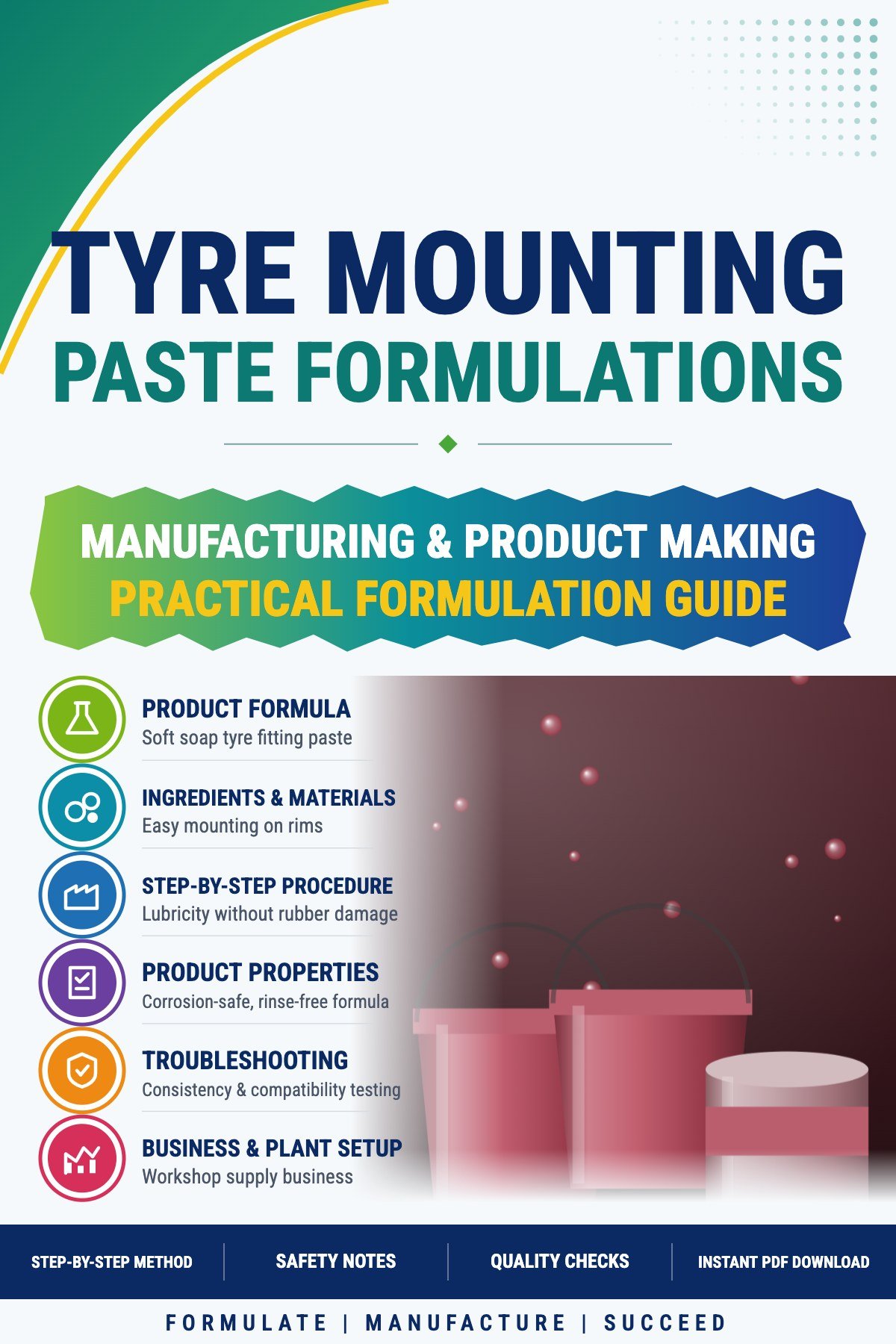
PDF manual · Instant downloadTyre Mounting Paste Formulations: a PDF guide to making soft soap tyre mounting paste, with soap base, lubricants, inhibitors, manufacturing, testing and workshop use.
Payment Methods
Refund Policy
Custom Formulation Services
Formulation Consultation
Contact Us
Tyre Mounting Paste Formulations is a practical PDF guide for workshop-chemical manufacturers, tyre-service suppliers, lubricant blenders and entrepreneurs who want to produce high-quality tyre mounting paste, a soft-soap type lubricant used to fit tyres onto wheel rims. Mounting a tyre is hard physical work, because the tyre bead is tight on the rim and must slide over the rim flange and seat correctly. A good paste lubricates the bead and rim, reduces the force and risk of damage, and helps the tyre seat evenly and seal, then dries or washes away without harming rubber or metal. This page explains how a tyre mounting paste formula works, what the guide covers and how a tyre mounting paste formulation is designed, made and tested, so you can decide whether it suits your business.
This guide is published by Chemical Formulation Services, the formulation publishing and consultancy business of CFS Formulation Services Ltd in Sheffield, United Kingdom. It is written for people who want to understand the product from the raw material to the finished pack, and it keeps its claims practical rather than promotional.
At a glance
- Product: Tyre Mounting Paste Formulations, a digital PDF Product Making Guide.
- Also searched as: tyre mounting paste formula, tire mounting lubricant, tyre fitting paste, tyre bead lubricant, soft soap mounting paste.
- What it covers: soap and surfactant bases, lubricants, corrosion inhibitors, preservatives, manufacturing and testing.
- Key goals: strong lubrication, rubber compatibility, correct bead seating, corrosion safety and easy handling.
- Who it is for: tyre workshops, chemical blenders, automotive-supply businesses and entrepreneurs.
- Delivery: instant PDF download after payment is confirmed.
- Publisher: CFS Formulation Services Ltd, England and Wales company number 16678503.
Why a mounting paste is needed
A tubeless tyre is held on its wheel by the bead, a hoop of steel wire wrapped in rubber at the inner edge of the tyre. The bead is designed to be a tight fit on the rim, so that air pressure holds it firmly against the rim seat and forms the air seal. This tight fit makes mounting and demounting difficult. The tyre technician must stretch the bead over the rim flange, usually with a tyre changer machine and levers, and then inflate the tyre so the bead pops into its seat. Without lubrication, the rubber grips the metal rim, the bead can be torn or scuffed, and levers can damage the wheel. In truck, agricultural and earthmover tyres, the forces are enormous. Lubrication reduces friction by a large factor, making fitting quicker, safer for operator and tyre, and better for sealing.
Tyre mounting paste, also sold as tyre fitting lubricant or bead paste, is a thick, soap-based or silicone-free lubricant applied with a brush to the bead and rim. After fitting, it lets the tyre seat evenly, and over time it dries or is absorbed so that the bead does not slip on the rim in service.
Types of mounting lubricant
Soft soap paste
The traditional type, made from potassium soap (soft soap) in water, often with glycerin and other additives. It is the focus of this guide. It is smooth, slippery, easy to wash off, compatible with natural and synthetic rubbers and relatively economical.
Gel and liquid lubricants
Water-based gels and liquids, applied by brush or spray, used in high-volume tyre shops.
White and coloured pastes
Many products are coloured so the technician can see coverage. Some pastes include a corrosion inhibitor and a mild abrasive-free filler.
Anti-corrosion and rim-protective pastes
Include inhibitors to protect steel and alloy wheels from corrosion after fitting, and are particularly important for steel wheels in humid or salty climates.
Specialty pastes
For run-flat tyres, truck tyres and agricultural tyres, with thicker consistency, higher lubricity and longer working time.
Products to avoid
Petroleum-based oils, greases and silicone fluids must not be used on tyre beads. Mineral oils swell and soften rubber, can damage the bead and, in time, reduce grip. Silicones can make tyre beads slip on rims, causing leaks. Antifreeze and solvents also attack rubber. Quality mounting pastes are formulated to be rubber-safe.
Main components of a soft soap mounting paste
Soap base
Potassium soaps of fatty acids, made from vegetable oils, tallow or fatty acids, are the traditional base. They are soft, water-soluble and form a slippery paste. Fatty acid chain length and soap content set the consistency and slip. Sodium soaps are harder and less suitable for soft paste.
Water
Soft or deionised water makes up much of the product. Water content controls consistency and economy but also mould risk.
Humectants
Glycerin, propylene glycol or sorbitol retain moisture, keeping the paste soft and slippery in the pot and during fitting, and preventing it from drying out too quickly.
Lubricity enhancers
Non-ionic surfactants, polyalkylene glycols and mild fatty derivatives that increase slip without harming rubber.
Fillers and thickeners
Fine, non-abrasive fillers, such as calcium carbonate or kaolin, add body and visual white colour. Gums or cellulose derivatives thicken the paste. Fillers must be soft enough not to scratch wheels.
Corrosion inhibitors
Alkanolamines, phosphates or organic inhibitors help prevent rust on steel rims. Compatibility with aluminium alloy wheels is checked, since high alkalinity can stain or etch aluminium.
Preservatives
Water-containing soap pastes are vulnerable to mould and bacteria. Appropriate preservatives keep them fresh in open pots.
pH adjusters
Keep pH in a safe range, typically mildly alkaline for soap pastes, but not so high that it harms aluminium or irritates hands excessively.
Colour and fragrance
A colourant allows visibility, and fragrance masks the soap smell. Colourants must not stain tyres or wheels.
What is inside the Tyre Mounting Paste Formulations guide
The guide is a specialised, professional industrial formulation guide for manufacturers, workshop suppliers and chemical businesses looking to produce high-quality tyre mounting paste of the soft soap type. It focuses on practical, industrially proven formulations that give strong lubrication, with ingredient roles, step-by-step manufacturing, quality control, packaging, troubleshooting and business advice. It follows the CFS style of clear, industrially minded instructions.
How the paste is made
The outline below shows the general sequence. The guide gives full details.
Step 1: Prepare the soap
If making the soap in-house, fatty acids or oils are reacted with potassium hydroxide in a controlled saponification, with temperature control, to produce soft soap. Many manufacturers buy ready-made potassium soap or fatty acid soap base to avoid handling strong alkali.
Step 2: Charge water and humectants
Soft water and humectant are loaded into a clean mixing vessel and warmed gently.
Step 3: Add the soap base
The soap is added gradually with stirring until completely dissolved or dispersed, forming a smooth paste. Heat helps, but overheating is avoided.
Step 4: Add lubricants, inhibitors and fillers
Non-ionic lubricant, corrosion inhibitor and filler are added in the order set out, mixing to uniformity.
Step 5: Adjust consistency and pH
Water, thickener or soap are adjusted to reach the target consistency, which should spread easily with a brush but not run off the bead. pH is checked.
Step 6: Add preservative, colour and fragrance
These are added when the batch has cooled.
Step 7: Fill and label
The paste is filled into tubs, pails or drums with lids, labelled with directions and safety information.
Equipment requirements
A small plant needs accurate scales, a stainless steel or plastic mixing vessel with a heavy-duty paddle or anchor stirrer (since the paste is thick), a heating source with a water bath, filling equipment for tubs and pails, and a laboratory. A laboratory needs a pH meter, penetrometer or cone for consistency, a balance and test pieces of rubber, steel and aluminium wheels. Cleaning and storage should be hygienic.
Use in the workshop
The tyre technician applies a thin, even layer of paste with a brush to both beads and the rim flanges before mounting. Paste is not smeared on the tread or sidewall decoratively, because excess lubricant can make the tyre slip on the rim. After mounting and inflating, the bead seats, excess paste is wiped off, and the wheel is balanced. For tubeless tyres, the paste also helps seal the bead to the rim. Technicians should clean rims of dirt and rust before mounting, and avoid over-lubrication, which can cause the tyre to creep on the rim. For run-flat and low-profile tyres, correct lubrication is especially important to avoid bead damage.
Quality control for every batch
- Appearance and consistency: smooth, homogeneous paste without lumps or separation.
- pH: in the specified range.
- Lubricity: friction measured between rubber and steel or aluminium surfaces.
- Rubber compatibility: soak tests with natural and synthetic rubber samples for swelling, hardness change and surface degradation.
- Corrosion protection: tests on steel coupons and no staining or etching of alloy wheels.
- Bead slip check: after drying, the paste should not cause slipping.
- Wash-off: easily rinsed with water.
- Storage stability: no separation, hardening or microbial growth.
- Temperature behaviour: performance in hot and cold workshops.
Troubleshooting
Paste too thick to spread
Too little water or too much soap. Adjust consistency.
Paste too thin and runs
Too much water or too little thickener. Add soap or thickener.
Poor lubrication
Soap level too low or wrong fatty acid. Increase soap and add lubricity enhancer.
Tyre slips on rim after fitting
Too much lubricant or residue left on bead seat. Wipe off excess and use a paste that dries appropriately.
Rim corrosion
No inhibitor or high alkalinity. Add corrosion inhibitors and lower pH.
Mould and odour
Weak preservation. Improve hygiene and preservative.
Paste dries out in the tub
Not enough humectant or poor sealing. Increase humectant and use tight lids.
Safety, health and environment
Soft soap pastes are mildly alkaline and can irritate skin and eyes, so gloves and eye protection are recommended during manufacture and use, and hands should be washed afterwards. Potassium hydroxide, if used to make soap, is highly corrosive and calls for full protection. The product must be safe for rubber and not contain mineral oils or silicones that damage tyres. Labels should include warnings, instructions, batch details and storage conditions. Dispose of waste and wash water according to local rules, and check that products meet workshop and chemical regulations. Tyre fitting is itself a hazardous job, because exploding tyres and wheels cause injuries, so users must follow safe inflation procedures, and nothing in a lubricant replaces training.
The business opportunity
Every tyre fitted in the world is mounted with some kind of lubricant, and workshops use it daily. Customers include tyre shops, garages, fleet workshops, truck and agricultural service centres, mining operations and tyre retreaders, along with distributors of workshop consumables. A manufacturer can pack paste in small tubs for car workshops and in large pails for commercial depots, offer coloured and anti-corrosion types, and bundle brushes. Low raw material costs, simple equipment and steady repeat sales make it an attractive entry product for chemical entrepreneurs. Reliable quality and clear labelling build workshop trust.
Related CFS guides help you build an automotive workshop range. Browse the Auto Care Products and Lubricant Formula categories, and see Soap Formula, Cheap Bathing Soap Formulations, Beauty Soap Formulation, , Calcium Sulfonate Grease Formulation and Aluminum Complex Grease Formula. For rubber knowledge, see Rubber Goods Making and CR Rubber Additives Formulation.
Getting started
Begin with a simple potassium soap, water and glycerin paste with a mild corrosion inhibitor and preservative. Make small batches, test consistency and slip, and soak rubber and steel samples. Try it on a tyre changer in a friendly workshop on used tyres and wheels, and compare with branded pastes. Gather feedback on feel, rinse-off and bead seating, refine, and prepare labels, safety data and packaging before scaling.
How to get the best results from this guide
Treat the guide as a tested starting point rather than a finished factory. Begin with a small trial batch in the laboratory or on a bench, using the exact raw materials you plan to buy, and record every weight, temperature, mixing time and observation. Compare the result with the quality checks in the guide, change only one thing at a time, and keep a note of what each change did. Once a small batch is consistently good, repeat it several times, then scale up in stages, because mixing, heating and cooling behave differently in larger vessels. Keep retained samples of every batch, write simple standard operating procedures for your team, and build relationships with two suppliers for each key raw material. Finally, check the labelling, safety and product rules in the country where you will sell, and ask a qualified person to review your process. This careful, documented approach is what turns a good formulation into a reliable product and a trusted brand.
Who should buy this guide?
The guide is written for practical readers. It suits manufacturers who want to add a new product to an existing plant, startups choosing their first product, private-label brands that need to understand what they are buying, technical staff who must set specifications and train operators, and consultants and students who want a structured, plain-language reference. It is less suitable for anyone looking for a quick shortcut or a guarantee, because every formulation still needs testing with your own materials, equipment and local rules. If you are unsure whether it matches your project, send a short question through the contact page before you order, and we will tell you honestly whether it fits.
What is inside the Tyre Mounting Paste Formulations guide
Every Product Making Guide in our shop follows the same structure so you know where to look. This guide includes the product formula, the ingredients and materials, the procedure and preparations, the industrial requirements and the technical specifications. In practice you receive:
- The formulation, written so you can follow it at the bench and scale it up.
- Ingredients and materials, with the job of each material and advice on grades and suppliers.
- The manufacturing procedure, including order of addition, mixing and preparations.
- Industrial requirements, covering equipment, space and packaging.
- Technical specifications, describing what a good finished product should look like and how it should behave.
- Troubleshooting for the faults that makers meet most often.
- Business guidance, to help you take the product from the bench to the market.
These Product Making Guides of chemical formulations and formulas are for manufacturers, startups and entrepreneurs. Every guide contains industrially tested, practical formulations. Anyone who buys a guide can make the product by following its step-by-step instructions. Raw materials vary between suppliers, so always confirm your results with a small trial batch before scaling up.
Who stands behind this guide?
Chemical Formulation Services is the trading name of CFS Formulation Services Ltd, registered in England and Wales under company number 16678503, with its office at Unit F, Winston Business Park, Churchill Way, Sheffield S35 2PS. The business was founded by George Enrick and publishes formulation manuals, technical guides and industry reports. You can check our details on the Companies House register, read about us, or contact us with any question before you order.
A written formulation cannot replace testing with your own raw materials, equipment and climate, and we say so plainly. What the guide does give you is a tested, structured starting point that can save you months of trial and error. Our terms and conditions explain what a purchase from us covers.
How to order
- Select Add to cart to keep browsing, or Buy Now to go straight to checkout.
- Pay with PayPal, Stripe, Xoom by PayPal, Payoneer, payment links for debit and credit cards, or Western Union, Ria and all money exchanges.
- If you pay through a money exchange, email your payment slip to Info@chemicalformulationservices.com. After confirmation, your instant download link is emailed to you.
- For online payments, the PDF is available as soon as the payment is confirmed.
All products are digital downloads and all payments are nonrefundable once the file is delivered, so please read the refund policy and the FAQs before you order. You can compare this guide with others in the formula shop or browse our industrial project reports.
Frequently asked questions about tyre mounting paste formulations
What are the Tyre Mounting Paste Formulations?
They are a digital PDF Product Making Guide to making soft soap type tyre mounting paste, with ingredients, manufacturing, quality control, use in workshops and business advice.
Why do tyres need a lubricant when fitted?
The bead fits tightly on the rim, so lubrication reduces friction, protects the bead and rim, and helps the tyre seat and seal.
Can I use oil or silicone to mount tyres?
No. Mineral oils can damage rubber, and silicones can make the bead slip on the rim, so use a purpose-made paste.
What is in a soft soap paste?
Potassium soap, water, humectant, lubricity enhancers, filler, corrosion inhibitor and preservative.
Why must excess paste be wiped off?
Too much lubricant can let the tyre creep or slip on the rim in service, so excess should be removed after fitting.
How do I receive the guide?
You receive an instant PDF download after payment is confirmed. For money exchanges, email your payment slip to Info@chemicalformulationservices.com and the link is emailed after we confirm it.
Is the payment refundable?
All payments are nonrefundable because the product is an instant digital download. See the refund policy for details.
Can you help with a custom formulation?
CFS Formulation Services Ltd offers formulation and product development consultancy. Send a short brief through the Contact page.
Last reviewed: November 2026. This page is general information about a digital product. It is not a safety data sheet or professional advice, and any formulation should be tested and reviewed by a qualified person before commercial use.