Table Tennis Booster Formulations
USD $75
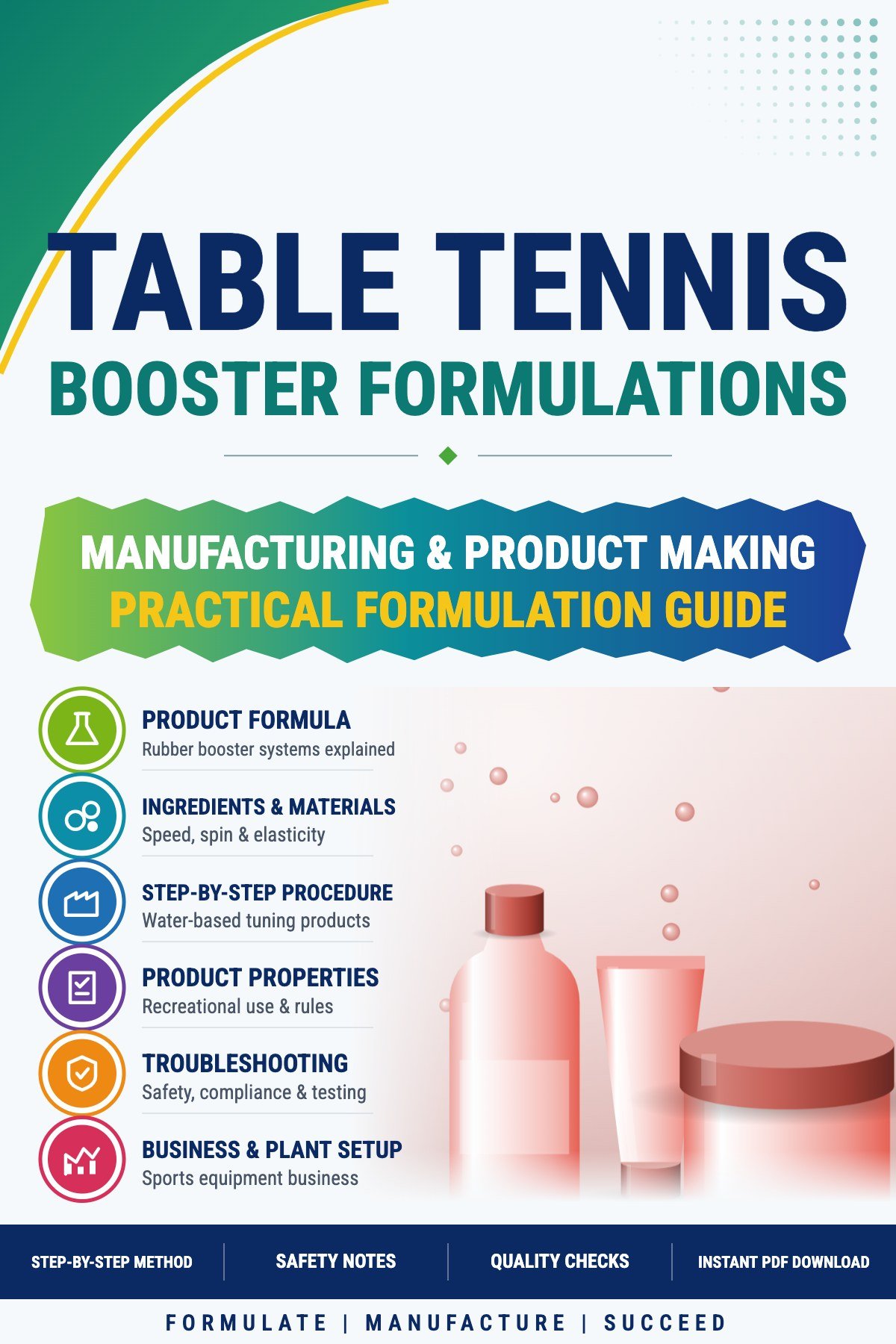
PDF manual · Instant downloadTable Tennis Booster Formulations: a PDF guide to rubber booster and care systems for table tennis, with rubber science, carriers, testing, safety and ITTF rule compliance notes.
Payment Methods
Refund Policy
Custom Formulation Services
Formulation Consultation
Contact Us
Table Tennis Booster Formulations is a practical PDF guide for sports-equipment manufacturers, formulators, brand owners, equipment tuners and advanced recreational players who want to understand and develop rubber booster systems with precision, consistency and confidence. Modern table tennis has moved far beyond simple rubber-and-wood equipment, and speed, spin, elasticity and feel are shaped by materials, rubber structure and treatments. This page explains how table tennis booster formulations work, what the guide covers and how a table tennis booster formula is approached as a product, so you can decide whether it suits your business. It is essential to understand the rules: boosting and tuning rubbers with chemicals is banned in sanctioned competition, so the product is relevant only to recreational, training and non-competition markets where permitted.
This guide is published by Chemical Formulation Services, the formulation publishing and consultancy business of CFS Formulation Services Ltd in Sheffield, United Kingdom. It is written for people who want to understand the product from the raw material to the finished pack, and it keeps its claims practical rather than promotional.
At a glance
- Product: Table Tennis Booster Formulations, a digital PDF Product Making Guide.
- Also searched as: table tennis booster formula, rubber booster, racket rubber tuning liquid, table tennis rubber treatment.
- What it covers: rubber structure, booster liquid principles, carriers, application, testing, safety and rule compliance.
- Key goals: consistent recreational-level performance feel, safe materials and honest marketing.
- Who it is for: sports-equipment makers, brand owners, tuners and advanced recreational players.
- Delivery: instant PDF download after payment is confirmed.
- Publisher: CFS Formulation Services Ltd, England and Wales company number 16678503.
Understanding the table tennis rubber
A modern table tennis racket (bat) has a wooden blade covered on each side by a sheet of rubber. The rubber sheet has two layers: a top sheet of solid rubber, which is the surface that contacts the ball, and beneath it a layer of sponge, the foam that sets the thickness of the rubber and its capacity to store and release energy. Different top sheet designs, such as inverted rubber with a smooth surface, pimples-out, short pimples, long pimples and anti-spin rubber, produce very different spin and speed characteristics. Sponge hardness and thickness, the stiffness of the top sheet, its elasticity, surface grip and the microstructure of the rubber all shape how the ball behaves: the speed of the shot, how much spin the rubber can create, the arc, the dwell time of the ball and the feel in the hand.
What boosters are
Booster is the name for liquid or oil-based treatments that players apply to the sponge or sheet of table tennis rubber to change how it plays. The idea is that a liquid absorbed into the sponge softens it, increases its elasticity and storage of energy and makes the rubber springier, so the ball rebounds faster. Different products target the sponge, the top sheet or both. Historically, speed glues based on organic solvents were used for this purpose, and as the solvents evaporated from the sponge over hours, the rubber stretched slightly and gained a temporary trampoline effect.
Rules and regulations: the essential context
The International Table Tennis Federation (ITTF) and national associations regulate equipment strictly. Since the 2000s, rules have banned the use of any speed-enhancing glue or solvent, and later the use of any booster, tuner or chemical treatment on the racket covering after it is manufactured. Racket coverings must be used without any physical, chemical or other treatment, and this is tested at major competitions using portable devices that sample and detect volatile organic compounds. Players found using prohibited treatments risk disqualification and bans. Only water-based adhesives free of volatile organic compounds are permitted for sticking rubber to the blade. Therefore, products described as boosters can be legitimately sold and used only for non-competitive play, training or experimentation where the rules do not apply, and they cannot be used in sanctioned events. A responsible manufacturer states this clearly on the product page, in the packaging and in the instruction sheet, and does not market the product to competitive players as legal for tournaments.
Technology background of booster systems
Carrier liquids
Boosters are made from carrier liquids that the rubber absorbs. Oils, esters, glycol ethers, hydrocarbon fractions and other low-volatility liquids have been used. The carrier’s compatibility with the rubber matters. Too aggressive a solvent can damage the rubber, make it sticky, shorten its life or make it swell unevenly.
Swelling and softening of the sponge
A moderate, controlled absorption of liquid softens the sponge and increases its flexibility. This changes the stiffness of the foam. The effect is temporary as the liquid migrates and evaporates.
Surface effects
Some products claim to refresh the surface grip of the rubber by conditioning the top sheet. These are generally cleaners or conditioners, and many are allowed in competition if applied outside the rules for prohibited treatments. Rules differ and are updated, so always check the current laws.
Water-based and compliant approaches
Modern products increasingly focus on water-based cleaners, rubber protectors, surface conditioners and gluing systems that stay within regulations. Cleaning products maintain the grip of the rubber by removing dust and oils from the surface, and protective films preserve rubber between sessions. Water-based glues allow safe, legal attachment of rubber to the blade. These are major, legitimate markets for a manufacturer, and the guide covers formulation of such products too.
Main components in tuning and care products
- Carrier solvents and oils: chosen for compatibility and low odour (for non-competition boosters).
- Water and surfactants: for cleaning solutions that lift dust and grease from rubber without leaving residue.
- Alcohols and glycols: for fast-drying cleaners and surface preparation.
- Film formers and conditioners: light polymers or silicone-free conditioners to protect surface and preserve tackiness.
- Preservatives: for water-containing products.
- Fragrance: usually minimal.
- Packaging: bottles with fine applicators, spray bottles, sponge applicators and sealed caps.
What is inside the Table Tennis Booster Formulations guide
The guide is a practical, industry-focused reference for manufacturers, formulators, brand owners, equipment tuners and advanced players. It explains the structure of rubber and how liquid systems interact with it, how to develop booster-type and rubber care formulations with precision and consistency, regulatory context, testing and safe use, packaging and branding. It follows the CFS style of clear, industrially minded instructions.
How a rubber care or booster product is made
The outline below shows the general sequence. The guide gives full details.
Step 1: Select compatible liquids
Candidate liquids are tested on offcuts of rubber and sponge to check absorption, swelling, stickiness, colour change and long-term effects.
Step 2: Blend
Liquids, surfactants and additives are mixed in a clean, dry vessel under gentle stirring until uniform. Flammable solvents need ventilation and earthing.
Step 3: Filter
The liquid is filtered to remove dust and particles that would mark the rubber.
Step 4: Test
Samples are tested for odour, appearance, volatility and effects on rubber offcuts, including controlled ageing.
Step 5: Fill and label
The product is filled into bottles with applicators, sealed and labelled with directions for use, safety information and a clear statement about rules for competition use.
Equipment requirements
A small production line needs accurate scales, glass or stainless steel mixing vessels, a stirrer, filtration, filling equipment and clean storage, plus a laboratory with a balance, a hardness tester for sponge, a thickness gauge and test equipment for ball rebound, such as a drop test rig or a high-speed measurement setup. Adhesive testing equipment is needed for glue products. Good ventilation is important.
Quality control for every batch
- Appearance, odour and clarity.
- Compatibility with rubber: no melting, cracking, colour change or permanent stickiness.
- Absorption and evaporation behaviour: measured by weighing treated samples over time.
- Effect on sponge hardness and rebound: measured on offcuts.
- Cleaning efficiency and residue: for cleaners.
- Application convenience: applicator performance, no dripping.
- Stability and shelf life.
- Labelling: includes warnings and rule statements.
Troubleshooting
Rubber becomes sticky or swells unevenly
Liquid too aggressive or applied unevenly. Choose milder carriers and apply with controlled amounts.
Rubber loses grip
Residue or oil on the surface. Clean with a proper cleaner and avoid getting treatments on the top sheet.
Effect fades quickly
Volatile carrier evaporates. This is inherent in the technology and should be explained to users.
Strong odour
Volatile solvents. Choose low-odour carriers and ensure ventilation.
Rubber cracks or ages quickly
Harsh solvents or overuse. Reduce strength and frequency.
Complaints about disqualification
Product used in competition against rules. Warn clearly and educate users.
Safety, health and compliance
Many volatile liquids used in boosters are flammable and their vapours can cause dizziness, headaches and respiratory irritation, particularly in enclosed spaces such as small rooms and gyms. Some solvents are toxic with repeated exposure, and in the past glue-sniffing and exposure to speed-glue vapours were health concerns, which is one reason these products were banned from competition. Use well-ventilated areas, keep away from heat and flames and avoid skin contact. Keep out of reach of children. Product labels must comply with chemical labelling laws, with hazard pictograms and safety data sheets. Do not use banned ingredients, and make no medical or performance claims you cannot support. Most importantly, comply with the ITTF rules and national association rules, state them clearly, and do not encourage use in sanctioned events.
The business opportunity
Table tennis is played by tens of millions of people worldwide, and equipment is a substantial market covering blades, rubbers, balls, tables and accessories. Recreational players, schools, clubs, coaches and collectors buy care products regularly, including rubber cleaners, protective films, water-based glues, edge tape and storage cases. Manufacturers can build a brand around legal, compliant care and maintenance products, and, where appropriate and lawful, offer clearly labelled recreational products. A reputation for honesty, quality and rule awareness is vital in a sport that takes fair play seriously. Sales channels include sports shops, specialist table tennis retailers, club shops and online platforms.
Related CFS guides can help you extend your sports and rubber product range. Browse the Resin Manufacturing and Rubber Goods Making categories, and see CR Rubber Additives Formulation, , Water-Based Shoe Adhesive Formula and Reziance 310 Liquid Resin Formulation. For cleaners, see Adhesive Remover Formula and the Cleaning Products category.
Getting started
Begin by reading the current ITTF and national equipment rules. Decide whether you will make compliant care products, such as cleaners, protectors and water-based glues, or recreational tuning products with clear warnings. Test your formulations on offcuts of several rubber types, record effects, and ask recreational players and coaches to try them in training. Prepare honest labels, safety data and instruction sheets, and build a brand around fair play and quality.
How to get the best results from this guide
Treat the guide as a tested starting point rather than a finished factory. Begin with a small trial batch in the laboratory or on a bench, using the exact raw materials you plan to buy, and record every weight, temperature, mixing time and observation. Compare the result with the quality checks in the guide, change only one thing at a time, and keep a note of what each change did. Once a small batch is consistently good, repeat it several times, then scale up in stages, because mixing, heating and cooling behave differently in larger vessels. Keep retained samples of every batch, write simple standard operating procedures for your team, and build relationships with two suppliers for each key raw material. Finally, check the labelling, safety and product rules in the country where you will sell, and ask a qualified person to review your process. This careful, documented approach is what turns a good formulation into a reliable product and a trusted brand.
Who should buy this guide?
The guide is written for practical readers. It suits manufacturers who want to add a new product to an existing plant, startups choosing their first product, private-label brands that need to understand what they are buying, technical staff who must set specifications and train operators, and consultants and students who want a structured, plain-language reference. It is less suitable for anyone looking for a quick shortcut or a guarantee, because every formulation still needs testing with your own materials, equipment and local rules. If you are unsure whether it matches your project, send a short question through the contact page before you order, and we will tell you honestly whether it fits.
What is inside the Table Tennis Booster Formulations guide
Every Product Making Guide in our shop follows the same structure so you know where to look. This guide includes the product formula, the ingredients and materials, the procedure and preparations, the industrial requirements and the technical specifications. In practice you receive:
- The formulation, written so you can follow it at the bench and scale it up.
- Ingredients and materials, with the job of each material and advice on grades and suppliers.
- The manufacturing procedure, including order of addition, mixing and preparations.
- Industrial requirements, covering equipment, space and packaging.
- Technical specifications, describing what a good finished product should look like and how it should behave.
- Troubleshooting for the faults that makers meet most often.
- Business guidance, to help you take the product from the bench to the market.
These Product Making Guides of chemical formulations and formulas are for manufacturers, startups and entrepreneurs. Every guide contains industrially tested, practical formulations. Anyone who buys a guide can make the product by following its step-by-step instructions. Raw materials vary between suppliers, so always confirm your results with a small trial batch before scaling up.
Who stands behind this guide?
Chemical Formulation Services is the trading name of CFS Formulation Services Ltd, registered in England and Wales under company number 16678503, with its office at Unit F, Winston Business Park, Churchill Way, Sheffield S35 2PS. The business was founded by George Enrick and publishes formulation manuals, technical guides and industry reports. You can check our details on the Companies House register, read about us, or contact us with any question before you order.
A written formulation cannot replace testing with your own raw materials, equipment and climate, and we say so plainly. What the guide does give you is a tested, structured starting point that can save you months of trial and error. Our terms and conditions explain what a purchase from us covers.
How to order
- Select Add to cart to keep browsing, or Buy Now to go straight to checkout.
- Pay with PayPal, Stripe, Xoom by PayPal, Payoneer, payment links for debit and credit cards, or Western Union, Ria and all money exchanges.
- If you pay through a money exchange, email your payment slip to Info@chemicalformulationservices.com. After confirmation, your instant download link is emailed to you.
- For online payments, the PDF is available as soon as the payment is confirmed.
All products are digital downloads and all payments are nonrefundable once the file is delivered, so please read the refund policy and the FAQs before you order. You can compare this guide with others in the formula shop or browse our industrial project reports.
Frequently asked questions about table tennis booster formulations
What are the Table Tennis Booster Formulations?
They are a digital PDF Product Making Guide to rubber booster and care product systems for table tennis, covering rubber structure, liquid carriers, testing, safety and rule compliance.
Are boosters legal in tournaments?
No. The ITTF and national associations prohibit boosting or chemical treatment of racket coverings in sanctioned competition and test for it.
Who can use booster products?
Only recreational and training players where the rules do not apply, and responsible brands label products accordingly.
What legal products can a brand make?
Rubber cleaners, protective films, water-based adhesives and accessories that comply with equipment rules.
Are booster liquids hazardous?
Volatile liquids can be flammable and harmful to inhale, so use ventilation, avoid flames and keep away from children.
How do I receive the guide?
You receive an instant PDF download after payment is confirmed. For money exchanges, email your payment slip to Info@chemicalformulationservices.com and the link is emailed after we confirm it.
Is the payment refundable?
All payments are nonrefundable because the product is an instant digital download. See the refund policy for details.
Can you help with a custom formulation?
CFS Formulation Services Ltd offers formulation and product development consultancy. Send a short brief through the Contact page.
Last reviewed: November 2026. This page is general information about a digital product. It is not a safety data sheet or professional advice, and any formulation should be tested and reviewed by a qualified person before commercial use.