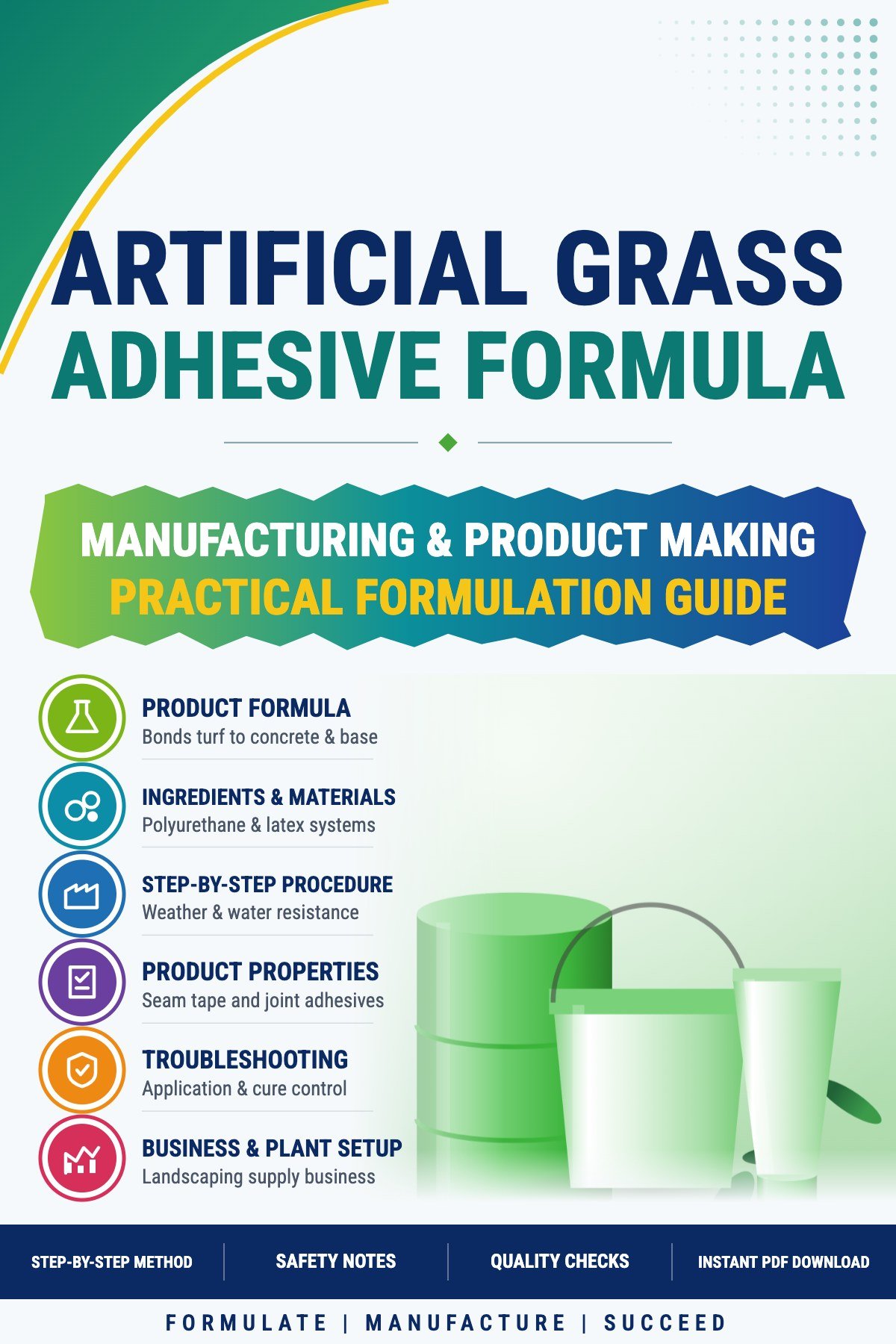
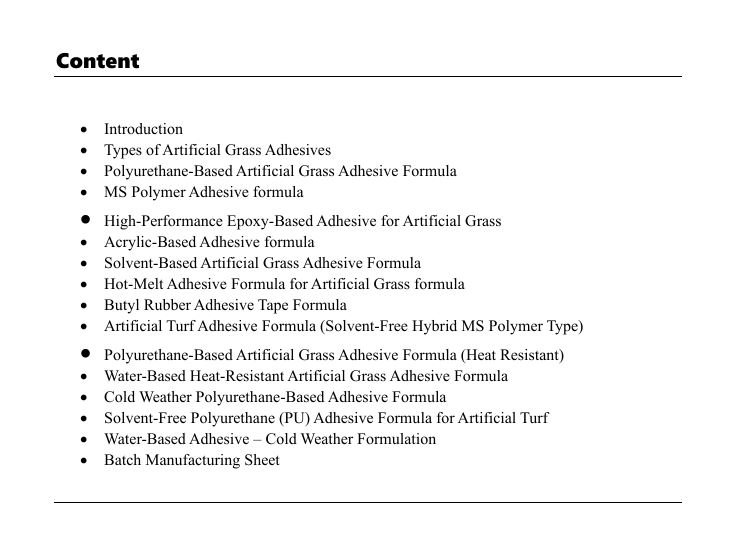
Artificial Grass Adhesive Formula
USD $65
PDF manual · Instant downloadArtificial Grass Adhesive Formula: a PDF guide to making weatherproof adhesives for installing synthetic turf, with chemistries, manufacturing, application and testing.
Payment Methods
Refund Policy
Custom Formulation Services
Formulation Consultation
Contact Us
Artificial Grass Adhesive Formula is a practical PDF guide for adhesive manufacturers, landscaping and sports-surface suppliers, chemists and entrepreneurs who want to make strong, weatherproof adhesives for installing synthetic turf. Artificial grass has become popular in gardens, balconies, schools, playgrounds, sports fields and commercial landscaping, and every installation relies on adhesive to join seams and fix the turf to its base. This page explains how an artificial grass adhesive formula works, what the guide covers and how an artificial grass adhesive formulation is made, applied and tested, so you can decide whether it suits your plans.
This guide is published by Chemical Formulation Services, the formulation publishing and consultancy business of CFS Formulation Services Ltd in Sheffield, United Kingdom. It is written for people who want to understand the product from the raw material to the finished pack, and it keeps its claims practical rather than promotional.
At a glance
- Product: Artificial Grass Adhesive Formula, a digital PDF Product Making Guide.
- Also searched as: artificial grass adhesive formulation, synthetic turf glue, turf seaming adhesive, artificial lawn glue.
- What it covers: adhesive chemistries, fillers, additives, manufacturing, application and testing.
- Key goals: strong bond, outdoor durability, water resistance and flexibility.
- Who it is for: adhesive makers, turf suppliers, installers, chemists and entrepreneurs.
- Delivery: instant PDF download after payment is confirmed.
- Publisher: CFS Formulation Services Ltd, England and Wales company number 16678503.
Why artificial turf needs a special adhesive
Artificial grass is made of plastic fibres, usually polyethylene, polypropylene or nylon, tufted into a backing. The backing is typically a woven polypropylene layer coated with latex or polyurethane to lock the fibres. Installers lay rolls of turf side by side, and the seams must be bonded so that the joins are invisible and do not lift. Turf may also be bonded to concrete, asphalt, timber decks, rooftops or compacted bases, and edges may be glued to kerbs and borders. The adhesive has to cope with a tough set of conditions: rain, sun, frost, foot traffic, thermal expansion of the turf and sometimes pets and cleaning chemicals.
A general-purpose glue will often fail outdoors. It may stay wet in damp weather, dissolve in water, harden and crack in cold, soften in summer heat or fail to grip low-energy plastics. A good turf adhesive is designed for these demands, and that is why a dedicated formula is valuable.
Where artificial grass adhesive is used
- Seaming: bonding two turf edges together, usually with seaming tape underneath.
- Bonding to hard bases: fixing turf to concrete, screed, asphalt or paving for balconies, rooftops, pools and patios.
- Edge fixing: attaching turf to kerbs, walls, sleepers and borders.
- Sports surfaces: line inlays, goal areas, putting greens and shock pad bonding.
- Repairs: patching damaged sections and fixing lifted edges.
Types of adhesive chemistry
Polyurethane adhesives
Polyurethane systems, either one-component moisture-cure or two-component, form tough, flexible, waterproof bonds and are widely used in professional turf installation. They grip well to concrete and many backings and tolerate movement. They need careful handling because they react with moisture and contain isocyanates, which require respect for health and safety.
Latex and acrylic dispersion adhesives
Water-based dispersions have low odour and are easy to apply. They suit porous bases and some seaming uses, though cure time depends on weather and water resistance may be lower than polyurethane.
Solvent-based contact adhesives
These dry quickly and give a strong initial grab, but they contain flammable solvents and are being reduced because of environmental and safety concerns.
MS polymer and hybrid adhesives
Silane-terminated or MS polymer adhesives combine good adhesion and flexibility with low odour and no isocyanates, which makes them attractive for installers who prefer safer products.
Epoxy and other rigid systems
Some specialised bonding tasks use epoxy, but rigid adhesives can crack under movement, so they are chosen with care.
Main components of an adhesive formula
Binder or base polymer
The polymer sets the basic strength, flexibility and durability of the adhesive. It could be a polyurethane prepolymer, a latex or acrylic dispersion, or another system.
Fillers
Calcium carbonate, silica and similar fillers give body, reduce cost and control how the adhesive flows. They prevent sagging, help the adhesive stay where it is applied and influence spreading properties.
Plasticisers and flexibilisers
These keep the bond flexible across temperature swings so the adhesive does not crack in cold or smear in heat.
Thickeners and rheology modifiers
They give the right consistency for trowelling or applying from a cartridge. Too thin and the adhesive soaks into the base and runs, too thick and it is hard to spread.
Catalysts, hardeners and cure promoters
Used in reactive systems to set the working time and cure speed. The right balance gives installers enough open time to position turf and a firm bond afterwards.
Stabilisers and additives
UV stabilisers, antioxidants, biocides for water-based types and adhesion promoters protect the adhesive and strengthen the bond to plastics and concrete.
Moisture scavengers
In moisture-cure systems, scavengers protect the adhesive in the cartridge or drum before use.
What is inside the Artificial Grass Adhesive Formula guide
The guide is a technical formulation data sheet created for chemists, manufacturers and entrepreneurs. It provides practical adhesive formulations, explains the role of each ingredient, sets out step-by-step manufacturing procedures, describes application methods and coverage, gives quality control tests, covers troubleshooting and discusses packaging and business ideas. It reflects the CFS focus on ready-to-use information that manufacturers can follow.
How the adhesive is made
The following outline shows the general sequence. The full method is in the guide.
Step 1: Prepare raw materials
Polymers, fillers and additives are checked and dried where necessary. Moisture control is critical for reactive polyurethane and MS polymer systems.
Step 2: Charge and disperse
The base polymer and plasticiser are loaded into a mixer, such as a planetary or double-planetary mixer, and fillers are added gradually under agitation until a smooth paste forms.
Step 3: Apply vacuum
Mixing under vacuum removes air and moisture, which prevents bubbles in the cured bond and extends shelf life.
Step 4: Add additives and catalyst
Stabilisers, adhesion promoters, thickeners and catalysts are added at the stage the method specifies, with careful control of temperature.
Step 5: Test
Samples are tested for consistency, open time, cure speed and bond strength. Adjustments are made as needed.
Step 6: Fill and seal
The adhesive is filled into moisture-proof pails, cartridges or sausages, sealed and labelled with batch and shelf-life details.
Equipment requirements
Production needs accurate scales, a planetary mixer with vacuum capability, a mill or disperser for filler wetting, filling machinery for pails and cartridges, a clean dry environment and a laboratory with a viscometer, hardness tester and bond strength test equipment. Reactive adhesives need dry air, sealed transfer lines and careful cleaning of equipment.
Application guidance
For installers, results depend on the base and the method. The base must be clean, dry, stable and free of dust, oil and loose material. For seams, turf edges are trimmed so that no backing shows, seaming tape is laid under the join, adhesive is spread on the tape with a notched trowel, and the two edges are pressed into it with the fibres brushed out of the joint. When bonding to a hard base, adhesive is spread in a pattern that ensures good coverage, the turf is laid within the open time and weighted or rolled to ensure contact. Temperature, humidity and rain affect curing, and work should be planned for suitable weather.
Quality control for every batch
- Consistency and viscosity: matched to the target for spreading or extrusion.
- Open time and skin-over time: measured under standard conditions.
- Cure rate: time to handling strength and full strength.
- Bond strength: peel and shear tests on turf backing and typical bases, dry and after water immersion.
- Flexibility: cured films tested through heat and cold cycles.
- Water resistance: samples immersed or exposed to moisture, then re-tested.
- UV and ageing resistance: accelerated weathering where possible.
- Shelf-life and storage stability: samples stored warm and checked for thickening or curing in the pack.
Troubleshooting adhesive problems
Seams lifting or opening
Poor surface preparation, too little adhesive, wrong open time, movement or an unsuitable adhesive are typical causes. Check each in turn.
Adhesive soaking into backing and showing through
Too low viscosity or too much adhesive. Increase thickener or reduce the amount applied.
Slow cure
Low temperature, low humidity for moisture-cure types, or low catalyst level slows setting. Adjust catalyst or advise on installation conditions.
Bubbles in the cured adhesive
Trapped air or moisture. Improve vacuum mixing and drying of fillers.
Premature skinning or gelling in the pack
Moisture contamination during manufacture or poor packaging. Improve moisture control and sealing.
Brittle bond in cold weather
Insufficient plasticiser or too rigid a polymer. Choose a more flexible system.
Poor adhesion to certain backings
Low-energy plastics need adhesion promoters or a different chemistry. Test on actual backing samples.
Safety, health and environment
Polyurethane adhesives contain isocyanates, which can cause respiratory sensitisation, so work in ventilated spaces and avoid inhaling vapour, and wear gloves and eye protection. Solvent-based contact adhesives are flammable and give off harmful vapours. Water-based and MS polymer products are generally safer, but still follow the safety data sheet. Installers should keep pets and children away until the adhesive cures, and product labels should explain use and first-aid measures clearly. Respect local rules on VOC content, labelling, transport of dangerous goods and waste disposal. Test each adhesive with the turf and base you plan to use before large installations.
The business opportunity
The artificial grass market keeps growing as homeowners seek low-maintenance gardens, schools and councils build safer play areas, and sports facilities choose all-weather pitches. Each project needs adhesive, seaming tape and related consumables. Manufacturers can supply turf installers, landscaping merchants, sports-surface contractors, builders’ merchants and online sellers. Selling bundled kits with adhesive, tape and tools is popular. Reliable performance in wet and cold weather, and clear instructions for installers, are the main factors that build a reputation.
Related CFS guides include Industrial Adhesive Formulations, which lists many adhesive formulas, Silicone Sealant Formulation, Mastic Adhesive for Tile Formula and PVC Solvent Cement Formulation. For construction products, browse the Construction Chemicals category, and see Transparent Waterproofing Agent Formula for protecting masonry bases before installation.
Getting started
Choose one chemistry that suits your equipment and market, make small batches and test them on sample turf backing bonded to concrete and other common bases. Check open time, cure, bond strength and water resistance, then run field trials with experienced installers. Collect their feedback, refine the formula and prepare data sheets and installation guides before scaling production.
How to get the best results from this guide
Treat the guide as a tested starting point rather than a finished factory. Begin with a small trial batch in the laboratory or on a bench, using the exact raw materials you plan to buy, and record every weight, temperature, mixing time and observation. Compare the result with the quality checks in the guide, change only one thing at a time, and keep a note of what each change did. Once a small batch is consistently good, repeat it several times, then scale up in stages, because mixing, heating and cooling behave differently in larger vessels. Keep retained samples of every batch, write simple standard operating procedures for your team, and build relationships with two suppliers for each key raw material. Finally, check the labelling, safety and product rules in the country where you will sell, and ask a qualified person to review your process. This careful, documented approach is what turns a good formulation into a reliable product and a trusted brand.
Who should buy this guide?
The guide is written for practical readers. It suits manufacturers who want to add a new product to an existing plant, startups choosing their first product, private-label brands that need to understand what they are buying, technical staff who must set specifications and train operators, and consultants and students who want a structured, plain-language reference. It is less suitable for anyone looking for a quick shortcut or a guarantee, because every formulation still needs testing with your own materials, equipment and local rules. If you are unsure whether it matches your project, send a short question through the contact page before you order, and we will tell you honestly whether it fits.
What is inside the Artificial Grass Adhesive Formula guide
Every Product Making Guide in our shop follows the same structure so you know where to look. This guide includes the product formula, the ingredients and materials, the procedure and preparations, the industrial requirements and the technical specifications. In practice you receive:
- The formulation, written so you can follow it at the bench and scale it up.
- Ingredients and materials, with the job of each material and advice on grades and suppliers.
- The manufacturing procedure, including order of addition, mixing and preparations.
- Industrial requirements, covering equipment, space and packaging.
- Technical specifications, describing what a good finished product should look like and how it should behave.
- Troubleshooting for the faults that makers meet most often.
- Business guidance, to help you take the product from the bench to the market.
These Product Making Guides of chemical formulations and formulas are for manufacturers, startups and entrepreneurs. Every guide contains industrially tested, practical formulations. Anyone who buys a guide can make the product by following its step-by-step instructions. Raw materials vary between suppliers, so always confirm your results with a small trial batch before scaling up.
Who stands behind this guide?
Chemical Formulation Services is the trading name of CFS Formulation Services Ltd, registered in England and Wales under company number 16678503, with its office at Unit F, Winston Business Park, Churchill Way, Sheffield S35 2PS. The business was founded by George Enrick and publishes formulation manuals, technical guides and industry reports. You can check our details on the Companies House register, read about us, or contact us with any question before you order.
A written formulation cannot replace testing with your own raw materials, equipment and climate, and we say so plainly. What the guide does give you is a tested, structured starting point that can save you months of trial and error. Our terms and conditions explain what a purchase from us covers.
How to order
- Select Add to cart to keep browsing, or Buy Now to go straight to checkout.
- Pay with PayPal, Stripe, Xoom by PayPal, Payoneer, payment links for debit and credit cards, or Western Union, Ria and all money exchanges.
- If you pay through a money exchange, email your payment slip to Info@chemicalformulationservices.com. After confirmation, your instant download link is emailed to you.
- For online payments, the PDF is available as soon as the payment is confirmed.
All products are digital downloads and all payments are nonrefundable once the file is delivered, so please read the refund policy and the FAQs before you order. You can compare this guide with others in the formula shop or browse our industrial project reports.
Frequently asked questions about artificial grass adhesive formula
What is the Artificial Grass Adhesive Formula guide?
It is a digital PDF Product Making Guide to formulating and manufacturing adhesives for installing synthetic turf, with ingredients, step-by-step methods, testing and business advice.
Which adhesive types are used for artificial grass?
Common choices are polyurethane, latex or acrylic dispersions, solvent-based contact adhesives and MS polymer hybrids. Each has strengths and limits.
Why do artificial grass seams lift?
Typical causes include poor surface preparation, too little adhesive, wrong open time, movement or an unsuitable adhesive for outdoor conditions.
Is polyurethane adhesive safe?
It contains isocyanates that can sensitise the airways, so use ventilation, gloves and eye protection and follow the safety data sheet. MS polymer adhesives avoid isocyanates.
Does weather affect curing?
Yes. Temperature, humidity and rain change curing speed, so installers should plan work for suitable conditions.
How do I receive the guide?
You receive an instant PDF download after payment is confirmed. For money exchanges, email your payment slip to Info@chemicalformulationservices.com and the link is emailed after we confirm it.
Is the payment refundable?
All payments are nonrefundable because the product is an instant digital download. See the refund policy for details.
Can you help with a custom formulation?
CFS Formulation Services Ltd offers formulation and product development consultancy. Send a short brief through the Contact page.
Last reviewed: November 2026. This page is general information about a digital product. It is not a safety data sheet or professional advice, and any formulation should be tested and reviewed by a qualified person before commercial use.