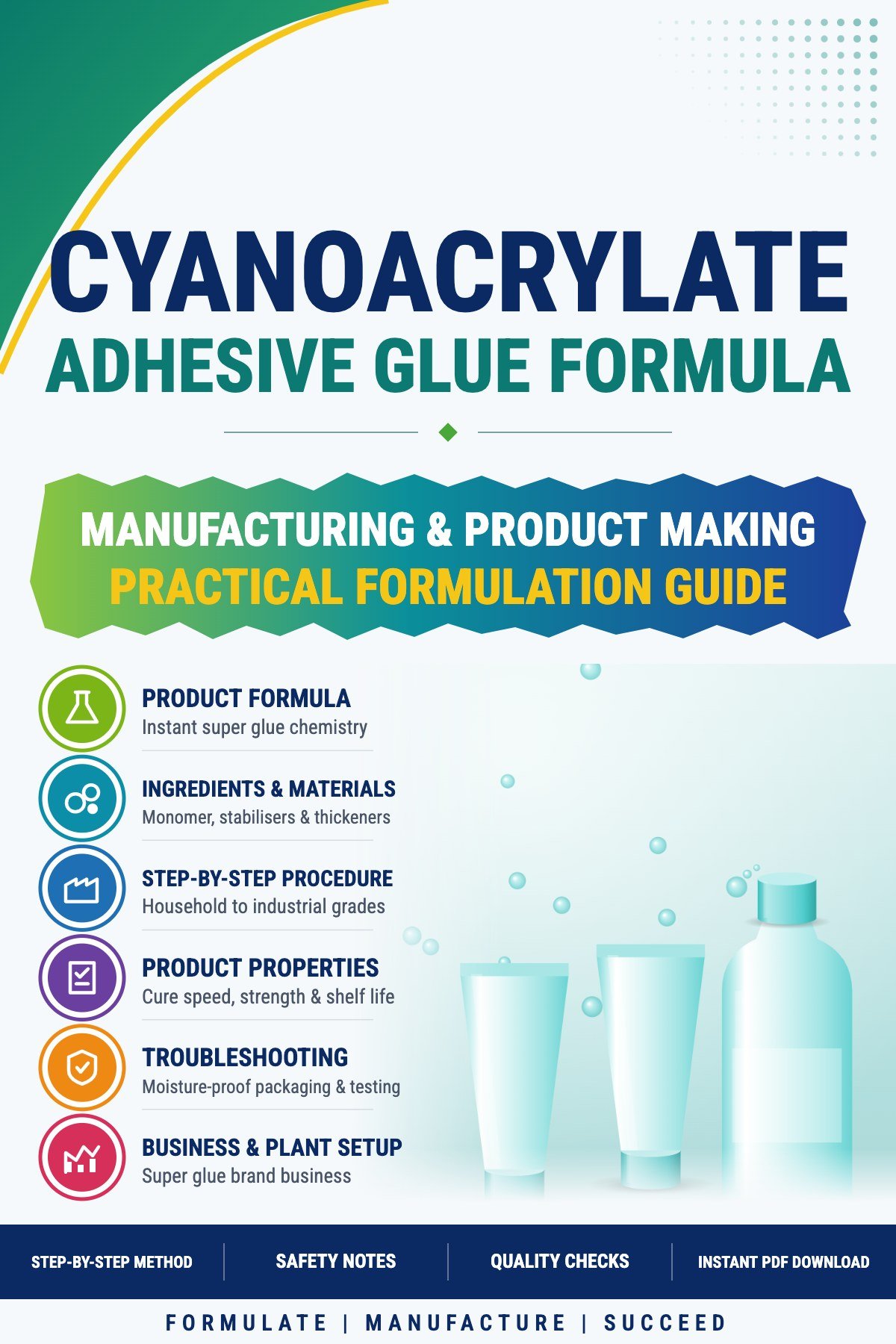

Cyanoacrylate Adhesive Glue Formula
USD $75
PDF manual · Instant downloadCyanoacrylate Adhesive Glue Formula: a PDF guide to making super glue from cyanoacrylate monomer, with stabilisers, thickeners, grades, blending, packaging, testing and safety.
Payment Methods
Refund Policy
Custom Formulation Services
Formulation Consultation
Contact Us
Cyanoacrylate Adhesive Glue Formula is a practical PDF guide for adhesive manufacturers, stationery and hardware brands, industrial suppliers and entrepreneurs who want to build a super glue brand. Cyanoacrylate adhesives, known as instant or super glues, bond in seconds, join an extraordinary range of materials and come in tiny tubes that fit in a household drawer or in industrial dispensers on assembly lines. This page explains how a cyanoacrylate adhesive glue formula works, what the guide covers and how a cyanoacrylate adhesive glue formulation is designed, blended, packaged and tested, from household grades to industrial products, so you can decide whether it suits your business. Because cyanoacrylate chemistry is delicate and the product bonds skin instantly, safety and packaging quality are emphasised.
This guide is published by Chemical Formulation Services, the formulation publishing and consultancy business of CFS Formulation Services Ltd in Sheffield, United Kingdom. It is written for people who want to understand the product from the raw material to the finished pack, and it keeps its claims practical rather than promotional.
At a glance
- Product: Cyanoacrylate Adhesive Glue Formula, a digital PDF Product Making Guide.
- Also searched as: cyanoacrylate adhesive glue formulation, super glue formula, instant adhesive, ethyl cyanoacrylate, CA glue.
- What it covers: monomer types, stabilisers, thickeners, modifiers, blending, packaging, testing and safety.
- Key goals: fast cure, strong bonds, stable shelf life, controlled viscosity and safe use.
- Who it is for: adhesive manufacturers, household and industrial brands, suppliers and entrepreneurs.
- Delivery: instant PDF download after payment is confirmed.
- Publisher: CFS Formulation Services Ltd, England and Wales company number 16678503.
How cyanoacrylate glue works
Cyanoacrylates are a family of fast-curing acrylic resins. The adhesive is a liquid monomer, such as ethyl cyanoacrylate, held in a stable state in the bottle by acidic stabilisers. When a thin film of the liquid is squeezed between two surfaces, trace amounts of surface moisture and the slightly basic character of the surfaces trigger anionic polymerisation. The molecules join into long chains within seconds, turning liquid into a hard plastic that locks the parts together. The reaction is quick, needs no mixing, no heat and no clamps beyond holding the parts for a short time, and it works best with extremely thin glue lines. Because the chemistry needs surface moisture and runs by itself, the most important properties of a super glue are its stability in the bottle, its speed on the part and the quality of its packaging.
Types of cyanoacrylate monomer
Ethyl cyanoacrylate
The standard monomer in household and general industrial super glues. It cures very quickly, gives strong bonds to metals, many plastics, rubbers and ceramics and is cost effective. Its bonds are rigid and somewhat brittle.
Methyl cyanoacrylate
Cures even faster and is used in some industrial grades, but has stronger vapours and shorter shelf life.
Butyl, octyl and other longer-chain cyanoacrylates
These cure more slowly and form more flexible, less irritating films. They are used in medical tissue adhesives and some cosmetic and specialty products, where there are strict purity and biocompatibility requirements. Medical-grade tissue adhesives are separately regulated medical devices.
Alkoxyalkyl cyanoacrylates
Such as ethoxyethyl cyanoacrylate, giving low-odour, low-bloom products that reduce the white haze that ordinary cyanoacrylate leaves around bonds.
Main components of a super glue formulation
Cyanoacrylate monomer
The base, making up the large majority of the formula. It must be of high purity, since impurities can start polymerisation early and shorten shelf life.
Acidic stabilisers (anionic inhibitors)
Very small amounts of acidic compounds, such as sulphur dioxide, sulphonic acids, phosphoric acid or boron trifluoride complexes, neutralise stray bases and stop the glue from curing in the bottle. The right amount is a balance: too little and the glue gels in storage, too much and it fails to cure on the part.
Free-radical stabilisers
Hydroquinone and similar inhibitors protect against radical polymerisation caused by heat and light.
Thickeners
Plain cyanoacrylate is very thin and runs like water. Thickeners such as polymethyl methacrylate (PMMA), fumed silica, cellulose derivatives or other soluble polymers produce gel or medium-viscosity grades, which are less likely to drip, more suited to porous surfaces and easier to apply on vertical surfaces.
Plasticisers and toughening agents
Phthalate alternatives, esters or rubber toughening agents reduce brittleness and improve peel and impact resistance.
Accelerators and primers
Spray or liquid activators contain amines or similar bases, and are used on difficult or oily surfaces, or to cure glue in large gaps. They are usually sold separately.
Colourants and dyes
Small amounts of dye are used in some products, but must be compatible with the stabilisers.
Special additives
Heat-resistance additives, rubber-toughened grades and low-bloom additives help serve particular uses.
Grades and viscosities
- Thin or water-thin grades: low viscosity, flowing into tight-fitting joints, curing in a few seconds. Suited to non-porous parts with very good fit.
- Medium-viscosity grades: versatile general-purpose glue.
- Gel grades: thick, non-running, useful for vertical surfaces, porous materials and gap-filling.
- Rubber-toughened grades: improved flexibility and peel strength.
- Surface-insensitive grades: for acidic surfaces like wood, leather or paper.
- Black and coloured grades: with fillers for gap filling and appearance.
- Low-odour, low-bloom grades: for visible joints in electronics and cosmetic parts.
What is inside the Cyanoacrylate Adhesive Glue Formula guide
The guide is a high-grade formulation crafted by experts with decades of hands-on experience in advanced adhesive technologies, for entrepreneurs producing household super glue or industrial adhesives. It explains chemistry, grades, practical formulations, step-by-step blending, packaging, quality control, safety, troubleshooting and business advice. It follows the CFS style of clear, industrially minded instructions.
How the adhesive is blended and packed
The outline below shows the general sequence. The guide gives full details.
Step 1: Prepare dry, clean equipment
All vessels, tools and containers must be completely dry and free of alkaline residues, because water or bases trigger polymerisation. Equipment is made of materials that do not contaminate the monomer, often polyethylene or fluoropolymer, and is cleaned with dry solvents.
Step 2: Charge the monomer
The cyanoacrylate monomer is loaded into a dry blending vessel, usually under dry air or nitrogen, in a low-humidity room.
Step 3: Add stabilisers
Acidic and free-radical inhibitors are added in precise amounts, with gentle mixing.
Step 4: Add thickeners and modifiers
Polymers or silica are dissolved or dispersed with gentle heating if required. Thickened products take time to become uniform, and the temperature is kept low to protect the monomer.
Step 5: Test
The blend is tested for viscosity, cure speed on standard substrates, bond strength and accelerated shelf life.
Step 6: Fill and seal
The adhesive is filled into specially designed low-density polyethylene tubes and bottles, or aluminium tubes with inner coatings, which are moisture-resistant and chemically compatible. Filling is done in low humidity with high accuracy, followed by sealing and fitting of nozzles and caps.
Step 7: Pack and label
Containers are packaged with moisture-proof, often foil-laminated, packaging, and labelled with safety information, batch number and expiry date.
Equipment requirements
Production needs clean, dry mixing vessels made of compatible materials, dry-air or nitrogen supply, dehumidified filling and packaging rooms, precision dosing and filling machines for small tubes and bottles, cap fitting equipment, and cold storage for finished goods. A laboratory needs a viscometer, balance, a tensile or lap-shear test jig, a stability oven for accelerated ageing and humidity control. Good quality plastic or aluminium containers are as vital as the formula.
Quality control for every batch
- Viscosity: matches the grade specification.
- Fixture time: time to hold parts on standard substrates such as steel, plastic and rubber.
- Bond strength: lap-shear on steel, aluminium and plastics, after full cure.
- Shelf life: accelerated ageing at raised temperature, measuring viscosity change.
- Appearance: clear, colourless to slightly yellow, free of particles.
- Bloom or frosting: white haze around bonded parts in a standard test.
- Moisture content of the monomer and containers.
- Packaging integrity: leak tests, nozzle function and seal checks.
- Odour and irritation: within customer expectations.
Troubleshooting
Glue thickens or gels in the bottle
Moisture or base contamination, low stabiliser or warm storage. Improve dryness, increase stabiliser and store cool.
Glue does not cure on the part
Too much acid stabiliser, acidic or very dry surface, or too thick a film. Adjust stabiliser, use an activator and apply a thin film.
Weak or brittle bonds
Poor fit, thick glue lines, contaminated surfaces or no toughener. Improve joint design and use toughened grades.
White bloom around bonds
Vapour from monomer recondenses and polymerises. Use low-bloom grades and ventilation.
Poor bonding to certain plastics
Polyethylene, polypropylene and PTFE have low surface energy. Use primers or surface treatment.
Nozzle blockage
Glue polymerises at the tip. Clean the tip, close the cap and use clog-resistant nozzles.
Short shelf life
Poor packaging or storage conditions. Use moisture-barrier containers and keep at the right temperature, sometimes refrigerated.
Safety, health and regulation
Super glue bonds skin and eyelids in seconds. If skin is stuck together, do not pull it apart. Soak in warm soapy water and gently peel or roll, and use acetone carefully only on skin if advised. For eye contact, rinse with water and seek medical help. Vapours irritate eyes, nose and throat, especially in heated or poorly ventilated spaces, so use ventilation. Cyanoacrylate cures exothermically on cotton, wool or tissue, and can cause burns and smoke, so never wipe spills with cotton cloths or tissues. Packaging should carry clear warnings, child-resistant design where required and instructions to keep out of reach of children. Products require safety data sheets and compliance with chemical regulations. Medical or cosmetic uses, such as skin adhesives and nail products, are separately regulated, and manufacturers should not make medical claims without approvals.
The business opportunity
Super glue is one of the most recognisable adhesives in the world, found in homes, offices, workshops and factories. Markets include household and stationery, hardware, craft, model making, shoe and leather repair, electronics assembly, automotive and industrial manufacturing. Small tubes, blister cards and display packs sell through supermarkets, stationery shops, hardware stores and online. Industrial buyers purchase bottles and bulk containers with dispensing equipment. A manufacturer can build a brand with different viscosities, colours and special-purpose grades, and by offering primers and accelerators. Product reliability and packaging quality are the keys to reputation.
Related CFS guides help you broaden an adhesive range. Browse the Industrial Adhesive Formulations category, and see , , Metal Bond Adhesive Formula, Typical Epoxy Adhesive Formulation, and Adhesive Remover Formula.
Getting started
Super glue is not the easiest adhesive to produce, so many new brands start by buying high-quality monomer or compounded base from a reputable supplier and focusing on blending, thickening, packaging and branding. Set up a dry, dehumidified filling area, use proper containers, and make small trial batches. Test fixture times, strengths and shelf life carefully, run accelerated ageing, and compare with market leaders. Pilot with hardware stores and workshops, gather feedback, improve your packaging and instructions, and scale up gradually.
How to get the best results from this guide
Treat the guide as a tested starting point rather than a finished factory. Begin with a small trial batch in the laboratory or on a bench, using the exact raw materials you plan to buy, and record every weight, temperature, mixing time and observation. Compare the result with the quality checks in the guide, change only one thing at a time, and keep a note of what each change did. Once a small batch is consistently good, repeat it several times, then scale up in stages, because mixing, heating and cooling behave differently in larger vessels. Keep retained samples of every batch, write simple standard operating procedures for your team, and build relationships with two suppliers for each key raw material. Finally, check the labelling, safety and product rules in the country where you will sell, and ask a qualified person to review your process. This careful, documented approach is what turns a good formulation into a reliable product and a trusted brand.
Who should buy this guide?
The guide is written for practical readers. It suits manufacturers who want to add a new product to an existing plant, startups choosing their first product, private-label brands that need to understand what they are buying, technical staff who must set specifications and train operators, and consultants and students who want a structured, plain-language reference. It is less suitable for anyone looking for a quick shortcut or a guarantee, because every formulation still needs testing with your own materials, equipment and local rules. If you are unsure whether it matches your project, send a short question through the contact page before you order, and we will tell you honestly whether it fits.
What is inside the Cyanoacrylate Adhesive Glue Formula guide
Every Product Making Guide in our shop follows the same structure so you know where to look. This guide includes the product formula, the ingredients and materials, the procedure and preparations, the industrial requirements and the technical specifications. In practice you receive:
- The formulation, written so you can follow it at the bench and scale it up.
- Ingredients and materials, with the job of each material and advice on grades and suppliers.
- The manufacturing procedure, including order of addition, mixing and preparations.
- Industrial requirements, covering equipment, space and packaging.
- Technical specifications, describing what a good finished product should look like and how it should behave.
- Troubleshooting for the faults that makers meet most often.
- Business guidance, to help you take the product from the bench to the market.
These Product Making Guides of chemical formulations and formulas are for manufacturers, startups and entrepreneurs. Every guide contains industrially tested, practical formulations. Anyone who buys a guide can make the product by following its step-by-step instructions. Raw materials vary between suppliers, so always confirm your results with a small trial batch before scaling up.
Who stands behind this guide?
Chemical Formulation Services is the trading name of CFS Formulation Services Ltd, registered in England and Wales under company number 16678503, with its office at Unit F, Winston Business Park, Churchill Way, Sheffield S35 2PS. The business was founded by George Enrick and publishes formulation manuals, technical guides and industry reports. You can check our details on the Companies House register, read about us, or contact us with any question before you order.
A written formulation cannot replace testing with your own raw materials, equipment and climate, and we say so plainly. What the guide does give you is a tested, structured starting point that can save you months of trial and error. Our terms and conditions explain what a purchase from us covers.
How to order
- Select Add to cart to keep browsing, or Buy Now to go straight to checkout.
- Pay with PayPal, Stripe, Xoom by PayPal, Payoneer, payment links for debit and credit cards, or Western Union, Ria and all money exchanges.
- If you pay through a money exchange, email your payment slip to Info@chemicalformulationservices.com. After confirmation, your instant download link is emailed to you.
- For online payments, the PDF is available as soon as the payment is confirmed.
All products are digital downloads and all payments are nonrefundable once the file is delivered, so please read the refund policy and the FAQs before you order. You can compare this guide with others in the formula shop or browse our industrial project reports.
Frequently asked questions about cyanoacrylate adhesive glue formula
What is the Cyanoacrylate Adhesive Glue Formula guide?
It is a digital PDF Product Making Guide to making super glue from cyanoacrylate monomer, stabilisers and thickeners, with grades, blending, packaging, testing and safety.
Why does super glue cure so quickly?
Trace moisture on surfaces triggers anionic polymerisation, linking monomer molecules into a hard plastic in seconds.
Why does glue sometimes thicken in the tube?
Moisture or base contamination, low stabiliser or warm storage start polymerisation early. Dry equipment, correct stabilisers and moisture-proof packaging prevent it.
What causes white bloom around a bond?
Monomer vapour recondenses on the surface and polymerises. Low-bloom grades and ventilation reduce it.
What should I do if it bonds skin?
Do not pull the skin apart. Soak in warm soapy water and gently peel or roll, and seek medical advice for eyes.
How do I receive the guide?
You receive an instant PDF download after payment is confirmed. For money exchanges, email your payment slip to Info@chemicalformulationservices.com and the link is emailed after we confirm it.
Is the payment refundable?
All payments are nonrefundable because the product is an instant digital download. See the refund policy for details.
Can you help with a custom formulation?
CFS Formulation Services Ltd offers formulation and product development consultancy. Send a short brief through the Contact page.
Last reviewed: November 2026. This page is general information about a digital product. It is not a safety data sheet or professional advice, and any formulation should be tested and reviewed by a qualified person before commercial use.