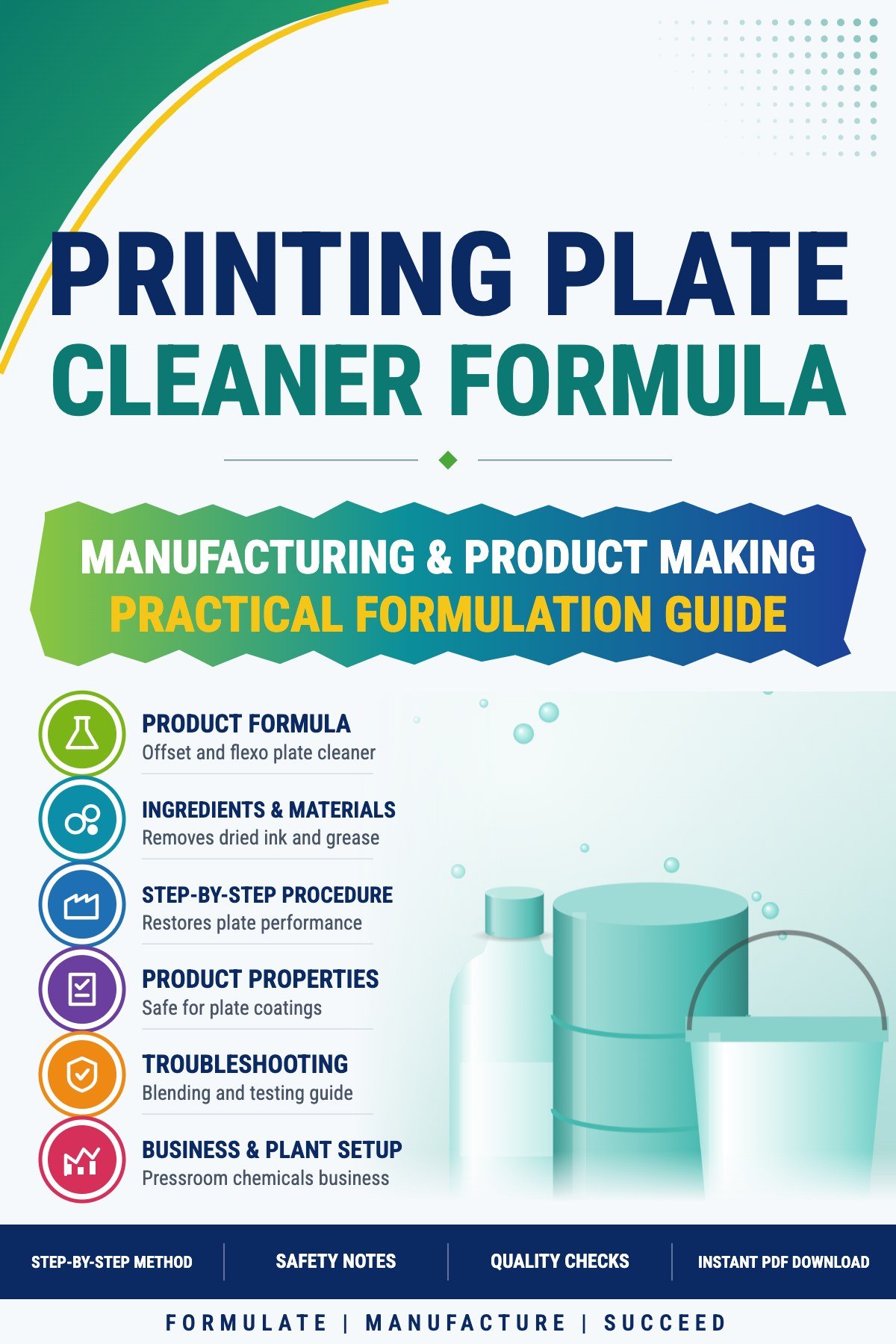

Printing Plate Cleaner Formula
USD $75
PDF manual · Instant downloadPrinting Plate Cleaner Formula: a PDF guide to cleaners for offset and flexographic printing plates, with ingredients, blending, compatibility testing and safety.
Payment Methods
Refund Policy
Custom Formulation Services
Formulation Consultation
Contact Us
Printing Plate Cleaner Formula from CFS (Chemical Formulation Services) is a practical PDF guide for pressroom chemical manufacturers, printing supply companies, startups and entrepreneurs who want to make a highly effective solution to restore and maintain the cleanliness and performance of printing plates used in offset and flexographic printing. A premium plate cleaner removes dried ink, grease, fingerprints and other contaminants that impair print quality and plate life. This page explains how a printing plate cleaner formulation works, what goes into a printing plate cleaner formula, how it is blended and tested, and how to turn it into a printing-supplies business.
This guide is published by Chemical Formulation Services, the formulation publishing and consultancy business of CFS Formulation Services Ltd in Sheffield, United Kingdom. It is written for people who want to understand the product from the raw material to the finished pack, and it keeps its claims practical rather than promotional.
At a glance
- Product: Printing Plate Cleaner Formula, a digital PDF Product Making Guide.
- Also searched as: printing plate cleaner formulation, offset plate cleaner, flexo plate cleaner, plate wash, plate cleaning solution.
- Used on: offset plates (PS and CTP) and flexographic photopolymer and rubber plates.
- Key goals: remove ink, grease and fingerprints without attacking the image or non-image area.
- Who it is for: printing chemical makers, pressroom suppliers, plate makers and entrepreneurs.
- Delivery: instant PDF download after payment is confirmed.
- Publisher: CFS Formulation Services Ltd, England and Wales company number 16678503.
Why plate cleaning matters
Printing plates are the heart of the printing process, and their surface condition directly affects print quality. A plate that is contaminated with dried ink, grease, fingerprints, dust or oxidation transfers an uneven or dirty image to the substrate. In offset printing, contamination of non-image areas causes scumming, toning and dot gain. In flexographic printing, dried ink in the plate relief fills fine detail, causes dirty print, filling-in of reverse text and loss of highlight dots. Cleaning is therefore a daily routine in every pressroom, during make-ready, during runs and at job end. A good plate cleaner works fast, rinses cleanly, is gentle on the plate and operators and does not leave residue that interferes with ink transfer.
Different plates, different cleaners
Offset plates
Offset plates have a grained, anodised aluminium surface with hydrophilic non-image areas and oleophilic image areas. Cleaners must remove ink and grease from the image area without dissolving the image coating, and restore the hydrophilic nature of non-image areas. Cleaners range from mildly acidic or neutral aqueous products to solvent emulsions for dried ink, and must be compatible with plate coatings.
Flexographic photopolymer plates
Photopolymer flexo plates swell and degrade if exposed to the wrong solvents. Cleaners for plates on press are usually water-based, alcohol-water blends or low-aggression solvent blends, with careful limits. Dried ink in the relief needs extra contact time, and brushes or ultrasonic cleaning may be used.
Rubber and polymer letterpress plates
Traditional plates and mounted type may be cleaned with mild solvents or alkaline washes according to material.
Anilox rolls and related equipment
Closely related are anilox cleaners, but these have their own chemistry and are covered by separate products.
Core ingredients
- Solvents: glycol ethers, isopropanol, ethanol, benzyl alcohol, esters or low-aromatic hydrocarbon blends, selected for ink-dissolving power, evaporation rate, plate compatibility and regulation.
- Surfactants: non-ionic and anionic surfactants for wetting, emulsifying and lifting ink; chosen to rinse cleanly.
- Alkalinity or acidity: mild builders or acids to break down ink binders or restore surfaces, within plate limits.
- Chelating agents: bind hardness and metal ions.
- Corrosion inhibitors: protect aluminium plates and press parts.
- Hydrotropes and coupling agents: to keep multiphase blends clear.
- Preservative: for water-based products.
- Water: deionised carrier.
Daily, weekly and deep cleaning routines
A good plate-cleaning programme uses different products and methods at different frequencies. During a run, a quick wipe with a mild cleaner removes ink buildup and paper dust without stopping the press for long. At job change, the plate is cleaned more thoroughly, and flexo plates are washed to remove ink from relief and between dots. Weekly, plates in storage are checked and cleaned, and mounting tapes and sleeves are inspected. Occasional deep cleaning, with longer dwell time or ultrasonic baths, restores plates that have collected dried ink. A schedule posted in the pressroom, together with the right cleaner for each task, reduces mistakes and extends plate life. Provide customers with a simple routine chart as part of your technical support and tell them how much product to use, so they neither under-clean nor waste chemical.
Plate care between runs: gumming, storage and handling
After cleaning, plates should be protected. Offset plates are gummed with plate gum to protect from oxidation, and flexo plates are dried, dusted lightly with talc if they are tacky, and stored flat or on sleeves away from light and ozone. Photopolymer flexo plates are sensitive to UV and ozone; they should be stored in dark conditions in a cool, dry place. Handle plates by the edges with clean gloves to avoid fingerprints. Keep cleaning rags clean and lint-free, and replace them often. Cleaning products work best when combined with good handling habits, and your technical advice should cover both.
Cleaning aids: brushes, cloths and equipment
The best cleaner can be undone by the wrong tool. Use soft nylon or natural bristle brushes that clean ink from relief without scratching. Microfibre or lint-free cloths pick up dissolved ink and avoid leaving fibres on plates. Spray bottles and pump dispensers give controlled application and reduce solvent use. Automated plate washers with brushes and recirculating solvent are used in flexo trade shops and large plants, and require compatible, low-foam, filterable cleaners. Offer tools and accessories alongside the chemical, since a kit with brush, cloth and bottle is easy to sell and use.
Environmental and health programmes
Printers are under pressure to reduce VOC emissions, hazardous waste and worker exposure. Plate cleaners are part of the picture. Low-VOC water-based cleaners, closed systems for solvent recovery, solvent-laden rag management through laundry services and regular air monitoring all help meet targets. Offering cleaners that carry environmental certification, or that comply with eco-labelling criteria for printing chemicals, opens doors to customers with sustainability policies and green procurement rules. Train staff in safe handling and emergency response, and provide safety data sheets in local languages.
Packaging, storage and shelf life
Water-based plate cleaners should be packed in plastic containers and protected from frost. Solvent-based cleaners should be packed in solvent-resistant plastic or metal containers with secure closures and stored in a ventilated, fire-safe area. Label with product name, plate types, directions for use, hazard pictograms and batch codes. Shelf life is generally one to two years. Retained samples allow comparison with returned goods and quick investigation of complaints.
What is inside the Printing Plate Cleaner Formula guide
The guide describes a highly effective solution designed to restore and maintain the cleanliness and performance of printing plates in offset and flexographic printing, a premium-grade cleaner formulated to remove dried ink, grease, fingerprints and other contaminants that can impair print quality. It gives recipes for offset and flexo grades, blending steps, plate compatibility tests, safety information and marketing guidance.
How the cleaner is made
Preparing the plant
Use clean tanks with stirrers, earthed if solvents are used, with ventilation and safe storage. Separate equipment for water-based and solvent-based products to avoid cross-contamination.
Water-based cleaner
Charge deionised water, dissolve chelating agent and builder, add surfactants and hydrotrope, then solvent and corrosion inhibitor. Adjust pH, add preservative and fragrance if wanted. Filter and pack.
Solvent-based cleaner
Blend solvents in an earthed vessel with gentle stirring, add surfactant and inhibitor, mix until clear, filter and pack in solvent-resistant containers.
Emulsion cleaner
Prepare a solvent phase with emulsifier and an aqueous phase with surfactant. Combine under high shear to make a stable emulsion that cleans both water-soluble and oily soils.
How to use the cleaner
For offset plates on press, apply cleaner with a lint-free cloth, work gently along the image, wipe off residue with a clean damp cloth, and re-gum or re-damp as required. For flexo plates, apply by brush or spray, allow dwell time, and brush or wipe in the direction of the relief, then rinse with water or wipe with a clean cloth, and allow plates to dry fully before reuse. Avoid prolonged soaking, scraping with hard tools and use of unsuitable solvents. Always wear gloves and eye protection.
Testing and quality control
- Cleaning efficiency: remove standard dried ink films from plate samples, measuring time and effort.
- Plate compatibility: expose plate samples to the cleaner for repeated or extended periods and check for swelling, hardness change, coating attack, dot loss or aluminium corrosion.
- Rinsability and residue.
- Evaporation rate and flash point.
- pH and clarity.
- Odour and operator comfort.
- Storage stability.
- Press trials: print quality after cleaning, including ink acceptance and dot sharpness.
Troubleshooting
Ink residue remains in fine detail
Dwell time too short or cleaner too weak. Increase contact time, add stronger solvent or use soft brushing.
Plate swelling or softening (flexo)
Solvent too aggressive. Use milder solvents and reduce contact time.
Image loss or coating attack (offset)
Alkalinity or solvent too high. Reduce alkali or choose compatible solvents.
Scum after cleaning
Residual cleaner or oxidation. Rinse well, apply gum or fountain solution.
Streaks or hazy plate
Residue from surfactant or hard water. Use deionised water and rinse thoroughly.
Aluminium discolouration
Aggressive pH or chlorides. Use inhibitors and maintain pH range.
Safety, environment and regulation
Solvent-based cleaners are flammable and give off vapours that irritate and affect the nervous system, so provide ventilation, use closed containers and minimise exposure. Wear gloves and eye protection. Choose low-VOC, low-aromatic, low-hazard solvents wherever possible, and follow rules on VOC content and hazardous air pollutants. Water-based products are preferred for safety and environment, though alkaline cleaners can burn skin. Used rags soaked in solvent are a fire risk and should be stored in closed metal containers and disposed of correctly. Collect waste wash liquids for authorised disposal. Provide safety data sheets and labels.
Business opportunity
Commercial printers, newspapers, packaging converters, label printers and flexo plate makers all consume plate cleaning products. A producer can offer a range, including offset plate cleaners, flexo plate washes, anilox cleaners, blanket washes and roller washes, in 1, 5, 20 and 200 litre packs. Selling through printing supply distributors, offering pressroom audits and training operators on proper cleaning builds loyalty. Eco-friendly, low-VOC and low-odour products are in demand. Private-label manufacturing for plate suppliers and distributors is a further route.
Related CFS guides help you build a printing-chemicals range. Browse the Ink Formulations category, and see Offset Plate Protective Gum Formula, Offset Plate Processing & Fountain Solution Technology Formulation, Press Room Cleaning & Maintenance Chemicals Formulations, Offset Printing Fountain Solution, and .
Getting started
Start with a water-based offset plate cleaner and a mild flexo plate wash. Make small batches, test cleaning on inked plate samples and check compatibility with common plates. Compare to a leading brand, refine, prepare safety sheets and offer samples to printers. Use their feedback to extend the range.
How to get the best results from this guide
Treat the guide as a tested starting point rather than a finished factory. Begin with a small trial batch in the laboratory or on a bench, using the exact raw materials you plan to buy, and record every weight, temperature, mixing time and observation. Compare the result with the quality checks in the guide, change only one thing at a time, and keep a note of what each change did. Once a small batch is consistently good, repeat it several times, then scale up in stages, because mixing, heating and cooling behave differently in larger vessels. Keep retained samples of every batch, write simple standard operating procedures for your team, and build relationships with two suppliers for each key raw material. Finally, check the labelling, safety and product rules in the country where you will sell, and ask a qualified person to review your process. This careful, documented approach is what turns a good formulation into a reliable product and a trusted brand.
Who should buy this guide?
The guide is written for practical readers. It suits manufacturers who want to add a new product to an existing plant, startups choosing their first product, private-label brands that need to understand what they are buying, technical staff who must set specifications and train operators, and consultants and students who want a structured, plain-language reference. It is less suitable for anyone looking for a quick shortcut or a guarantee, because every formulation still needs testing with your own materials, equipment and local rules. If you are unsure whether it matches your project, send a short question through the contact page before you order, and we will tell you honestly whether it fits.
What is inside the Printing Plate Cleaner Formula guide
Every Product Making Guide in our shop follows the same structure so you know where to look. This guide includes the product formula, the ingredients and materials, the procedure and preparations, the industrial requirements and the technical specifications. In practice you receive:
- The formulation, written so you can follow it at the bench and scale it up.
- Ingredients and materials, with the job of each material and advice on grades and suppliers.
- The manufacturing procedure, including order of addition, mixing and preparations.
- Industrial requirements, covering equipment, space and packaging.
- Technical specifications, describing what a good finished product should look like and how it should behave.
- Troubleshooting for the faults that makers meet most often.
- Business guidance, to help you take the product from the bench to the market.
These Product Making Guides of chemical formulations and formulas are for manufacturers, startups and entrepreneurs. Every guide contains industrially tested, practical formulations. Anyone who buys a guide can make the product by following its step-by-step instructions. Raw materials vary between suppliers, so always confirm your results with a small trial batch before scaling up.
Who stands behind this guide?
Chemical Formulation Services is the trading name of CFS Formulation Services Ltd, registered in England and Wales under company number 16678503, with its office at Unit F, Winston Business Park, Churchill Way, Sheffield S35 2PS. The business was founded by George Enrick and publishes formulation manuals, technical guides and industry reports. You can check our details on the Companies House register, read about us, or contact us with any question before you order.
A written formulation cannot replace testing with your own raw materials, equipment and climate, and we say so plainly. What the guide does give you is a tested, structured starting point that can save you months of trial and error. Our terms and conditions explain what a purchase from us covers.
How to order
- Select Add to cart to keep browsing, or Buy Now to go straight to checkout.
- Pay with PayPal, Stripe, Xoom by PayPal, Payoneer, payment links for debit and credit cards, or Western Union, Ria and all money exchanges.
- If you pay through a money exchange, email your payment slip to Info@chemicalformulationservices.com. After confirmation, your instant download link is emailed to you.
- For online payments, the PDF is available as soon as the payment is confirmed.
All products are digital downloads and all payments are nonrefundable once the file is delivered, so please read the refund policy and the FAQs before you order. You can compare this guide with others in the formula shop or browse our industrial project reports.
Frequently asked questions about printing plate cleaner formula
What is the Printing Plate Cleaner Formula guide?
It is a digital PDF Product Making Guide to cleaners for offset and flexographic printing plates, covering ingredients, blending, plate compatibility, testing and safety.
Why do flexo plates need mild cleaners?
Photopolymer plates swell or degrade with aggressive solvents, which damages fine detail.
Can one cleaner suit all plates?
No. Offset, flexo and letterpress plates differ, so compatibility must be tested.
Are solvent cleaners dangerous?
They are flammable and harmful by inhalation, so ventilation and safe storage are essential.
What is a lower-hazard option?
Water-based and low-VOC blends with suitable surfactants and glycol ethers.
How do I receive the guide?
You receive an instant PDF download after payment is confirmed. For money exchanges, email your payment slip to Info@chemicalformulationservices.com and the link is emailed after we confirm it.
Is the payment refundable?
All payments are nonrefundable because the product is an instant digital download. See the refund policy for details.
Can you help with a custom formulation?
CFS Formulation Services Ltd offers formulation and product development consultancy. Send a short brief through the Contact page.
Last reviewed: November 2026. This page is general information about a digital product. It is not a safety data sheet or professional advice, and any formulation should be tested and reviewed by a qualified person before commercial use.