Epoxy Resin Formulation
USD $100
PDF manual · Instant downloadPayment Methods
Refund Policy
Custom Formulation Services
Formulation Consultation
Contact Us
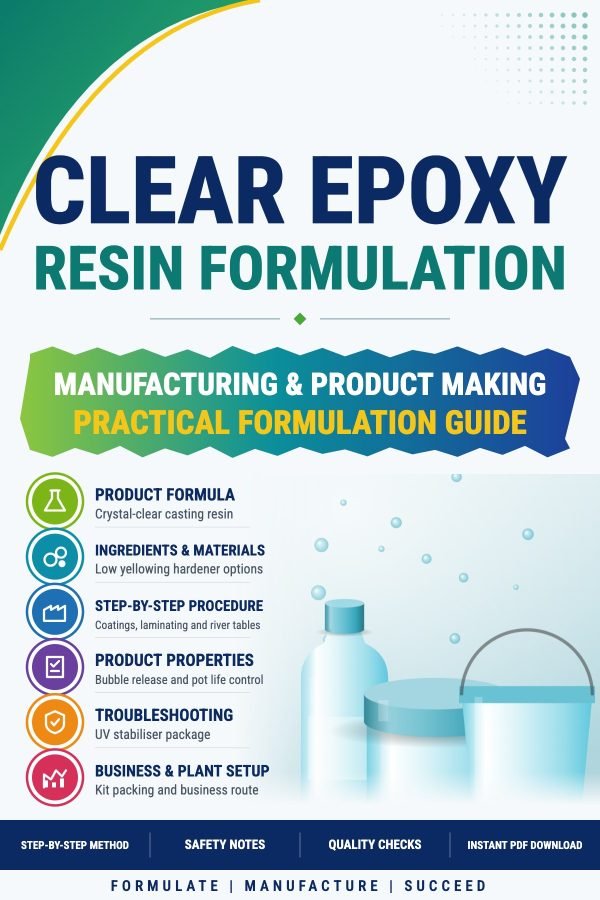
Epoxy resin is a versatile thermosetting polymer known for its excellent adhesion, chemical resistance, and mechanical properties. It is widely used in various applications, including coatings, adhesives, composites, and electronics. The formulation of epoxy resin involves combining epoxy monomers with curing agents and additives.
epoxy resin formulation
- Epoxy Monomers: Epoxy resins derives from epoxy monomers, which are typically bisphenol A (BPA) or bisphenol F (BPF) epoxies. These monomers contain reactive epoxy groups (epoxide) that can cross-link and form a three-dimensional network during the curing process.
- Curing Agents: Epoxy resin requires a curing agent or hardener to initiate the cross-linking reaction. Common curing agents include aliphatic amines, aromatic amines, anhydrides, or polyamides. The choice of curing agent depends on factors such as desired cure speed, temperature resistance, and chemical resistance.
- Additives: Various additives can be incorporated into the epoxy resin chemical formula to modify specific properties or improve processing characteristics. Some common additives include:
- Fillers: Fillers like silica, glass fibers, or mineral fillers can be added to enhance mechanical properties, such as strength, stiffness, and impact resistance.
- Plasticizers: Plasticizers improve the flexibility and toughness of cured epoxy resin, particularly in applications where flexibility is desired.
- Flame Retardants: Flame retardant additives can be incorporated to improve the fire resistance properties of epoxy resin.
- UV Stabilizers: UV stabilizers protect epoxy resin from degradation caused by ultraviolet (UV) light exposure.
- Colorants and Pigments: you can add Colorants and pigments to provide desired colors or to achieve specific aesthetic effects.
Formulation Optimization
- The proportions of epoxy monomers, curing agents, and additives are optimized to achieve the desired performance characteristics of the epoxy resin. These proportions are determined based on factors such as the application requirements, desired cure properties, and end-use conditions.
- Mixing and Dispersion: The epoxy resin formulation is typically mixed using mechanical stirring or mixing equipment to ensure thorough dispersion of the components. Proper mixing is crucial to achieve a uniform and homogenous mixture, avoiding any clumps or air bubbles.
- Curing Process: Once the epoxy resin formulation is mixed, it is applied or molded into the desired shape. The curing process is initiated by the curing agent, which triggers the cross-linking reaction between epoxy monomers. The curing process may involve heat, moisture, or a combination of both, depending on the specific curing agent used.
It’s important to note that the formulation of epoxy resin can vary significantly depending on the specific application and performance requirements. Manufacturers may employ proprietary formulations or customize the resin formulation to meet specific customer needs.
If you require a complete formulation with its processing techniques follow the checkout of this product and start your own Epoxy resin production.