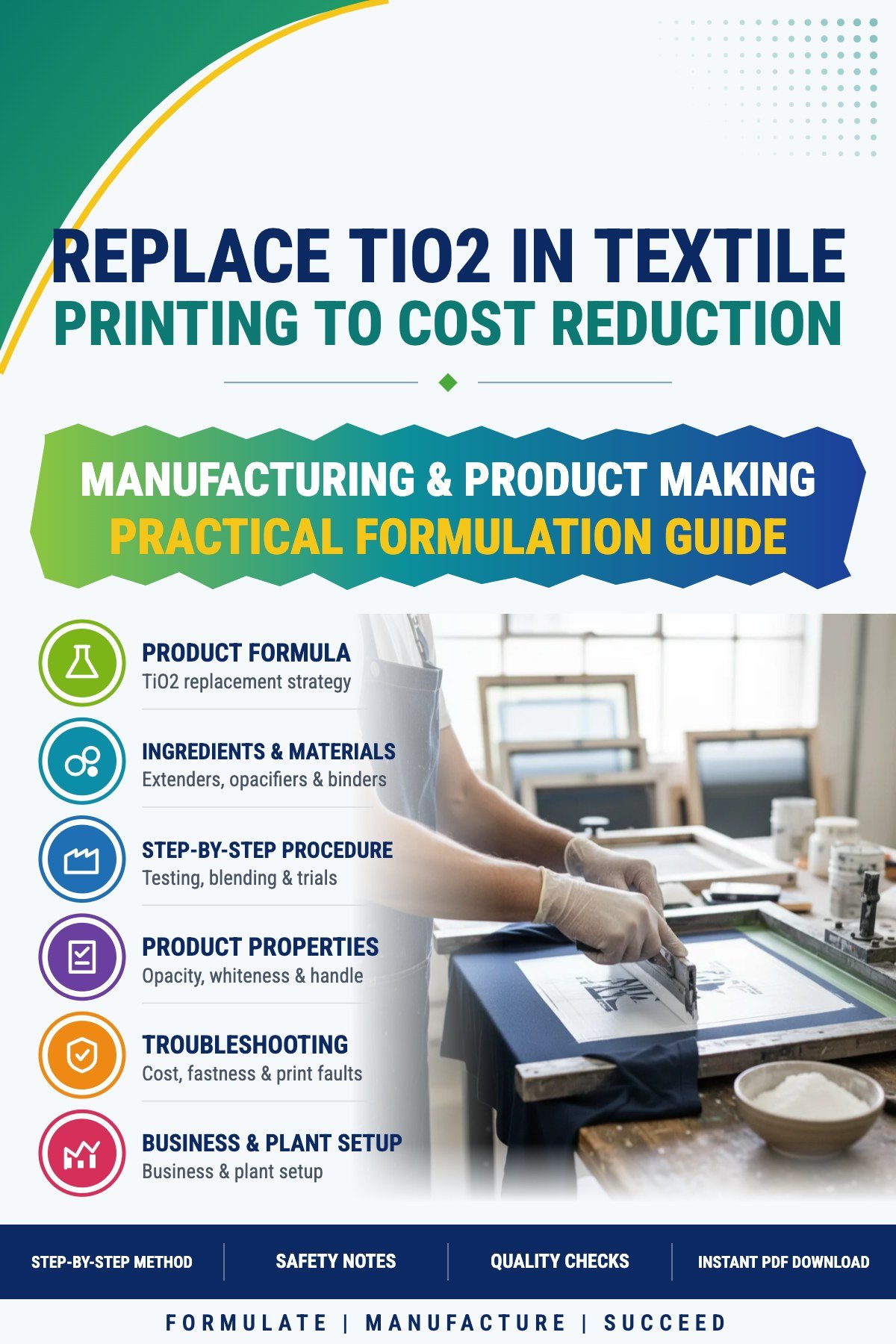

Replace TiO₂ in Textile Printing To Cost Reduction
USD $70
PDF manual · Instant downloadReplace TiO₂ in Textile Printing To Cost Reduction: a PDF guide to cutting titanium dioxide cost in textile print pastes while keeping opacity and fastness.
Payment Methods
Refund Policy
Custom Formulation Services
Formulation Consultation
Contact Us
Replace TiO₂ in Textile Printing To Cost Reduction is a practical PDF guide for textile ink and paste manufacturers, print houses and formulators who want to lower the cost of white and light-coloured prints by reducing, partly replacing or optimising titanium dioxide. Titanium dioxide, usually written TiO₂, is the standard white pigment in textile printing because of its brilliant whiteness, strong opacity and stability. It is also one of the costliest raw materials in a print paste, and its price swings have hurt margins across the industry. This page explains the thinking behind a sound TiO₂ replacement formula, what the guide covers, and how to decide whether it fits your operation. If you are looking for a way to replace TiO₂ in textile printing to cost reduction without losing quality, the sections below show where savings can be found and where they cannot.
This guide is published by Chemical Formulation Services, the formulation publishing and consultancy business of CFS Formulation Services Ltd in Sheffield, United Kingdom. It is written for people who want to understand the product from the raw material to the finished pack, and it keeps its claims practical rather than promotional.
At a glance
- Product: Replace TiO₂ in Textile Printing To Cost Reduction, a digital PDF Product Making Guide.
- Also searched as: TiO2 replacement in textile printing, reduce titanium dioxide in print paste, low-cost white pigment textile ink, TiO2 extender formulation.
- What it covers: strategies and formulation approaches for cutting titanium dioxide cost in textile printing pastes and inks.
- Key concerns: opacity, whiteness, handle, wash fastness, cost per metre and process stability.
- Who it is for: textile printing ink makers, print shops, formulators and purchasing teams.
- Delivery: instant PDF download after payment is confirmed.
- Publisher: CFS Formulation Services Ltd, England and Wales company number 16678503.
Why titanium dioxide is so important, and so expensive
Titanium dioxide is the whitest and most opaque white pigment available at industrial scale. Its very high refractive index scatters light so effectively that a thin print film can cover a dark fabric. In textile printing, this matters most on dark garments, where the white or light colour sits on top of a dark base and has to hide it. TiO₂ also resists light, heat, weather and most chemicals, so prints stay white through washing and sun exposure.
These properties come at a cost. The pigment is made by energy-intensive processes, its price follows the global coatings, plastics and paper industries, and supply shocks can send it up sharply. For a textile print house, TiO₂ may be the biggest single cost in white and pastel pastes. Even small percentage savings add up quickly at production volumes, which is why so many manufacturers ask whether the pigment can be cut back or partly replaced.
What replacing TiO₂ really means
It is important to be honest about what is possible. At present, no single material matches titanium dioxide in opacity per unit of cost. Claims that a cheap filler can fully replace it are rarely true. What can be done is to use the pigment more efficiently, so that less of it produces the same visual result, and to replace some of it with materials that contribute opacity, bulk or whiteness at lower cost. Savings therefore come from a combination of smart formulation, good dispersion and careful process control, not from a single magic additive.
The guide takes this realistic approach. It explains where the opacity in a print film comes from, how titanium dioxide behaves in textile binders, and how extenders, opacifying polymers and process improvements can reduce the amount needed. It also explains where the limits are, so you can set targets that you can actually reach.
Where the savings can come from
Better pigment dispersion
Titanium dioxide scatters light best when its particles are well separated. If the particles clump together, they lose efficiency, and more pigment is needed to reach the same coverage. Improving dispersion, through better wetting and dispersing agents, higher-shear mixing or milling and good pigment grade selection, can restore opacity and allow the pigment level to be lowered. This is often the cheapest and safest first step.
Choosing the right TiO₂ grade
Not all titanium dioxide is the same. Grades differ in particle size distribution, surface treatment, whiteness and compatibility with different binders. A grade made for plastics may not perform well in a water-based textile binder. Selecting a grade designed for waterborne systems, with the right surface treatment and particle size, can give higher opacity per kilogram, so less pigment is needed.
Extenders and spacing fillers
Fine mineral extenders can help space titanium dioxide particles apart so that they scatter light more effectively, a principle known as spacing. When used carefully, this can allow a lower pigment level without a visible loss of opacity. Materials such as fine calcium carbonate, silicates and similar fillers are commonly tested. Too much extender, however, reduces whiteness, stiffens the print or hurts wash fastness, so the level must be tested.
Opacifying polymers
Hollow-sphere polymer particles and other opacifying polymers scatter light through tiny air voids, and can replace part of the titanium dioxide in some systems. They are more expensive than simple fillers, so the saving depends on prices and the target level, but they can help maintain opacity and a soft handle.
Optimising binder and film build
The binder carries the pigment and fixes it to the fabric. A binder that gives a smooth, even film helps the pigment work efficiently, while a poor binder wastes opacity. Adjusting the binder level, the viscosity and the way the paste lays down on the fabric can improve coverage without changing the pigment amount. Screen mesh, squeegee settings and the number of print passes also affect how much paste ends up on the fabric.
Reducing waste in the process
Some savings come not from the formula but from the plant. Overprinting, excess paste, long screen cleaning cycles, poor batch control and leftover paste all waste pigment. Tighter process control, a good paste-return system and clear standards for coat weight can reduce usage across the whole operation.
What to watch for when you reduce TiO₂
- Opacity on dark fabrics. The white must still hide the base colour. Test on the darkest fabrics you print.
- Whiteness and shade. Extenders and some polymers can shift the shade towards yellow or grey.
- Handle. Heavily filled prints can feel stiff or rubbery. Customers notice this quickly.
- Wash and rub fastness. More filler means less binder per unit of film, which can reduce fastness.
- Crack resistance. A film with too much filler may crack when the fabric stretches.
- Paste stability. Changing the solids and the filler system affects viscosity, storage life and printing behaviour.
- Cost per metre, not cost per kilogram. The real measure is the cost of printing a metre of fabric to the required standard.
A realistic way to set your savings target
Many teams ask how much titanium dioxide they can safely remove. There is no universal number, because the answer depends on the fabric, the binder, the print method, the colour and the customer standard. A sensible target is to begin with a modest reduction on one product line, prove that opacity, handle and fastness are unchanged, and then take another step. This stepwise method protects quality and gives you real data to share with customers and buyers. Keep a simple table of formula changes, cost per metre and test results, so every decision can be explained later. Over time, a series of small, proven improvements usually delivers more reliable savings than one large change that has to be reversed after customer complaints.
What is inside the Replace TiO₂ in Textile Printing To Cost Reduction guide
The guide is a technical formulation data sheet that explains the options for reducing titanium dioxide cost in textile printing. It covers the raw materials involved, practical processing techniques, test methods and ways to evaluate results. It also provides troubleshooting help, notes on pilot trials and guidance for building a business case.
How to run a TiO₂ reduction programme
The guide describes a stepwise approach that limits risk. The outline below shows how it works.
Step 1: Set a baseline
Record the current formula, cost, opacity, whiteness, handle and fastness results. Without a baseline, you cannot show that a change is an improvement.
Step 2: Improve dispersion first
Before changing the formula, make sure the pigment is dispersed well. Test dispersing agents and mixing conditions, and measure opacity at the existing pigment level.
Step 3: Trial extenders and spacers
Replace small portions of titanium dioxide with extenders or opacifying polymers, in controlled steps. Print on the actual fabrics and compare against the baseline.
Step 4: Check fastness, handle and stability
Run wash, rub and crock tests, assess handle, and check paste stability over time. Reject any formula that fails these tests, even if its opacity is acceptable.
Step 5: Scale up and monitor
Move successful formulas to production batches, and monitor quality and complaints. Keep records of each formula and batch so you can trace and refine results.
Equipment and plant requirements
You do not need much new equipment to start a reduction programme. A good laboratory mixer or disperser, accurate scales, a small test print table with screens, a spectrophotometer or a standard visual comparison method, and access to wash and rub testing are the essentials. For production, high-shear dispersers or bead mills help achieve fine dispersion. Better process control, such as automatic dosing and viscosity monitoring, pays back through reduced waste.
Quality control for every batch
- Opacity and coverage: compared with the baseline on dark and light fabrics.
- Whiteness and shade: measured under standard lighting.
- Fineness of grind: checked for pigment clumps.
- Viscosity and rheology: within specification for the printing method.
- Handle and flexibility: assessed on cured prints.
- Wash, rub and light fastness: tested to the standards your customers use.
- Storage stability: retained samples checked for settling, thickening and colour change.
Troubleshooting TiO₂ reduction
Print looks greyish or translucent
Opacity has dropped. Improve dispersion, restore some pigment or use a more efficient grade, and check the coat weight.
Print feels stiff or rubbery
Filler or polymer level may be too high. Adjust the binder and softener balance, and check cure conditions.
Wash fastness has fallen
There may not be enough binder in the film. Adjust the ratio of binder to pigment and filler, and check the curing temperature and time.
Cracking on stretch
Reduce filler, use a more flexible binder and confirm that the print is fully cured.
Paste thickens or settles in storage
Review the thickener and dispersant system, and test the effect of the filler on rheology.
Shade shift toward yellow
Some extenders and binders are off-white. Choose whiter grades and consider small optical brightener or toner adjustments, with testing.
Safety, regulation and responsible claims
Pigments and fillers are fine powders, so control dust with ventilation, wear suitable respiratory protection and avoid breathing airborne particles. Read the safety data sheet for each material. Customers and brands often have restricted-substance lists for textile products, so check them before changing raw materials. Be honest in claims: say how much titanium dioxide has been reduced under which test conditions, and avoid saying it has been replaced entirely unless that is true and proven. You remain responsible for meeting the safety, labelling and textile-chemical rules where you manufacture and sell, and a qualified person should review your process before commercial production.
The business case for cost reduction
Raw material cost is one of the few levers a print house can control. A few percentage points saved on titanium dioxide, multiplied by monthly production, can fund new equipment or improve competitiveness against rivals. For ink and paste makers, a lower-cost white that still performs becomes a selling point to customers under price pressure. The guide helps you estimate the savings, plan trials and decide how to present results to customers.
It also helps to see the wider textile chemistry range. Our guides include Textile Screen Printing inks, Textile Screen Printing Ink Formula, Textile Gloss Coat Screen Printing Ink Formula, Textile Discharge Screen Printing Ink Formula, Brown Plastisol Liquid Thickener Formula, Fluorescent Plastisol Ink Formula, Plastisol Foil Adhesive Formulations, Textile Dye Thickener Formula, Silicone Textile Printing Inks Formula, CMYKW DTF Printing Ink Formula, DTF Printing Inks Formulation and Professional DTF Ink Formulation Handbook. You can also explore the textile auxiliaries category for more.
Starting your own cost-reduction programme
Begin with small, well-documented trials on one product line, and involve production and quality teams from the start. Agree what quality standards cannot be compromised, and share results openly. The Replace TiO₂ in Textile Printing To Cost Reduction guide gives you a structured, honest starting point, so that your savings are real and your customers stay satisfied.
What is inside the Replace TiO₂ in Textile Printing To Cost Reduction guide
Every Product Making Guide in our shop follows the same structure so you know where to look. This guide includes the product formula, the ingredients and materials, the procedure and preparations, the industrial requirements and the technical specifications. In practice you receive:
- The formulation, written so you can follow it at the bench and scale it up.
- Ingredients and materials, with the job of each material and advice on grades and suppliers.
- The manufacturing procedure, including order of addition, mixing and preparations.
- Industrial requirements, covering equipment, space and packaging.
- Technical specifications, describing what a good finished product should look like and how it should behave.
- Troubleshooting for the faults that makers meet most often.
- Business guidance, to help you take the product from the bench to the market.
These Product Making Guides of chemical formulations and formulas are for manufacturers, startups and entrepreneurs. Every guide contains industrially tested, practical formulations. Anyone who buys a guide can make the product by following its step-by-step instructions. Raw materials vary between suppliers, so always confirm your results with a small trial batch before scaling up.
Who stands behind this guide?
Chemical Formulation Services is the trading name of CFS Formulation Services Ltd, registered in England and Wales under company number 16678503, with its office at Unit F, Winston Business Park, Churchill Way, Sheffield S35 2PS. The business was founded by George Enrick and publishes formulation manuals, technical guides and industry reports. You can check our details on the Companies House register, read about us, or contact us with any question before you order.
A written formulation cannot replace testing with your own raw materials, equipment and climate, and we say so plainly. What the guide does give you is a tested, structured starting point that can save you months of trial and error. Our terms and conditions explain what a purchase from us covers.
How to order
- Select Add to cart to keep browsing, or Buy Now to go straight to checkout.
- Pay with PayPal, Stripe, Xoom by PayPal, Payoneer, payment links for debit and credit cards, or Western Union, Ria and all money exchanges.
- If you pay through a money exchange, email your payment slip to Info@chemicalformulationservices.com. After confirmation, your instant download link is emailed to you.
- For online payments, the PDF is available as soon as the payment is confirmed.
All products are digital downloads and all payments are nonrefundable once the file is delivered, so please read the refund policy and the FAQs before you order. You can compare this guide with others in the formula shop or browse our industrial project reports.
Frequently asked questions about replace tio₂ in textile printing to cost reduction
What is the Replace TiO₂ in Textile Printing To Cost Reduction guide?
It is a digital PDF Product Making Guide that explains how to reduce or partly replace titanium dioxide in textile printing pastes and inks to lower cost while keeping opacity, whiteness and fastness.
Can titanium dioxide be completely replaced in textile printing?
Not in most cases. No low-cost material matches its opacity, so savings usually come from better dispersion, efficient grades, extenders, opacifying polymers and process control.
What are extenders and spacing fillers?
They are fine mineral materials that help separate titanium dioxide particles, so the pigment scatters light more efficiently and less of it is needed.
What are the risks of reducing TiO₂?
Lower opacity, shade shift, stiffer handle, reduced wash fastness and unstable paste. Each change should be tested before production.
How do I know if the savings are real?
Compare cost per metre of printed fabric against a recorded baseline for opacity, whiteness, handle and fastness, not just the price per kilogram of raw materials.
How do I receive the guide?
You receive an instant PDF download after payment is confirmed. For money exchanges, email your payment slip to Info@chemicalformulationservices.com and the link is emailed after we confirm it.
Is the payment refundable?
All payments are nonrefundable because the product is an instant digital download. See the refund policy for details.
Can you help with a custom formulation?
CFS Formulation Services Ltd offers formulation and product development consultancy. Send a short brief through the Contact page.
Last reviewed: November 2026. This page is general information about a digital product. It is not a safety data sheet or professional advice, and any formulation should be tested and reviewed by a qualified person before commercial use.