
OVI Color Pigments Formulation
USD $70
PDF manual · Instant downloadOVI Color Pigments Formulation: a PDF guide to formulating inks and coatings with colour-shifting optically variable pigments, with mixing, printing and testing.
Payment Methods
Refund Policy
Custom Formulation Services
Formulation Consultation
Contact Us
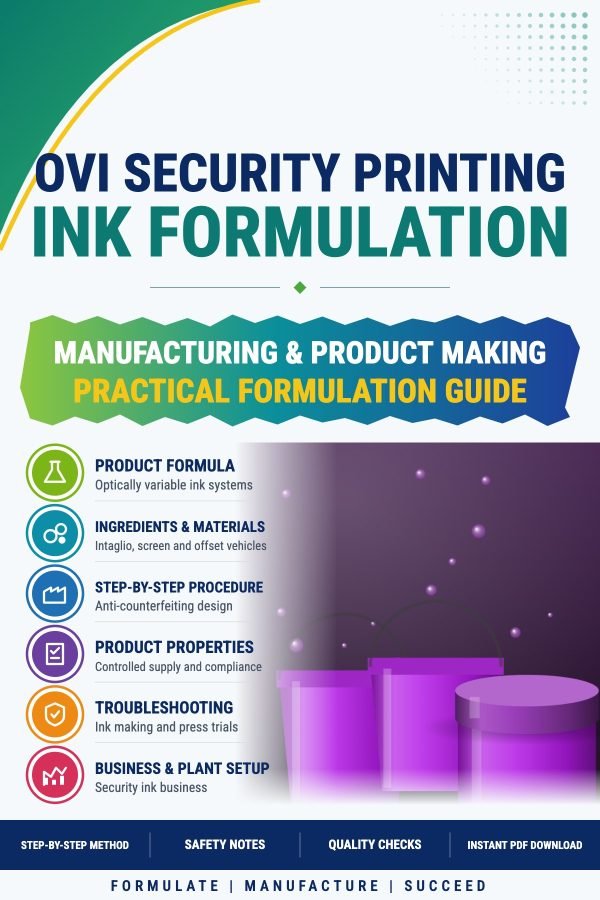
OVI Color Pigments Formulation is a technical PDF guide for security-ink makers, specialty coating producers, brand-protection printers and entrepreneurs who want to understand and formulate with optically variable ink (OVI) pigments. OVI pigments are a highly specialised class of security pigments that show a colour-shifting effect depending on the angle of observation or illumination. They are widely used in anti-counterfeiting applications, especially in banking, currency, identity cards, passports and brand protection. This page explains how a OVI color pigments formulation works, what goes into an OVI color pigments formula for inks and coatings, how it is dispersed, applied and tested, and what business and compliance issues surround this specialised market.
This guide is published by Chemical Formulation Services, the formulation publishing and consultancy business of CFS Formulation Services Ltd in Sheffield, United Kingdom. It is written for people who want to understand the product from the raw material to the finished pack, and it keeps its claims practical rather than promotional.
At a glance
- Product: OVI Color Pigments Formulation, a digital PDF Product Making Guide.
- Also searched as: OVI color pigments formula, optically variable ink formulation, color shifting pigment ink, security ink pigment, colour-shift coating.
- Effect: colour changes with viewing angle, for example green to blue or gold to green.
- Used for: banknotes, ID documents, passports, brand protection and packaging authentication.
- Who it is for: security-ink makers, specialty coating producers and licensed security printers.
- Delivery: instant PDF download after payment is confirmed.
- Publisher: CFS Formulation Services Ltd, England and Wales company number 16678503.
What optically variable ink is
Most colours in print come from pigments that absorb part of the light and reflect the rest, so the colour looks the same from any angle. OVI pigments are different. They are made of microscopic flakes with a precisely engineered layered structure that interferes with light. As the viewing angle changes, the wavelengths that are reinforced change, so the colour appears to shift, for example from green to blue or from gold to green. This effect is easy for a person to see by tilting a document, but is extremely hard to reproduce with ordinary printing, photocopying or scanning. That is why central banks, passport agencies and brand owners use OVI features as a first-line check on authenticity.
Because the technology exists to protect currency and identity documents, supply of the highest-security pigments is tightly controlled, and many producers sell only to licensed security printers. Lower-security colour-shift pigments for decorative and packaging use are more widely available. The guide focuses on the formulation of inks and coatings using commercially available colour-shift pigments, not on counterfeiting.
Types of colour-shifting pigments
Thin-film interference flakes
Multilayer flakes, built by vacuum deposition of thin layers of metal and dielectric materials, show strong, clean colour shifts. A typical structure has a reflective metal core, a transparent dielectric spacer layer and a semi-transparent absorber. The thickness of the spacer decides the colours. These pigments are used in banknotes and high-value security documents.
Liquid-crystal polymer pigments
Cholesteric liquid-crystal polymer flakes reflect specific colours depending on the angle, with effects that appear on dark backgrounds. They are used in security and decorative inks.
Interference (pearlescent) pigments
Mica or glass flakes coated with titanium dioxide or iron oxide layers give pearl and colour-flop effects. They are less intense than thin-film types, but widely available and used in automotive paints, cosmetics, packaging and consumer goods.
How OVI pigments behave in ink
The pigment particles are flakes, typically a few microns thick and ten to fifty microns across. The colour effect depends on the flakes lying flat and parallel to the surface of the print. The ink and coating therefore have to let the flakes orient. Thick, high-solids inks with strong viscosity and rapid drying can leave flakes tilted, which dulls the effect. Printing processes with thick ink films, such as screen printing, intaglio and some flexographic and gravure processes, give the strongest effect. The flakes are also fragile, so aggressive milling or bead mills crush them and destroy the optical structure. This is the opposite of ordinary pigment dispersion, where the goal is intense grinding.
Formulation principles
- Gentle dispersion: flakes are stirred in at low shear with a paddle or low-speed mixer, never milled.
- Transparent, low-colour vehicle: clear binders and varnishes let the optical effect show. Strongly coloured or hazy vehicles reduce the effect.
- Pigment loading: typically moderate, because too many flakes crowd and disturb orientation, while too few give a weak effect.
- Rheology: the ink must be fluid enough to let flakes settle flat during film formation, yet structured to avoid settling in the container.
- Dark background: printing on dark or black substrates or over a dark underprint intensifies colour shift.
- Binder and curing system: screen, UV, solvent or water-based systems each need compatible resins and additives.
- Additives: wetting agents, defoamers and anti-settling agents used sparingly.
Where colour-shift effects are used
Colour-shifting pigments appear far beyond currency. Pharmaceutical cartons use them on seals and labels so pharmacists and patients can check authenticity at a glance. Premium spirits, perfumes and cosmetics use colour-shift foils and inks to signal quality. Electronics and automotive parts suppliers apply them to labels on spare parts. Gift cards, tickets, certificates and event passes use them as a low-cost covert or overt feature. In consumer markets, colour-shift paints are applied to car finishes, motorcycle tanks, phone cases, nail polish and craft products for pure visual effect. Understanding each market’s needs helps you choose the right pigment grade, the right print process and an honest description of security level.
Layering OVI with other security features
A single feature is easier to defeat than several used together. Good security design combines overt features that anyone can check, such as colour shift or holograms, with semi-covert features like UV-fluorescent inks that need a simple lamp, and covert features that require a reader, such as taggants or special codes. Serialisation using unique numbers or QR codes linked to a database adds a digital layer. The OVI element handles the quick visual check. Advise customers to build a system and to train inspectors and consumers on what to look for, because a feature that nobody knows how to check offers little protection.
Handling, storage and shelf life
Keep OVI pigments and inks in sealed containers, protected from heat, strong light and contamination. Many flake pigments are supplied as dry powder or paste in solvent, and the paste form reduces dust. Store at moderate temperature and label clearly. Avoid transferring ink between containers with metal scoops that might scratch or bend flakes. Stir gently before use, since flakes settle faster than ordinary pigments. Keep a record of batch numbers for pigment and ink, because traceability is a basic requirement in security printing.
Cost and positioning
Colour-shift pigments are among the most expensive pigments, so they are used at modest loadings and applied to small areas. Compare cost per print rather than cost per kilogram: a small security patch uses little ink. Decorative grades cost far less than high-security grades. Position your product honestly. Describe it as a visual authentication or decorative effect unless it has been independently assessed for higher-security use, and avoid claims that your product makes forgery impossible.
What is inside the OVI Color Pigments Formulation guide
The guide describes OVI colour pigments as a highly specialised class of security pigments that exhibit colour-shifting effects depending on viewing angle or illumination, used widely in anti-counterfeiting in the banking, currency, identity card, passport and brand protection industries. It sets out how to select pigment types and vehicles, a gentle mixing method, printing recommendations, tests and troubleshooting.
How the ink is prepared
Selecting the vehicle
Choose a clear, low-yellowing binder suited to the print process: a screen-printing varnish, UV-curable clear base, solvent-based clear lacquer or water-based clear base. Check the supplier’s compatibility advice for the pigment.
Pre-wetting the pigment
Mix the flakes with a small portion of the vehicle or compatible solvent to a loose slurry, without grinding, to wet them and break loose clumps.
Let-down
Add the slurry to the remaining vehicle under slow stirring with a low-shear paddle. Avoid air entrainment, and do not run high-speed dispersers, bead mills or three-roll mills.
Adjusting viscosity and filtration
Adjust viscosity to the printing process and use coarse filtration only, with mesh larger than the flake size so the flakes are not removed.
Printing and application
The chosen print process decides the result. Screen printing with a coarse mesh deposits a thick ink film, giving strong, saturated colour shift, and is the most common route for decorative and brand-protection use. Flexographic and gravure printing can work with suitable anilox or cell volumes and flake sizes. Spray and coating processes can apply OVI paints to products, automotive parts and consumer goods. Print over dark ground for best effect, avoid over-varnishing with hazy coatings and test drying conditions, because rapid drying can lock flakes in a poor orientation.
Testing
- Colour-shift angle test: view and measure with a goniospectrophotometer at defined angles.
- Chroma and brightness: compare drawdowns against a reference on dark and light ground.
- Flake integrity: inspect under a microscope for crushed or broken flakes after mixing.
- Print trial: check on actual printing equipment and substrate.
- Adhesion, rub and chemical resistance: as required for the end use.
- Lightfastness: exposure tests to check stability.
- Stability: settling and viscosity change on storage.
Troubleshooting
Weak colour shift
Flakes crushed, poorly oriented or vehicle too coloured. Use gentler mixing, adjust the viscosity and drying, and use clearer binders.
Specks and uneven appearance
Clumps or air. Pre-wet the pigment properly and de-aerate.
Settling
Dense flakes in a thin ink. Use a rheology modifier and stir before use.
Blocked screens or cells
Mesh or anilox too fine for the flake size. Choose a coarser mesh or larger flakes appropriately.
Dull appearance on white paper
Light background reduces contrast. Print over a dark underlay.
Safety, compliance and responsible use
Flake pigments may contain metals or metal oxides, and dry powder can be an inhalation hazard, so handle with ventilation, gloves and masks and follow the supplier’s safety data sheet. Solvent-based and UV inks carry their own flammability and sensitisation hazards. Security features for currency, passports and official identity documents are controlled by law and by suppliers, and it is illegal to use such materials to imitate currency or official documents. Make sure that your use is lawful, that you comply with trademark and security-feature licensing rules and that you supply only legitimate customers. For brand protection, discuss with customers how the OVI feature will be combined with other covert features and tracking.
Business opportunity
Brand owners in pharmaceuticals, spirits, luxury goods, electronics and automotive parts increasingly use colour-shift features on labels, cartons and seals to fight counterfeiting. Decorative uses include cosmetics packaging, premium print, car wraps, vape and consumer product finishes and craft inks. A formulator can supply ready-to-print OVI screen inks, varnishes and lacquers, spray paints and kits for label printers. Testing support and application guidance matter more than price, because buyers need confidence that the effect is reproducible. Cooperation with pigment manufacturers, security printers and packaging converters opens routes to market.
Related CFS guides help you expand a specialty ink and coating range. Browse the Ink Formulations category and see UV Invisible Ink Formulation, Printing Ink Dispersion Formula, Bronze Gold Ink Formulation, Watermark Printing Ink Formulations, Screen Printing Ink Formula, Color Pigment Pastes Formula and Photoluminescent Line Marking Paint Formula.
Getting started
Begin with decorative-grade colour-shift pigment and a clear screen-printing varnish. Make a gentle let-down, print on black card with a coarse mesh and compare angles of view. Adjust loading and viscosity, then trial on label or packaging substrates. Document your method and test data, and present sample prints to packaging designers, label printers and brand owners.
How to get the best results from this guide
Treat the guide as a tested starting point rather than a finished factory. Begin with a small trial batch in the laboratory or on a bench, using the exact raw materials you plan to buy, and record every weight, temperature, mixing time and observation. Compare the result with the quality checks in the guide, change only one thing at a time, and keep a note of what each change did. Once a small batch is consistently good, repeat it several times, then scale up in stages, because mixing, heating and cooling behave differently in larger vessels. Keep retained samples of every batch, write simple standard operating procedures for your team, and build relationships with two suppliers for each key raw material. Finally, check the labelling, safety and product rules in the country where you will sell, and ask a qualified person to review your process. This careful, documented approach is what turns a good formulation into a reliable product and a trusted brand.
Who should buy this guide?
The guide is written for practical readers. It suits manufacturers who want to add a new product to an existing plant, startups choosing their first product, private-label brands that need to understand what they are buying, technical staff who must set specifications and train operators, and consultants and students who want a structured, plain-language reference. It is less suitable for anyone looking for a quick shortcut or a guarantee, because every formulation still needs testing with your own materials, equipment and local rules. If you are unsure whether it matches your project, send a short question through the contact page before you order, and we will tell you honestly whether it fits.
What is inside the OVI Color Pigments Formulation guide
Every Product Making Guide in our shop follows the same structure so you know where to look. This guide includes the product formula, the ingredients and materials, the procedure and preparations, the industrial requirements and the technical specifications. In practice you receive:
- The formulation, written so you can follow it at the bench and scale it up.
- Ingredients and materials, with the job of each material and advice on grades and suppliers.
- The manufacturing procedure, including order of addition, mixing and preparations.
- Industrial requirements, covering equipment, space and packaging.
- Technical specifications, describing what a good finished product should look like and how it should behave.
- Troubleshooting for the faults that makers meet most often.
- Business guidance, to help you take the product from the bench to the market.
These Product Making Guides of chemical formulations and formulas are for manufacturers, startups and entrepreneurs. Every guide contains industrially tested, practical formulations. Anyone who buys a guide can make the product by following its step-by-step instructions. Raw materials vary between suppliers, so always confirm your results with a small trial batch before scaling up.
Who stands behind this guide?
Chemical Formulation Services is the trading name of CFS Formulation Services Ltd, registered in England and Wales under company number 16678503, with its office at Unit F, Winston Business Park, Churchill Way, Sheffield S35 2PS. The business was founded by George Enrick and publishes formulation manuals, technical guides and industry reports. You can check our details on the Companies House register, read about us, or contact us with any question before you order.
A written formulation cannot replace testing with your own raw materials, equipment and climate, and we say so plainly. What the guide does give you is a tested, structured starting point that can save you months of trial and error. Our terms and conditions explain what a purchase from us covers.
How to order
- Select Add to cart to keep browsing, or Buy Now to go straight to checkout.
- Pay with PayPal, Stripe, Xoom by PayPal, Payoneer, payment links for debit and credit cards, or Western Union, Ria and all money exchanges.
- If you pay through a money exchange, email your payment slip to Info@chemicalformulationservices.com. After confirmation, your instant download link is emailed to you.
- For online payments, the PDF is available as soon as the payment is confirmed.
All products are digital downloads and all payments are nonrefundable once the file is delivered, so please read the refund policy and the FAQs before you order. You can compare this guide with others in the formula shop or browse our industrial project reports.
Frequently asked questions about ovi color pigments formulation
What is the OVI Color Pigments Formulation guide?
It is a digital PDF Product Making Guide to formulating inks and coatings with colour-shifting optically variable pigments for security, brand protection and decorative uses.
What makes the colour change with angle?
Layered flakes interfere with light, so different wavelengths are reinforced as the viewing angle changes.
Can I mill OVI pigments in a bead mill?
No. Milling crushes the flakes and destroys the effect, so use gentle low-shear mixing.
What background gives the strongest effect?
Dark or black grounds give higher contrast and a stronger colour shift.
Is it legal to use OVI for currency or documents?
No. Security features for currency and official documents are controlled by law and suppliers, so only lawful uses and licensed customers are appropriate.
How do I receive the guide?
You receive an instant PDF download after payment is confirmed. For money exchanges, email your payment slip to Info@chemicalformulationservices.com and the link is emailed after we confirm it.
Is the payment refundable?
All payments are nonrefundable because the product is an instant digital download. See the refund policy for details.
Can you help with a custom formulation?
CFS Formulation Services Ltd offers formulation and product development consultancy. Send a short brief through the Contact page.
Last reviewed: November 2026. This page is general information about a digital product. It is not a safety data sheet or professional advice, and any formulation should be tested and reviewed by a qualified person before commercial use.