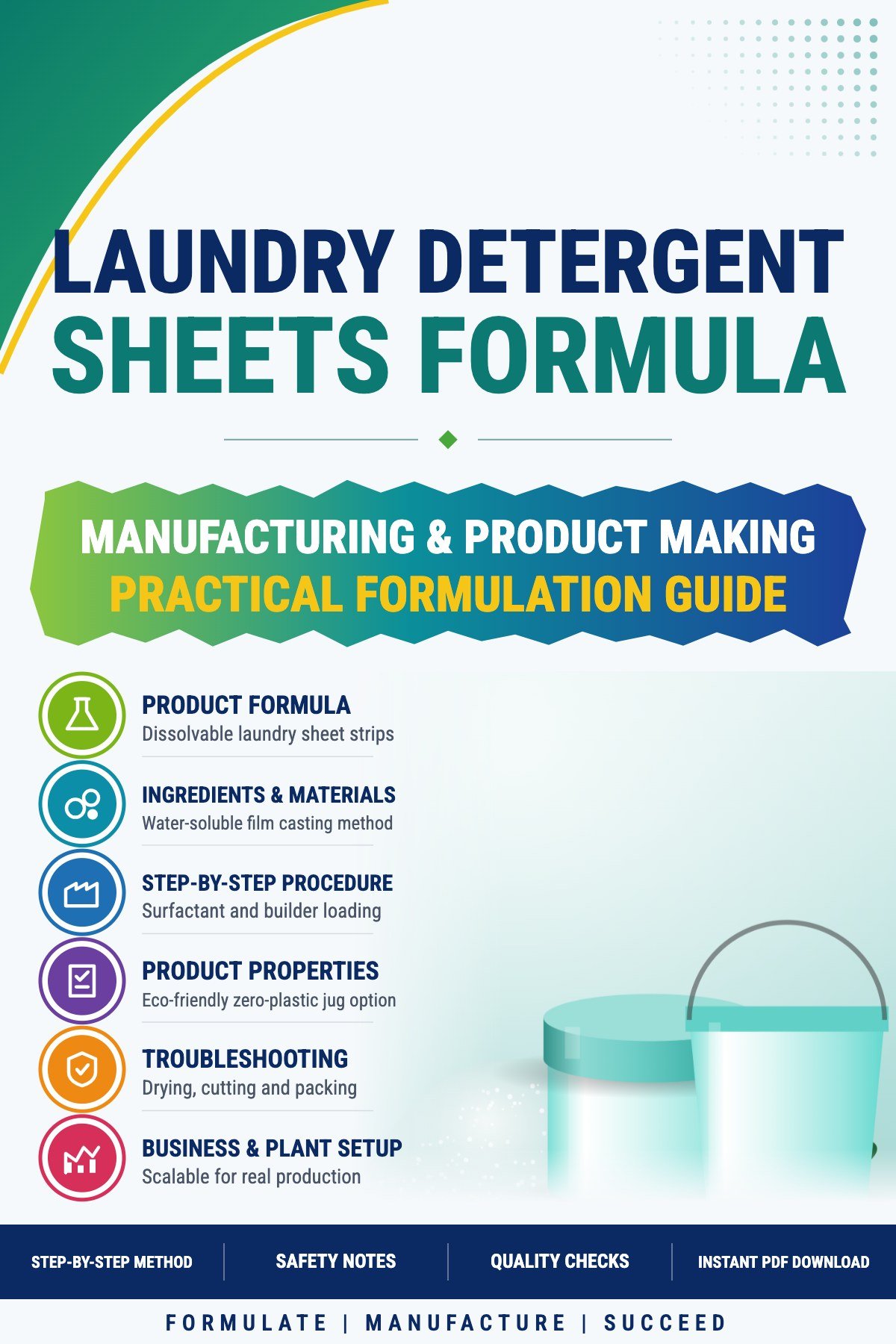
Laundry Detergent Sheets Formula
USD $75
PDF manual · Instant downloadLaundry Detergent Sheets Formula: a PDF guide to making dissolvable laundry sheets, with PVOH film casting, surfactant loading, drying, testing, packing and business tips.
Payment Methods
Refund Policy
Custom Formulation Services
Formulation Consultation
Contact Us
This comprehensive Laundry Detergent Sheets Formula digital book from CFS is a complete industrial guide to manufacturing laundry detergent sheets, one of the fastest-growing products in the cleaning industry. Whether you are a chemical manufacturer, entrepreneur or formulation expert, the guide offers ready-to-use, scalable formulations designed for real production environments. This page explains how a laundry detergent sheets formulation works, which ingredients and film-forming polymers are used, how sheets are cast, dried, cut and packed, and how to launch a brand.
This guide is published by Chemical Formulation Services, the formulation publishing and consultancy business of CFS Formulation Services Ltd in Sheffield, United Kingdom. It is written for people who want to understand the product from the raw material to the finished pack, and it keeps its claims practical rather than promotional.
At a glance
- Product: Laundry Detergent Sheets Formula, a digital PDF Product Making Guide.
- Also searched as: laundry detergent sheets formulation, laundry strips, dissolvable detergent sheets, eco laundry sheets, detergent film.
- Structure: water-soluble polymer film loaded with surfactants, builders and enzymes.
- Key goals: fast dissolving, cleaning power, flexibility, no sticking and long shelf life.
- Who it is for: detergent manufacturers, eco-brand founders, private-label sellers and entrepreneurs.
- Delivery: instant PDF download after payment is confirmed.
- Publisher: CFS Formulation Services Ltd, England and Wales company number 16678503.
Why detergent sheets are growing
Laundry sheets are thin, lightweight strips that dissolve in the washing machine. They are popular because they are compact and spill-free, easy to dose, plastic-jug free and light to ship, which cuts freight cost per wash. Online sellers and eco-focused brands have driven rapid growth. For a manufacturer, they offer a differentiated product with strong margins, provided the formulation is stable and the process is controlled.
How a detergent sheet is built
A sheet is a matrix of water-soluble polymer that holds the cleaning actives. The polymer, most often polyvinyl alcohol, forms a flexible film when cast and dried. Surfactants, builders and other actives are dissolved or dispersed in the polymer solution before casting. When the sheet meets water, the polymer dissolves and releases the detergent. The challenge is to load enough active detergent into a thin film while keeping the sheet flexible, non-sticky and quick to dissolve, even in cold water.
Core ingredients
- Film-forming polymer: partially hydrolysed polyvinyl alcohol grades chosen for cold-water solubility, sometimes blended with other water-soluble polymers.
- Plasticisers: glycerin, sorbitol or propylene glycol for flexibility.
- Surfactants: anionic types such as linear alkylbenzene sulfonate or alcohol ether sulfate, plus non-ionic ethoxylates and mild amphoterics.
- Builders and softeners: sodium citrate, sodium carbonate, zeolite or polymer builders, depending on regional rules.
- Chelating agents.
- Enzymes: protease, amylase or lipase for stains, in encapsulated or stabilised forms.
- Optical brighteners.
- Fragrance: microencapsulated or neat, within limits that avoid sticky sheets.
- Anti-sticking and anti-foam agents.
- Preservative and colour.
Scaling from lab drawdown to a production line
A hand drawdown proves the chemistry, but production exposes new problems. Casting speed, belt length and oven temperature must be matched so sheets leave the dryer at the target moisture, usually a few percent. Wet film thickness is the main control for dose per sheet, so install a simple inline gauge or check weighed samples every fifteen minutes. Solution viscosity drifts as it cools in the feed tank, so hold it at a steady temperature and recirculate gently. Small batches of 20 to 50 kilograms of solution on a pilot belt are a sensible step before buying industrial equipment, and many startups contract-manufacture the first few runs while they confirm demand.
Fragrance-free, sensitive-skin and stain-fighting variants
A fragrance-free sheet with a milder surfactant package suits sensitive households and baby clothes. A stain-fighting sheet adds enzymes and more non-ionic surfactant for oily and protein stains. A cold-wash sheet focuses on cold-soluble polymer and fast-dissolving surfactants. A travel pack of ten sheets in a small pouch makes a good trial product. Each variant uses the same casting line with adjusted recipes, so a brand can build a small family of products and cross-sell across them.
Shipping, shelf life and customer experience
Sheets are light, so shipping cost is low, but humidity is their enemy. Use foil or barrier pouches and ship with a clear instruction to keep the pack closed and dry. Typical shelf life is twelve to eighteen months when stored cool and dry. Include dosing guidance by load size and soil level on the pack, and tell users to place sheets directly in the drum, not in the dispenser drawer, to prevent residue. Responsive customer support and simple replacement policies for damaged packs protect reviews.
What is inside the Laundry Detergent Sheets Formula guide
The guide is presented as a complete industrial guide to manufacturing laundry detergent sheets, delivering ready-to-use, scalable formulations for real production environments. It includes recipe tables, solution preparation, casting parameters, drying schedules, cutting and packing instructions, quality checks and troubleshooting.
Manufacturing process
Step 1: Polymer solution
Slowly add PVOH powder to warm water under agitation, heating to dissolve fully without lumps, usually around 80 to 90 degrees Celsius for the required time. De-aerate or allow the solution to stand so bubbles escape.
Step 2: Add plasticiser and actives
Cool the solution, then add plasticiser, surfactants, builders and other actives in an order that avoids precipitation or gelling. Add heat-sensitive materials such as enzymes and fragrance last, at low temperature.
Step 3: Casting
Spread the viscous solution on a moving belt or release film using a doctor blade or slot die to a controlled wet thickness. Uniform thickness is vital for consistent dose per sheet.
Step 4: Drying
Dry in a tunnel with warm air, controlling temperature and airflow to avoid skinning, bubbles and brittle films. Final moisture content is critical to flexibility and shelf life.
Step 5: Cutting, packing
Cut into sheets of standard size and weight, check dose weight, and pack in moisture-barrier pouches or cardboard packs with desiccant if required. Keep the packing area dry and cool.
Balancing cleaning power and sheet integrity
Heavy surfactant loading plasticises and weakens the film, causing sticky, curling sheets. Too little detergent leaves cleaning weak. Makers resolve this by choosing high-activity surfactant forms, combining polymers for strength, and using powder fillers or builders as part of the matrix. Test cleaning against a liquid benchmark on standard stained fabrics at the real dose, typically one or two sheets per load, and tune accordingly.
Testing and quality control
- Weight and thickness uniformity.
- Moisture content.
- Dissolution time in cold and warm water.
- Residue: check washed fabric and drum for undissolved film.
- Cleaning performance on stained swatches.
- Tensile strength and flexibility.
- Storage stability: humidity and temperature.
- Foam level compatibility with machines, including high-efficiency types.
Troubleshooting
Sheets stick together
Too much humectant or humid storage. Reduce plasticiser, add anti-block powder and improve packaging barrier.
Sheets are brittle
Over-dried or too little plasticiser. Adjust moisture and plasticiser.
Slow dissolving in cold water
Wrong PVOH grade or thick film. Use cold-soluble grade and thinner casting.
Film residue on clothes
Poor dissolution or overloaded washer. Improve solubility and advise dose per load.
Bubbles and pinholes
Air in the solution or fast drying. De-aerate and slow the drying.
Fragrance fades
Volatile loss. Use encapsulated fragrance and good barrier packaging.
Safety, labelling and claims
Handle enzymes carefully because enzyme dust is a respiratory sensitiser. Use gloves and eye protection with surfactants and alkaline builders. Label sheets according to local detergent regulations, with ingredient lists, dosing instructions, hazard statements if applicable and a keep-out-of-reach-of-children warning, because concentrated sheets can be mistaken for sweets or dissolved film can be swallowed. Check country rules on phosphates, biodegradability and polymer content. Support claims such as “plastic-free” or “eco-friendly” with evidence, since polyvinyl alcohol is a synthetic polymer and rules on environmental claims are strict.
Packaging and business opportunity
Cardboard boxes with moisture-barrier liners, compostable pouches and small tins hold 30 to 60 sheets. Customers include eco-minded households, travellers, students, hotels and private-label buyers on online marketplaces. A subscription model with refill packs increases lifetime value. Develop fragrance-free, baby-safe and strong-stain versions, and consider fabric softener sheets as a complementary product. Strong packaging photography and clear dissolving videos help conversion.
Extend your detergent range with the Detergent Formulations, Cleaning Products, Soap Formula and Textile auxiliaries categories, and see Heavy Duty Liquid Laundry Detergent, Heavy Duty Washing Powder Formula, Liquid Hand Soap Formula, , and Car Wash and Wax Formulation.
Getting started
Begin with a small laboratory casting trial using a hand drawdown on glass or release paper. Evaluate dissolution, flexibility and cleaning, then scale to a pilot belt. Track every parameter: solution viscosity, wet thickness, drying temperature and final moisture. Prepare labels, safety data and pack designs, and start with a limited online launch to gather reviews.
How to get the best results from this guide
Treat the guide as a tested starting point rather than a finished factory. Begin with a small trial batch in the laboratory or on a bench, using the exact raw materials you plan to buy, and record every weight, temperature, mixing time and observation. Compare the result with the quality checks in the guide, change only one thing at a time, and keep a note of what each change did. Once a small batch is consistently good, repeat it several times, then scale up in stages, because mixing, heating and cooling behave differently in larger vessels. Keep retained samples of every batch, write simple standard operating procedures for your team, and build relationships with two suppliers for each key raw material. Finally, check the labelling, safety and product rules in the country where you will sell, and ask a qualified person to review your process. This careful, documented approach is what turns a good formulation into a reliable product and a trusted brand.
Who should buy this guide?
The guide is written for practical readers. It suits manufacturers who want to add a new product to an existing plant, startups choosing their first product, private-label brands that need to understand what they are buying, technical staff who must set specifications and train operators, and consultants and students who want a structured, plain-language reference. It is less suitable for anyone looking for a quick shortcut or a guarantee, because every formulation still needs testing with your own materials, equipment and local rules. If you are unsure whether it matches your project, send a short question through the contact page before you order, and we will tell you honestly whether it fits.
What is inside the Laundry Detergent Sheets Formula guide
Every Product Making Guide in our shop follows the same structure so you know where to look. This guide includes the product formula, the ingredients and materials, the procedure and preparations, the industrial requirements and the technical specifications. In practice you receive:
- The formulation, written so you can follow it at the bench and scale it up.
- Ingredients and materials, with the job of each material and advice on grades and suppliers.
- The manufacturing procedure, including order of addition, mixing and preparations.
- Industrial requirements, covering equipment, space and packaging.
- Technical specifications, describing what a good finished product should look like and how it should behave.
- Troubleshooting for the faults that makers meet most often.
- Business guidance, to help you take the product from the bench to the market.
These Product Making Guides of chemical formulations and formulas are for manufacturers, startups and entrepreneurs. Every guide contains industrially tested, practical formulations. Anyone who buys a guide can make the product by following its step-by-step instructions. Raw materials vary between suppliers, so always confirm your results with a small trial batch before scaling up.
Who stands behind this guide?
Chemical Formulation Services is the trading name of CFS Formulation Services Ltd, registered in England and Wales under company number 16678503, with its office at Unit F, Winston Business Park, Churchill Way, Sheffield S35 2PS. The business was founded by George Enrick and publishes formulation manuals, technical guides and industry reports. You can check our details on the Companies House register, read about us, or contact us with any question before you order.
A written formulation cannot replace testing with your own raw materials, equipment and climate, and we say so plainly. What the guide does give you is a tested, structured starting point that can save you months of trial and error. Our terms and conditions explain what a purchase from us covers.
How to order
- Select Add to cart to keep browsing, or Buy Now to go straight to checkout.
- Pay with PayPal, Stripe, Xoom by PayPal, Payoneer, payment links for debit and credit cards, or Western Union, Ria and all money exchanges.
- If you pay through a money exchange, email your payment slip to Info@chemicalformulationservices.com. After confirmation, your instant download link is emailed to you.
- For online payments, the PDF is available as soon as the payment is confirmed.
All products are digital downloads and all payments are nonrefundable once the file is delivered, so please read the refund policy and the FAQs before you order. You can compare this guide with others in the formula shop or browse our industrial project reports.
Frequently asked questions about laundry detergent sheets formula
What is the Laundry Detergent Sheets Formula guide?
It is a digital PDF Product Making Guide to manufacturing laundry detergent sheets, with film casting, actives, drying, packing and troubleshooting.
What polymer holds the sheet together?
Usually a water-soluble polyvinyl alcohol grade, often with a plasticiser such as glycerin.
Why do sheets stick together?
Too much plasticiser or humid storage. Reduce humectant and improve barrier packaging.
Do sheets work in cold water?
Yes, if a cold-soluble polymer grade and thin, even films are used.
Are laundry sheets safe around children?
They need clear warnings and child-safe packaging because they can be mistaken for something edible.
How do I receive the guide?
You receive an instant PDF download after payment is confirmed. For money exchanges, email your payment slip to Info@chemicalformulationservices.com and the link is emailed after we confirm it.
Is the payment refundable?
All payments are nonrefundable because the product is an instant digital download. See the refund policy for details.
Can you help with a custom formulation?
CFS Formulation Services Ltd offers formulation and product development consultancy. Send a short brief through the Contact page.
Last reviewed: November 2026. This page is general information about a digital product. It is not a safety data sheet or professional advice, and any formulation should be tested and reviewed by a qualified person before commercial use.