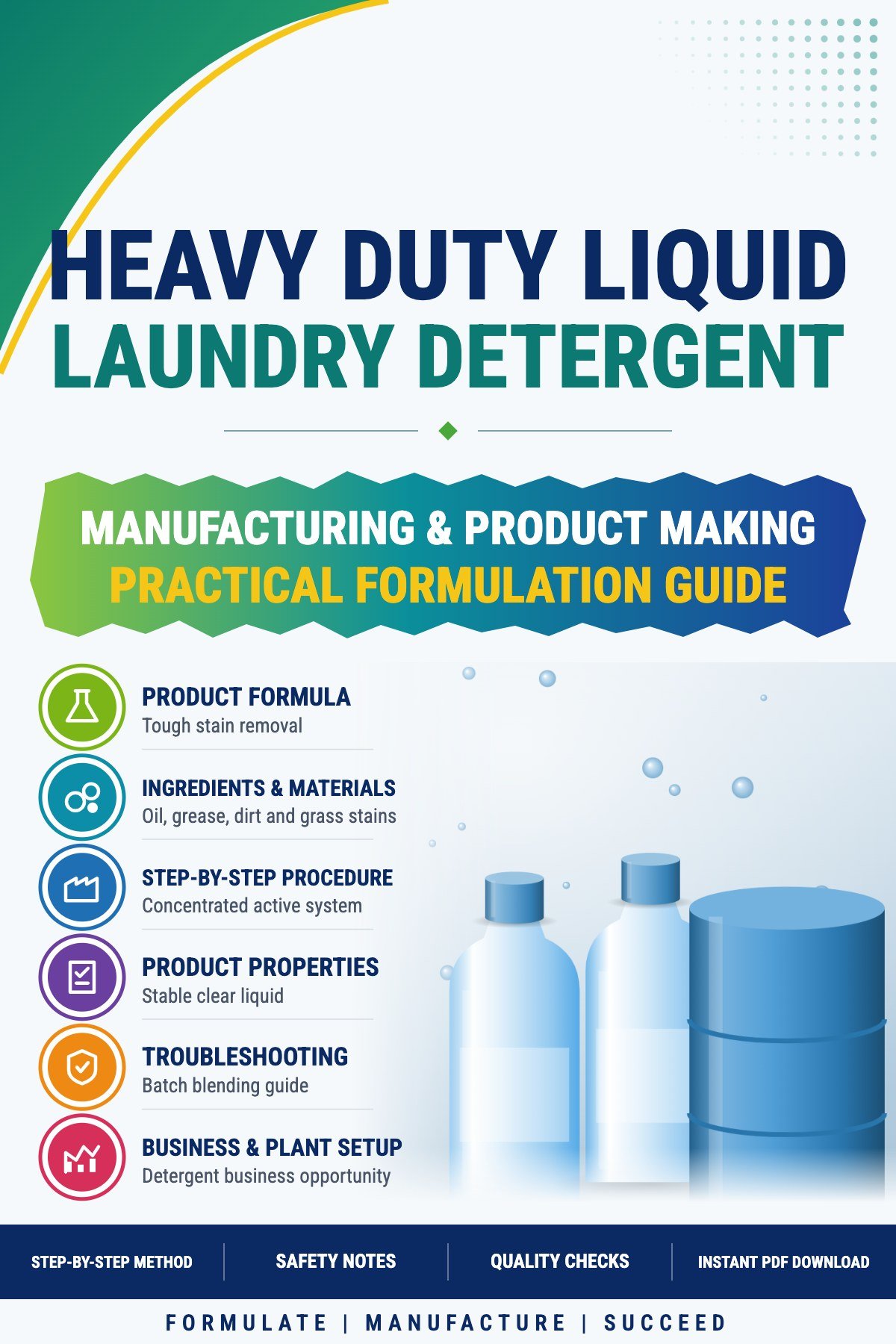

Heavy Duty Liquid Laundry Detergent
USD $65
PDF manual · Instant downloadHeavy Duty Liquid Laundry Detergent: a PDF guide to formulating and blending a concentrated liquid detergent for tough stains, with testing and troubleshooting.
Payment Methods
Refund Policy
Custom Formulation Services
Formulation Consultation
Contact Us
Heavy Duty Liquid Laundry Detergent is a practical PDF guide for detergent manufacturers, household-chemical startups, private-label suppliers and entrepreneurs who want to make a liquid detergent that tackles tough stains and heavily soiled fabrics. A heavy duty liquid carries a higher concentration of actives than a light-duty liquid and is built to deal with oil, grease, dirt and grass stains in a normal wash. This page explains how a heavy duty liquid laundry detergent formulation works, what goes into a heavy duty liquid laundry detergent formula, how it is blended and tested, and how to turn it into a profitable detergent business.
This guide is published by Chemical Formulation Services, the formulation publishing and consultancy business of CFS Formulation Services Ltd in Sheffield, United Kingdom. It is written for people who want to understand the product from the raw material to the finished pack, and it keeps its claims practical rather than promotional.
At a glance
- Product: Heavy Duty Liquid Laundry Detergent, a digital PDF Product Making Guide.
- Also searched as: heavy duty liquid laundry detergent formula, HDL detergent, liquid laundry detergent formulation, concentrated liquid detergent.
- Cleans: oil, grease, dirt, grass and other heavy stains.
- Active system: anionic and non-ionic surfactants, builders, enzymes and additives.
- Who it is for: detergent makers, household-chemical startups, private-label suppliers and entrepreneurs.
- Delivery: instant PDF download after payment is confirmed.
- Publisher: CFS Formulation Services Ltd, England and Wales company number 16678503.
What makes a liquid detergent “heavy duty”
Laundry liquids span a range from gentle fine-fabric washes to strong all-purpose products. A heavy duty liquid (HDL) sits at the strong end. It is formulated to wash cotton, polyester and blends that carry body soil, food, grease and outdoor dirt, and to do so in machine washes with water of different hardness and temperature. It generally contains more surfactant, a builder system to deal with hardness, enzymes for protein, starch and fat stains, and additives for whiteness, soil suspension and fragrance. Because the product is a liquid, it dissolves instantly, even in cold water, and can be dosed neatly from the bottle cap or a machine dispenser.
The challenge is that so many different ingredients must live together in a clear, stable liquid with an attractive appearance, a pleasant smell and a reasonable cost. Surfactants must be balanced for performance and foam. Enzymes must be kept active. Builders must be soluble. The whole system must resist separation, cloudiness and microbial growth over a shelf life of a year or more.
Core components
- Anionic surfactants: linear alkylbenzene sulphonate (LAS) is the workhorse, supplying detergency and foam. Alcohol ether sulphates (AES) add mildness, hard-water tolerance and solubility.
- Non-ionic surfactants: alcohol ethoxylates handle oily soils and work in cold water, and improve stability when blended with anionics.
- Soap: fatty acid soap controls foam and adds cleaning, though it can be sensitive to hardness.
- Builders and chelants: citrates, phosphonates or other sequestrants reduce the effect of water hardness. Phosphates are restricted in many regions.
- Alkalinity source: monoethanolamine or sodium hydroxide to neutralise the acid form of LAS and set the pH.
- Enzymes: protease, amylase, lipase and cellulase, supplied as liquids and protected by stabilisers.
- Hydrotropes and solvents: help keep the concentrate clear and lower viscosity.
- Polymers: soil-suspension agents and anti-redeposition polymers to keep soil off fabrics.
- Optical brighteners: improve whiteness impressions.
- Preservative, fragrance, colour and viscosity modifiers: protect, perfume and finish the product.
Understanding how the surfactants share the work
Each surfactant in a heavy duty liquid has a role. LAS is the main cleaner and is excellent on particulate and body soils, but it is sensitive to calcium and can form scum in very hard water. Alcohol ether sulphate tolerates hardness better and boosts solubility, so it is often blended with LAS to keep the formula clear. Non-ionic alcohol ethoxylates attack oily and greasy stains, work well at low temperature and stabilise the mix against hardness. Soap controls foam, so that front-loading machines do not overflow, and adds some detergency. The ratio between these ingredients is the heart of the formula. A higher non-ionic proportion suits cold-water washing and oily soils, while a higher anionic proportion boosts cleaning of clay and particulate soil and foam. The guide explains how to shift the balance for different markets.
Enzymes and what they remove
Protease enzymes break down proteins in blood, egg, milk, grass and sweat. Amylase removes starch residues from food such as pasta, sauces and gravy. Lipase attacks fats and oils, helping with greasy collars and cooking oil stains. Cellulase smooths fibres and helps restore colour on worn cotton. Mannanase removes gum-based stains from foods and cosmetics. Enzymes work best within a moderate pH range and temperature, and they can be damaged by strong oxidisers and some surfactants. In a liquid they need stabilisers such as polyols or specific salts so they stay active during storage. Keep the enzyme dose in line with supplier recommendations, and use liquid or encapsulated forms for safe handling.
Handling water hardness and soil redeposition
Calcium and magnesium ions in hard water react with anionic surfactants and soap and form insoluble deposits that dull fabrics and reduce cleaning. Citrates and phosphonates bind these ions and keep the surfactants working. Polymers, such as polyacrylates and carboxymethyl cellulose, keep loosened soil suspended in the wash water so it does not settle back onto the cloth, preventing greying. Soil-release polymers help synthetic fabrics release oily soil in later washes. Because water quality varies from place to place, test a formula in the hardness of your own market before launch, and adjust the builder level.
Fragrance, colour and appearance
Consumers judge a detergent by look and smell before they judge its cleaning. A clear liquid with a clean, fresh fragrance and a stable colour signals quality. Fragrance oils must be compatible with surfactants, so they are first solubilised with a little non-ionic surfactant. Dyes should be light-stable and non-staining, used at very low levels. Opacifiers can create a creamy appearance for premium lines. Test the final colour and fragrance after weeks of storage at room temperature and at 40 degrees Celsius, since fading, darkening and off-odours are common complaints.
Packaging and dosing
Choose bottles made from HDPE or PET with a measuring cap, a pump or a pour spout. Concentrated products need clear dosing instructions, because overdosing wastes product and leaves residue. Refill pouches and large jerricans cut cost and plastic use. Check that closures seal well and that the plastic resists the surfactant and fragrance system without stress cracking. Label the bottle with directions, the dose for light, normal and heavy soil, safety statements, batch number, expiry or best-before guidance and the manufacturer’s contact details. Add storage advice: keep in a cool place, out of reach of children and away from direct sun.
Costing the formula
Work out the raw material cost of one tonne of detergent from current prices, add packaging, labour, energy and overheads and divide by the number of washes per bottle. Customers compare price per wash, so a concentrated formula with a lower dose can win even at a higher bottle price. Surfactant is the largest cost, so small savings in active level or in the AES-to-LAS ratio add up quickly. Keep batch records and make small adjustments only after performance tests, so cost savings do not weaken the product.
What is inside the Heavy Duty Liquid Laundry Detergent guide
The guide describes a liquid detergent formulated to tackle tough stains and give effective cleaning of heavily soiled fabrics, handling oil, grease, dirt and grass, and typically containing a higher concentration of active ingredients than ordinary liquids. It provides the formulation, ingredient functions, the manufacturing method, quality tests, packaging and troubleshooting.
How the detergent is made
Production is a batch blending operation in a corrosion-resistant tank with an agitator. Order of addition matters.
Charging water and neutralising LAS
Charge softened water, then add the LAS acid slowly, followed by the neutraliser. Neutralisation releases heat, so control temperature and add gradually. Check pH.
Adding other surfactants and soap
Add AES, non-ionic surfactant and fatty acid soap, mixing until clear. Adjust viscosity with hydrotrope or a small amount of salt.
Adding builders and polymers
Dissolve citrate or phosphonate, and add soil-release and anti-redeposition polymers.
Cooling and adding sensitive ingredients
Cool the batch below about 35 degrees Celsius, then add enzymes, fragrance, brightener, dye and preservative with gentle mixing.
Final adjustment and filling
Adjust pH and viscosity, check clarity and filter if necessary before filling bottles, pouches or jerricans.
Quality control
- Appearance and colour: clear or uniformly opaque, with no separation.
- pH: in the target range for stability and enzyme activity.
- Viscosity: pourable and consistent.
- Active matter: anionic content by titration.
- Cleaning performance: standard soiled swatches washed against a reference detergent.
- Foam height: suited for front and top-loading machines.
- Enzyme activity: retained after storage.
- Stability: hot and cold storage, freeze-thaw cycles and microbial testing.
Troubleshooting
Cloudy or separating liquid
Poor balance of surfactants or too little hydrotrope. Adjust the ratio and add solubiliser.
Too thin or too thick
Electrolyte or hydrotrope level is wrong. Adjust salt, solvent or polymer thickener.
Loss of cleaning on protein stains
Enzymes deactivated. Add enzymes last in the cool stage, add stabiliser and check storage.
Excess foam
Too much anionic or soap shortage. Add soap or anti-foam, and rebalance surfactants.
Odour development
Microbial growth or oxidation. Improve preservative system and hygiene in production.
Yellowing in storage
Oxidation or light exposure. Add antioxidant and use opaque packaging.
Safety and regulation
LAS acid is strongly acidic and neutralisation generates heat, so use protective equipment. Enzymes are respiratory sensitisers in dust form, so use liquid or encapsulated grades and avoid creating mist. Surfactants irritate eyes and skin. Laundry detergents are regulated in many markets, covering phosphate content, biodegradability of surfactants, labelling of allergenic fragrances and enzymes, child-resistant packaging for concentrated pods and general product safety. Provide safety data sheets and clear label directions.
Business opportunity
Laundry detergent is one of the largest and most reliable household product categories. A new brand can compete by focusing on niches: concentrated formulas, baby and sensitive skin, eco-friendly ingredients, scented premium lines, industrial and hospitality laundries, or low-cost bulk products for institutional users. Private labelling for supermarkets and distributors is another entry route. Refill packs reduce packaging cost and appeal to environmentally minded buyers. Good packaging design, dosing instructions and honest claims drive repeat buying.
Related CFS guides help you build a detergent range. Browse the Detergent Formulations and Cleaning Products categories, and see , , , , Colored Active Foam Cleaners Formulation and Biopolishing Textile Enzyme Formula.
Getting started
Start with a simple base of LAS, AES and non-ionic surfactant with a builder, then add enzymes once you are confident with stability. Test washes on standard soils against a leading brand and use real household loads. Choose packaging, prepare labels and safety data, and sell to local shops or online, gathering feedback to refine.
How to get the best results from this guide
Treat the guide as a tested starting point rather than a finished factory. Begin with a small trial batch in the laboratory or on a bench, using the exact raw materials you plan to buy, and record every weight, temperature, mixing time and observation. Compare the result with the quality checks in the guide, change only one thing at a time, and keep a note of what each change did. Once a small batch is consistently good, repeat it several times, then scale up in stages, because mixing, heating and cooling behave differently in larger vessels. Keep retained samples of every batch, write simple standard operating procedures for your team, and build relationships with two suppliers for each key raw material. Finally, check the labelling, safety and product rules in the country where you will sell, and ask a qualified person to review your process. This careful, documented approach is what turns a good formulation into a reliable product and a trusted brand.
Who should buy this guide?
The guide is written for practical readers. It suits manufacturers who want to add a new product to an existing plant, startups choosing their first product, private-label brands that need to understand what they are buying, technical staff who must set specifications and train operators, and consultants and students who want a structured, plain-language reference. It is less suitable for anyone looking for a quick shortcut or a guarantee, because every formulation still needs testing with your own materials, equipment and local rules. If you are unsure whether it matches your project, send a short question through the contact page before you order, and we will tell you honestly whether it fits.
What is inside the Heavy Duty Liquid Laundry Detergent guide
Every Product Making Guide in our shop follows the same structure so you know where to look. This guide includes the product formula, the ingredients and materials, the procedure and preparations, the industrial requirements and the technical specifications. In practice you receive:
- The formulation, written so you can follow it at the bench and scale it up.
- Ingredients and materials, with the job of each material and advice on grades and suppliers.
- The manufacturing procedure, including order of addition, mixing and preparations.
- Industrial requirements, covering equipment, space and packaging.
- Technical specifications, describing what a good finished product should look like and how it should behave.
- Troubleshooting for the faults that makers meet most often.
- Business guidance, to help you take the product from the bench to the market.
These Product Making Guides of chemical formulations and formulas are for manufacturers, startups and entrepreneurs. Every guide contains industrially tested, practical formulations. Anyone who buys a guide can make the product by following its step-by-step instructions. Raw materials vary between suppliers, so always confirm your results with a small trial batch before scaling up.
Who stands behind this guide?
Chemical Formulation Services is the trading name of CFS Formulation Services Ltd, registered in England and Wales under company number 16678503, with its office at Unit F, Winston Business Park, Churchill Way, Sheffield S35 2PS. The business was founded by George Enrick and publishes formulation manuals, technical guides and industry reports. You can check our details on the Companies House register, read about us, or contact us with any question before you order.
A written formulation cannot replace testing with your own raw materials, equipment and climate, and we say so plainly. What the guide does give you is a tested, structured starting point that can save you months of trial and error. Our terms and conditions explain what a purchase from us covers.
How to order
- Select Add to cart to keep browsing, or Buy Now to go straight to checkout.
- Pay with PayPal, Stripe, Xoom by PayPal, Payoneer, payment links for debit and credit cards, or Western Union, Ria and all money exchanges.
- If you pay through a money exchange, email your payment slip to Info@chemicalformulationservices.com. After confirmation, your instant download link is emailed to you.
- For online payments, the PDF is available as soon as the payment is confirmed.
All products are digital downloads and all payments are nonrefundable once the file is delivered, so please read the refund policy and the FAQs before you order. You can compare this guide with others in the formula shop or browse our industrial project reports.
Frequently asked questions about heavy duty liquid laundry detergent
What is the Heavy Duty Liquid Laundry Detergent guide?
It is a digital PDF Product Making Guide to formulating and blending a concentrated liquid laundry detergent for tough stains.
What makes it heavy duty?
Higher active surfactant levels, a builder system and enzymes designed for oil, grease, dirt and grass stains.
Why are enzymes added last?
They are heat sensitive, so they are added once the batch has cooled.
Do I need to avoid phosphates?
Many regions restrict phosphates, so citrate and phosphonate builders are common alternatives.
Can I make it without a factory?
Yes. A small blending tank, scales, a pH meter and filling equipment are enough to start.
How do I receive the guide?
You receive an instant PDF download after payment is confirmed. For money exchanges, email your payment slip to Info@chemicalformulationservices.com and the link is emailed after we confirm it.
Is the payment refundable?
All payments are nonrefundable because the product is an instant digital download. See the refund policy for details.
Can you help with a custom formulation?
CFS Formulation Services Ltd offers formulation and product development consultancy. Send a short brief through the Contact page.
Last reviewed: November 2026. This page is general information about a digital product. It is not a safety data sheet or professional advice, and any formulation should be tested and reviewed by a qualified person before commercial use.