
Livestock Mineral Bolus & Controlled Release Systems Handbook
USD $90
PDF manual · Instant downloadLivestock Mineral Bolus & Controlled Release Systems Handbook: a PDF guide to designing, making, testing and regulating rumen-retained mineral boluses for cattle and sheep.
Payment Methods
Refund Policy
Custom Formulation Services
Formulation Consultation
Contact Us
Livestock Mineral Bolus & Controlled Release Systems Handbook is a practical PDF guide for veterinary-product manufacturers, feed-supplement companies and livestock-input entrepreneurs who want to understand how solid, rumen-retained boluses are designed and made. A mineral bolus is a dense oral dosage form that stays in the rumen and releases trace minerals, vitamins and other nutritional actives slowly over weeks or months, instead of delivering a short peak like a drench or a feed additive. This page explains how a livestock mineral bolus formula works, what the handbook covers and how controlled-release systems are developed, made and tested, so you can decide if it fits your business.
This guide is published by Chemical Formulation Services, the formulation publishing and consultancy business of CFS Formulation Services Ltd in Sheffield, United Kingdom. It is written for people who want to understand the product from the raw material to the finished pack, and it keeps its claims practical rather than promotional.
At a glance
- Product: Livestock Mineral Bolus & Controlled Release Systems Handbook, a digital PDF Product Making Guide.
- Also searched as: livestock mineral bolus formula, rumen bolus manufacturing, controlled release trace mineral bolus, cattle and sheep bolus.
- What it covers: bolus design, ingredients, binders, density, pressing, coating, release testing and quality control.
- Key goals: rumen retention, slow dissolution and long-duration nutrient delivery.
- Who it is for: supplement and veterinary-product manufacturers, livestock suppliers and entrepreneurs.
- Delivery: instant PDF download after payment is confirmed.
- Publisher: CFS Formulation Services Ltd, England and Wales company number 16678503.
What a mineral bolus is
A bolus is a large, solid tablet or capsule-like dosage unit given by mouth to cattle, sheep, goats and other ruminants with a special applicator. Once swallowed, it passes into the rumen, the first and largest compartment of the stomach. A mineral bolus is designed to stay there and dissolve slowly, so the animal receives a steady supply of trace minerals, vitamins and other actives over a long period. This is very different from a liquid supplement or drench, which gives a rapid dose that is absorbed or passed on within hours or days.
Boluses are popular where animals graze large areas or are handled only a few times a year. One treatment can cover several weeks or months, which saves labour and avoids the uneven intake that sometimes occurs with feed blocks, licks and mineral mixes. They are used in dairy cattle, beef cattle, sheep and goats to help address deficiencies of elements such as cobalt, copper, selenium, iodine and zinc, depending on local soil and forage conditions.
Why controlled release matters
Trace minerals work within a narrow range between too little and too much. A single large dose can overload an animal and waste much of the mineral. Controlled release keeps levels steadier. In ruminants, cobalt is a good example: rumen microbes need it to produce vitamin B12, and a steady supply keeps them working. A bolus that releases cobalt gradually can support this process far better than an occasional big dose. The same logic applies to other trace elements and to vitamins and nutritional actives.
How a bolus stays in the rumen
For a bolus to work, it must remain in the rumen rather than pass quickly through the digestive tract. The most important design factor is density. A bolus that is dense enough sinks to the bottom of the rumen and stays there as the contents move around it. Manufacturers reach this high density by including heavy materials such as iron or other dense fillers within the formulation, and by pressing the mass tightly. Size and shape are important too. The bolus must be small enough to be swallowed safely but large enough to be retained. The handbook explains the principles that link density, size and retention.
How release is controlled
Several design routes control how fast a bolus releases its contents. The guide explains them in practical terms.
Matrix systems
In a matrix bolus, actives are mixed through a slowly eroding or slowly dissolving material. As the surface wears away in the rumen fluid, fresh active is exposed. The rate depends on the matrix material, the compaction level and the surface area.
Coated and layered systems
A coating or barrier can delay or slow release, and layered designs can deliver different actives at different times.
Erosion versus diffusion
Some systems release by physical erosion of the bolus surface, while others release by diffusion of the active through a gel or barrier. Each has its own pattern of release over time.
Binders and release modifiers
Binders hold the bolus together and have a major effect on how quickly it erodes. Waxes, polymers and similar substances can slow dissolution, while soluble fillers speed it up.
Typical ingredients and their roles
Trace mineral sources
Cobalt, copper, selenium, iodine, zinc, manganese and other minerals are supplied as salts or oxides, chosen for bioavailability, stability and compatibility. Different forms dissolve at different rates, which gives the formulator another tool for fine-tuning release.
Vitamins and nutritional actives
Fat-soluble and some water-soluble vitamins may be included, but they are sensitive to heat, moisture and pressing, so stability must be checked carefully.
Weighting agents
Dense materials increase the specific gravity of the bolus so it is retained in the rumen.
Binders and lubricants
These help the powder form a strong compact and release cleanly from the press. They affect hardness, erosion rate and appearance.
Coatings
Coatings can protect the bolus during handling, mask dust and, in some designs, control the start of release.
What is inside the handbook
The handbook is a technical formulation reference for people who want to make such products. It describes the principles of bolus design, typical ingredient classes and their roles, manufacturing steps from powder preparation to pressing and coating, testing methods for density, hardness and release, quality control practices, troubleshooting, and the business and regulatory landscape for controlled-release livestock products. It is written in the same practical style as other CFS guides, so that manufacturers and entrepreneurs can follow it step by step.
How boluses are made
The handbook gives the full detail. The outline below shows the general flow.
Step 1: Select and check materials
Mineral salts, weighting agents, binders and other ingredients are checked for identity, purity, particle size and moisture. Consistent materials give consistent boluses.
Step 2: Mill and blend
Powders are milled where needed and blended until completely uniform. Because trace minerals are used in small, precise amounts, uniform mixing is especially important so that every bolus carries the same dose.
Step 3: Granulate where required
Some formulas are granulated to improve flow and compressibility. Granules are dried to a controlled moisture level.
Step 4: Compress
The blend is pressed in a heavy-duty tablet press or similar compaction equipment at high pressure to give a dense, strong bolus of the target weight and shape.
Step 5: Coat or finish
If the design calls for it, boluses are coated and dried.
Step 6: Test and pack
Samples are tested for weight, density, hardness and release behaviour. Approved boluses are packed in moisture-resistant containers with batch details and clear instructions.
Equipment and plant requirements
A bolus unit needs accurate balances, a mill, a blender such as a V-blender or ribbon mixer, a granulator and dryer if used, a high-pressure press with strong tooling, a coating pan where required, dust extraction and a quality laboratory. Dies and punches endure heavy wear because the formulations are dense and abrasive, so tooling quality and maintenance are significant costs. Hygiene, containment of dust and segregation between products are also vital.
Quality control for every batch
- Dose accuracy: analysis of mineral content per bolus against the label claim.
- Weight and dimensions: consistent size and weight across the batch.
- Density: confirms the bolus will be retained in the rumen.
- Hardness and friability: boluses must survive transport and handling without crumbling.
- Release testing: dissolution or erosion measured in suitable test media over time.
- Moisture and stability: checks that actives remain potent during shelf life.
- Appearance: no cracks, capping or surface defects.
Troubleshooting bolus production
Capping or lamination
A bolus splitting horizontally during pressing often reflects trapped air, too much fines or excessive pressure. Adjust granulation, press speed and pressure.
Low hardness
Insufficient binder, low pressure or incorrect moisture lowers strength. Optimise those variables.
Release too fast or too slow
Adjust binder type and level, compaction pressure and the proportion of soluble components.
Uneven dose
Poor blending or segregation of fine and coarse particles gives variable content. Improve blending and consider granulation.
Sticking to punches
Moisture, too little lubricant or worn tooling are common causes.
Excess tooling wear
Dense, abrasive blends damage tooling. Use hardened tools and a maintenance schedule.
Safety, animal welfare and regulation
Rumen boluses must be given correctly, with the proper applicator and by trained people, because careless administration can injure the animal’s throat. Dosage must match the species and weight of the animal and the local mineral status, since excess copper, selenium and some other elements are toxic, and sheep are particularly sensitive to copper. In many countries, boluses and controlled-release products are regulated as feed additives or veterinary medicines, and they may require registration, specific labelling, approved ingredients and manufacturing licences. Claims about preventing or treating disease are tightly controlled. This handbook is a technical reference and does not replace advice from a veterinarian or animal nutritionist, who should be involved in product design and use. You are responsible for meeting every regulatory requirement.
The business opportunity
Where labour is scarce, herds are large or grazing is extensive, long-acting products have a clear advantage. Boluses suit dairy and beef producers, sheep farmers, veterinary clinics and feed or agricultural suppliers. Once a product is trusted, repeat purchases are likely each season. Success depends on proven performance, simple use, correct labelling and good relationships with veterinarians and distributors. Local mineral deficiencies differ widely, so tailoring products to regional needs can set you apart.
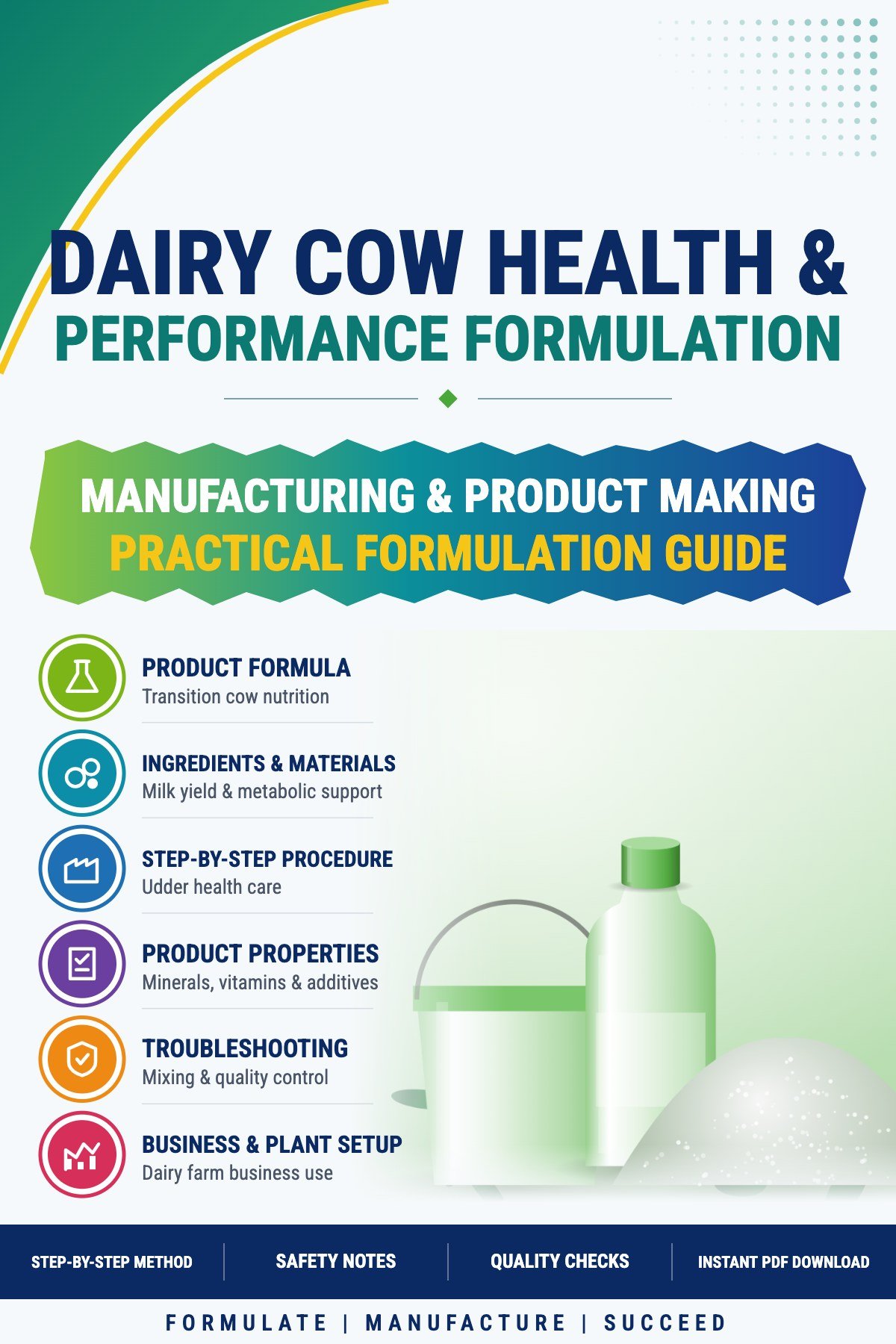
Related livestock and farm products appear in our Poultry Veterinary Livestock category, and the guide on Dairy Cow Health & Performance Formulation is a natural companion for dairy-focused suppliers. For farm inputs beyond animal health, browse Fertilizers and Herbicide Formulations.
Getting started
Begin with a simple single-mineral design, perhaps using a common deficiency in your region, and make small trial batches. Test density, hardness and release in the laboratory, then arrange supervised field observations with a veterinarian. Document all results, refine the design and prepare the registration documents your market requires before selling.
How to get the best results from this guide
Treat the guide as a tested starting point rather than a finished factory. Begin with a small trial batch in the laboratory or on a bench, using the exact raw materials you plan to buy, and record every weight, temperature, mixing time and observation. Compare the result with the quality checks in the guide, change only one thing at a time, and keep a note of what each change did. Once a small batch is consistently good, repeat it several times, then scale up in stages, because mixing, heating and cooling behave differently in larger vessels. Keep retained samples of every batch, write simple standard operating procedures for your team, and build relationships with two suppliers for each key raw material. Finally, check the labelling, safety and product rules in the country where you will sell, and ask a qualified person to review your process. This careful, documented approach is what turns a good formulation into a reliable product and a trusted brand.
Who should buy this guide?
The guide is written for practical readers. It suits manufacturers who want to add a new product to an existing plant, startups choosing their first product, private-label brands that need to understand what they are buying, technical staff who must set specifications and train operators, and consultants and students who want a structured, plain-language reference. It is less suitable for anyone looking for a quick shortcut or a guarantee, because every formulation still needs testing with your own materials, equipment and local rules. If you are unsure whether it matches your project, send a short question through the contact page before you order, and we will tell you honestly whether it fits.
What is inside the Livestock Mineral Bolus & Controlled Release Systems Handbook guide
Every Product Making Guide in our shop follows the same structure so you know where to look. This guide includes the product formula, the ingredients and materials, the procedure and preparations, the industrial requirements and the technical specifications. In practice you receive:
- The formulation, written so you can follow it at the bench and scale it up.
- Ingredients and materials, with the job of each material and advice on grades and suppliers.
- The manufacturing procedure, including order of addition, mixing and preparations.
- Industrial requirements, covering equipment, space and packaging.
- Technical specifications, describing what a good finished product should look like and how it should behave.
- Troubleshooting for the faults that makers meet most often.
- Business guidance, to help you take the product from the bench to the market.
These Product Making Guides of chemical formulations and formulas are for manufacturers, startups and entrepreneurs. Every guide contains industrially tested, practical formulations. Anyone who buys a guide can make the product by following its step-by-step instructions. Raw materials vary between suppliers, so always confirm your results with a small trial batch before scaling up.
Who stands behind this guide?
Chemical Formulation Services is the trading name of CFS Formulation Services Ltd, registered in England and Wales under company number 16678503, with its office at Unit F, Winston Business Park, Churchill Way, Sheffield S35 2PS. The business was founded by George Enrick and publishes formulation manuals, technical guides and industry reports. You can check our details on the Companies House register, read about us, or contact us with any question before you order.
A written formulation cannot replace testing with your own raw materials, equipment and climate, and we say so plainly. What the guide does give you is a tested, structured starting point that can save you months of trial and error. Our terms and conditions explain what a purchase from us covers.
How to order
- Select Add to cart to keep browsing, or Buy Now to go straight to checkout.
- Pay with PayPal, Stripe, Xoom by PayPal, Payoneer, payment links for debit and credit cards, or Western Union, Ria and all money exchanges.
- If you pay through a money exchange, email your payment slip to Info@chemicalformulationservices.com. After confirmation, your instant download link is emailed to you.
- For online payments, the PDF is available as soon as the payment is confirmed.
All products are digital downloads and all payments are nonrefundable once the file is delivered, so please read the refund policy and the FAQs before you order. You can compare this guide with others in the formula shop or browse our industrial project reports.
Frequently asked questions about livestock mineral bolus & controlled release systems handbook
What is the Livestock Mineral Bolus & Controlled Release Systems Handbook?
It is a digital PDF Product Making Guide to designing and manufacturing rumen-retained mineral boluses and other controlled-release systems for livestock.
What is a mineral bolus?
It is a dense oral dosage unit that stays in the rumen and slowly releases trace minerals, vitamins and other actives over a long period.
How does a bolus stay in the rumen?
High density keeps it at the bottom of the rumen, and a suitable size and shape help retention until it dissolves.
Why not just use a drench or feed additive?
Drenches give a short peak, while boluses provide steady release over weeks or months, saving labour and giving more even supply, especially for grazing animals.
Do I need approval to sell boluses?
Often yes. Many countries regulate them as feed additives or veterinary medicines, so check registration and labelling rules and involve a veterinarian.
How do I receive the guide?
You receive an instant PDF download after payment is confirmed. For money exchanges, email your payment slip to Info@chemicalformulationservices.com and the link is emailed after we confirm it.
Is the payment refundable?
All payments are nonrefundable because the product is an instant digital download. See the refund policy for details.
Can you help with a custom formulation?
CFS Formulation Services Ltd offers formulation and product development consultancy. Send a short brief through the Contact page.
Last reviewed: November 2026. This page is general information about a digital product. It is not a safety data sheet or professional advice, and any formulation should be tested and reviewed by a qualified person before commercial use.