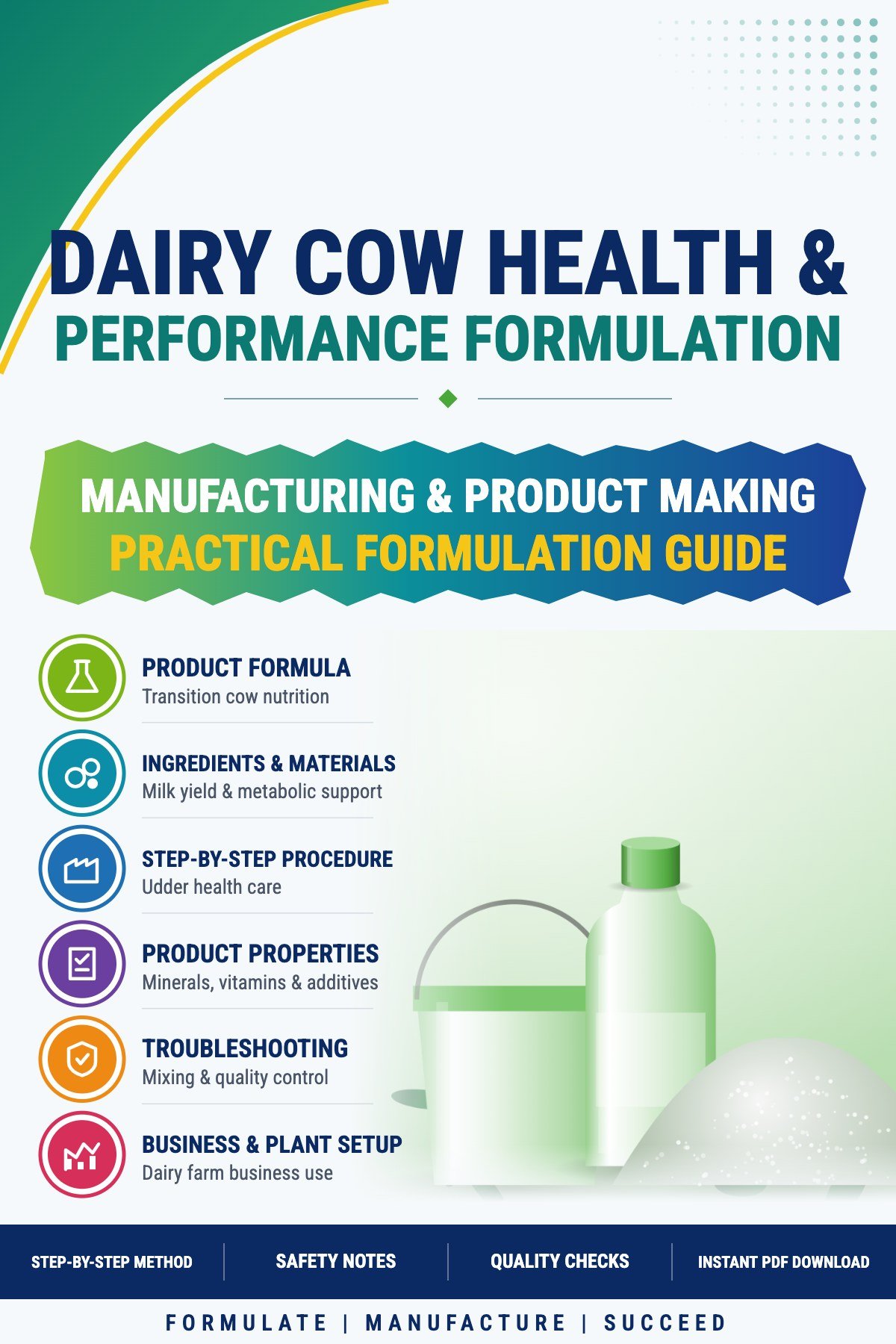

Dairy Cow Health & Performance Formulation
USD $90
PDF manual · Instant downloadDairy Cow Health & Performance Formulation: a PDF guide to making nutritional and udder-care products for dairy herds, with manufacturing methods, quality control and regulatory notes.
Payment Methods
Refund Policy
Custom Formulation Services
Formulation Consultation
Contact Us
Dairy Cow Health & Performance Formulation is a practical PDF guide for feed and supplement manufacturers, dairy-input entrepreneurs and farm suppliers who want to make nutritional and topical support products for commercial dairy herds. The modern dairy cow works at a very high metabolic level, and the weeks around calving and the peak of lactation put her under the greatest strain. A well-designed dairy cow health and performance formula supports milk production efficiency, metabolic stability, udder health and reproductive resilience. This page explains the thinking behind a dairy cow health & performance formulation, what the guide covers and how to judge whether it fits your business.
This guide is published by Chemical Formulation Services, the formulation publishing and consultancy business of CFS Formulation Services Ltd in Sheffield, United Kingdom. It is written for people who want to understand the product from the raw material to the finished pack, and it keeps its claims practical rather than promotional.
At a glance
- Product: Dairy Cow Health & Performance Formulation, a digital PDF Product Making Guide.
- Also searched as: dairy cow supplement formula, dairy cattle health premix, transition cow supplement, udder care formulation.
- What it covers: nutritional support systems and topical udder-care products for dairy herds.
- Key goals: milk production efficiency, metabolic stability, udder health and reproductive resilience.
- Who it is for: feed and premix manufacturers, farm-input suppliers and dairy entrepreneurs.
- Delivery: instant PDF download after payment is confirmed.
- Publisher: CFS Formulation Services Ltd, England and Wales company number 16678503.
Why dairy cows need targeted support
A high-yielding dairy cow turns feed into milk at a rate that few other farm animals match. In early lactation she may produce far more energy in milk than she can take in from her feed, so she draws on body reserves to bridge the gap. This negative energy balance, together with the sudden demand for calcium at calving, makes the transition period a time of real risk. Problems that appear then, such as low blood calcium, ketosis, retained placenta, displaced abomasum, mastitis and delayed return to breeding, cost dairy farms heavily in lost milk, treatment and culling.
Supplement and care products cannot replace good management, comfortable housing, clean water and a well-balanced ration. Their role is to fill gaps, support the cow through demanding stages and help farmers reach the potential of their herd. A good dairy cow health & performance formula works within that whole picture.
The stages of the dairy cow cycle
Dry period and close-up
In the weeks before calving, the cow rests her udder and prepares for the next lactation. Nutrition at this stage affects calf growth, the cow’s immune system and her ability to cope with calcium demand. Mineral balance in the dry ration, especially the levels of calcium, magnesium and potassium, receives special attention.
The transition period
The transition period covers roughly the three weeks before and after calving. Feed intake drops around calving just as energy and calcium demands rise sharply. Support in this phase focuses on energy supply, calcium availability, rumen function and immune support.
Early and peak lactation
Milk yield climbs quickly to a peak a few weeks after calving, while appetite lags behind. Supplements that help rumen stability, energy density and nutrient supply support the cow through this demanding stretch and set up fertility for the next breeding.
Mid and late lactation
As milk yield declines, the cow’s priorities shift to maintaining condition and getting back in calf. Nutrition here is about efficiency and avoiding over-conditioning before the next dry period.
Types of support product covered
Nutritional supplements and premixes
These are blends of minerals, vitamins, trace elements and functional additives that are added to the ration or fed in a carrier. Calcium, magnesium, phosphorus, zinc, copper, manganese, selenium, iodine, cobalt and vitamins A, D and E all play roles in milk production, immunity and fertility. The challenge for the manufacturer is to blend small quantities of potent ingredients evenly through a large mass of carrier so that every cow gets the right dose.
Metabolic and energy support
Energy-supporting formulations help the cow through the period when intake lags behind demand. They are designed to support liver function and help the cow manage fat mobilisation. The guide explains the thinking behind these products and the kinds of ingredient they combine.
Rumen-support additives
The rumen is a fermentation vat, and its microbes produce most of the energy the cow uses. Buffers, yeast products and other additives can help keep rumen conditions stable when the ration is rich in starch. Good rumen function means better fibre digestion, steadier intake and higher milk components.
Topical udder-care products
Teat dips and sprays, udder washes and conditioning products help keep teat skin healthy and reduce the spread of bacteria that cause mastitis. They must be effective against common mastitis organisms, gentle on skin, stable in storage and easy to use twice or more per day. The guide covers topical systems as part of a complete herd-health range.
What is inside the Dairy Cow Health & Performance Formulation guide
The guide is a technical formulation data sheet with practical compositions and step-by-step manufacturing methods for the nutritional and topical products described above. It explains how to select raw materials, how to blend and process them, how to test finished batches, how to pack and label products and how to present them to farmers. It also contains advice on dose rates, feeding guidance and starting a small manufacturing business. As with every CFS guide, the aim is practical, industrially minded information that a manufacturer can follow.
How a premix or supplement is made
The detail is in the guide. The outline shows how production is organised.
Step 1: Source and check raw materials
Minerals, vitamins and additives must be of feed grade from reliable suppliers, with certificates of analysis. Particle size, moisture and potency are checked, because vitamins in particular lose activity with heat, light and moisture.
Step 2: Prepare the carrier
A carrier such as limestone, wheat middlings, rice hulls or similar material is dried and sieved to a consistent size so that small ingredients distribute evenly.
Step 3: Pre-mix the potent ingredients
Trace elements and vitamins are used at very low levels, so they are first blended into a small premix with part of the carrier, then added to the main batch. This step prevents hot spots.
Step 4: Blend to uniformity
The batch is mixed for the time shown to give a uniform product. Mixing time and mixer type decide uniformity, and the guide describes how to check it.
Step 5: Sample, test and pack
Samples are tested for key nutrients and mix uniformity. The product is packed in moisture-resistant bags, sealed and labelled with batch number, composition, feeding instructions and storage conditions.
Equipment and plant requirements
A feed-supplement unit needs accurate scales, a horizontal ribbon or paddle mixer, a small premix mixer, sieves, dust extraction, a bag filler and sealer, dry storage and a simple laboratory. For topical products, add stainless or plastic mixing tanks, filling equipment and clean storage. Cleanliness and the avoidance of cross-contamination between products are essential, especially where some ingredients are not permitted in certain species or markets.
Quality control for every batch
- Raw material testing: identity, potency and contamination checks on incoming minerals and vitamins.
- Mix uniformity: tracer or analytical checks on samples from different parts of the batch.
- Nutrient analysis: verifying declared levels of key minerals and vitamins.
- Moisture and stability: low moisture protects vitamin potency and prevents caking and mould.
- Microbial safety: testing for Salmonella and other contaminants as required.
- Teat-care checks: concentration, pH, stability and skin tolerance of topical products.
- Traceability: batch records that allow any product to be traced back to its ingredients.
Troubleshooting production
Uneven nutrient levels
Poor mixing, wrong order of addition, static or particle size mismatch are the main causes. Use a premix step and check mixer capacity and time.
Caking and lumps
Moisture is the usual cause. Dry raw materials, keep the plant dry and use moisture-proof packaging.
Loss of vitamin activity
Heat, light, air and some minerals destroy vitamins. Store cool and dark, protect with coatings where suitable and follow shelf-life limits.
Poor palatability
Cows may reject a supplement with strong or bitter flavours. Adjust the carrier, add a suitable flavour or change the way it is fed.
Dust problems
Fine dust is a nuisance and a hazard. A small amount of oil or a binder, and good extraction, reduce it.
Safety, regulation and veterinary involvement
Animal-feed products are regulated in most countries. Rules cover which ingredients may be used, maximum levels for minerals and additives, labelling, registration of premises and claims you may make. Several trace elements, copper and selenium for example, are essential at low levels and harmful in excess, and some minerals are toxic to particular species, so formulation and dosing must be accurate. Products that claim to treat or prevent disease may count as veterinary medicines, which are strictly controlled. This guide is meant for supplement and care product manufacturing, and it does not replace advice from a veterinarian or a qualified animal nutritionist. Always involve one when designing rations for a herd, and check the regulations in your market before selling anything.
The business opportunity
Dairying is a large, steady industry, and farmers continually look for practical ways to improve yields, health and fertility. Suppliers who understand the transition cow, provide consistent products and offer sound technical support can build lasting relationships with farms, feed mills, cooperatives and veterinary practices. Selling through distributors and farm-supply stores, or supplying under private label to larger feed companies, are common routes. Strong results come from trust, so keep your claims honest and your quality high.
Livestock and farm-input products connect with other CFS guides. Browse the Poultry Veterinary Livestock category, and see Fertilizers for related agricultural products. For farm hygiene and cleaning, you may also want the Cleaning Products and Detergent Formulations categories.
Starting out
Begin with one or two products for which you can source reliable ingredients and test results, such as a mineral premix and a teat-care product. Run small trial batches, compare them with established products, and ask a local nutritionist or veterinarian to review your composition and feeding guidance. Keep careful records, pack professionally and build from a base of satisfied customers.
How to get the best results from this guide
Treat the guide as a tested starting point rather than a finished factory. Begin with a small trial batch in the laboratory or on a bench, using the exact raw materials you plan to buy, and record every weight, temperature, mixing time and observation. Compare the result with the quality checks in the guide, change only one thing at a time, and keep a note of what each change did. Once a small batch is consistently good, repeat it several times, then scale up in stages, because mixing, heating and cooling behave differently in larger vessels. Keep retained samples of every batch, write simple standard operating procedures for your team, and build relationships with two suppliers for each key raw material. Finally, check the labelling, safety and product rules in the country where you will sell, and ask a qualified person to review your process. This careful, documented approach is what turns a good formulation into a reliable product and a trusted brand.
Who should buy this guide?
The guide is written for practical readers. It suits manufacturers who want to add a new product to an existing plant, startups choosing their first product, private-label brands that need to understand what they are buying, technical staff who must set specifications and train operators, and consultants and students who want a structured, plain-language reference. It is less suitable for anyone looking for a quick shortcut or a guarantee, because every formulation still needs testing with your own materials, equipment and local rules. If you are unsure whether it matches your project, send a short question through the contact page before you order, and we will tell you honestly whether it fits.
What is inside the Dairy Cow Health & Performance Formulation guide
Every Product Making Guide in our shop follows the same structure so you know where to look. This guide includes the product formula, the ingredients and materials, the procedure and preparations, the industrial requirements and the technical specifications. In practice you receive:
- The formulation, written so you can follow it at the bench and scale it up.
- Ingredients and materials, with the job of each material and advice on grades and suppliers.
- The manufacturing procedure, including order of addition, mixing and preparations.
- Industrial requirements, covering equipment, space and packaging.
- Technical specifications, describing what a good finished product should look like and how it should behave.
- Troubleshooting for the faults that makers meet most often.
- Business guidance, to help you take the product from the bench to the market.
These Product Making Guides of chemical formulations and formulas are for manufacturers, startups and entrepreneurs. Every guide contains industrially tested, practical formulations. Anyone who buys a guide can make the product by following its step-by-step instructions. Raw materials vary between suppliers, so always confirm your results with a small trial batch before scaling up.
Who stands behind this guide?
Chemical Formulation Services is the trading name of CFS Formulation Services Ltd, registered in England and Wales under company number 16678503, with its office at Unit F, Winston Business Park, Churchill Way, Sheffield S35 2PS. The business was founded by George Enrick and publishes formulation manuals, technical guides and industry reports. You can check our details on the Companies House register, read about us, or contact us with any question before you order.
A written formulation cannot replace testing with your own raw materials, equipment and climate, and we say so plainly. What the guide does give you is a tested, structured starting point that can save you months of trial and error. Our terms and conditions explain what a purchase from us covers.
How to order
- Select Add to cart to keep browsing, or Buy Now to go straight to checkout.
- Pay with PayPal, Stripe, Xoom by PayPal, Payoneer, payment links for debit and credit cards, or Western Union, Ria and all money exchanges.
- If you pay through a money exchange, email your payment slip to Info@chemicalformulationservices.com. After confirmation, your instant download link is emailed to you.
- For online payments, the PDF is available as soon as the payment is confirmed.
All products are digital downloads and all payments are nonrefundable once the file is delivered, so please read the refund policy and the FAQs before you order. You can compare this guide with others in the formula shop or browse our industrial project reports.
Frequently asked questions about dairy cow health & performance formulation
What is the Dairy Cow Health & Performance Formulation guide?
It is a digital PDF Product Making Guide that explains how to make nutritional and topical support products for dairy herds, covering formulation, manufacturing, quality control and use.
Why is the transition period so important?
The weeks before and after calving combine falling feed intake with sharply rising energy and calcium needs, so many metabolic and health problems appear then.
Why use a premix step when blending?
Trace elements and vitamins are used at tiny levels, so they are blended first into a small premix and then added to the batch to ensure even distribution.
Do these products replace veterinary advice?
No. Supplements support good management but do not replace a veterinarian or animal nutritionist, and products making treatment claims may be regulated as medicines.
Are feed supplements regulated?
Yes. Most countries regulate permitted ingredients, maximum levels, labelling and claims, so check local rules before selling.
How do I receive the guide?
You receive an instant PDF download after payment is confirmed. For money exchanges, email your payment slip to Info@chemicalformulationservices.com and the link is emailed after we confirm it.
Is the payment refundable?
All payments are nonrefundable because the product is an instant digital download. See the refund policy for details.
Can you help with a custom formulation?
CFS Formulation Services Ltd offers formulation and product development consultancy. Send a short brief through the Contact page.
Last reviewed: November 2026. This page is general information about a digital product. It is not a safety data sheet or professional advice, and any formulation should be tested and reviewed by a qualified person before commercial use.