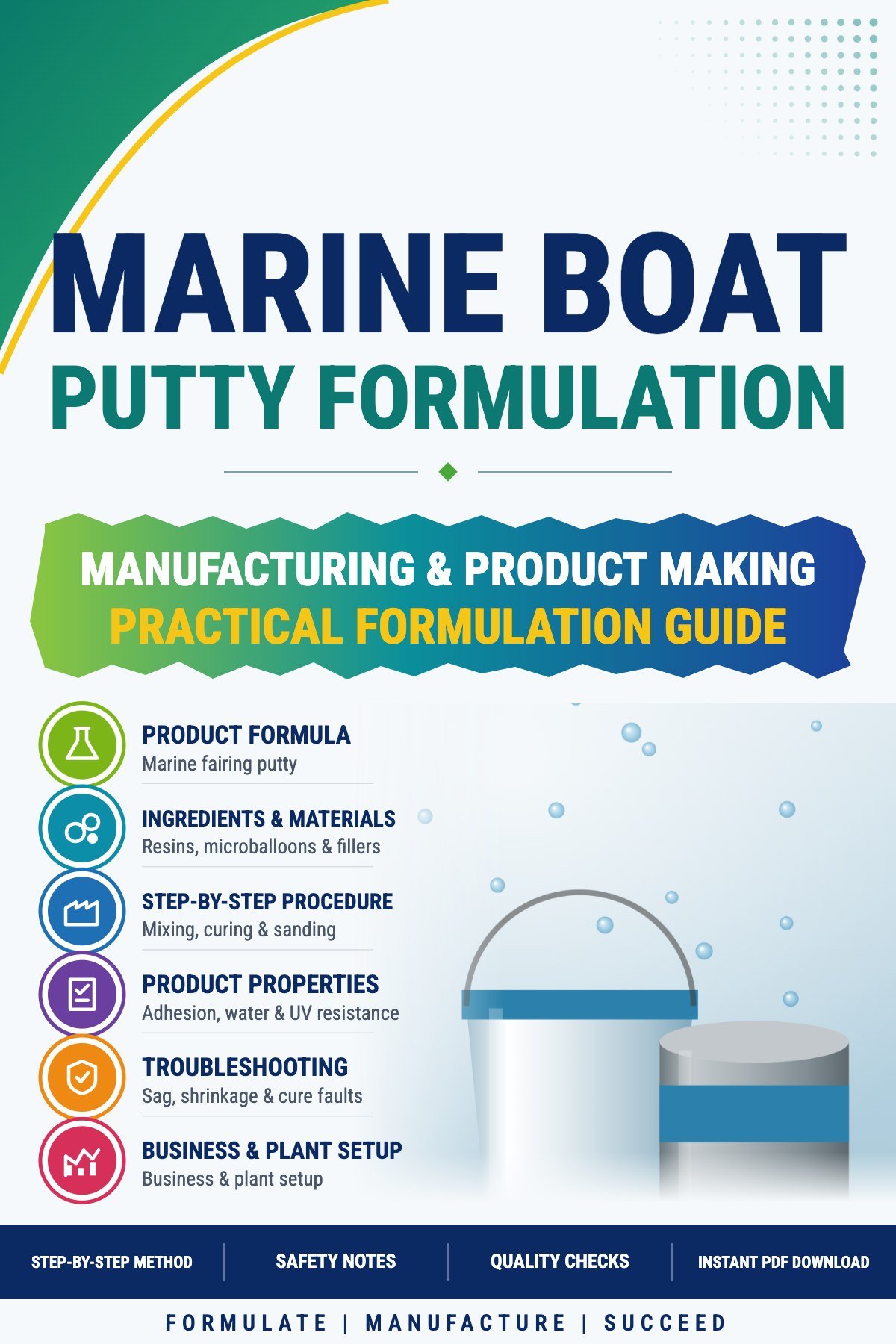
Marine Boat Putty Formulation
USD $70
PDF manual · Instant downloadMarine Boat Putty Formulation: a PDF guide to marine putty and fairing compounds for boats, covering resins, fillers, process, quality control and troubleshooting.
Payment Methods
Refund Policy
Custom Formulation Services
Formulation Consultation
Contact Us
Marine Boat Putty Formulation is a practical PDF guide for formulators, marine coating manufacturers, boat repair workshops and technical professionals who want to design high-performance putty systems for boats, yachts and other watercraft. A marine putty is a thick, sandable filler used to repair damaged hulls, fill gouges and holes, fair out uneven surfaces and prepare a boat for painting. Boats work in a harsh environment, with constant moisture, saltwater, ultraviolet light, vibration and flexing, so an ordinary building filler will not last. This page explains how a sound marine boat putty formula works, what the guide covers and how to judge whether it fits your business.
This guide is published by Chemical Formulation Services, the formulation publishing and consultancy business of CFS Formulation Services Ltd in Sheffield, United Kingdom. It is written for people who want to understand the product from the raw material to the finished pack, and it keeps its claims practical rather than promotional.
At a glance
- Product: Marine Boat Putty Formulation, a digital PDF Product Making Guide.
- Also searched as: marine boat putty formula, boat fairing compound, epoxy putty for boats, polyester boat filler, hull repair putty.
- What it covers: resin systems, fillers, curing, sanding behaviour, adhesion and durability of marine putties.
- Typical uses: hull repair, fairing, filling screw holes and gelcoat damage, and surface preparation before painting.
- Who it is for: coating manufacturers, formulators, boat yards and repair businesses.
- Delivery: instant PDF download after payment is confirmed.
- Publisher: CFS Formulation Services Ltd, England and Wales company number 16678503.
Why boats need special putty
A boat is a moving structure that lives in water. A hull flexes in waves, warms and cools with the sun, sits in salt spray and is hit by trailers, docks and debris. Water is the biggest enemy of any filler. If a putty absorbs water, it swells, softens, loses adhesion and eventually falls out, and water can then reach the layers underneath. Marine putties therefore have to be low in water absorption, strongly adhesive to different hull materials, tough enough to cope with flexing and stable under ultraviolet light and temperature changes.
Boats are built from fibreglass, wood, aluminium, steel and composites, and each material needs a putty that bonds to it. A good marine putty also has to be easy to work: it should spread smoothly, hold its shape on vertical surfaces without sagging, cure at a predictable rate and sand to a fine, feather-edged finish that disappears under paint. The balance between these demands is the art of marine putty formulation.
The main types of marine putty
The guide explains the main resin systems used in marine putties and the advantages and limits of each.
Epoxy putties
Epoxy putties are the premium choice for marine work. Epoxy resin bonds strongly to many surfaces, resists water extremely well, shrinks little during cure and is very tough. These putties are usually supplied as two components, a resin and a hardener, which are mixed just before use. Epoxy fairing compounds, which are lightweight and easy to sand, are widely used to smooth hulls, while heavier epoxy putties fill structural defects and holes. The downside is cost, and the need for accurate mixing ratios and temperature control.
Polyester putties
Polyester resin putties are cheaper and cure faster, and are commonly used for fibreglass repair and gelcoat work. They are mixed with a small amount of a peroxide hardener. They bond well to polyester laminates but are less water-resistant and have lower adhesion on some other materials, so they are best used above the waterline or on compatible substrates.
Polyurethane and other systems
Flexible polyurethane fillers and sealant-type putties are used where movement is expected, for example around fittings, deck joints and some wooden structures. They have lower hardness and sandability, but better flexibility.
The building blocks of a marine putty formula
The guide sets out the exact materials, proportions and order of addition. In outline, the main groups are as follows.
Resin and hardener
The resin and its hardener or catalyst form the matrix that binds everything together. The choice of resin decides adhesion, water resistance, flexibility, cure speed and cost. Hardener selection controls working time and cure temperature range. Because curing chemistry is sensitive to temperature, formulators often make summer and winter versions.
Lightweight fillers
Hollow glass or phenolic microspheres, often called microballoons, reduce weight and make the putty easy to sand. They are the main ingredient in fairing compounds, because a boat putty that is easy to sand and light gives a fair, smooth surface with less effort. Too much microballoon can make the putty weak and absorbent, so balance is important.
Reinforcing and thixotropic fillers
Fumed silica and similar materials give the putty its sag resistance and creamy, spreadable consistency, so it stays where it is applied. Fibres, such as short glass or other fibres, can add strength for structural fills. Talc, calcium carbonate and other mineral fillers adjust density, cost and sanding behaviour.
Pigments and additives
Pigments give the putty a colour that helps you see where it has been applied and that sands to a visible boundary. Wetting and dispersing agents, adhesion promoters and defoamers improve manufacturing and performance. Colour change between components in two-part systems can also show that mixing is complete.
Why mixing and cure matter so much
Two-part marine putties depend on accurate mixing of resin and hardener. Too little hardener leaves the putty soft and tacky, and too much can make it brittle or cure too fast. The cure is also temperature-dependent: cold slows it greatly, and heat can speed it dangerously. Thick sections of epoxy generate heat as they cure, which can shorten working time or cause cracks. A good formulation is designed to give workers a reasonable window, and its instructions explain how to handle different conditions. Manufacturers often supply colour-coded components, pumps or pre-measured packs to reduce mixing mistakes.
What is inside the Marine Boat Putty Formulation guide
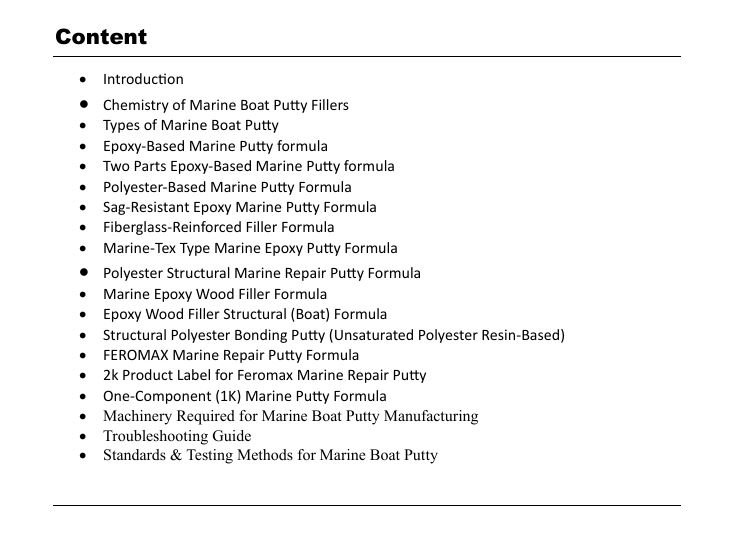
The guide is a technical formulation data sheet that explains how marine putty systems are designed and made. It covers resin selection, fillers, additives, mixing and filling processes, testing methods and troubleshooting, together with advice on packaging, labelling and business planning. It is designed for formulators who want a dependable starting point.
How marine putty is manufactured
The full method is in the guide. The outline below shows how the process runs.
Step 1: Check and weigh materials
Resins, hardeners, fillers and additives are checked against specification and weighed accurately. Fillers should be dry, because moisture interferes with cure and bonds.
Step 2: Prepare the resin component
Resin, wetting agents and any adhesion promoters are charged into a mixer, and the thixotropic filler is dispersed under shear to give a smooth, stable paste.
Step 3: Add lightweight fillers
Microballoons are added gently, because high shear breaks the hollow spheres and ruins the weight advantage. Mixing is done in a way that wets the fillers without crushing them.
Step 4: Prepare the hardener component
The second component is prepared and filled separately. For two-part systems, the two components are designed to be mixed in an easy ratio, such as equal volumes, and they are colour coded.
Step 5: Test, fill and label
Samples are mixed and tested for working time, cure, sanding and adhesion. Containers are filled, sealed and labelled with mixing instructions, working time, cure times, safety information and batch codes.
Equipment and plant requirements
A marine putty plant needs accurate scales, a planetary or double-arm mixer for heavy pastes, a gentle mixer for lightweight fillers, vacuum capability if possible to remove air, filling equipment for pastes in tins, tubs or cartridges, and clean storage. A laboratory with a cure-time test, a hardness gauge, sanding tests and a water absorption test is valuable. Because resins and hardeners can irritate skin and release vapours, ventilation, gloves and eye protection are essential. Many small manufacturers start with a single mixer and manual filling, then add automation as sales grow.
Quality control for every batch
- Appearance and consistency: smooth, uniform, free of lumps, air bubbles and settling.
- Sag resistance: check that a layer on a vertical surface does not run.
- Working time and cure: measured at standard and extreme temperatures.
- Sanding: after cure, sand the putty and check that it feathers cleanly without clogging.
- Adhesion: pull-off or cross-hatch tests on the surfaces the product is sold for.
- Water absorption: immersion tests to confirm low uptake.
- Shrinkage and cracking: check thick and thin applications.
- Shelf stability: samples stored to check for settling, thickening or loss of reactivity.
Troubleshooting marine putty making
Putty sags on vertical surfaces
Increase the thixotropic filler level, adjust viscosity and check the working conditions. Test on vertical test panels.
Putty is hard to sand or clogs the paper
Review filler balance, resin level and cure. Overcured or resin-rich putty can be tough to sand, and under-cured putty gums up the paper.
Soft, sticky or slow cure
Check mixing ratio, hardener quality, temperature and the presence of moisture or contaminants in fillers.
Cracking or shrinkage
Thick sections, high exotherm, wrong resin system or too much filler can cause cracking. Adjust the formula, recommend building up in layers and test thick applications.
Poor adhesion
Surface preparation and adhesion promoters matter. Make sure surfaces are clean, dry and abraded, and choose a resin system that bonds to the target material.
Pinholes and voids
Air trapped during mixing or application can cause voids. Improve de-airing in production and give users good application advice.
Water uptake and blistering
Choose a more water-resistant resin, limit hollow fillers in critical areas, and recommend a barrier coat below the waterline.
Safety, labelling and responsible claims
Resin systems can sensitise skin and irritate eyes and lungs, and some hardeners are corrosive, so manufacturing and use need protective equipment and good ventilation. Sanding creates dust that should not be breathed, so recommend masks and dust extraction. Read the safety data sheet for each raw material, label packs with hazard information, mixing ratios and cure times, and check chemical and product regulations where you sell. Do not claim waterproof performance below the waterline unless you have tested and documented it. You remain responsible for meeting safety, labelling and legal requirements, and a qualified person should review your process before commercial production.
The business opportunity in marine repair products
Boats of every size need maintenance and repair, and the market includes boat builders, repair yards, marinas, fishing fleets, yacht owners and do-it-yourself boaters. Marine products carry premium prices for quality and reliability, and customers are loyal to brands that work. A manufacturer can sell through chandlers, marine supply stores, boat yards and online platforms, and can supply private-label brands. A complete range, including primers, putties, paints and sealants, makes it easier to win repeat business.
Putty works alongside related products. Our guides include Epoxy Marine Coating Formula, Epoxy Marine Paint Formula, Paint Putty Formula, Car Body Filler Putty Formula, Epoxy Paint Primer Formula, Polyurea Hot Spray Coating Formulation, PU Sealant Formulations, Silicone Sealant Formulation and Red Oxide Metal Primer Formula. Browse the Paint Industry and Coating Formulations categories for more.
Starting a marine putty business
Choose one resin system and one or two products to start, such as a lightweight fairing compound and a structural filler. Test them on real boats and in different climates, gather feedback from boat yards, and refine before scaling. Document your batches, prepare clear instructions and safety information, and be honest about limits. The Marine Boat Putty Formulation guide gives you the technical foundation, so you can focus on testing, customers and quality.
How to get the best results from this guide
Treat the guide as a tested starting point rather than a finished factory. Begin with a small trial batch in the laboratory or on a bench, using the exact raw materials you plan to buy, and record every weight, temperature, mixing time and observation. Compare the result with the quality checks in the guide, change only one thing at a time, and keep a note of what each change did. Once a small batch is consistently good, repeat it several times, then scale up in stages, because mixing, heating and cooling behave differently in larger vessels. Keep retained samples of every batch, write simple standard operating procedures for your team, and build relationships with two suppliers for each key raw material. Finally, check the labelling, safety and product rules in the country where you will sell, and ask a qualified person to review your process. This careful, documented approach is what turns a good formulation into a reliable product and a trusted brand.
Who should buy this guide?
The guide is written for practical readers. It suits manufacturers who want to add a new product to an existing plant, startups choosing their first product, private-label brands that need to understand what they are buying, technical staff who must set specifications and train operators, and consultants and students who want a structured, plain-language reference. It is less suitable for anyone looking for a quick shortcut or a guarantee, because every formulation still needs testing with your own materials, equipment and local rules. If you are unsure whether it matches your project, send a short question through the contact page before you order, and we will tell you honestly whether it fits.
What is inside the Marine Boat Putty Formulation guide
Every Product Making Guide in our shop follows the same structure so you know where to look. This guide includes the product formula, the ingredients and materials, the procedure and preparations, the industrial requirements and the technical specifications. In practice you receive:
- The formulation, written so you can follow it at the bench and scale it up.
- Ingredients and materials, with the job of each material and advice on grades and suppliers.
- The manufacturing procedure, including order of addition, mixing and preparations.
- Industrial requirements, covering equipment, space and packaging.
- Technical specifications, describing what a good finished product should look like and how it should behave.
- Troubleshooting for the faults that makers meet most often.
- Business guidance, to help you take the product from the bench to the market.
These Product Making Guides of chemical formulations and formulas are for manufacturers, startups and entrepreneurs. Every guide contains industrially tested, practical formulations. Anyone who buys a guide can make the product by following its step-by-step instructions. Raw materials vary between suppliers, so always confirm your results with a small trial batch before scaling up.
Who stands behind this guide?
Chemical Formulation Services is the trading name of CFS Formulation Services Ltd, registered in England and Wales under company number 16678503, with its office at Unit F, Winston Business Park, Churchill Way, Sheffield S35 2PS. The business was founded by George Enrick and publishes formulation manuals, technical guides and industry reports. You can check our details on the Companies House register, read about us, or contact us with any question before you order.
A written formulation cannot replace testing with your own raw materials, equipment and climate, and we say so plainly. What the guide does give you is a tested, structured starting point that can save you months of trial and error. Our terms and conditions explain what a purchase from us covers.
How to order
- Select Add to cart to keep browsing, or Buy Now to go straight to checkout.
- Pay with PayPal, Stripe, Xoom by PayPal, Payoneer, payment links for debit and credit cards, or Western Union, Ria and all money exchanges.
- If you pay through a money exchange, email your payment slip to Info@chemicalformulationservices.com. After confirmation, your instant download link is emailed to you.
- For online payments, the PDF is available as soon as the payment is confirmed.
All products are digital downloads and all payments are nonrefundable once the file is delivered, so please read the refund policy and the FAQs before you order. You can compare this guide with others in the formula shop or browse our industrial project reports.
Frequently asked questions about marine boat putty formulation
What is the Marine Boat Putty Formulation guide?
It is a digital PDF Product Making Guide covering the design and manufacture of marine putties and fairing compounds for boats, with resins, fillers, process, testing, troubleshooting and business guidance.
What is the difference between epoxy and polyester boat putty?
Epoxy putties bond strongly, resist water very well and shrink little but cost more. Polyester putties are cheaper and faster curing but less water-resistant and best on compatible fibreglass.
Why are microballoons used in marine putty?
Hollow glass or phenolic microspheres make the putty light and easy to sand, so it fairs a hull smoothly with less effort.
Why does temperature matter for two-part putty?
Cure speed depends on temperature. Cold slows it and heat speeds it, so working time and final properties change, which is why seasonal versions are often made.
Can marine putty be used below the waterline?
Only if it is formulated and tested for permanent immersion, usually a water-resistant epoxy system with a barrier coat. Do not claim it without testing.
How do I receive the guide?
You receive an instant PDF download after payment is confirmed. For money exchanges, email your payment slip to Info@chemicalformulationservices.com and the link is emailed after we confirm it.
Is the payment refundable?
All payments are nonrefundable because the product is an instant digital download. See the refund policy for details.
Can you help with a custom formulation?
CFS Formulation Services Ltd offers formulation and product development consultancy. Send a short brief through the Contact page.
Last reviewed: November 2026. This page is general information about a digital product. It is not a safety data sheet or professional advice, and any formulation should be tested and reviewed by a qualified person before commercial use.