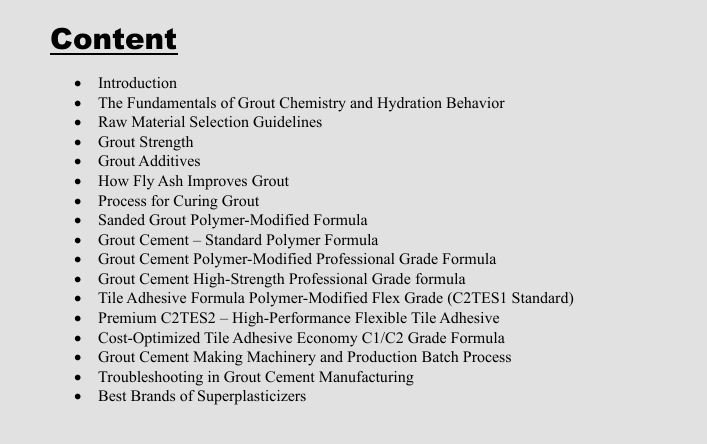
Grout Cement Formula
USD $75
PDF manual · Instant downloadProduct Making Guide. These Product Making Guides of chemical formulations and formulas are for manufacturers, startups and entrepreneurs. Every guide contains industrially tested, practical formulations. Anyone who buys a guide can make the product by following its step-by-step instructions.
Payment Methods
Pay with PayPal, Stripe, Xoom by PayPal, Payoneer, payment links for debit and credit cards, or Western Union, Ria and all money exchanges. For payment links, Payoneer, Western Union, Ria or any other money exchange, email Info@chemicalformulationservices.com and we will send you the payment details for your country. After you pay, share your payment slip at the same address. Once we confirm it, your instant download link is emailed to you. Online payments unlock the download as soon as they are confirmed. More answers are on our FAQs page.
Refund Policy
Every manual is a digital download, so refunds are not available after a successful download or access. If you cannot open your file we will help you get access, and an accidental duplicate purchase can be reviewed if you contact us within 7 days. Read the full Refund Policy, Terms and Conditions and Privacy Policy.
Custom Formulation Services
Need a formula adapted to your raw materials, batch size or market? Send us a short brief and we will tell you what is possible. Use the Contact page or email Info@chemicalformulationservices.com.
Formulation Consultation
CFS Formulation Services Ltd offers technical consultancy on formulation and product development. Tell us what you plan to make and we will guide you on raw materials, equipment and next steps. Learn more about us or book a consultation.
Contact Us
Email Info@chemicalformulationservices.com or call +44 7365 764496. Our address is Unit F, Winston Business Park, Churchill Way, Sheffield S35 2PS, United Kingdom. You can also use the Contact page.
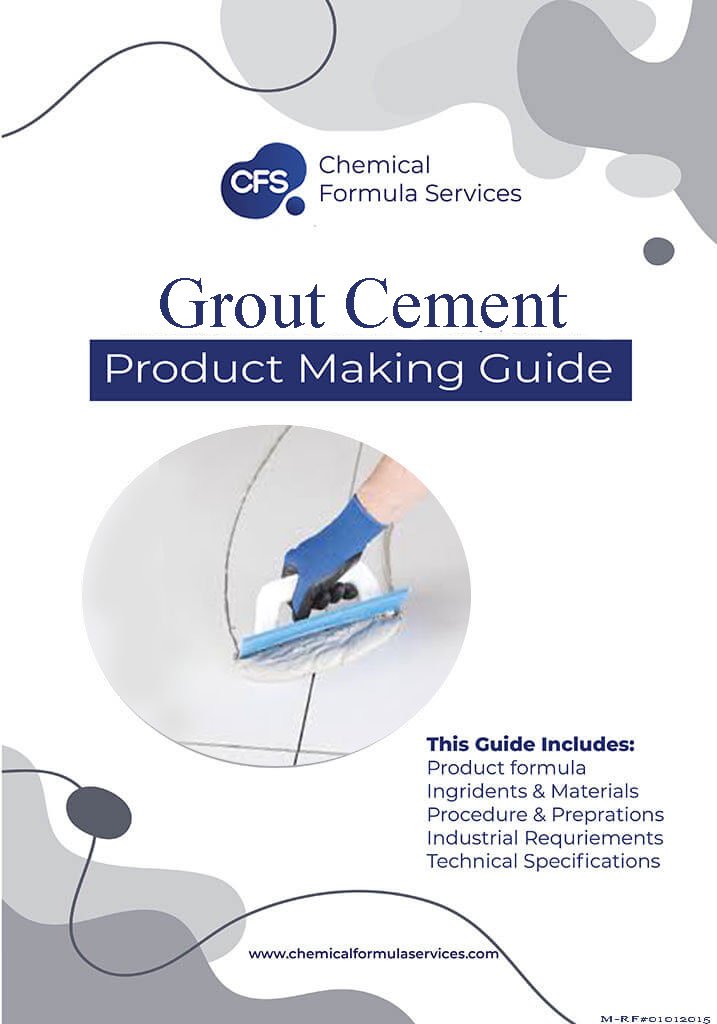
Grout cement formula is a composite material used in construction to fill gaps, seal joints, and provide structural reinforcement. It is commonly used in a variety of applications, including tile installation, masonry work, and the stabilization of structural elements.
Grout cement formula Key Characteristics:
- Fluidity:
- Grout cement has a flowable consistency that allows it to be easily poured or injected into gaps and cavities.
- Strength:
- It develops significant compressive strength, providing stability and support to the structures it fills.
- Adhesion:
- Grout cement adheres well to various surfaces, including concrete, stone, and masonry, ensuring a secure bond.
- Durability:
- It is resistant to environmental conditions such as moisture, temperature fluctuations, and chemical exposure, ensuring long-term performance.
- Shrinkage Resistance:
- High-quality grout cement minimizes shrinkage during curing, reducing the risk of cracks and ensuring structural integrity.
Common Types of Grout Cement:
- Non-Shrink Grout:
- Designed to maintain its volume during curing, preventing shrinkage cracks and providing long-lasting support.
- Epoxy Grout:
- A two-part system consisting of epoxy resin and hardener, known for its high strength, chemical resistance, and durability.
- Polymer-Modified Grout:
- Contains added polymers to enhance flexibility, adhesion, and water resistance.
- Hydraulic Cement Grout:
- Uses hydraulic cement, which sets and hardens through a chemical reaction with water, suitable for underwater applications.
- Cementitious Grout:
- The most common type, made from a mixture of cement, sand, and water, sometimes with additional admixtures to enhance properties.
Applications:
- Tile Installation:
- Fills the joints between tiles to secure them in place and provide a smooth, finished surface.
- Masonry Work:
- Used to fill voids in brick, stone, or block constructions, enhancing stability and strength.
- Structural Repair:
- Reinforces and repairs damaged concrete structures by filling cracks and gaps.
- Anchor Grouting:
- Secures anchor bolts and rebar in concrete, providing a solid foundation for structural elements.
- Underpinning:
- Stabilizes and strengthens existing foundations by injecting grout beneath them.
- Void Filling:
- Fills cavities and voids in soil or rock formations to provide stability and prevent settlement.
Benefits:
- Enhanced Structural Integrity:
- Improves the overall strength and stability of structures.
- Versatility:
- Suitable for a wide range of applications and conditions.
- Ease of Application:
- Can be easily mixed and applied, whether poured, pumped, or injected.
- Cost-Effective:
- Provides a reliable solution for structural reinforcement and repairs at a relatively low cost.
- Environmental Resistance:
- Withstands various environmental stresses, including moisture, temperature changes, and chemical exposure.
Considerations:
- Proper Mixing:
- Ensure thorough and consistent mixing to achieve the desired properties and performance.
- Curing:
- Follow appropriate curing procedures to maximize strength and durability.
- Compatibility:
- Select the right type of grout cement for the specific application and materials involved.
- Quality Control:
- Conduct regular testing and quality control checks to ensure consistent performance.
Grout cement is a crucial material in construction, offering versatility, strength, and durability for a wide range of applications. Its ability to fill gaps, secure structures, and resist environmental factors makes it an essential component in modern building practices.