
Oasis Floral Foam Formulation
USD $90
PDF manual · Instant downloadOasis Floral Foam Formulation: a step-by-step PDF guide to making open-cell phenolic floral foam, with raw materials, process, quality control, troubleshooting and safety notes.
Payment Methods
Refund Policy
Custom Formulation Services
Formulation Consultation
Contact Us
Oasis Floral Foam Formulation is a step-by-step PDF guide for people who want to understand, make and sell the green, water-absorbing foam blocks that florists use to hold cut flowers. If you search for an Oasis floral foam formula, you are really looking for three things: the right raw materials, a repeatable manufacturing method and a way to check that every batch behaves like the product florists already trust. This guide is written to give you exactly that, in the same practical order a production chemist would work in.
This page explains what floral foam is, how it works, what the guide covers, how the manufacturing process is organised, what can go wrong and what you must know about safety and the environment before you start. It is written by the team behind Chemical Formulation Services, the publishing and consultancy business of CFS Formulation Services Ltd in Sheffield, United Kingdom, and it is meant to help you decide whether this guide fits your project.
Quick facts about this guide
- Product: Oasis Floral Foam Formulation, a digital PDF Product Making Guide.
- Also searched as: Oasis floral foam formula, floral foam formulation, floral foam making, phenolic floral foam.
- Foam type covered: the open-cell, water-absorbent, phenolic-resin-based foam used for flower arranging.
- Who it is for: manufacturers, startups and entrepreneurs entering the floristry supply market.
- Delivery: instant download once payment is confirmed. For money exchanges, your download link is emailed after we confirm your payment slip.
- Publisher: CFS Formulation Services Ltd, England and Wales company number 16678503.
What is floral foam, and why does the formulation matter?
Floral foam is a rigid, lightweight, open-cell foam block. Florists soak it in water, push the stems of flowers and foliage into it and use it as both a support and a water reservoir. It is cut to shape with a knife, so it has to be firm enough to hold a stem upright yet soft enough to accept it without cracking. It also has to take up water quickly and hold it for days. Those requirements pull in different directions, and the formulation is how you balance them.
The foam used for this purpose is generally a phenolic foam. Patent literature on floral foam, for example US 4,225,679 and US 4,426,462, describes phenol-formaldehyde (and in some cases urea-formaldehyde) resins that are foamed under acid-catalysed conditions together with a surfactant, a wetting agent, a blowing agent and a colour. The same literature explains an important point that many newcomers miss: ordinary phenolic foam is mostly closed-cell and barely absorbs water, so floral foam needs a deliberately different cell structure. Choosing and controlling the ingredients that create that open structure is the heart of any serious floral foam formulation.
“Oasis” is a brand name owned by Smithers-Oasis, and many people use “Oasis” as shorthand for any green floral foam block. We use the phrase “Oasis floral foam” on this page because it is how buyers search for the product type. Our guide is independent and is not connected with, endorsed by or sold by Smithers-Oasis.
How floral foam actually works
Open cells and capillary uptake
When a dry block is placed on water, it does not need to be pushed under. Water is drawn into the interconnected cells by capillary action and the block sinks as it fills. That behaviour depends on two things: how open the cells are and how well the cell walls are wetted. A surface-active ingredient in the formulation lowers the contact angle between water and the resin, so the water spreads through the structure instead of beading on top of it. If either the cell structure or the wetting is wrong, the block floats, soaks unevenly or stays dry in the centre.
Density and stem holding
Density is the quiet variable behind almost every complaint about floral foam. Patent descriptions of floral foams give densities in the region of 1 to 2 pounds per cubic foot, which is roughly 16 to 32 kilograms per cubic metre. A foam that is too light crumbles and cannot grip a stem. A foam that is too dense feels hard, resists insertion and holds less water. The practical task for a manufacturer is to find the density window that gives firm stem support and fast, full saturation, and then to hold every batch inside that window.
Water retention
Once wet, the block must keep its water for the life of the arrangement. Retention comes from the same open-cell structure, but it is also affected by block size, the room it is stored in and how the foam is used. This is why florists soak blocks fully, avoid pushing a stem in and out repeatedly and keep the block supported on a base that stops it drying from underneath.
The raw material families behind a floral foam formula
A formulation guide has to name materials and give their proportions. On a public web page, the sensible thing is to explain the families of materials and the job each one does, so you can judge whether you can source and handle them. The exact materials, percentages and order of addition are in the guide itself.
- Phenolic resin. The resin is the backbone of the foam. Its viscosity and reactivity decide how the mixture rises and sets. Resin quality varies between suppliers, which is one reason the guide stresses testing a small batch first.
- Surfactants and wetting agents. These control cell size and make the cured foam accept water. The surfactant helps the mixture form fine, uniform bubbles, while the wetting agent works on the water-uptake side. If you want background on wetting chemistry, our textile wetting agent formulation shows how wetting agents are selected and dosed in a different industry.
- Blowing agent. The blowing agent creates the gas that expands the resin into foam. Its type and level affect density and cell structure. Some blowing agents are flammable, which is a handling and storage issue covered in the safety section below.
- Acid catalyst or hardener. Phenolic resols are cured by acid. The strength and amount of the catalyst control how fast the foam sets and how much heat it generates. Patent literature notes that milder foaming conditions, with a lower concentration of acid and a longer cure, can be useful when heat-sensitive additives are present.
- Colour. Floral foam is conventionally green because florists expect it, and the dye also helps you see mixing uniformity. Colour fading is a known problem and is listed in the troubleshooting section of the guide.
- Optional additives. Some formulations add cut flower food or a preservative to the resin before foaming, so the finished block carries nutrients and a bacteriocide. Published patents describe sugar-based flower food mixed into the resin before foaming. Urea is sometimes used to reduce formaldehyde odour.
If you are comparing this guide with other resin-based products, the shop has related manuals such as Phenolic Sheet Molding Compound Formula and Epoxy Resin Formulation, and the wider resin manufacturing category groups guides that share resin-handling skills.
What you get in the Oasis Floral Foam Formulation guide
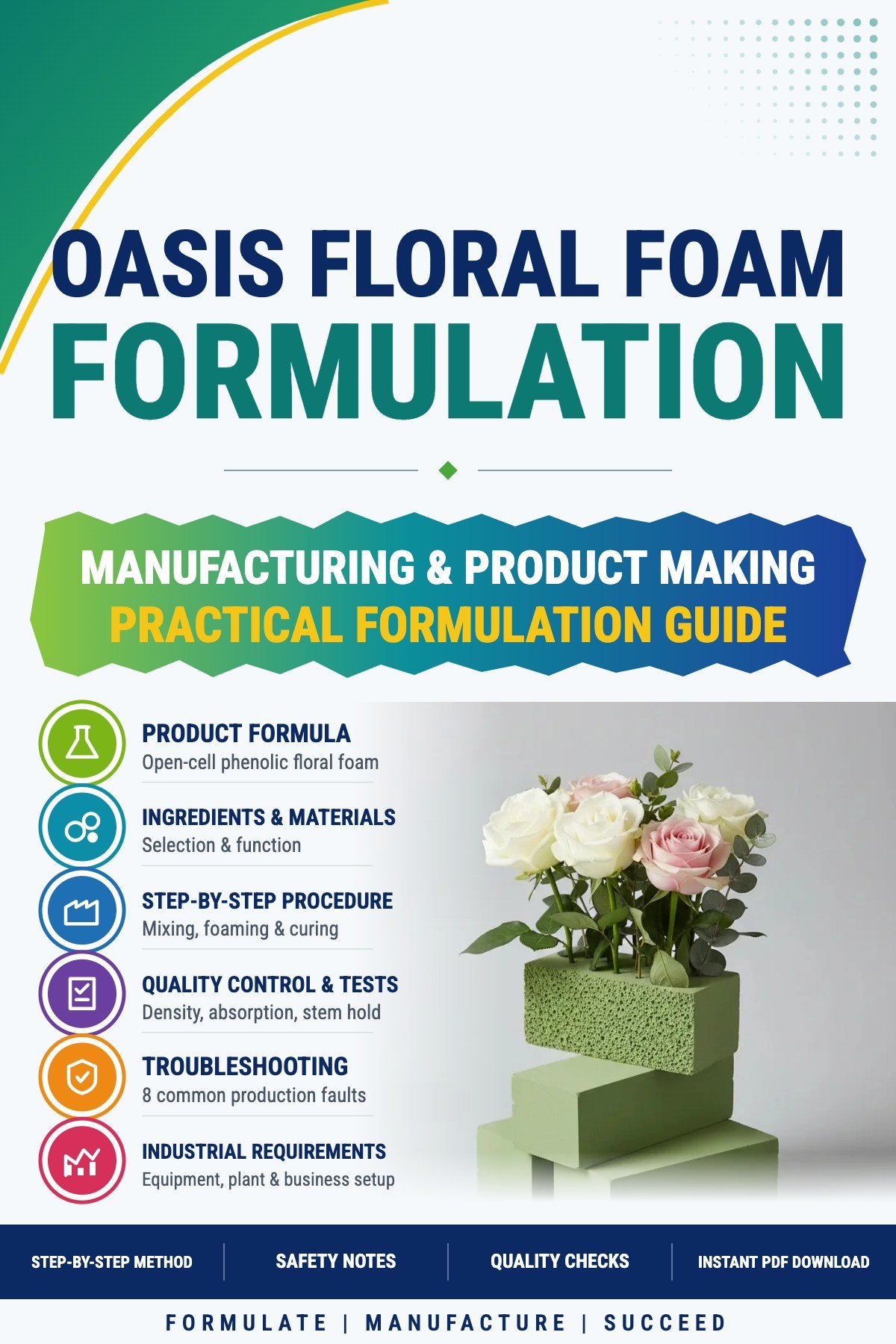
Every Product Making Guide in our shop follows a consistent structure, and this one is no exception. The cover of the guide lists what it includes: the product formula, the ingredients and materials, the procedure and preparations, the industrial requirements and the technical specifications. In practice that means you receive:
- The formulation itself, with materials listed in a way you can follow at the bench.
- The ingredients and materials section, describing what each material does and what to look for when buying it.
- The procedure and preparations, setting out the manufacturing steps in order.
- Industrial requirements, covering the space, equipment and supply relationships a floral foam business needs.
- Technical specifications, so you know what the finished block should achieve.
- A floral foam making business overview, taking you through market research, business planning, location and setup, product development, regulatory compliance, production, quality control, sales and distribution, branding, customer service and growth.
- A troubleshooting section covering inconsistent density, poor water absorption, crumbling, stems that are hard to insert, rapid drying, uneven expansion, mould and colour fading.
These Product Making Guides of chemical formulations and formulas are for manufacturers, startups and entrepreneurs. Every guide contains industrially tested, practical formulations. Anyone who buys a guide can make the product by following its step-by-step instructions. As with all of our guides, treat the formula as a starting point: raw materials differ between suppliers, so confirm performance with a trial batch before you scale up.
An overview of the floral foam manufacturing process
The exact method is in the guide, but it helps to understand the shape of the process before you buy, because it tells you what equipment and skills you will need.
1. Preparation and weighing
Everything starts with accurate weighing. Floral foam is sensitive to small changes in the proportions of surfactant, blowing agent and catalyst, so scales must be calibrated and materials measured by weight rather than by eye. Raw materials should be at a stable, known temperature, because resin viscosity changes noticeably with temperature.
2. Mixing
The resin, surfactant, wetting agent, colour and any optional additives are blended first, usually at room temperature. The goal is a uniform, lump-free mixture with a consistent colour. Mixing speed matters: too slow and the batch is uneven, too fast and you trap air that later shows up as large voids.
3. Foaming
The blowing agent and catalyst are introduced and the mixture begins to rise. This step is quick and the window for good mixing is short, so the order of addition and the timing are critical. The foam is usually allowed to rise in a mould or on a conveyor-style set-up, and it is the stage most responsible for cell structure and density.
4. Curing
The foam sets as the resin cross-links under the influence of the acid. Curing releases heat and can continue for hours. Under-cured foam is soft and crumbly, while over-aggressive curing can scorch or crack the block. A controlled cure environment gives more consistent results.
5. Conditioning, cutting and packing
Once cured, the foam block, or bun, is allowed to rest before it is cut into standard brick sizes. Cutting should be done with clean, sharp tooling to avoid tearing the cells. Finished bricks are inspected, counted and packed in a way that keeps them dry, clean and undamaged during transport.
Equipment and industrial requirements
A small floral foam plant does not need exotic machinery, but it does need the right kind. Typical requirements include accurate scales, a mixing vessel and mixer suited to viscous resin, moulds or a forming system, a curing area with good ventilation, a cutting system and a clean packing area. Because the process involves hazardous chemicals, you also need local exhaust ventilation, spill containment and appropriate storage for resin, catalyst and any flammable blowing agents.
It also helps to understand the neighbouring foam and resin technologies, because the skills overlap. If you are considering other foamed or bonded products in the same plant, take a look at our Polyurethane Spray Foam Formula, the Foam Spray Adhesive Formula and the Laminating Plywood Adhesive Formulation. They are different products from floral foam, but they share many of the same ideas about mixing, cure control and safe resin handling.
Quality control: how to judge a good batch
A formula only counts if it works every time. The guide’s business section highlights quality control, and these are the checks that matter most for floral foam.
- Density. Weigh and measure a representative block from each batch. Record it, and investigate any batch that drifts outside your accepted range.
- Water uptake. Float a dry block on water and note how quickly and completely it sinks and saturates. Cut it open to check for dry cores.
- Stem insertion. Push standard stems into a soaked block. They should go in smoothly and stay upright, with no splitting or crumbling.
- Appearance. Check colour consistency, surface finish and cell structure. Large voids or a streaky colour point to mixing problems.
- Dimensions. Measure cut bricks so they match the sizes you advertise.
- pH and residues. Because the foam is acid-cured, confirm that the water in contact with it does not become aggressive to cut flowers.
- Shelf life and storage. Keep retention samples from each batch so you can see how the foam behaves over time.
Keeping simple records of each batch makes troubleshooting much faster. When a customer reports a problem, you can compare their batch number against your own test results instead of guessing.
Troubleshooting floral foam making
The guide lists eight common problems. Here is how to think about each one, so you know what to look at first.
Inconsistent foam density
Variation from block to block usually traces back to measuring, mixing or temperature. Check that scales are accurate, that materials are at the same temperature each time and that the interval between mixing and pouring is controlled.
Poor water absorption
If the block floats or soaks slowly, the cell structure may be too closed or the surface wetting too weak. Review the surfactant and wetting agent, the foaming conditions and the cure.
Excessive crumbling or breakage
Crumbling points to under-cure, density that is too low or a poorly bonded cell structure. Also look at how the block is cut and handled.
Too hard to insert stems
A block that fights the stem is generally too dense or too tightly cross-linked. Adjusting the foaming and curing conditions can open up the structure.
Rapid drying out
If the block loses its water quickly, the cell structure may be too open for water retention or the block size and storage are unsuitable. Trial batches help you find the balance.
Uneven expansion or formation
Uneven rise comes from poor mixing, an unbalanced catalyst level or temperature differences in the mould. Make sure the mould is clean, level and at a stable temperature.
Mould or fungal growth
A damp block is a good place for microbes. Controlling storage humidity, packing dry product and, where allowed, including a preservative addresses the problem.
Colour fading
Fading is often a dye choice or light-exposure problem. Choose dyes that are stable in the acid-cured resin and store finished bricks away from direct sunlight.
Safety, health and environmental responsibility
This is the part of floral foam manufacturing that deserves the most care, and any honest guide has to say so plainly.
Phenol and formaldehyde are hazardous chemicals. Formaldehyde is recognised as a carcinogen by bodies such as the International Agency for Research on Cancer and the US National Toxicology Program, and phenol is toxic and corrosive. Anyone working with phenolic resins must read the safety data sheet for every material, use suitable protective equipment, ensure good ventilation and follow the workplace rules in their country. Acid catalysts are corrosive, and some blowing agents are flammable, so storage and handling must be planned in advance.
There is also a growing environmental conversation around floral foam. Conventional phenolic foam is not biodegradable, and florists, event planners and some regulators have raised concerns about its disposal and the fragments it leaves behind. If you plan to sell floral foam, check the rules in your market and think about your waste stream from day one. Academic research is exploring alternatives, including phenolic foams where part of the phenol is replaced by lignin from forestry residues, and other foam-free arrangement methods are increasingly popular with florists. A forward-looking manufacturer can use these developments to position a more sustainable product line.
Finally, you remain responsible for meeting the safety, labelling and regulatory rules where you manufacture and sell. A qualified chemist or safety professional should review your process before production begins. Our terms and conditions explain what a purchase from us covers.
The market for floral foam
Floral foam sells to wholesale florists, retail flower shops, wedding and event planners, floral design schools and craft suppliers. Demand rises and falls with seasonal events, with spikes around Valentine’s Day, Mother’s Day, weddings and festival periods. The guide’s business section walks you through understanding demand, analysing competitors, planning your finances and choosing between direct sales and distributors.
Competition comes from established global brands and from lower-priced regional products, so a new manufacturer usually wins by being reliable, by offering consistent quality and by serving local customers who find imported blocks expensive or slow to arrive. It is also worth considering what makes your product different, whether that is a size range, a pack format, a price point or a lower-impact formulation.
If you are still deciding which industrial project to pursue, our industrial project reports cover raw materials, plant set-up, costing and the business case for a range of chemical products, and the plastics products and industrial adhesive formulations categories show related opportunities that use similar equipment and skills.
Who is behind this guide?
Chemical Formulation Services is the trading name of CFS Formulation Services Ltd, a company registered in England and Wales under company number 16678503, with its registered office at Unit F, Winston Business Park, Churchill Way, Sheffield S35 2PS. The business was founded by George Enrick, a chemist and entrepreneur, and publishes formulation manuals, technical guides and industry reports for people who make chemical products. You can verify the company on the Companies House register, read more about us, or contact the team with questions before you buy.
We aim to be open about what a guide can and cannot do. A written formulation, however carefully prepared, cannot replace testing in your own plant with your own raw materials. What it can do is save you months of trial and error by giving you a tested starting point and a clear method.
How to buy and what happens next
- Choose Add to cart if you want to keep browsing, or Buy Now to go straight to checkout.
- Pay with PayPal, Stripe, Xoom by PayPal, Payoneer, a payment link for your debit or credit card, or Western Union, Ria and all money exchanges.
- For money exchanges, email your payment slip to Info@chemicalformulationservices.com. Once we confirm it, your instant download link is emailed to you.
- Online payments unlock the PDF download as soon as payment is confirmed.
Because every product is a digital download, refunds are not available once the file has been downloaded. Please read the refund policy and our FAQs before you order. If you are unsure whether this guide suits your plans, ask us first. You can also explore the full formula shop to compare it with other foam, resin and adhesive guides.
Frequently asked questions about Oasis floral foam formulation
What is the Oasis Floral Foam Formulation guide?
It is a digital PDF Product Making Guide that explains how floral foam is formulated and manufactured, what materials are involved, how to run the process, how to check quality and how to start a floral foam making business.
Is this the same as an Oasis floral foam formula from the brand?
No. “Oasis” is a brand owned by Smithers-Oasis. Our guide is an independent formulation guide for the type of open-cell phenolic foam that people commonly call Oasis floral foam. We are not affiliated with the brand.
What type of foam does the guide cover?
It covers the open-cell, water-absorbent foam used by florists to hold and hydrate cut flowers, generally based on a phenolic resin together with surfactants, a blowing agent and a catalyst.
Do I need a laboratory to follow it?
You need accurate scales, suitable mixing and moulding equipment, good ventilation and proper safety measures. You do not need a full research laboratory, but you should run small trial batches before any production run.
Can I make an eco-friendly floral foam with this guide?
The guide covers the conventional foam and discusses environmental considerations. It is a starting point for understanding the chemistry. Developing a lower-impact alternative will need your own testing and local regulatory checks.
Which problems does the troubleshooting section cover?
Inconsistent density, poor water absorption, crumbling or breakage, stems that are hard to insert, rapid drying, uneven expansion, mould or fungal growth and colour fading.
How do I receive the guide?
You get an instant PDF download once your payment is confirmed. If you pay by Western Union, Ria or another money exchange, email your payment slip to Info@chemicalformulationservices.com and your download link is emailed after we confirm it.
Can I get a refund?
Refunds are not available once the file has been downloaded, because it is a digital product. Technical access problems are always helped, and duplicate purchases can be reviewed within seven days. See the refund policy.
Do you offer help with custom formulations?
Yes. CFS Formulation Services Ltd offers technical consultancy on formulation and product development. Send a short brief through the Contact page.
Last reviewed: November 2026. This page is general information about a digital product. It is not a safety data sheet or professional advice, and the formulation should be tested and reviewed by a qualified person before commercial use.