
Transparent Cleansing Cream Formula
USD $50
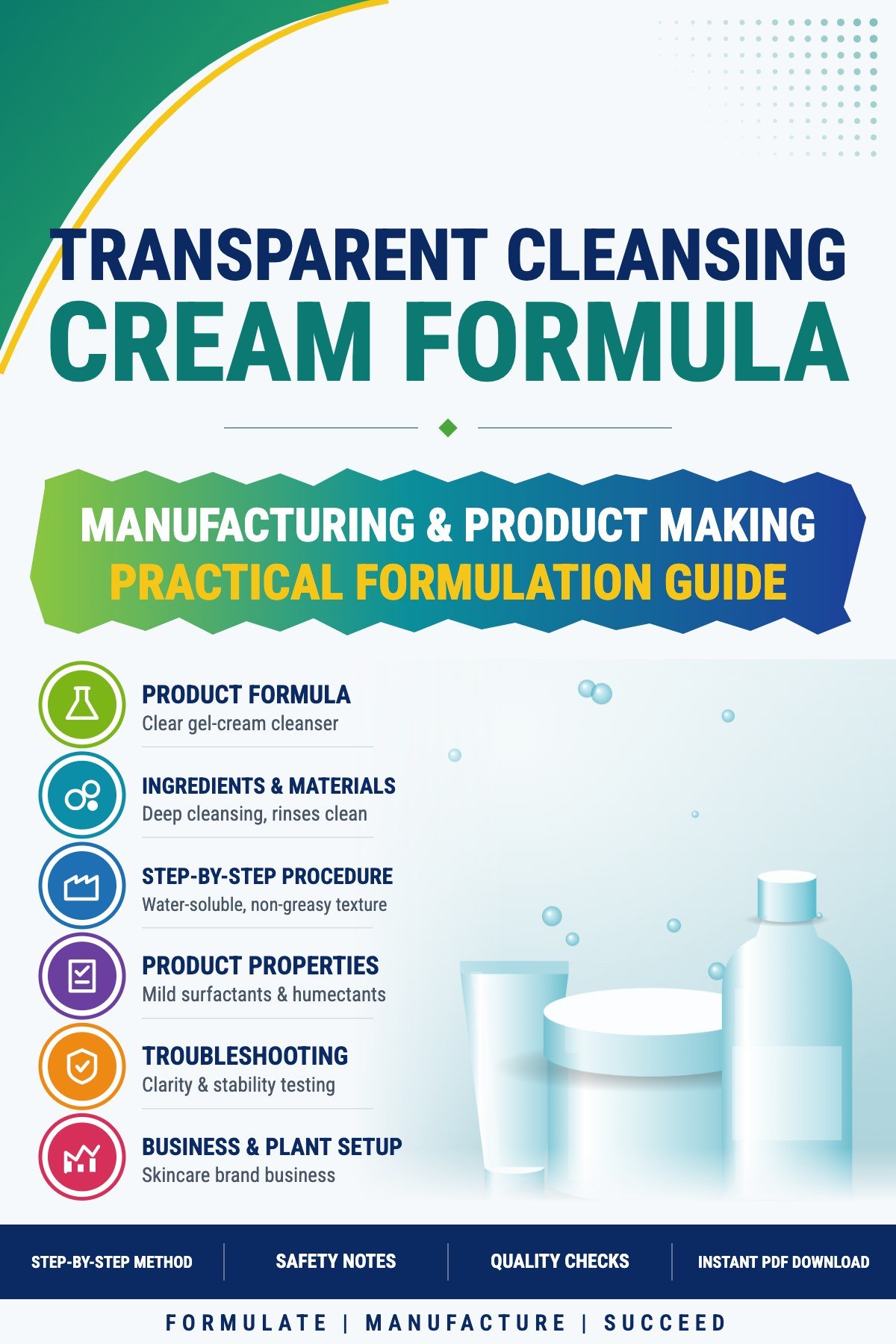
PDF manual · Instant downloadTransparent Cleansing Cream Formula: a PDF guide to making a clear gel-cream facial cleanser, with mild surfactants, solubilisers, gelling agents, manufacturing and testing.
Payment Methods
Refund Policy
Custom Formulation Services
Formulation Consultation
Contact Us
Transparent Cleansing Cream Formula is a practical PDF guide for cosmetic manufacturers, skincare startups, private-label brands and entrepreneurs who want to make a clear, water-soluble cleanser with a light gel-cream or lotion-like texture. A transparent cleansing cream gives deep cleansing without compromising skin comfort. Unlike traditional creamy or foaming cleansers, it spreads easily, removes impurities effectively, and rinses cleanly without leaving a greasy film. This page explains how a transparent cleansing cream formula works, what the guide covers and how a transparent cleansing cream formulation is designed, made and tested, so you can decide whether it suits your business.
This guide is published by Chemical Formulation Services, the formulation publishing and consultancy business of CFS Formulation Services Ltd in Sheffield, United Kingdom. It is written for people who want to understand the product from the raw material to the finished pack, and it keeps its claims practical rather than promotional.
At a glance
- Product: Transparent Cleansing Cream Formula, a digital PDF Product Making Guide.
- Also searched as: transparent cleansing cream formulation, clear cleansing gel cream, water-soluble cleanser, gel cleanser.
- What it covers: surfactant systems, solubilised oils, gelling agents, humectants, preservation, manufacturing and testing.
- Key goals: crystal clarity, gentle deep cleansing, easy rinsing and stable texture.
- Who it is for: cosmetic makers, skincare startups, private-label brands and entrepreneurs.
- Delivery: instant PDF download after payment is confirmed.
- Publisher: CFS Formulation Services Ltd, England and Wales company number 16678503.
What makes a cleanser transparent
Most cleansing creams and lotions are opaque white emulsions, because they contain tiny droplets of oil dispersed in water that scatter light. A transparent cleanser contains no light-scattering droplets large enough to cloud the product. It is made as a clear solution or microemulsion in which all the ingredients are dissolved or so finely dispersed that light passes straight through. This gives a modern, clean and fresh appearance, a lighter feel and often a more luxurious look in the bottle, tube or pump.
Clarity is not just aesthetics. The need to keep a formula clear forces the formulator to use ingredients that are well dissolved, which often leads to a product that rinses easily and leaves no oily residue. That is why transparent gel-cream cleansers are popular with people who find rich cleansing creams too heavy, including those with oily, combination or normal skin, and those who like a fresh feel.
How the cleansing works
A cleanser removes sebum, sweat, dust, sunscreen and makeup. Water-soluble dirt is removed by water, but oily soils need surfactants. A transparent cleansing cream uses mild surfactants that surround oil and dirt particles with their hydrophobic tails while their water-loving heads face the water, lifting the soil off the skin so that it rinses away. Some formulas include solubilised oils or oil-like emollients, bound into the surfactant system as a microemulsion, which dissolve makeup and sebum and help the product feel creamy but still rinse clean. The selection of surfactants controls how strongly the product cleans, how much it foams and how mild it is for the skin.
Main components of the formulation
Primary surfactants
Mild surfactants such as sodium cocoyl glutamate, decyl glucoside, coco-glucoside, sodium cocoyl isethionate, disodium cocoamphodiacetate and cocamidopropyl betaine clean with low irritation. Sulphate-based surfactants such as sodium laureth sulphate are used for stronger cleansing, in lower amounts with mild co-surfactants. The blend decides foam, clarity and mildness.
Solubilisers
PEG-based or polyglyceryl-based solubilisers, such as PEG-40 hydrogenated castor oil, polysorbate 20 or caprylyl/capryl glucoside, solubilise small amounts of oils, fragrance and oil-soluble actives into the water base, keeping the product clear.
Gelling agents and thickeners
Carbomer, acrylates copolymers, xanthan gum, hydroxyethylcellulose and sclerotium gum create the light gel-cream body. Clear polymers keep the formula transparent. Salt can thicken surfactant systems, but must be balanced for clarity.
Humectants and conditioners
Glycerin, propanediol, panthenol, sodium PCA and hyaluronic acid help prevent the dry, tight feeling after cleansing. Polyquaternium polymers and cationic conditioners can add a soft after-feel.
Emollients (solubilised)
Light oils and esters at low levels in a solubilised system give a cream-like feel and help dissolve makeup. Examples are caprylic/capric triglyceride, jojoba esters and light plant oils.
Soothing and active ingredients
Aloe vera, allantoin, bisabolol, green tea, cucumber and chamomile extracts add comfort. Mild actives such as salicylic acid or niacinamide can be included within regulatory limits and pH requirements.
pH adjusters
Citric acid or lactic acid with a suitable base adjusts pH, usually to 5 to 6, close to the skin’s natural acidity, which also helps gelling and preservation.
Preservative system
A broad-spectrum preservative keeps the water-rich cleanser safe. Compatibility with surfactants and polymers, and efficacy at the formula’s pH, must be checked.
Fragrance and colour
Light fragrance and a gentle tint, such as pale blue or green, fit the fresh image. Colourants and fragrance must be solubilised and not cause haze.
What is inside the Transparent Cleansing Cream Formula guide
The guide is a technical formulation data sheet for a highly specialised skincare product designed for deep cleansing without compromising skin comfort. It describes the water-soluble gel-cream or lotion-like texture, ingredient roles, practical formulations, step-by-step manufacturing, quality control, packaging, troubleshooting and business advice. It follows the CFS style of clear, industrially minded instructions.
How the cleanser is made
The outline below shows the general sequence. The guide gives full details.
Step 1: Prepare the gel base
Polymer thickener is dispersed slowly into water with stirring, avoiding lumps and air. Humectants are added and the polymer is allowed to hydrate fully.
Step 2: Prepare the solubilised oil phase
Solubiliser, light oil, fragrance and oil-soluble actives are mixed together until clear, so that they are ready to be dispersed in the water phase.
Step 3: Combine the phases
The solubilised phase is added to the gel base with gentle mixing, forming a clear dispersion or microemulsion.
Step 4: Add surfactants
Surfactants are added slowly, with low-shear mixing to avoid foaming. Where the surfactant is a paste or solid, it may need gentle warming first.
Step 5: Adjust viscosity and pH
Neutraliser builds the gel viscosity for carbomer systems. Salt or thickener is added if needed. pH is adjusted to the target.
Step 6: Add heat-sensitive ingredients
Preservative, extracts, vitamins and any actives are added at low temperature.
Step 7: De-aerate, check and fill
The batch is allowed to rest so that bubbles escape. Clarity, viscosity and pH are checked, and the cleanser is filled into clear or semi-clear tubes, bottles or pumps, which show off its appearance.
Equipment and hygiene
The equipment is simple: accurate scales, stainless steel or plastic vessels, a low-shear stirrer or paddle mixer, a pH meter, viscometer and filling tools. A homogeniser is helpful but must be used gently to avoid air. Hygiene is essential for a water-based cleanser, with sanitised equipment, clean clothing, batch records and controlled storage.
Quality control for every batch
- Clarity: transparent, with no haze or particles, and compared with a reference.
- Colour and odour: consistent between batches.
- pH: within the skin-friendly range.
- Viscosity: consistent gel-cream thickness.
- Foam and cleansing: performance on makeup and sebum test soils.
- Rinsability: no sticky or oily residue after rinsing.
- Stability: hot, cold and freeze-thaw storage for clarity, viscosity and colour.
- Microbial testing: preservative challenge tests.
- Skin and eye mildness: patch tests and in-use feedback under suitable oversight.
Troubleshooting
Cloudy or hazy product
Insufficient solubiliser, too much oil, incompatible ingredients or temperature effects. Increase solubiliser, reduce oil and check compatibility.
Gel loses viscosity
Electrolytes or low pH disrupting polymer, or surfactant interaction. Choose electrolyte-tolerant thickeners and adjust the order of addition.
Air bubbles trapped
Fast mixing. Mix slowly, rest the batch and de-aerate.
Stinging or irritation
Surfactant too strong, wrong pH, fragrance or preservative. Use milder surfactants and simplify.
Too much or too little foam
Adjust surfactant ratios and add foam boosters or reducers.
Greasy residue after rinsing
Too much oil. Reduce emollients or increase solubiliser balance.
Colour fades
Dye instability to light or pH. Choose stable dyes and use tinted packaging.
Safety, labelling and regulation
Cosmetics are regulated in nearly every market. In the UK and EU, products need a safety assessment by a qualified person, notification, good manufacturing practice and labelling with INCI names and warnings. Other markets have their own rules, and ingredient limits apply to actives like salicylic acid. Rinse-off products are considered lower risk than leave-on, but eye contact should be avoided and labelled accordingly. Claims such as deep cleansing, gentle, dermatologically tested and hypoallergenic should be supported with evidence. Do not claim to treat acne or skin conditions as a medical effect. You are responsible for compliance wherever you sell.
The business opportunity
Facial cleansing is the first step in nearly every skincare routine, and clear gel-cream cleansers are popular in warm climates and with those who prefer a light, fresh feel. Brands can sell through pharmacies, beauty retailers, spas, salons, online shops and supermarkets, and private-label production for other brands is common. A clear product in a transparent pump bottle looks modern and clean, which supports premium pricing. Combined with toner, moisturiser and night cream, it forms a complete range.
Related CFS guides help build a skincare line. See for a creamy cleanser, Oil Free Night Cream Formulation, Best Moisture Cream for Dry Skin, Universal Skin Cream Formula, Almond Oil Cream Formula and Sunflower Oil Cream Formulation, and browse the Cosmetics Industry and Personal Care Products categories. For cleaning bars and liquids, see Beauty Soap Formulation, Dishwashing Liquid Formulation and the Soap Formula category.
Getting started
Begin with a simple clear gel cleanser based on a mild surfactant blend, glycerin and a clear polymer, and add the solubilised oil phase once the base is stable. Make small batches, observe clarity under bright light, and test cleansing on makeup and sebum. Compare with products you admire, refine the foam and feel, and run stability and preservation tests. Gather volunteer feedback, then arrange safety assessment and labelling before you sell.
How to get the best results from this guide
Treat the guide as a tested starting point rather than a finished factory. Begin with a small trial batch in the laboratory or on a bench, using the exact raw materials you plan to buy, and record every weight, temperature, mixing time and observation. Compare the result with the quality checks in the guide, change only one thing at a time, and keep a note of what each change did. Once a small batch is consistently good, repeat it several times, then scale up in stages, because mixing, heating and cooling behave differently in larger vessels. Keep retained samples of every batch, write simple standard operating procedures for your team, and build relationships with two suppliers for each key raw material. Finally, check the labelling, safety and product rules in the country where you will sell, and ask a qualified person to review your process. This careful, documented approach is what turns a good formulation into a reliable product and a trusted brand.
Who should buy this guide?
The guide is written for practical readers. It suits manufacturers who want to add a new product to an existing plant, startups choosing their first product, private-label brands that need to understand what they are buying, technical staff who must set specifications and train operators, and consultants and students who want a structured, plain-language reference. It is less suitable for anyone looking for a quick shortcut or a guarantee, because every formulation still needs testing with your own materials, equipment and local rules. If you are unsure whether it matches your project, send a short question through the contact page before you order, and we will tell you honestly whether it fits.
What is inside the Transparent Cleansing Cream Formula guide
Every Product Making Guide in our shop follows the same structure so you know where to look. This guide includes the product formula, the ingredients and materials, the procedure and preparations, the industrial requirements and the technical specifications. In practice you receive:
- The formulation, written so you can follow it at the bench and scale it up.
- Ingredients and materials, with the job of each material and advice on grades and suppliers.
- The manufacturing procedure, including order of addition, mixing and preparations.
- Industrial requirements, covering equipment, space and packaging.
- Technical specifications, describing what a good finished product should look like and how it should behave.
- Troubleshooting for the faults that makers meet most often.
- Business guidance, to help you take the product from the bench to the market.
These Product Making Guides of chemical formulations and formulas are for manufacturers, startups and entrepreneurs. Every guide contains industrially tested, practical formulations. Anyone who buys a guide can make the product by following its step-by-step instructions. Raw materials vary between suppliers, so always confirm your results with a small trial batch before scaling up.
Who stands behind this guide?
Chemical Formulation Services is the trading name of CFS Formulation Services Ltd, registered in England and Wales under company number 16678503, with its office at Unit F, Winston Business Park, Churchill Way, Sheffield S35 2PS. The business was founded by George Enrick and publishes formulation manuals, technical guides and industry reports. You can check our details on the Companies House register, read about us, or contact us with any question before you order.
A written formulation cannot replace testing with your own raw materials, equipment and climate, and we say so plainly. What the guide does give you is a tested, structured starting point that can save you months of trial and error. Our terms and conditions explain what a purchase from us covers.
How to order
- Select Add to cart to keep browsing, or Buy Now to go straight to checkout.
- Pay with PayPal, Stripe, Xoom by PayPal, Payoneer, payment links for debit and credit cards, or Western Union, Ria and all money exchanges.
- If you pay through a money exchange, email your payment slip to Info@chemicalformulationservices.com. After confirmation, your instant download link is emailed to you.
- For online payments, the PDF is available as soon as the payment is confirmed.
All products are digital downloads and all payments are nonrefundable once the file is delivered, so please read the refund policy and the FAQs before you order. You can compare this guide with others in the formula shop or browse our industrial project reports.
Frequently asked questions about transparent cleansing cream formula
What is the Transparent Cleansing Cream Formula guide?
It is a digital PDF Product Making Guide to making a clear, water-soluble gel-cream facial cleanser, covering surfactants, solubilisers, gelling agents, manufacturing, testing and business advice.
What makes the cleanser transparent?
It contains no light-scattering droplets: oils and fragrances are dissolved or solubilised in a surfactant system, and clear polymers provide body.
Why use solubilisers?
They bring small amounts of oils, fragrance and oil-soluble actives into the water base without clouding the product.
What pH is best?
Usually mildly acidic, around 5 to 6, which suits skin, supports gel structure and helps preservative performance.
Will it remove makeup?
Yes. Surfactants and solubilised oils dissolve and lift sebum and makeup, and the product rinses clean without a greasy film.
How do I receive the guide?
You receive an instant PDF download after payment is confirmed. For money exchanges, email your payment slip to Info@chemicalformulationservices.com and the link is emailed after we confirm it.
Is the payment refundable?
All payments are nonrefundable because the product is an instant digital download. See the refund policy for details.
Can you help with a custom formulation?
CFS Formulation Services Ltd offers formulation and product development consultancy. Send a short brief through the Contact page.
Last reviewed: November 2026. This page is general information about a digital product. It is not a safety data sheet or professional advice, and any formulation should be tested and reviewed by a qualified person before commercial use.