Leather Gum Adhesive Formulation
USD $65
PDF manual · Instant downloadLeather Gum Adhesive Formulation: a PDF guide to leather contact cement, with polychloroprene rubber, resins, solvents, making, application, testing and solvent safety.
Payment Methods
Refund Policy
Custom Formulation Services
Formulation Consultation
Contact Us
Leather gum adhesive formulation, also known as leather cement, is a type of adhesive specifically designed for bonding leather. It is commonly used in leatherworking and shoemaking for attaching leather parts, joining seams or repairing leather goods. This practical PDF guide, Leather Gum Adhesive Formulation, is for adhesive manufacturers, footwear and leather goods suppliers, startups and entrepreneurs. This page explains how a leather gum adhesive formula works, which rubbers, resins and solvents are used, how it is made, applied and tested, and how to sell it safely.
This guide is published by Chemical Formulation Services, the formulation publishing and consultancy business of CFS Formulation Services Ltd in Sheffield, United Kingdom. It is written for people who want to understand the product from the raw material to the finished pack, and it keeps its claims practical rather than promotional.
At a glance
- Product: Leather Gum Adhesive Formulation, a digital PDF Product Making Guide.
- Also searched as: leather gum adhesive formula, leather cement, shoe glue, contact adhesive for leather, polychloroprene leather glue.
- Base: rubber solution (polychloroprene or natural rubber) with resins and solvents.
- Key goals: tack, bond strength, flexibility, heat resistance and open time.
- Who it is for: adhesive makers, shoe and bag factories, cobblers and leather craft suppliers, entrepreneurs.
- Delivery: instant PDF download after payment is confirmed.
- Publisher: CFS Formulation Services Ltd, England and Wales company number 16678503.
How leather adhesives work
Leather is a flexible, fibrous, porous material, often with a finished or coated surface. Adhesives for leather must wet the surface, penetrate slightly into the fibres, and form a strong but flexible bond that moves with the leather without cracking. The classic approach is contact bonding: the adhesive is applied to both surfaces, allowed to dry until tacky, then the parts are pressed together. The two dried films fuse on contact and develop strength immediately, so no clamping is needed, which suits fast shoe production lines and craft work.
Main adhesive types
Polychloroprene (neoprene) contact adhesive
The workhorse of footwear. A solution of polychloroprene rubber with tackifying resins such as phenolic resin, metal oxides, antioxidants and solvents. It offers strong initial tack, high bond strength, good flexibility and resistance to oils and ageing.
Natural rubber solution (rubber cement)
Natural rubber latex or crepe dissolved in solvent, with resins. Cheap and tacky, but weaker in heat and ageing resistance. Used for leather crafts and temporary bonds.
Polyurethane adhesives
Solvent-based or water-based polyurethanes, often used with isocyanate crosslinkers, give very strong, heat-resistant bonds for shoe soles and automotive leather. Reactivation by heat is common in factory use.
Water-based adhesives
Polychloroprene latex, acrylic or polyurethane dispersions provide lower VOC and safer handling, and are growing in use. They need longer drying times and heating or forced air in production.
Core components of a solvent-based polychloroprene leather gum
- Polychloroprene rubber: the film-forming polymer, chosen for crystallisation rate and viscosity.
- Tackifying resin: phenolic or terpene-phenolic resins to improve tack, adhesion and heat resistance.
- Metal oxides: magnesium oxide and zinc oxide, acid acceptors and crosslink promoters for polychloroprene.
- Antioxidant: protects against ageing.
- Solvent blend: typically a mix of ketones (acetone, MEK), esters (ethyl acetate), and hydrocarbons (hexane-free alternatives, toluene substitutes, cyclohexane) selected for drying speed and solubility.
- Fillers (optional): fine silica for viscosity and sag control.
- Colourants: light tints to identify adhesives.
- Isocyanate crosslinker (optional): added by the user for higher heat resistance.
Footwear, bag, belt and craft applications compared
Different leather jobs need different gum. Shoe soling needs a polyurethane or polychloroprene adhesive with high heat resistance and peel strength, often reactivated by heat in a factory line. Upper-to-lining joins need a softer, more flexible film that stays supple. Bag and belt makers need a quick-tack glue that holds edges before stitching and does not stain light leather. Saddlery and upholstery need strong, durable films that resist sweat and flexing. Craft hobbyists need a safe, easy-to-use glue in small tubes that works on thin leather and does not bleed. Offering a range of viscosities, colours and strengths, labelled by application, allows each buyer to choose confidently.
Water-based and low-VOC conversion
Regulation and worker health push shoe and leather factories toward water-based adhesives. Water-based polyurethane dispersions and polychloroprene latexes can bond leather well, but they dry more slowly and need heat or airflow, and they are sensitive to dirty or greasy leather. The conversion usually requires adjustments in drying tunnels, reactivation temperatures and primers. Support customers with trials, line audits and clear instructions, and keep a solvent-based option available for workshops without drying equipment. Selling both lets you serve the entire market while steering customers toward cleaner products.
Customer education to prevent glue failures
Most complaints trace back to poor preparation: finished leather not roughened, oils or waxes left on the surface, glue applied too thickly or too thinly, parts joined too early or too late, and insufficient pressure. A one-page illustrated guide with simple steps, open time by temperature, and a “test on scrap first” reminder reduces returns. Offer a short video, a helpline or a QR code on the label, and train distributor staff, who often answer craft buyers’ questions in person.
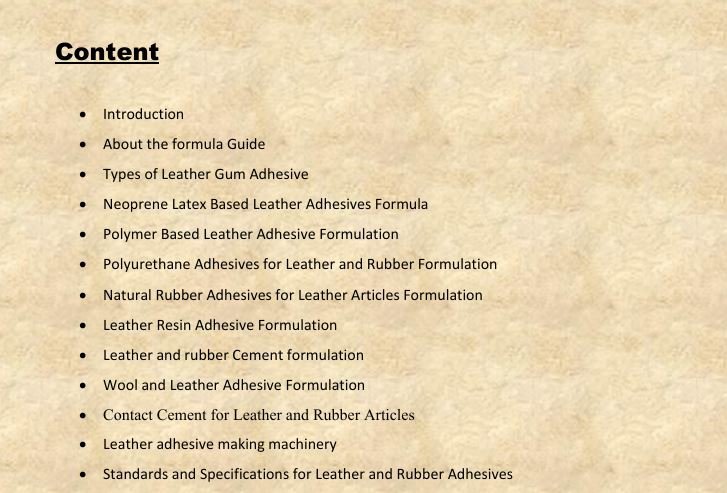
What is inside the Leather Gum Adhesive Formulation guide
The guide explains that leather gum adhesive formulation, also known as leather cement, is a type of adhesive specifically designed for bonding leather materials, commonly used in leatherworking and shoemaking for attaching parts, joining seams or repairing leather goods. It then offers recipes, process details, application methods, testing and troubleshooting.
Manufacturing process
Step 1: Masticate the rubber
Polychloroprene is supplied as chips. It is masticated on a two-roll mill or in an internal mixer to reduce its viscosity and make it dissolve readily. Add magnesium oxide, zinc oxide and antioxidant during this stage to form a masterbatch.
Step 2: Dissolve in solvent
In a closed, earthed, explosion-proof mixer, charge solvent and add the masticated rubber slowly with agitation. Dissolving may take several hours.
Step 3: Add resin
Phenolic resin is often pre-reacted with magnesium oxide to form a resinate, which improves heat resistance and storage stability. Add the resin solution to the rubber solution.
Step 4: Adjust viscosity
Thin with solvent to the target viscosity, usually measured with a viscometer or flow cup, and check solids content typically around 15 to 25 percent.
Step 5: Filter and fill
Filter and fill into metal tins, drums or tubes under proper fire safety measures.
Applying leather gum
Prepare the leather by cleaning, lightly roughening smooth finishes with fine abrasive, and removing dust. Apply an even coat to both surfaces, allow to dry until tacky to the touch but not transferring, usually 5 to 15 minutes, then join carefully and press firmly or roll or hammer the bond for good contact. Contact adhesives bond instantly, so alignment must be right before parts touch. Allow full strength to develop over 24 hours. For shoe soles, a second coat on porous surfaces and heat reactivation are common practice.
Testing and quality control
- Viscosity and solids content.
- Open time and tack retention.
- Peel strength on leather to leather and leather to sole materials.
- Heat resistance of the bond.
- Flexibility by flexing tests.
- Ageing and humidity resistance.
- Storage stability: skinning, gelling and viscosity change.
- Staining and migration of colour into light leather.
Troubleshooting
Poor bond or peeling
Surface oil, dust or glue allowed to dry too long. Clean, roughen and bond within open time.
Glue goes stringy or gels in the can
Moisture, wrong resin interaction or old rubber. Keep sealed, use fresh materials and adjust stabiliser.
Bond line shows through thin leather
Too much adhesive or staining colourants. Use thinner coats and light-coloured glue.
Bond becomes hard and cracks
Poor flexibility or ageing. Adjust resin level and use plasticised grades.
Slow drying
Heavy solvent blend or cold, humid air. Use faster solvents and better ventilation.
Strong odour complaints
Solvent choice. Consider water-based or lower-odour solvent systems.
Safety and regulation
Solvent-based contact adhesives are highly flammable and their vapours harmful. Several solvents formerly used, notably n-hexane and toluene, are linked to nerve damage and reproductive toxicity and are restricted in many regions, so use compliant alternatives. Provide ventilation, extraction, grounding, no ignition sources, gloves and respirators. Keep cans closed, and never use adhesives near flames or hot surfaces. Label with hazard symbols, flash point and safe use information, and provide safety data sheets. Follow VOC rules and dangerous goods transport regulations. Do not sell glue to children for inhalation misuse, and warn against deliberate sniffing, which is dangerous.
Packaging and business opportunity
Pack in small tubes and tins of 30 to 500 millilitres for cobblers and craft users, 1 to 5 litre cans for workshops, and 20 or 200 litre pails and drums for factories. Customers include shoe factories, bag and belt makers, upholstery and saddlery workshops, repair shops and hobbyists. Offer matching cleaners, primers, thinners and brushes, and a water-based line for factories that need low VOC. Private-label supply to hardware chains and leather-supply stores is common. Technical advice on surface preparation and application helps customers succeed.
Extend your adhesive range with the Industrial Adhesive Formulations, Rubber Goods Making, Plastics Products and Resin Manufacturing categories, and see Flexible Glue Formula, Thermoplastic Adhesive Formulation, Polyurethane Adhesive Sealant Formulation, , Hi-per Woodworking Adhesive and Butyl Tape Formulation.
Getting started
Begin with a small laboratory batch of polychloroprene, phenolic resin, magnesium oxide and a ketone-ester solvent blend. Test on leather strips for tack and peel strength, adjust, then test shoe sole bonds. Set up safe flammable-liquid storage and ventilation, prepare labels and data sheets, and give samples to cobblers and small factories for feedback.
How to get the best results from this guide
Treat the guide as a tested starting point rather than a finished factory. Begin with a small trial batch in the laboratory or on a bench, using the exact raw materials you plan to buy, and record every weight, temperature, mixing time and observation. Compare the result with the quality checks in the guide, change only one thing at a time, and keep a note of what each change did. Once a small batch is consistently good, repeat it several times, then scale up in stages, because mixing, heating and cooling behave differently in larger vessels. Keep retained samples of every batch, write simple standard operating procedures for your team, and build relationships with two suppliers for each key raw material. Finally, check the labelling, safety and product rules in the country where you will sell, and ask a qualified person to review your process. This careful, documented approach is what turns a good formulation into a reliable product and a trusted brand.
Who should buy this guide?
The guide is written for practical readers. It suits manufacturers who want to add a new product to an existing plant, startups choosing their first product, private-label brands that need to understand what they are buying, technical staff who must set specifications and train operators, and consultants and students who want a structured, plain-language reference. It is less suitable for anyone looking for a quick shortcut or a guarantee, because every formulation still needs testing with your own materials, equipment and local rules. If you are unsure whether it matches your project, send a short question through the contact page before you order, and we will tell you honestly whether it fits.
What is inside the Leather Gum Adhesive Formulation guide
Every Product Making Guide in our shop follows the same structure so you know where to look. This guide includes the product formula, the ingredients and materials, the procedure and preparations, the industrial requirements and the technical specifications. In practice you receive:
- The formulation, written so you can follow it at the bench and scale it up.
- Ingredients and materials, with the job of each material and advice on grades and suppliers.
- The manufacturing procedure, including order of addition, mixing and preparations.
- Industrial requirements, covering equipment, space and packaging.
- Technical specifications, describing what a good finished product should look like and how it should behave.
- Troubleshooting for the faults that makers meet most often.
- Business guidance, to help you take the product from the bench to the market.
These Product Making Guides of chemical formulations and formulas are for manufacturers, startups and entrepreneurs. Every guide contains industrially tested, practical formulations. Anyone who buys a guide can make the product by following its step-by-step instructions. Raw materials vary between suppliers, so always confirm your results with a small trial batch before scaling up.
Who stands behind this guide?
Chemical Formulation Services is the trading name of CFS Formulation Services Ltd, registered in England and Wales under company number 16678503, with its office at Unit F, Winston Business Park, Churchill Way, Sheffield S35 2PS. The business was founded by George Enrick and publishes formulation manuals, technical guides and industry reports. You can check our details on the Companies House register, read about us, or contact us with any question before you order.
A written formulation cannot replace testing with your own raw materials, equipment and climate, and we say so plainly. What the guide does give you is a tested, structured starting point that can save you months of trial and error. Our terms and conditions explain what a purchase from us covers.
How to order
- Select Add to cart to keep browsing, or Buy Now to go straight to checkout.
- Pay with PayPal, Stripe, Xoom by PayPal, Payoneer, payment links for debit and credit cards, or Western Union, Ria and all money exchanges.
- If you pay through a money exchange, email your payment slip to Info@chemicalformulationservices.com. After confirmation, your instant download link is emailed to you.
- For online payments, the PDF is available as soon as the payment is confirmed.
All products are digital downloads and all payments are nonrefundable once the file is delivered, so please read the refund policy and the FAQs before you order. You can compare this guide with others in the formula shop or browse our industrial project reports.
Frequently asked questions about leather gum adhesive formulation
What is the Leather Gum Adhesive Formulation guide?
It is a digital PDF Product Making Guide to leather contact adhesives, covering rubber bases, resins, solvents, making, application, testing and troubleshooting.
Why is it applied to both surfaces?
Contact adhesives bond when two dried, tacky films meet, giving instant strength.
Are solvent glues hazardous?
Yes. They are flammable and vapours are harmful, so ventilation, grounding and compliant solvents are essential.
Is there a water-based option?
Yes, using polychloroprene latex, acrylic or polyurethane dispersions, though drying takes longer.
Why does leather glue string or gel?
Moisture or unstable resin-rubber interaction. Keep it sealed and adjust the formula.
How do I receive the guide?
You receive an instant PDF download after payment is confirmed. For money exchanges, email your payment slip to Info@chemicalformulationservices.com and the link is emailed after we confirm it.
Is the payment refundable?
All payments are nonrefundable because the product is an instant digital download. See the refund policy for details.
Can you help with a custom formulation?
CFS Formulation Services Ltd offers formulation and product development consultancy. Send a short brief through the Contact page.
Last reviewed: November 2026. This page is general information about a digital product. It is not a safety data sheet or professional advice, and any formulation should be tested and reviewed by a qualified person before commercial use.