
High Shine Floor Polish Formula
USD $70
PDF manual · Instant downloadHigh Shine Floor Polish Formula: a PDF guide to acrylic floor polish, with polymers, waxes, coalescents, making, application, testing and troubleshooting.
Payment Methods
Refund Policy
Custom Formulation Services
Formulation Consultation
Contact Us
High Shine Floor Polish Formula is a versatile cleaning and polishing product designed to improve the look and extend the life of many floor types. It helps remove dirt, grime and light stains and leaves a clean, glossy finish. It is used on marble, ceramic, vinyl and other hard floors, giving a residue-free, slip-aware shine. This practical PDF guide is for floor care manufacturers, janitorial suppliers, startups and entrepreneurs. This page explains how a high shine floor polish formulation works, which polymers, waxes and additives are used, how it is made, tested and applied, and how to sell it.
This guide is published by Chemical Formulation Services, the formulation publishing and consultancy business of CFS Formulation Services Ltd in Sheffield, United Kingdom. It is written for people who want to understand the product from the raw material to the finished pack, and it keeps its claims practical rather than promotional.
At a glance
- Product: High Shine Floor Polish Formula, a digital PDF Product Making Guide.
- Also searched as: high shine floor polish formulation, floor finish, acrylic floor polish, wet look floor polish, vinyl floor finish.
- Base: acrylic or styrene-acrylic polymer emulsion with wax, plasticiser and levelling aids.
- Key goals: gloss, levelling, durability, slip safety and removability.
- Who it is for: floor care makers, janitorial suppliers, cleaning contractors and entrepreneurs.
- Delivery: instant PDF download after payment is confirmed.
- Publisher: CFS Formulation Services Ltd, England and Wales company number 16678503.
How a floor polish works
Floor polish, also called floor finish, is a water-based emulsion of film-forming polymers that dries into a thin, glossy, protective layer. It fills microscopic scratches, so the surface reflects light uniformly, and it acts as a sacrificial layer that absorbs scuffs, foot traffic and cleaning. When the finish wears, it can be buffed, topped up with another coat or stripped and recoated. A good high shine polish dries quickly to a clear, hard but flexible film, resists black heel marks, withstands detergent mopping and water spotting, and still strips cleanly with a stripper solution.
Main components
Polymer emulsion
The principal film-former. Acrylic or styrene-acrylic copolymer emulsions, often with acid-functional groups, give gloss, hardness and durability. Metal-crosslinked polymers, which use zinc or other ions to bridge polymer chains, offer extra durability but require good strippers and, in some markets, are being replaced by zinc-free alternatives due to environmental concerns.
Alkali-soluble resin
Resin such as styrene-maleic or acrylic types dissolved in ammonia or amine solution provides gloss, levelling and removability by stripper.
Wax emulsion
Polyethylene or oxidised wax emulsions and carnauba improve slip resistance, scuff resistance and depth of gloss, and make buffing easier.
Plasticisers and coalescents
Glycol ethers and phosphate esters help the polymer particles fuse into a continuous film at room temperature. The choice affects gloss, hardness, odour and regulatory status; many makers use low-odour or low-VOC alternatives.
Levelling agents and wetting agents
Fluorosurfactants or silicone-based surfactants in tiny amounts help the polish flow into a smooth film without streaks or craters.
Preservative, defoamer and fragrance
To protect the emulsion from microbes, control foam during manufacture and application, and give a pleasant odour after application.
Floor finish systems: sealer, finish and maintainer
A durable floor depends on more than one product. A sealer fills pores in porous surfaces such as concrete, terrazzo or unsealed tile, stopping the finish from sinking in. The finish builds gloss and protection in several coats. A daily maintainer, often a neutral cleaner with a little polymer, keeps the finish clean without stripping it. A restorer or spray buff product revives gloss between recoats. A stripper removes old finish when build-up, yellowing or damage demands a fresh start. Offering all of these under one brand, with a chart showing which to use on each surface and traffic level, makes it easy for facility managers to standardise and for you to sell more per customer.
Gloss levels, slip safety and traffic zones
Not every area needs mirror gloss. Lobbies and showrooms benefit from high shine; kitchens, corridors and entrances need slip-aware finishes with good wet traction. Wax and certain polymer blends raise the coefficient of friction, while very smooth films reduce it. Ask your raw material suppliers for slip data, test panels with a tribometer where possible and publish results. Provide safety guidance for wet-floor signs, mat placement, drying time before foot traffic and avoiding over-application, which creates slippery build-up. Safety and liability concerns weigh heavily with commercial customers.
Sales demonstrations and cost per square metre
Contract cleaners buy results and economy. Bring a demonstration kit, finish a test strip of floor, show before and after, and calculate cost per square metre per coat using the coverage rate printed on the label. Typical coverage is 40 to 80 square metres per litre per coat, depending on the product and floor. Keep a record of job outcomes, store photographs and ask satisfied customers for references. A solid track record with a few well-known sites will do more than any brochure to convince larger clients.
What is inside the High Shine Floor Polish Formula guide
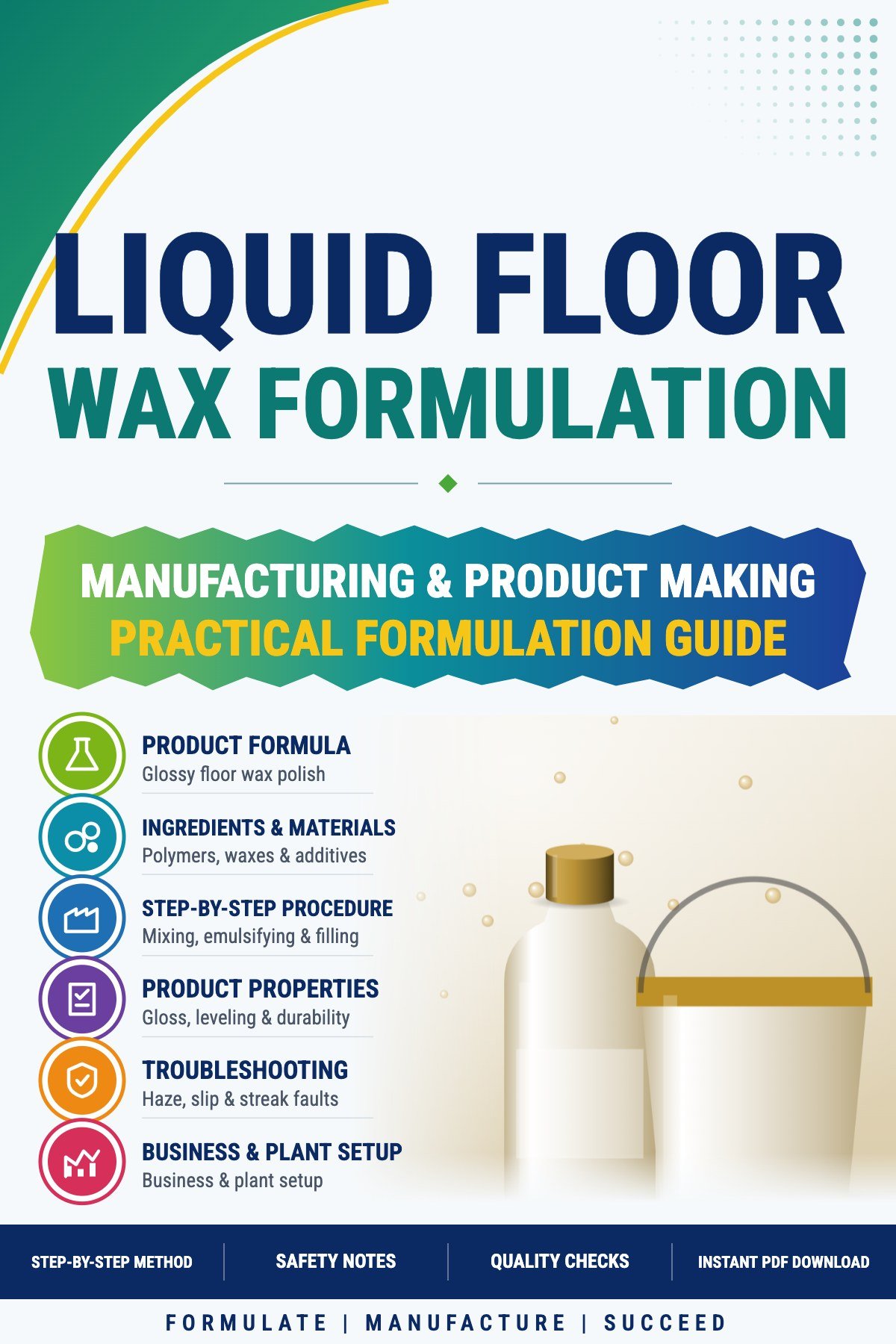
The guide presents high shine floor polish formula as a versatile cleaning and polishing solution designed to enhance the appearance and longevity of various types of flooring, effectively removing dirt, grime and stains and leaving a spotless, glossy finish, suitable for marble, ceramic, vinyl and other hard floors, producing a residue-free film. It offers example recipes for different gloss levels, production steps, tests and application advice.
Making the polish
Step 1: Water phase
Charge deionised water to a clean stainless steel or plastic tank. Add preservative, wetting agent and defoamer under gentle stirring.
Step 2: Polymer emulsions
Add the main acrylic emulsion slowly and mix gently to avoid foam. Add alkali-soluble resin solution and wax emulsion in order, mixing between additions.
Step 3: Coalescents and plasticisers
Pre-mix coalescents and add slowly into the vortex or as a diluted solution to avoid shocking the emulsion.
Step 4: Final adjustment
Adjust pH to the target, typically 7.5 to 9, add levelling agent, fragrance and any metal cross-linker solution. Check solids, usually 15 to 25 percent, and adjust with water.
Step 5: Filter and fill
Filter through a fine bag or cartridge to remove gels, then fill into jugs, pails or drums.
Application guidance
Clean the floor thoroughly and remove old finish if it is worn. Ensure the floor is dry. Apply thin, even coats with a clean mop or applicator, working in one direction and avoiding puddles. Allow each coat to dry fully, usually 20 to 40 minutes, before the next. Two to four coats create a durable finish. Let the final coat cure, typically 24 hours, before heavy traffic. Maintain by dust mopping and damp mopping with neutral cleaner, and burnish with high-speed machine if the polish is designed for it. Restore with a recoat, and strip periodically with an alkaline stripper when build-up gets heavy.
Surfaces and cautions
Do not apply water-based polish to unsealed wood, laminate, natural stone or terrazzo unless the product is approved for it. Marble is calcium carbonate and can be etched by acidic cleaners, so use neutral products and test a hidden spot first. Some floors, such as ceramic tile and polished stone, are naturally glossy and slippery, and an additional film may increase slip risk when wet. Check slip resistance requirements in commercial settings. Always follow the floor maker’s care instructions.
Testing and quality control
- Solids content, pH, viscosity and density.
- Gloss at 60 degrees on vinyl tiles.
- Levelling and film appearance.
- Black heel mark and scuff resistance.
- Detergent resistance and water spotting.
- Slip resistance by coefficient of friction.
- Removability by stripper.
- Mechanical stability and freeze-thaw.
- Storage stability.
Troubleshooting
White powder or hazing
Film failed to coalesce or detergent attack. Add coalescent, use neutral cleaners and keep temperatures above minimum film-forming limits.
Streaks and poor levelling
Poor application or levelling aid. Apply thinner coats and adjust levelling agents.
Low gloss
Low solids, absorbent floor or too few coats. Raise polymer, add resin, apply additional coats.
Soft film and tackiness
Too much plasticiser or wax. Adjust formula and drying conditions.
Foam in the mop bucket
Surfactant. Add defoamer and tell users to avoid pouring from height.
Hard to strip
Over-crosslinking. Choose a more removable polymer or stronger stripper.
Safety and regulation
Floor polishes are generally low hazard but contain glycol ethers, ammonia or amines that can irritate eyes and respiratory tract. Provide ventilation and gloves, and keep out of reach of children. Spills make floors dangerously slippery, so clean them quickly and use warning signs during application. Follow VOC and labelling rules, and avoid ingredients restricted in your region, for example certain glycol ethers or metal cross-linkers. Provide safety data sheets and safe disposal instructions.
Packaging and business opportunity
Retail bottles of 500 millilitres to 2 litres suit households, and 5 and 20 litre pails and 200 litre drums suit janitorial and commercial use. Customers include hotels, hospitals, schools, offices, shopping centres and cleaning contractors. Build a system with stripper, neutral cleaner, sealer, polish and maintainer, supported by training and application guides. Private-label supply to distributors is attractive, and photographs of glossy floors with test data are strong sales material.
Extend your floor care range with the Floor Products, Cleaning Products, Wood Polish Formulation and Detergent Formulations categories, and see , , Seamless Epoxy Flooring Systems, Acrylic Emulsion Formulations, and Touchless Car Wash Formula.
Getting started
Begin with a purchased floor finish polymer emulsion, add wax, coalescent and levelling aid, and test on vinyl tiles for gloss, levelling and durability. Adjust, then prepare labels, stripper and cleaner companions, and offer sample pails to cleaning contractors for trials before scaling.
How to get the best results from this guide
Treat the guide as a tested starting point rather than a finished factory. Begin with a small trial batch in the laboratory or on a bench, using the exact raw materials you plan to buy, and record every weight, temperature, mixing time and observation. Compare the result with the quality checks in the guide, change only one thing at a time, and keep a note of what each change did. Once a small batch is consistently good, repeat it several times, then scale up in stages, because mixing, heating and cooling behave differently in larger vessels. Keep retained samples of every batch, write simple standard operating procedures for your team, and build relationships with two suppliers for each key raw material. Finally, check the labelling, safety and product rules in the country where you will sell, and ask a qualified person to review your process. This careful, documented approach is what turns a good formulation into a reliable product and a trusted brand.
Who should buy this guide?
The guide is written for practical readers. It suits manufacturers who want to add a new product to an existing plant, startups choosing their first product, private-label brands that need to understand what they are buying, technical staff who must set specifications and train operators, and consultants and students who want a structured, plain-language reference. It is less suitable for anyone looking for a quick shortcut or a guarantee, because every formulation still needs testing with your own materials, equipment and local rules. If you are unsure whether it matches your project, send a short question through the contact page before you order, and we will tell you honestly whether it fits.
What is inside the High Shine Floor Polish Formula guide
Every Product Making Guide in our shop follows the same structure so you know where to look. This guide includes the product formula, the ingredients and materials, the procedure and preparations, the industrial requirements and the technical specifications. In practice you receive:
- The formulation, written so you can follow it at the bench and scale it up.
- Ingredients and materials, with the job of each material and advice on grades and suppliers.
- The manufacturing procedure, including order of addition, mixing and preparations.
- Industrial requirements, covering equipment, space and packaging.
- Technical specifications, describing what a good finished product should look like and how it should behave.
- Troubleshooting for the faults that makers meet most often.
- Business guidance, to help you take the product from the bench to the market.
These Product Making Guides of chemical formulations and formulas are for manufacturers, startups and entrepreneurs. Every guide contains industrially tested, practical formulations. Anyone who buys a guide can make the product by following its step-by-step instructions. Raw materials vary between suppliers, so always confirm your results with a small trial batch before scaling up.
Who stands behind this guide?
Chemical Formulation Services is the trading name of CFS Formulation Services Ltd, registered in England and Wales under company number 16678503, with its office at Unit F, Winston Business Park, Churchill Way, Sheffield S35 2PS. The business was founded by George Enrick and publishes formulation manuals, technical guides and industry reports. You can check our details on the Companies House register, read about us, or contact us with any question before you order.
A written formulation cannot replace testing with your own raw materials, equipment and climate, and we say so plainly. What the guide does give you is a tested, structured starting point that can save you months of trial and error. Our terms and conditions explain what a purchase from us covers.
How to order
- Select Add to cart to keep browsing, or Buy Now to go straight to checkout.
- Pay with PayPal, Stripe, Xoom by PayPal, Payoneer, payment links for debit and credit cards, or Western Union, Ria and all money exchanges.
- If you pay through a money exchange, email your payment slip to Info@chemicalformulationservices.com. After confirmation, your instant download link is emailed to you.
- For online payments, the PDF is available as soon as the payment is confirmed.
All products are digital downloads and all payments are nonrefundable once the file is delivered, so please read the refund policy and the FAQs before you order. You can compare this guide with others in the formula shop or browse our industrial project reports.
Frequently asked questions about high shine floor polish formula
What is the High Shine Floor Polish Formula guide?
It is a digital PDF Product Making Guide to acrylic floor polishes, covering polymers, waxes, additives, making, application, testing and troubleshooting.
What makes a floor polish shiny?
A smooth, level polymer film that reflects light evenly.
How many coats are applied?
Usually two to four thin coats, each dried before the next.
Can it be used on marble?
Only with care. Use neutral products, test a hidden area and follow the stone maker advice.
Why do polishes turn white?
Poor coalescence, detergent attack or too-cold application. Use suitable coalescents and neutral cleaners.
How do I receive the guide?
You receive an instant PDF download after payment is confirmed. For money exchanges, email your payment slip to Info@chemicalformulationservices.com and the link is emailed after we confirm it.
Is the payment refundable?
All payments are nonrefundable because the product is an instant digital download. See the refund policy for details.
Can you help with a custom formulation?
CFS Formulation Services Ltd offers formulation and product development consultancy. Send a short brief through the Contact page.
Last reviewed: November 2026. This page is general information about a digital product. It is not a safety data sheet or professional advice, and any formulation should be tested and reviewed by a qualified person before commercial use.